
In the current landscape of rapid digital transformation, few technologies have generated as much discourse, curiosity, and technical evolution as the blockchain. Often misunderstood as merely the underlying framework for digital currencies, blockchain is, at its core, a sophisticated architectural paradigm for data management. It represents a fundamental shift from centralized database structures to a decentralized, distributed ledger system that ensures data integrity, transparency, and security through mathematics and peer-to-peer networking. To understand how blockchain works is to understand the future of digital trust and the mechanics of a web where data cannot be unilaterally altered or deleted.
The Structural Anatomy of a Distributed Ledger
To comprehend the mechanics of a blockchain, one must first visualize its physical and logical structure. Unlike a traditional database managed by a single entity—such as a bank or a cloud provider—a blockchain is a shared record of information that is replicated across thousands of independent computers, known as nodes.
Blocks, Headers, and the Merkle Tree
A blockchain consists of a linear sequence of “blocks.” Each block serves as a container for data, typically a batch of recent transactions or interactions. However, the technical sophistication lies in the block header. The header contains several critical metadata components: the version number, a timestamp, a difficulty target for the consensus algorithm, a nonce (a random number used in mining), and most importantly, the cryptographic hash of the previous block.
Inside the block body, data is organized using a structure called a Merkle Tree or a binary hash tree. This is a mathematical way of summarizing all the transactions in a block by repeatedly hashing pairs of data until only one hash remains: the Merkle Root. This structure allows the network to verify whether a specific transaction exists within a block without having to download the entire dataset, maximizing efficiency and speed.
The Chain of Hashes
The “chain” in blockchain refers to the cryptographic link between these blocks. Because each new block includes the unique hash of the block that preceded it, they are inextricably linked. If a malicious actor attempts to change a single piece of data in an old block, that block’s hash changes. This causes a “domino effect” where the hash of every subsequent block becomes invalid. In a distributed network, the other nodes would immediately recognize this discrepancy and reject the altered version of the chain. This is the foundation of blockchain’s immutability.
The Role of Nodes and Peer-to-Peer Networking
The network is powered by nodes, which are individual computers running specific software that follows the blockchain’s protocol. There are different types of nodes, ranging from “Full Nodes” that maintain a complete history of the ledger to “Light Nodes” that only verify specific parts of the data. These nodes communicate via a peer-to-peer (P2P) gossip protocol, where information about new transactions and blocks is broadcasted and spread through the network like a rumor until every participant is synchronized.
Cryptography: The Engine of Security and Identity
Blockchain technology relies heavily on advanced cryptography to secure data and establish identity without requiring a central authority to vouch for the participants. This is achieved primarily through hashing and asymmetric encryption.
Hashing: The Digital Fingerprint
A cryptographic hash function, such as SHA-256 (Secure Hash Algorithm 256-bit), is a mathematical algorithm that takes an input of any size and produces a fixed-size string of characters. This hash is deterministic: the same input will always produce the same output. However, it is also a “one-way street”—it is computationally impossible to reverse-engineer the original data from the hash.
In a blockchain, hashing is used to ensure data has not been tampered with. It acts as a digital fingerprint for every piece of information. By hashing the contents of a block and including that hash in the next block, the system creates a mathematical proof of the sequence of events.
Asymmetric Encryption and Digital Signatures
To facilitate secure interactions, blockchain uses public-key cryptography. Every user possesses a pair of keys: a public key and a private key. The public key is akin to an email address or a bank account number; it can be shared with anyone and is used to identify the user on the network. The private key, however, must be kept secret, as it acts as a digital signature.
When a user initiates a transaction, they “sign” it using their private key. Other nodes in the network can then use the corresponding public key to verify that the signature is authentic and that the transaction was indeed authorized by the owner of the private key. This ensures that even in a decentralized environment, identity and authorization are ironclad.
Achieving Consensus in a Trustless Environment
One of the most significant technical hurdles for any distributed system is the “Byzantine Generals Problem”—the challenge of reaching an agreement among decentralized parties who do not necessarily trust one another. Blockchain solves this through consensus mechanisms, which are sets of rules that govern how the network agrees on the “true” state of the ledger.
Proof of Work (PoW)
Proof of Work was the first consensus mechanism, popularized by Bitcoin. It requires nodes (called miners) to compete to solve a complex mathematical puzzle. This puzzle is essentially a “brute-force” search for a nonce that, when hashed with the block’s data, produces a result that meets a specific difficulty target.
The difficulty is adjusted by the network to ensure that blocks are produced at a consistent interval. PoW is highly secure because it requires immense computational power to alter the chain; an attacker would need to control more than 50% of the network’s total computing power (the 51% attack) to rewrite the history, which is economically and technically prohibitive on large-scale blockchains.
Proof of Stake (PoS)
As a more energy-efficient alternative, Proof of Stake replaces computational competition with a system based on “stake” or ownership. In PoS, validators are chosen to create new blocks based on the number of tokens they hold and are willing to “stake” as collateral.
If a validator acts dishonestly, they risk losing their staked assets. This provides a technical and economic incentive for honesty without the massive electricity consumption associated with PoW. PoS also allows for faster transaction finality and greater scalability, making it the choice for many modern enterprise and utility-focused blockchains.
Other Consensus Variations
The technology continues to evolve with newer models like Proof of History (PoH), which uses a verifiable delay function to timestamp events, and Delegated Proof of Stake (DPoS), where users vote for a small number of delegates to handle validation. Each of these mechanisms represents a different technical trade-off between speed, decentralization, and security.
The Technical Lifecycle of a Transaction
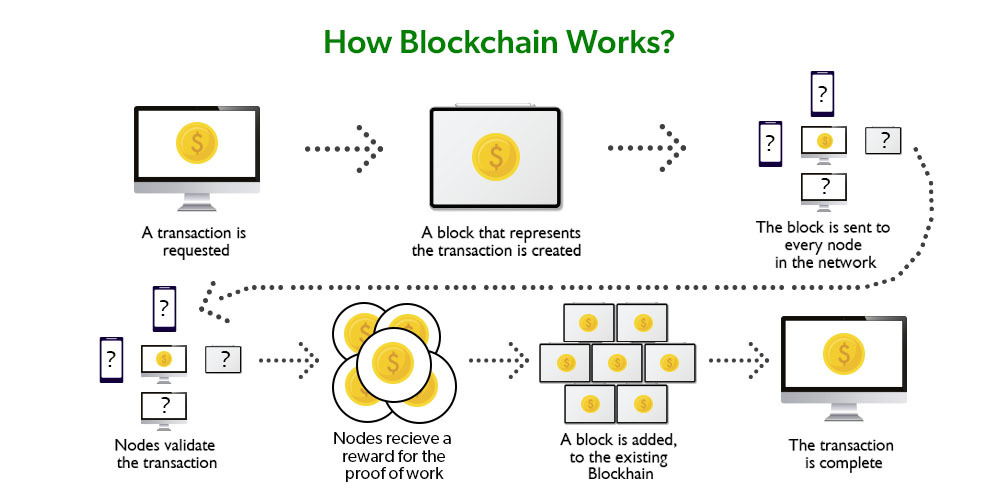
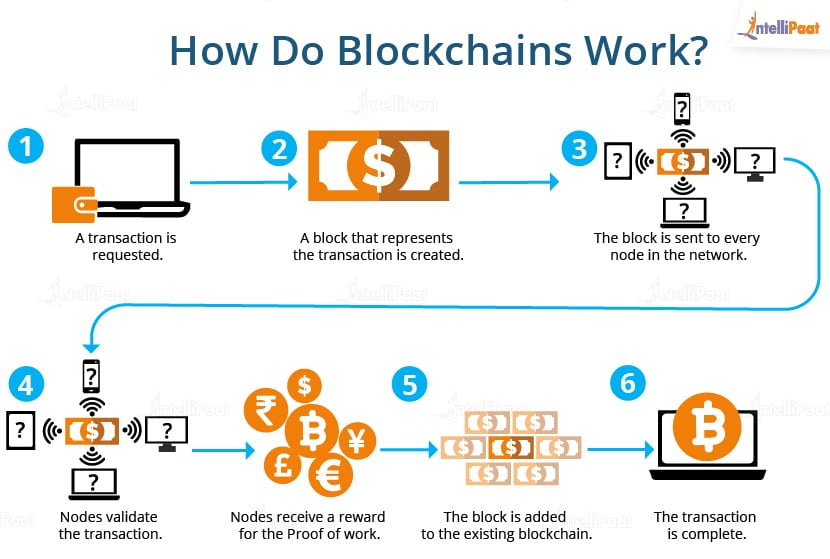
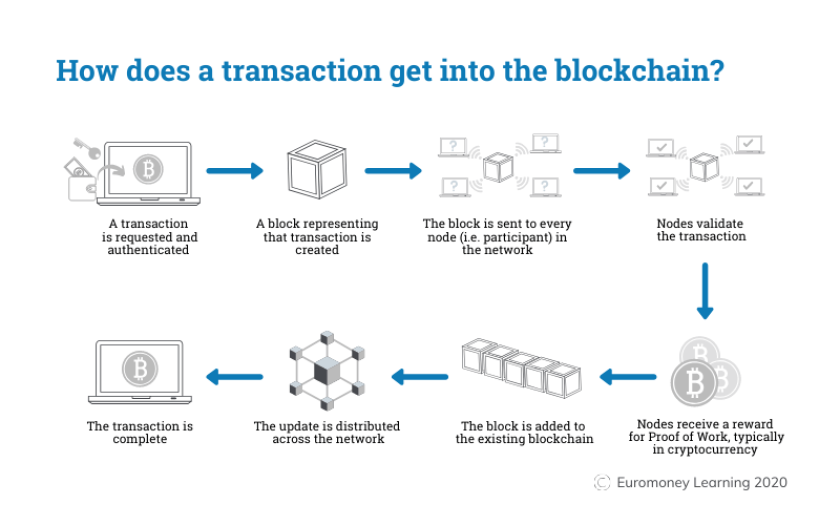
To see how these components work in unison, it is helpful to trace the lifecycle of a single data entry or transaction through the system.
-
Initiation: A user creates a transaction, specifying the recipient and the data to be sent. They sign this request with their private key.
-
Broadcasting: The transaction is broadcasted to the P2P network. It enters a “mempool” (memory pool), which is a waiting area for unconfirmed transactions.
-
Validation: Individual nodes check the transaction for validity. They verify the digital signature, ensure the sender has the necessary permissions or balance, and check that the transaction follows the network’s protocol rules.
-
Block Inclusion: A miner or validator selects a group of transactions from the mempool and packages them into a candidate block. They calculate the Merkle Root and include the hash of the previous block.
-
Reaching Consensus: The network engages in its consensus protocol (PoW, PoS, etc.). Once the block is “solved” or “validated,” it is broadcasted back to the network.
-
Finality: Other nodes receive the new block, verify its contents, and add it to their local copy of the blockchain. The transaction is now part of the permanent, immutable record.
Beyond Digital Currency: Smart Contracts and Scalability
While the earliest blockchains were designed for simple data transfers, the technology has evolved to support complex logic through “Smart Contracts.”
The Programmable Blockchain
Introduced by Ethereum, a smart contract is a self-executing script that resides on the blockchain. These are “If-Then” statements written in code (such as Solidity or Rust). When certain conditions are met, the code automatically executes the specified action. This turns the blockchain into a “World Computer,” where software can run in a decentralized environment without the possibility of downtime, censorship, or third-party interference.
The execution of these contracts happens within a virtual environment, such as the Ethereum Virtual Machine (EVM). This ensures that the code runs identically on every node in the network, maintaining the consistency of the state across the entire system.
Solving the Scalability Trilemma
A major technical challenge in blockchain development is the “Scalability Trilemma,” a term coined by Vitalik Buterin. It suggests that it is difficult to achieve high levels of security, decentralization, and scalability simultaneously.
To address this, developers are creating Layer 2 solutions. These are protocols built on top of the main blockchain (Layer 1) that handle transactions off-chain to reduce congestion. Technologies like Optimistic Rollups and Zero-Knowledge (ZK) Rollups bundle thousands of transactions into a single proof that is then submitted to the main chain. This drastically increases the throughput (transactions per second) while maintaining the security of the underlying decentralized network.
Blockchain technology is far more than a trend; it is a rigorous discipline of software engineering and cryptography. By combining distributed systems, cryptographic hashing, and economic game theory, it creates a robust environment for data that is verifiable, secure, and permanent. As the technology continues to mature through improvements in consensus efficiency and Layer 2 scaling, its role as the foundational infrastructure for the next generation of the internet—the decentralized web—becomes increasingly certain.
aViewFromTheCave is a participant in the Amazon Services LLC Associates Program, an affiliate advertising program designed to provide a means for sites to earn advertising fees by advertising and linking to Amazon.com. Amazon, the Amazon logo, AmazonSupply, and the AmazonSupply logo are trademarks of Amazon.com, Inc. or its affiliates. As an Amazon Associate we earn affiliate commissions from qualifying purchases.