
In the rapidly evolving landscape of financial technology, few companies have undergone a transformation as radical as SoFi Technologies, Inc. Originally founded in 2011 as Social Finance, the company began with a niche focus: helping Stanford alumni refinance their student loans using a peer-to-peer model. Fast forward to the present, and SoFi has evolved into a comprehensive digital financial ecosystem, holding a federal bank charter and offering everything from mortgages to cryptocurrency trading and enterprise-level fintech infrastructure.
To understand how SoFi makes money, one must look past the sleek mobile interface and delve into a diversified business model that operates across three distinct yet synergistic segments: Lending, Financial Services, and the Technology Platform. Unlike traditional banks that rely heavily on physical branches and legacy systems, SoFi leverages a “Financial Services Productivity Loop” (FSPL) strategy designed to lower customer acquisition costs and maximize the lifetime value of every member.
The Lending Segment: The Traditional Core of SoFi’s Revenue
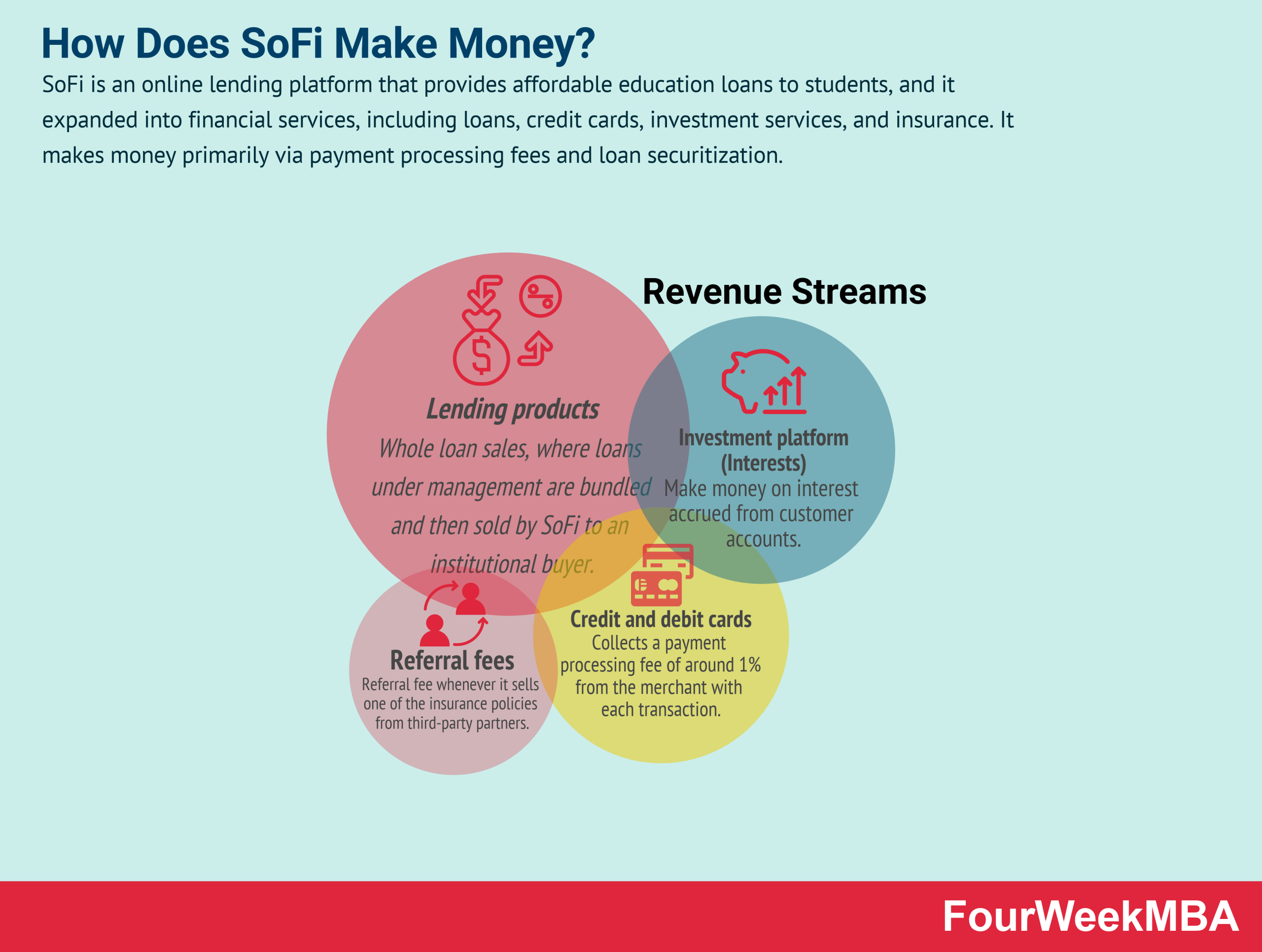
The Lending segment remains the primary engine of SoFi’s profitability. While the company has diversified, the core of its income is derived from the interest and fees associated with personal, student, and home loans. This segment operates on two primary revenue mechanisms: Net Interest Income (NII) and Non-Interest Income.
Personal Loans and Student Loan Refinancing
Personal loans have surged to become SoFi’s most significant lending product. These are typically unsecured loans used by high-income, “HENRY” (High Earner, Not Rich Yet) individuals for debt consolidation or major purchases. SoFi makes money here by charging interest rates that, while competitive, provide a healthy “spread” over the company’s cost of capital.
Student loan refinancing, once the flagship product, saw a temporary decline during the federal student loan payment moratorium but remains a critical component of the business. By targeting young professionals with high earning potential, SoFi captures customers early in their financial journey. The revenue is generated through the interest paid over the life of the loan.
Net Interest Income (NII) and the Bank Charter Advantage
A pivotal moment in SoFi’s revenue history occurred in early 2022 when it received a national bank charter through the acquisition of Golden Pacific Bancorp. This allowed SoFi to hold deposits (from SoFi Money accounts) and use those low-cost deposits to fund its loans.
Before the charter, SoFi had to rely on expensive warehouse lines of credit from other banks to fund its lending. Now, by using its members’ deposits—on which it pays a competitive APY—to fund personal loans that charge significantly higher interest rates, SoFi captures a much wider Net Interest Margin (NIM). This spread between the interest paid to depositors and the interest earned from borrowers is a fundamental source of revenue.
Gain on Sale and Securitization
Beyond interest income, SoFi makes money by selling the loans it originates to third-party investors or securitizing them into bonds. When SoFi sells a package of loans to a hedge fund or an institutional investor, it often records a “Gain on Sale.” This provides immediate liquidity and allows the company to recycle its capital to issue new loans. Additionally, SoFi often retains the “servicing rights” for these loans, earning a small, recurring fee for managing the billing and collections on behalf of the new owners.
Financial Services: The High-Growth Ecosystem
The Financial Services segment is where SoFi’s “one-stop-shop” vision comes to life. While this segment has historically been less profitable than lending on a standalone basis, its primary role is to act as a funnel for customer acquisition and a source of low-cost capital (deposits).
SoFi Money: Interchange Fees and Cash Management
SoFi Money (now integrated into SoFi Checking and Savings) generates revenue primarily through interchange fees. Every time a member swipes their SoFi debit card, the merchant pays a small percentage of the transaction to the card issuer and the network. Because SoFi operates as a bank, it captures a larger portion of these fees than non-bank fintechs. Furthermore, the deposits held in these accounts provide the fuel for the lending segment’s Net Interest Income, as discussed above.
SoFi Invest: Payment for Order Flow and Advisory Fees
SoFi Invest offers a platform for trading stocks, ETFs, and formerly cryptocurrencies. It generates revenue through several channels:
-
Payment for Order Flow (PFOF): Like many commission-free brokerages, SoFi receives small payments from market makers for routing trades through them.
-
Share Lending: SoFi earns income by lending out the securities held in member accounts to institutional investors (often for short-selling purposes).
-
Management Fees: While many of SoFi’s own ETFs are designed to be low-cost or zero-fee to attract users, certain specialized investment products carry management fees.
SoFi Relay and Credit Card
SoFi Relay is a free financial monitoring tool that tracks spending and credit scores across multiple institutions. While Relay does not generate direct revenue, it is a powerful lead-generation tool. By analyzing a user’s financial data, SoFi can suggest targeted products—such as a personal loan to pay off a high-interest credit card—thereby driving revenue to other segments.
The SoFi Credit Card adds to the revenue mix through interest charges on revolving balances and interchange fees from merchant transactions. It also serves as a loyalty tool, offering rewards that can be redeemed as extra payments toward SoFi loans or deposits into SoFi Invest accounts.
The Technology Platform: Becoming the “AWS of Fintech”
What truly sets SoFi apart from both traditional banks and most neobanks is its Technology Platform segment, comprised largely of Galileo Financial Technologies and Technisys. This segment allows SoFi to act as a B2B service provider, earning revenue from the very competitors it battles in the consumer space.
Galileo: The Engine for Neobanks
In 2020, SoFi acquired Galileo, a payment processing and card issuer platform. Galileo provides the backend infrastructure for some of the world’s most famous fintechs, including Revolut and Dave. Every time a customer of a Galileo-powered fintech uses their card or opens an account, SoFi earns a fee.
The revenue model for Galileo is based on:
-
Platform Fees: Recurring fees for account setup and maintenance.
-
Transaction Fees: Fees charged for processing payments and moving money.
-
API Usage: Fees for accessing Galileo’s suite of financial tools.
Technisys: Cloud-Native Core Banking
The acquisition of Technisys in 2022 added a cloud-native core banking platform to the mix. This allows SoFi to offer traditional banks a path to modernization. By combining Technisys’s core banking with Galileo’s payment processing, SoFi offers an end-to-end “bank-in-a-box” solution. This generates revenue through long-term enterprise software contracts and implementation fees, providing a stable, recurring revenue stream that is decoupled from the fluctuations of the interest rate environment.
The Financial Services Productivity Loop (FSPL)
To understand SoFi’s profitability, one must understand the strategic synergy between these three segments, which the company calls the Financial Services Productivity Loop.
The goal is to acquire a customer through a low-cost, high-frequency product like SoFi Money or SoFi Relay. Once the customer is in the ecosystem, SoFi uses its data advantage to cross-sell higher-margin products, like a personal loan or a mortgage. Because the customer is already a member, the “Customer Acquisition Cost” (CAC) for the second and third product is effectively zero.
This strategy creates a virtuous cycle:
-
Lower CAC: Cross-selling to existing members is significantly cheaper than buying ads on Google or Facebook.
-
Higher LTV: As members use more products, their Lifetime Value (LTV) increases.
-
Data Advantage: More touchpoints provide SoFi with more data, allowing for better credit underwriting and more personalized marketing.
By owning the full stack—the bank, the technology platform, and the consumer interface—SoFi captures margins at every level of the financial transaction. When a member uses a SoFi credit card, SoFi earns the interchange fee. When that member carries a balance, SoFi earns the interest. When that member uses the technology platform (Galileo) to process the payment, SoFi earns the processing fee.

Challenges and Future Outlook
While SoFi’s revenue model is robust, it is not without risks. The Lending segment is sensitive to interest rate cycles; as rates rise, the demand for refinancing may drop, and the cost of maintaining high-yield savings accounts for members increases. Furthermore, as a bank, SoFi must maintain significant capital reserves, which can limit the amount of money it can deploy for growth compared to a pure software company.
However, the diversification into B2B technology services provides a hedge against these banking-specific risks. As more traditional financial institutions look to digitize, SoFi’s Technology Platform segment is positioned to capture a growing share of the enterprise market.
In conclusion, SoFi makes money through a sophisticated blend of traditional banking (interest and spreads), modern fintech (interchange and PFOF), and enterprise software-as-a-service (Galileo and Technisys). By integrating these revenue streams into a single “Productivity Loop,” SoFi aims to prove that the future of finance isn’t just about being a bank or a tech company—it’s about being both.
aViewFromTheCave is a participant in the Amazon Services LLC Associates Program, an affiliate advertising program designed to provide a means for sites to earn advertising fees by advertising and linking to Amazon.com. Amazon, the Amazon logo, AmazonSupply, and the AmazonSupply logo are trademarks of Amazon.com, Inc. or its affiliates. As an Amazon Associate we earn affiliate commissions from qualifying purchases.