
For over two decades, SiriusXM has remained a dominant force in the North American media landscape, offering a seamless audio experience that persists even in the most remote geographical locations. While traditional AM/FM radio relies on local towers with limited range, SiriusXM utilizes a sophisticated network of orbital satellites and terrestrial infrastructure. Understanding how this technology works requires a deep dive into satellite constellations, digital signal processing, and the hardware engineering that allows a vehicle traveling at highway speeds to maintain a crystal-clear connection to a signal originating 22,000 miles above the Earth.
The Architecture of Satellite Radio: From Earth to Orbit
At its core, SiriusXM is a digital broadcast service that utilizes the S-band spectrum (specifically between 2.3 GHz and 2.332 GHz) to transmit audio data. Unlike traditional radio, which uses analog waves that are susceptible to atmospheric interference and physical obstacles, SiriusXM is a digital system that packages audio into data packets, much like a computer network.
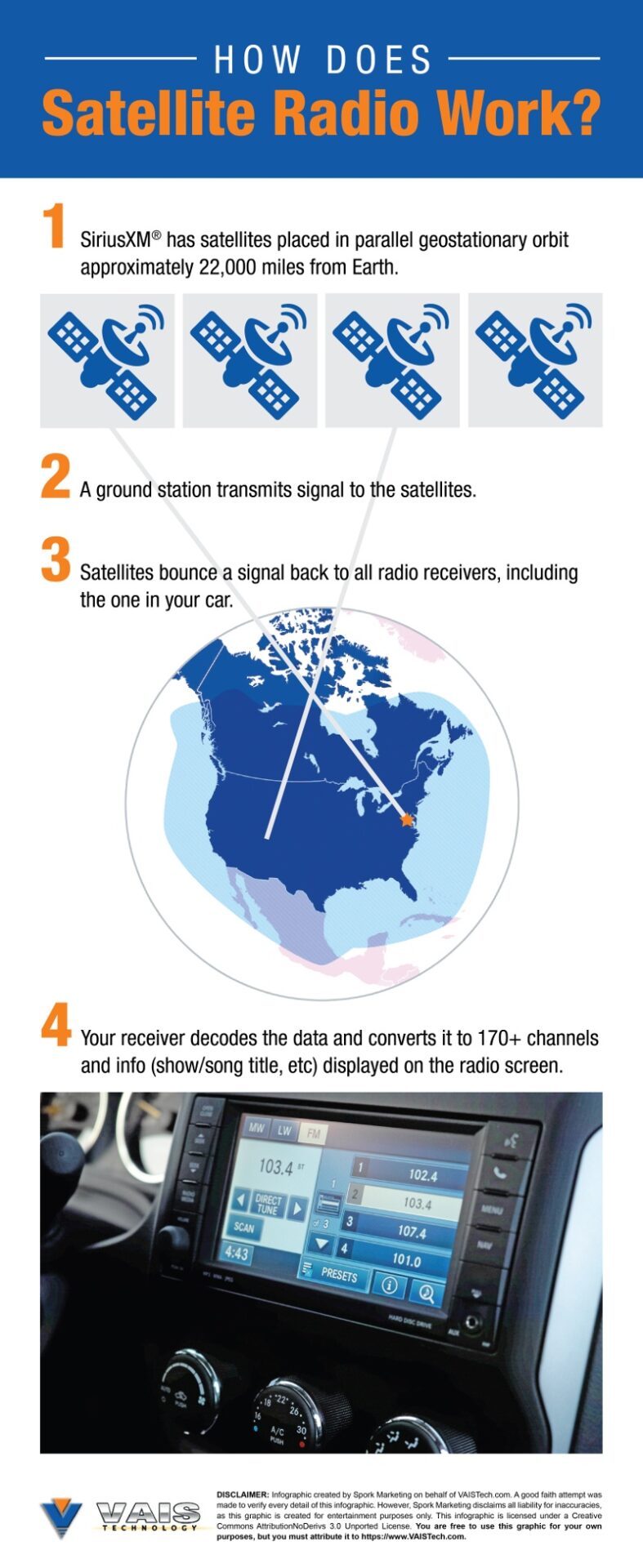
The Satellite Constellation
The backbone of the system is its fleet of high-powered satellites. Historically, Sirius and XM (before their merger) utilized different orbital strategies. Sirius originally used a highly elliptical orbit (HEO) system, which ensured that satellites were high in the sky over North America for most of the day. XM utilized geostationary orbits (GEO), where satellites remain over a fixed point on the equator.
Today, the combined SiriusXM fleet primarily utilizes geostationary satellites. These satellites, such as the SXM-7 and SXM-8 models, are positioned in a “Clarke Belt” approximately 22,236 miles above the Earth. Because they rotate at the same speed as the Earth, they appear stationary from the perspective of a receiver, providing a constant target for the vehicle’s antenna. These satellites are among the most powerful commercial communications satellites ever launched, designed to beam high-energy signals across the entire continent.
Uplink Facilities and Ground Control
The journey of a song or a talk show begins at a ground-based broadcast center. SiriusXM operates massive uplink facilities, most notably in New Jersey and Washington, D.C. Here, audio from hundreds of studios is ingested, processed, and bundled into a single high-bandwidth data stream.
This stream is converted into a microwave signal and beamed up to the satellites via large parabolic antennas. This is known as the “uplink.” The satellite acts as a “bent pipe” or transponder; it receives the signal, amplifies it, shifts the frequency to the S-band range, and broadcasts it back down to Earth in a massive footprint that covers the United States, Canada, and parts of Mexico and the Caribbean.
Signal Processing and Digital Compression
One of the greatest technical challenges SiriusXM faces is bandwidth. The S-band spectrum allocated for satellite radio is relatively narrow. To fit over 150 high-quality audio channels, along with metadata (such as song titles and artist names) and emergency alert data, the system must employ extreme levels of digital efficiency.
Audio Codecs and Bandwidth Management
SiriusXM uses proprietary audio compression algorithms to minimize the size of the data packets. In the early days, this was based on a variant of the AAC (Advanced Audio Coding) and PAC (Perceptual Audio Coding) standards. These codecs are “lossy,” meaning they remove frequencies that the human ear cannot easily perceive, significantly reducing the file size.
The system employs a technique called “statistical multiplexing.” Not every channel requires the same amount of data at every moment. A talk show host’s voice requires far less bandwidth than a complex orchestral performance. The system dynamically allocates more “bits” to channels that need them and fewer to others, ensuring the best possible sound quality across the entire spectrum within the fixed bandwidth limit.
S-Band Transmission Advantages
The choice of the S-band is intentional. Lower frequencies, like those used for FM radio, travel further but carry less data. Higher frequencies, like those used for Wi-Fi or 5G, carry massive amounts of data but are easily blocked by rain or buildings. The 2.3 GHz S-band strikes a balance: it offers enough bandwidth for high-quality digital audio while maintaining enough “permeability” to survive various atmospheric conditions. However, it still requires a clear line-of-sight to the satellite, which leads to the next critical component of the system.
Overcoming the Line-of-Sight Challenge: Terrestrial Repeaters
The primary weakness of satellite technology is the “urban canyon” effect. If you drive between tall skyscrapers or through a tunnel, the physical mass of the structure blocks the signal from the satellite. To prevent audio dropouts, SiriusXM employs a hybrid delivery model that combines space-based signals with a network of ground-based “terrestrial repeaters.”
Solving the Urban Canyon Problem
In major metropolitan areas, SiriusXM has installed thousands of small, low-power transmitters on top of buildings and towers. These repeaters receive the satellite signal via a dedicated dish and rebroadcast it locally on the same S-band frequency.
When your car drives through downtown Chicago or New York City, your receiver is likely not “listening” to the satellite at all. Instead, it is picking up the signal from a repeater just blocks away. This ensures that the audio remains uninterrupted even when the direct line-of-sight to the southern sky is obstructed.
Time Diversity and Spatial Diversity
To make the transition between satellite and repeater signals invisible to the listener, SiriusXM utilizes a concept called “Time Diversity.” The receiver actually buffers several seconds of audio data. Furthermore, the satellites and repeaters do not broadcast the exact same data at the exact same millisecond. The signals are slightly offset in time.
If a bridge momentarily blocks the satellite signal, the receiver fills the gap using the data it already buffered or switches to the slightly delayed signal from a terrestrial repeater. By the time the buffer would have run out, the car has cleared the obstacle. This “spatial and temporal diversity” is the reason why SiriusXM can maintain a signal under conditions that would cause a standard satellite TV dish to lose its connection.
The Receiver Ecosystem: Decoding the Data Stream
The hardware inside the vehicle or the home is just as complex as the satellites in orbit. A SiriusXM receiver is essentially a specialized computer designed to filter, decrypt, and convert a high-frequency stream of data into an analog audio signal.
The Role of the Antenna
The antenna is the first point of contact. Because SiriusXM uses circular polarization, the antenna is designed to capture signals from any direction, provided there isn’t a massive physical obstruction. Modern automotive antennas are often “shark fin” designs that house not only the SiriusXM receiver but also GPS and cellular antennas. These antennas include a Low Noise Amplifier (LNA) to boost the weak signal received from space before sending it down the wire to the head unit.
Conditional Access and Encryption
Unlike FM radio, which is free-to-air, SiriusXM is a subscription-based “Conditional Access” system. The data stream is heavily encrypted. Every SiriusXM receiver has a unique Radio ID or Electronic Serial Number (ESN).
When you subscribe to the service, the ground station sends an “Activation Signal” (often called a “hit”) into the global broadcast. This signal contains the unique ID of your radio and the “keys” required to unlock the specific channels you have paid for. Your radio listens for its ID in the metadata of the stream; when it hears it, it stores the decryption keys in its internal memory. This is why you must have your radio turned on and tuned to a signal to activate a new subscription.
The Shift to IP-Based Streaming: SiriusXM 360L
As cellular networks have become faster and more reliable, SiriusXM has evolved beyond a pure satellite-only service. The latest generation of the technology, known as SiriusXM 360L, represents a “hybrid” approach that merges satellite delivery with internet protocol (IP) streaming.
Integrating Satellite and LTE/5G
The 360L system uses a vehicle’s built-in 4G LTE or 5G modem to supplement the satellite signal. This allows for several technological leaps:
-
On-Demand Content: While satellite is a “one-way” broadcast, the IP connection allows for “two-way” communication, enabling users to browse a library of thousands of hours of recorded podcasts and shows.
-
Bandwidth Supplementation: If a user is in an area with poor satellite coverage but great cellular coverage (or vice-versa), the system can seamlessly switch the data source to prevent any interruption.
-
Personalization: The IP back-channel allows SiriusXM to track listener preferences and serve personalized “For You” recommendations, similar to Spotify or Netflix.

The Future of Satellite Audio
While IP streaming is a powerful tool, the satellite component remains the core of the SiriusXM value proposition. In rural areas, national parks, and vast stretches of highway where cellular towers are non-existent, the satellite signal remains the only reliable source of digital entertainment. By leveraging the immense reach of orbital assets with the precision of terrestrial repeaters and the flexibility of IP streaming, SiriusXM has built one of the most resilient and technologically advanced media delivery networks in the world. As they continue to launch newer, more powerful satellites, the system is poised to support even higher fidelity audio and more interactive features, maintaining its relevance in an increasingly connected world.
aViewFromTheCave is a participant in the Amazon Services LLC Associates Program, an affiliate advertising program designed to provide a means for sites to earn advertising fees by advertising and linking to Amazon.com. Amazon, the Amazon logo, AmazonSupply, and the AmazonSupply logo are trademarks of Amazon.com, Inc. or its affiliates. As an Amazon Associate we earn affiliate commissions from qualifying purchases.