
In an increasingly digitized world, the term “blockchain” has moved from obscure technical jargon to a mainstream buzzword, often associated with cryptocurrencies like Bitcoin. However, understanding blockchain solely through the lens of digital money misses the profound technological innovation it represents. At its heart, blockchain is a revolutionary form of distributed ledger technology (DLT) that promises enhanced security, transparency, and immutability across a vast array of applications. This article delves into the fundamental principles and intricate mechanisms that allow blockchains to function, explaining how this decentralized network creates a tamper-proof record of data.
The Foundational Concepts: What is a Blockchain?
To grasp the operational mechanics of blockchain, it’s essential to first understand its core conceptual pillars. Far more than just a database, blockchain represents a paradigm shift in how we store, verify, and interact with digital information.
Distributed Ledger Technology (DLT)
At its core, a blockchain is a type of distributed ledger technology (DLT). Unlike traditional, centralized databases where a single entity maintains and controls all records, a DLT replicates the ledger across numerous computers (nodes) in a network. Every participant on the network has access to an identical, continuously updated copy of the ledger. This distribution means there’s no single point of failure and no single authority dictating the truth, making the system inherently more resilient and resistant to censorship or manipulation. The “ledger” itself is a sequential record of all transactions or data entries that have occurred on the network.
Immutability and Transparency
Two critical characteristics of a blockchain are its immutability and transparency. Immutability means that once data (a transaction, a record, an event) is recorded on the blockchain and added to a block, it cannot be altered, deleted, or reversed. This permanence is enforced through cryptographic principles and the chaining mechanism itself. Any attempt to modify a past record would invalidate all subsequent blocks in the chain, making such an action immediately detectable and rejected by the network.
Transparency, on the other hand, refers to the visibility of the ledger. In most public blockchains, all transactions are visible to every participant on the network. While the identities of the participants are typically pseudonymous (represented by cryptographic addresses rather than personal names), the data itself and the history of interactions are open for scrutiny. This combination of immutability and transparency fosters trust among network participants, as everyone can verify the integrity of the ledger independently.
Decentralization: No Single Point of Control
Perhaps the most revolutionary aspect of blockchain is its decentralization. Traditional systems rely on central authorities (banks, governments, companies) to validate and record transactions. This centralization creates single points of control and potential failure, making them vulnerable to hacks, corruption, or arbitrary decision-making. Blockchain fundamentally removes this intermediary.
In a decentralized blockchain network, control is distributed across all participating nodes. There is no central server, no single administrator, and no one entity has overarching authority. Instead, the network relies on a consensus mechanism (discussed later) for all nodes to agree on the state of the ledger. This collective agreement ensures that the system can continue to operate and maintain its integrity even if individual nodes or groups of nodes fail or attempt malicious actions.
The Anatomy of a Block: Data, Hash, and Timestamp
The term “blockchain” is derived from its structure: a chain of interconnected “blocks” of data. Each block serves as a container for information, and understanding its composition is key to understanding the entire system.
Transaction Data and Merkle Trees
At its core, a block contains a collection of validated transactions. These transactions can represent anything from financial transfers (as in cryptocurrency) to records of supply chain movements, medical data, or digital identity proofs. For efficiency and cryptographic security, transactions within a block are not stored individually but are often organized into a Merkle tree (also known as a hash tree).
A Merkle tree is a data structure where each non-leaf node is a hash of its child nodes, and the leaf nodes are hashes of individual transaction data. The “Merkle root,” the topmost hash in the tree, provides a single cryptographic representation of all transactions in the block. This allows for quick and efficient verification that a specific transaction is included in the block without having to download and process every single transaction.
Cryptographic Hashing: The Digital Fingerprint
Central to blockchain’s security and integrity is cryptographic hashing. A cryptographic hash function takes an input (data of any size) and produces a fixed-size string of characters, known as a hash value or “digital fingerprint.” This process is one-way: it’s easy to compute the hash from the data, but practically impossible to reverse-engineer the original data from the hash. Crucially, even a tiny change to the input data will result in a completely different hash output.
Each block in the blockchain contains not only its own transaction data but also a hash of the previous block. This is the fundamental mechanism that creates the “chain.” If someone were to tamper with a transaction in an older block, its hash would change. Consequently, the hash stored in the next block, which references the older block’s hash, would no longer match, instantly invalidating the chain from that point forward.
Linking Blocks: The Chain’s Integrity
The “chain” aspect of blockchain comes from this sequential linking via cryptographic hashes. Each new block created on the network includes:
-
A timestamp: indicating when the block was created.
-
A Merkle root: summarizing all transactions within that block.
-
Its own unique cryptographic hash.
-
The hash of the immediately preceding block in the chain.
This backward-linking mechanism is what ensures immutability. To alter a block (e.g., change a transaction), one would have to:
-
Change the data within that block.
-
Recalculate that block’s hash.
-
Recalculate the hash of every subsequent block in the chain, as each contains the hash of its predecessor.
-
In a decentralized network, this immense computational task would need to be performed on the majority of the network’s nodes, which is practically impossible due to the computational resources and network consensus required. This makes the blockchain highly resistant to tampering.
Consensus Mechanisms: How Networks Agree
Given that there’s no central authority, how do all the distributed nodes in a blockchain network agree on the true state of the ledger and which new blocks are valid to add to the chain? This is where consensus mechanisms come into play. They are algorithms that enable all participants in a distributed system to reach agreement on a single data value or the state of the network.
Proof of Work (PoW): Mining and Computation
Proof of Work (PoW) is the original consensus mechanism, famously used by Bitcoin and Ethereum (prior to its transition to PoS). In PoW, participants called “miners” compete to solve a complex computational puzzle. This puzzle involves finding a nonce (a number used once) that, when combined with the block’s data and hashed, produces a result that meets specific difficulty requirements (e.g., starts with a certain number of zeros). This process is energy-intensive and requires significant computational power.
The first miner to solve the puzzle “wins” the right to add the new block to the blockchain and broadcasts it to the network. Other nodes verify the solution’s correctness (which is much easier than finding it) and, if valid, add the block to their copy of the ledger. The winning miner is typically rewarded with newly minted tokens and transaction fees. The “work” makes it economically unfeasible to rewrite history, as an attacker would need to out-compute the majority of the network.
Proof of Stake (PoS): Staking and Validation
Proof of Stake (PoS) emerged as an alternative to PoW, primarily addressing its energy consumption concerns and aiming for better scalability. In PoS, instead of competing with computational power, validators (the PoS equivalent of miners) are chosen to create new blocks based on the amount of cryptocurrency they are willing to “stake” (lock up) as collateral. The more tokens a validator stakes, the higher their chance of being selected to create the next block.
If a validator is chosen and successfully validates a new block, they receive a reward (often transaction fees). If they act maliciously or improperly, they risk losing a portion or all of their staked tokens, a mechanism known as “slashing.” PoS is significantly more energy-efficient than PoW and offers potential benefits in terms of decentralization and transaction finality, as it doesn’t rely on expensive hardware.
Other Consensus Models (e.g., DPoS, PoA)
Beyond PoW and PoS, various other consensus mechanisms exist, each with different trade-offs in terms of decentralization, security, and scalability:
-
Delegated Proof of Stake (DPoS): Used in networks like EOS and TRON, where token holders vote for a set of “delegates” or “witnesses” who are responsible for validating transactions and creating blocks. This can lead to faster transaction times but is more centralized than pure PoS.
-
Proof of Authority (PoA): Relies on a set of pre-approved, authoritative validators who are known and trusted entities. This is common in private or consortium blockchains where identity and reputation are key. It offers high transaction throughput but at the cost of significantly less decentralization.
The choice of consensus mechanism profoundly impacts a blockchain’s performance characteristics and its suitability for different applications.
Transaction Lifecycle: From Submission to Confirmation
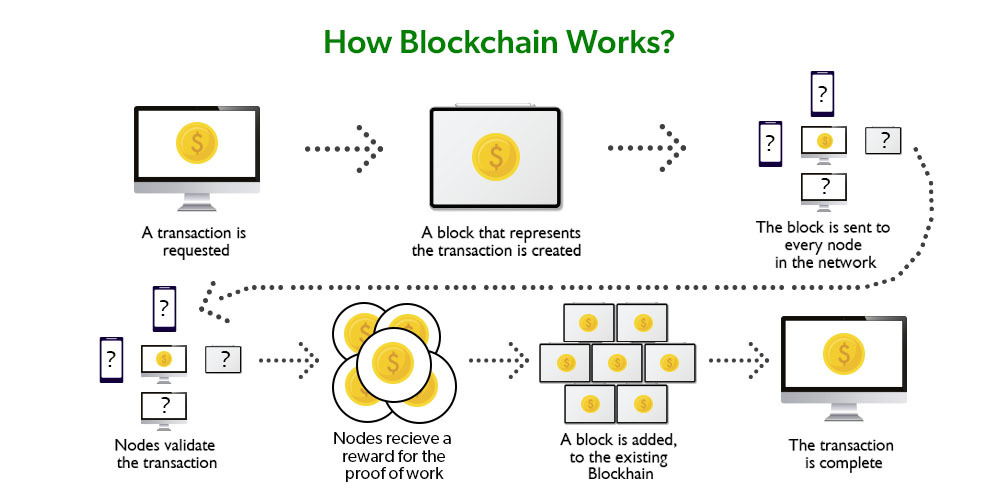
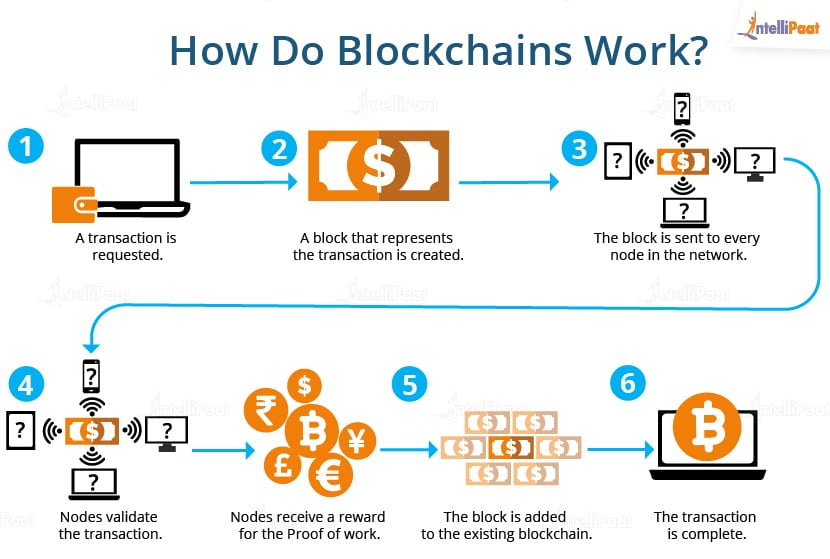
Understanding how a single transaction moves through the blockchain network provides a comprehensive view of its operational flow. This process ensures that data is validated, packaged, and permanently recorded.
Initiation and Verification
The lifecycle begins when a user initiates a transaction. This could be sending cryptocurrency, updating a supply chain record, or registering an asset. The transaction is digitally signed by the sender using their private key, proving ownership and authorization. This signature is then bundled with the transaction data and broadcast to the blockchain network.
Upon receiving a broadcasted transaction, individual nodes in the network perform initial verification checks. They confirm the digital signature’s validity, ensure the sender has sufficient funds or authorization (if applicable), and check for double-spending attempts (trying to spend the same funds twice). Invalid transactions are rejected at this early stage.
Propagation and Mempool
Once verified by individual nodes, the transaction is propagated across the network, reaching more nodes. Valid transactions temporarily reside in a “mempool” (memory pool) or “transaction pool” – a waiting area for unconfirmed transactions. The mempool of each node can vary slightly, as transactions arrive at different times and nodes may prioritize them differently (e.g., based on transaction fees).
Transactions typically include a fee, which incentivizes miners/validators to include them in a block. Users can often set higher fees to encourage faster processing, especially during periods of high network congestion.
Block Creation and Network Consensus
From the pool of unconfirmed transactions, miners (PoW) or validators (PoS) gather a selection of transactions to include in a new block. They then begin the process of competing to add this block to the chain, following their respective consensus mechanism.
Once a miner/validator successfully creates a valid block (e.g., solves the PoW puzzle or is selected in PoS), they broadcast it to the network. Other nodes verify the block’s integrity – checking its hash, the validity of all included transactions, and ensuring it correctly references the previous block. If the block is deemed valid by a majority of the network, it is appended to their copy of the blockchain. At this point, the transactions within that block are considered “confirmed” and immutable. As more blocks are added on top of it, the confirmation gains increasing finality, making reversal practically impossible.
Security, Scalability, and the Future of Blockchain
Blockchain technology offers profound advantages, but it also faces significant challenges that are actively being addressed by researchers and developers worldwide.
Cryptographic Security and Attack Vectors
The security of blockchain relies heavily on advanced cryptography. The use of hash functions, digital signatures (public/private key pairs), and the immutable chaining of blocks makes it incredibly difficult to compromise historical data. However, no system is entirely invulnerable. Potential attack vectors include:
-
51% Attacks: In PoW networks, if a single entity or coordinated group gains control of more than 50% of the network’s total hashing power, they could theoretically manipulate transaction ordering, reverse recent transactions, and prevent legitimate transactions from being confirmed.
-
Sybil Attacks: An attacker creates multiple fake identities or nodes to gain disproportionate influence over the network. Blockchain consensus mechanisms are designed to mitigate this.
-
Smart Contract Vulnerabilities: For blockchains that support programmable contracts (e.g., Ethereum), flaws in the code of these “smart contracts” can be exploited, leading to loss of funds or unintended behavior.
Ongoing research focuses on strengthening cryptographic primitives, developing more robust consensus mechanisms, and designing secure smart contract languages and auditing tools.
The Scalability Trilemma and Ongoing Solutions
One of the most significant challenges for public, decentralized blockchains is the “scalability trilemma.” This theory suggests that a blockchain system can only achieve two out of three desirable properties at any given time: decentralization, security, and scalability (the ability to process a high volume of transactions quickly). Bitcoin and early Ethereum, prioritizing decentralization and security, often struggled with scalability, leading to slow transaction times and high fees during peak usage.
Numerous solutions are being explored and implemented to overcome this:
-
Layer 2 Solutions: These are protocols built on top of existing blockchains to handle transactions off-chain, then periodically settle them on the main chain. Examples include Lightning Network for Bitcoin and rollups (Optimistic and ZK-rollups) for Ethereum, which can dramatically increase transaction throughput.
-
Sharding: Dividing the blockchain into smaller, interconnected segments called “shards,” each capable of processing transactions independently. This allows for parallel processing and significantly higher overall throughput.
-
New Consensus Mechanisms: As discussed, PoS and its variants aim to improve scalability and energy efficiency over PoW.
-
Sidechains and Interoperability Protocols: Separate blockchains that run parallel to a main chain, allowing assets and data to be transferred between them. This facilitates specialized functionality and workload distribution.

Beyond Cryptocurrencies: Real-World Applications
While cryptocurrencies brought blockchain into the public consciousness, the underlying technology has far broader applications beyond finance. Its ability to create immutable, transparent, and verifiable records without a central intermediary makes it suitable for diverse industries:
-
Supply Chain Management: Tracking goods from origin to consumer, ensuring authenticity and transparency, reducing fraud, and improving logistics.
-
Digital Identity: Creating self-sovereign digital identities that give individuals control over their personal data, streamlining verification processes, and enhancing privacy.
-
Healthcare: Securely managing and sharing patient medical records, ensuring data integrity, and facilitating research while maintaining privacy.
-
Intellectual Property and Royalties: Timestamping creative works, proving ownership, and automating royalty distribution for artists and creators.
-
Voting Systems: Enhancing the transparency, security, and verifiability of elections.
The technological ingenuity behind blockchain continues to evolve at a rapid pace. As these innovations mature, they promise to reshape how we manage data, establish trust, and facilitate interactions in an increasingly digital world, underpinning the next generation of secure and distributed systems.
aViewFromTheCave is a participant in the Amazon Services LLC Associates Program, an affiliate advertising program designed to provide a means for sites to earn advertising fees by advertising and linking to Amazon.com. Amazon, the Amazon logo, AmazonSupply, and the AmazonSupply logo are trademarks of Amazon.com, Inc. or its affiliates. As an Amazon Associate we earn affiliate commissions from qualifying purchases.