
The stock market, often perceived as a complex and exclusive realm, is in reality a vital mechanism for economic growth and an accessible avenue for individuals to build wealth. For many, the idea of “trading” conjures images of fast-paced screens and high-stakes decisions. While that can be a facet, understanding how to navigate this market systematically and strategically is key. This guide will demystify the process, offering a comprehensive look at what it takes to trade effectively on the stock market, from fundamental principles to practical execution and essential risk management.
Understanding the Stock Market Ecosystem
Before diving into the mechanics of trading, it’s crucial to grasp what the stock market is and its fundamental components. It’s not a single entity but a network of exchanges and institutions where financial securities are bought and sold.
What is the Stock Market?
At its core, the stock market is a marketplace where investors buy and sell shares of publicly traded companies. When you buy a stock, you’re essentially purchasing a tiny fraction of ownership in that company. This ownership stake can appreciate in value if the company performs well, allowing you to sell your shares for a profit. Conversely, if the company struggles, the value of your shares may decline. The market also allows companies to raise capital by issuing shares to the public, financing expansion, research, and other corporate activities. It reflects investor sentiment, economic conditions, and corporate performance, making it a dynamic and often volatile environment.
Key Participants and Their Roles
The stock market operates with several key players, each fulfilling a distinct role:
- Investors: These are individuals or institutions (like mutual funds, pension funds, or hedge funds) who buy and sell stocks with the goal of generating returns. They can be long-term investors focused on growth and dividends or short-term traders aiming for quick profits from price fluctuations.
- Companies (Issuers): These are the businesses that issue shares to the public to raise capital. Their performance, news, and future prospects heavily influence stock prices.
- Brokerage Firms: These are licensed financial institutions that act as intermediaries between investors and the stock exchanges. They provide platforms, tools, and services necessary for investors to execute trades. Examples include traditional full-service brokers and discount online brokers.
- Stock Exchanges: These are the organized markets where stocks are bought and sold. Major exchanges include the New York Stock Exchange (NYSE) and NASDAQ in the U.S., the London Stock Exchange (LSE), and the Tokyo Stock Exchange (TSE).
- Regulators: Government bodies like the Securities and Exchange Commission (SEC) in the U.S. or the Financial Conduct Authority (FCA) in the UK oversee the stock market to ensure fair and transparent practices and protect investors.
Stocks vs. Other Investment Vehicles
While “stock market” often implies just stocks, it’s a broader term. It’s important to differentiate stocks from other common investment vehicles:
- Stocks: Represent ownership in a company.
- Bonds: Represent a loan made by an investor to a borrower (typically a corporation or government). Bonds pay regular interest and return the principal at maturity. They are generally considered less risky than stocks.
- Mutual Funds: Professionally managed portfolios of stocks, bonds, or other securities. Investors buy shares in the fund, and fund managers make investment decisions.
- Exchange-Traded Funds (ETFs): Similar to mutual funds, but they trade like individual stocks on an exchange throughout the day. They often track an index, commodity, or sector.
Understanding these distinctions helps in building a diversified portfolio that aligns with one’s financial goals and risk tolerance.
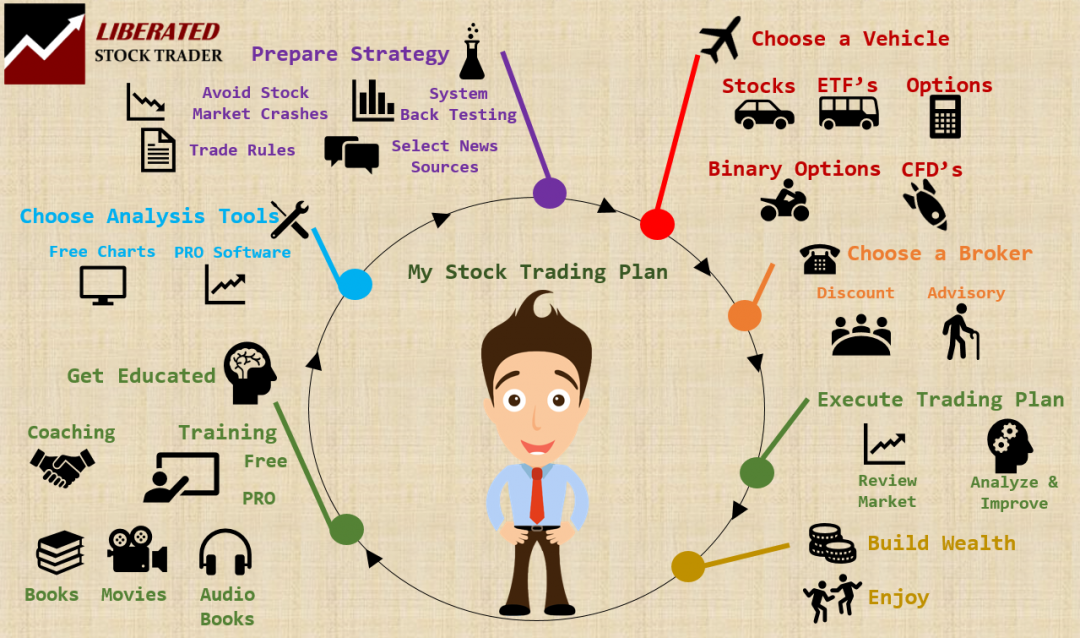
Getting Started: Essential Steps to Trading
Embarking on your trading journey requires careful preparation and a structured approach. Haphazard decisions can lead to significant losses, so laying a solid foundation is paramount.
Defining Your Financial Goals and Risk Tolerance
Before placing your first trade, ask yourself: Why am I investing? Your goals could range from saving for retirement, a down payment on a house, or simply growing your wealth. These goals will dictate your investment horizon (how long you plan to invest) and, consequently, your strategy.
Equally important is understanding your risk tolerance. How comfortable are you with the possibility of losing money?
- Conservative investors prefer lower risk, often opting for bonds or dividend-paying stocks.
- Moderate investors seek a balance between growth and safety.
- Aggressive investors are willing to take on higher risks for potentially higher returns, often investing in volatile growth stocks.
Be honest with yourself; market downturns can be emotionally taxing, and knowing your risk tolerance helps prevent panic selling.
Choosing and Funding Your Brokerage Account
To trade on the stock market, you need a brokerage account. These accounts act as your gateway to the exchanges.
- Online Discount Brokers: These are popular for individual investors due to their low commissions (often zero for stock trades), user-friendly platforms, and extensive research tools. Examples include Charles Schwab, Fidelity, TD Ameritrade (now part of Schwab), and Robinhood.
- Full-Service Brokers: These offer personalized advice, research, and financial planning services, often at a higher cost. They are suitable for investors who prefer hands-on guidance.
When choosing a broker, consider:
- Fees and Commissions: Look for low or zero commissions on stock trades. Be aware of other potential fees like account maintenance, inactivity, or transfer fees.
- Platform and Tools: Evaluate the user interface, charting capabilities, research reports, and educational resources.
- Investment Options: Ensure the broker offers access to the types of investments you’re interested in (stocks, ETFs, options, etc.).
- Customer Service: Good support is crucial, especially for beginners.
Once you’ve chosen a broker, opening an account typically involves an online application and identity verification. You’ll then need to fund your account, usually via bank transfer (ACH), wire transfer, or linking an external bank account. Be mindful of minimum deposit requirements.
Research and Continuous Education

The stock market is constantly evolving, making continuous learning indispensable.
- Fundamental Analysis: Involves evaluating a company’s financial health, management, industry position, and economic outlook to determine its intrinsic value. Key metrics include earnings per share (EPS), price-to-earnings (P/E) ratio, revenue growth, and debt levels.
- Technical Analysis: Involves studying historical price charts and volume data to identify patterns and predict future price movements. Tools include moving averages, Bollinger Bands, and Relative Strength Index (RSI).
- Stay Informed: Read financial news from reputable sources (e.g., Wall Street Journal, Bloomberg, Financial Times), follow economic indicators, and understand global events that can impact markets. Many brokerage firms also provide extensive research reports and educational materials.
Trading Strategies and Order Types
With your account set up and an understanding of market fundamentals, it’s time to explore how you’ll actually buy and sell.
Investment Philosophies: Long-Term vs. Short-Term
Your investment horizon significantly influences your strategy:
- Long-Term Investing: Often called “buy and hold,” this involves purchasing stocks with the intention of holding them for years, benefiting from capital appreciation and dividends. It focuses on fundamentally strong companies and minimizes the impact of short-term market fluctuations. This approach aligns well with retirement planning and typically involves less frequent trading.
- Short-Term Trading: Aims to profit from rapid price movements over days, weeks, or even hours. This includes strategies like day trading (buying and selling within the same day), swing trading (holding for a few days to weeks), and momentum trading. Short-term trading requires significant time commitment, advanced analytical skills, and a high tolerance for risk. It often incurs more transaction costs and tax implications.
Common Trading Strategies
Within these philosophies, several popular strategies are employed:
- Value Investing: Pioneered by Benjamin Graham and popularized by Warren Buffett, this strategy involves finding stocks that are trading below their intrinsic value, often overlooked or undervalued by the broader market.
- Growth Investing: Focuses on companies expected to grow at an above-average rate compared to the market. These companies often reinvest profits back into the business, leading to potential significant capital appreciation.
- Dividend Investing: Centers on companies that regularly pay out a portion of their earnings to shareholders as dividends. This strategy provides a steady income stream and can be attractive for income-focused investors.
- Index Investing: Involves investing in funds (like ETFs or mutual funds) that track a specific market index (e.g., S&P 500). This provides broad market exposure and diversification with typically lower fees.
Executing Trades: Understanding Order Types
When you decide to buy or sell, you’ll use different order types:
- Market Order: An instruction to buy or sell immediately at the best available current market price. While guaranteeing execution, it doesn’t guarantee a specific price, which can be an issue in fast-moving markets.
- Limit Order: An instruction to buy or sell a security at a specific price or better. A buy limit order will only execute at your specified price or lower, while a sell limit order will only execute at your specified price or higher. This gives you control over the price but doesn’t guarantee execution.
- Stop-Loss Order: An order placed to sell a security when it reaches a certain price, designed to limit an investor’s potential loss on a position. If the stock falls to the stop price, it triggers a market order to sell.
- Stop-Limit Order: Similar to a stop-loss order but converts to a limit order once the stop price is reached. This offers more price control but risks non-execution if the limit price isn’t met.
Understanding these order types is crucial for efficient trade execution and risk management.
Risk Management and Trading Psychology
Successful trading is as much about managing risk and emotions as it is about strategy and analysis. The market is unpredictable, and losses are an inevitable part of the journey.
The Importance of Diversification
“Don’t put all your eggs in one basket” is a golden rule in investing. Diversification means spreading your investments across various asset classes, industries, and geographies. This strategy reduces the impact of a poor performance by any single investment on your overall portfolio. If one sector experiences a downturn, others might be performing well, balancing out returns. Diversification helps mitigate risk without sacrificing potential returns significantly.
Setting Stop-Loss Orders and Take-Profit Targets
These are critical tools for disciplined trading:
- Stop-Loss Orders: As mentioned, these automatically sell a stock if it falls to a predetermined price, capping your potential losses. They are essential for protecting capital, especially in volatile markets.
- Take-Profit Targets: Conversely, these are predetermined prices at which you sell a stock to lock in profits. This prevents greed from leading to holding a winning position too long, only to see its gains evaporate. Establishing these targets before entering a trade instills discipline.
Emotional Discipline and Avoiding Biases
The biggest enemy of a trader is often themselves. Fear and greed are powerful emotions that can lead to irrational decisions.
- Fear: Can cause panic selling during market downturns, locking in losses instead of waiting for a recovery.
- Greed: Can lead to holding onto winning trades for too long, expecting endless gains, or taking on excessive risk.
To counter emotional biases:
- Stick to your trading plan: Define your entry, exit, and risk management rules before you trade, and adhere to them.
- Avoid impulsive decisions: Don’t chase “hot” stocks or react to every piece of news.
- Review and learn: Analyze your trades, both winners and losers, to understand what worked and what didn’t. This objective assessment helps refine your strategy.
- Understand cognitive biases: Be aware of common psychological traps like confirmation bias (seeking information that confirms your beliefs) or herd mentality (following the crowd).
Continuous Learning and Adaptation
The stock market is a dynamic environment. Economic conditions, geopolitical events, technological advancements, and corporate landscapes are constantly shifting. What worked yesterday might not work tomorrow. Successful traders are perpetual students, continually refining their knowledge, adapting their strategies, and learning from both their successes and failures. Subscribing to financial publications, attending webinars, reading books, and engaging with reputable financial communities can all contribute to ongoing education.

Conclusion
Trading on the stock market is a journey that offers immense potential for wealth creation but demands discipline, continuous learning, and a robust understanding of both market mechanics and personal finance. It begins with clearly defined goals and an honest assessment of your risk tolerance, followed by selecting the right brokerage and committing to thorough research. Employing sound trading strategies, utilizing various order types effectively, and, crucially, mastering the psychological aspects of trading and risk management are all integral to long-term success. While the allure of quick gains can be strong, approaching the stock market with patience, a structured plan, and a commitment to ongoing education will provide the most sustainable path to achieving your financial aspirations.
aViewFromTheCave is a participant in the Amazon Services LLC Associates Program, an affiliate advertising program designed to provide a means for sites to earn advertising fees by advertising and linking to Amazon.com. Amazon, the Amazon logo, AmazonSupply, and the AmazonSupply logo are trademarks of Amazon.com, Inc. or its affiliates. As an Amazon Associate we earn affiliate commissions from qualifying purchases.