
For many individuals, the idea of paying taxes is confined to an annual ritual of filing a return and, perhaps, receiving a refund or making a final payment. However, for a significant portion of the workforce—including freelancers, independent contractors, small business owners, and those with substantial income not subject to withholding—the tax obligation extends throughout the year in the form of quarterly estimated taxes. This system, mandated by the IRS, ensures that taxpayers pay income tax as they earn or receive income, rather than waiting until the end of the year. Navigating this process can seem daunting at first, but with a clear understanding of the rules, calculation methods, and payment options, it becomes a manageable aspect of financial planning. This article will demystify quarterly estimated taxes, providing a comprehensive guide to understanding, calculating, and effectively paying your dues to the IRS.
Understanding Estimated Taxes: Who Pays and Why?
The U.S. tax system operates on a “pay-as-you-go” principle. For most employees, this is handled automatically through payroll withholding. However, if you don’t have enough tax withheld from your salary or other income, or if you earn income from sources not subject to withholding, you are generally required to pay estimated tax directly to the IRS. Failing to do so can result in penalties, even if you ultimately pay all your taxes by the annual deadline.
The Rationale Behind Estimated Taxes
The IRS requires estimated tax payments to prevent a large, unmanageable tax bill at the end of the year and to ensure a steady stream of revenue for government operations. It’s an equitable system designed to match tax payments with income generation, rather than surprising taxpayers with a substantial lump sum payment when they file their annual return. This approach helps individuals and the government manage cash flow more effectively.
Identifying Who Needs to Pay
The primary candidates for quarterly estimated tax payments are those who anticipate owing at least $1,000 in tax for the year, and whose withholding (if any) and tax credits will not cover at least 90% of their current year’s tax liability or 100% of their prior year’s tax liability (110% for high-income taxpayers). Common scenarios include:
-
Self-employed individuals: Freelancers, independent contractors, gig workers, and sole proprietors.
-
Small business owners: Partnerships, S corporations, and sometimes even C corporations.
-
Individuals with significant unearned income: This includes income from interest, dividends, capital gains, alimony, and rental income.
-
Certain employees: Those with multiple jobs, significant bonuses, or who receive substantial income from sources not subject to withholding.
It’s crucial to assess your income streams and previous tax situations to determine if you fall into one of these categories. A simple rule of thumb: if you expect to make money that doesn’t have taxes automatically deducted, you likely need to pay estimated taxes.
Penalties for Underpayment
The IRS can impose penalties if you don’t pay enough tax throughout the year, either through withholding or estimated tax payments. This penalty applies even if you are due a refund when you file your tax return. The penalty is typically calculated on the underpaid amount for the period of underpayment. There are certain “safe harbor” rules that can help you avoid these penalties, which we will discuss in the next section, but generally, proactive payment is the best defense.
Calculating Your Estimated Tax Liability
The most challenging aspect of paying quarterly estimated taxes is often the calculation itself. Since you’re estimating future income and expenses, precision can be elusive. However, the IRS provides tools and guidelines to help you make the most accurate estimate possible.
Estimating Your Income and Deductions
The first step is to project your adjusted gross income (AGI) for the entire tax year. This includes all expected income from your self-employment, investments, rentals, and any other sources, minus any eligible adjustments to income (like contributions to an IRA or health savings account).
Next, estimate your deductions and credits. If you plan to itemize, estimate your itemized deductions (e.g., mortgage interest, state and local taxes, charitable contributions). Otherwise, use the standard deduction. Factor in any applicable tax credits you anticipate qualifying for, such as the child tax credit, education credits, or credits for energy-efficient home improvements.
Subtract your deductions from your AGI to arrive at your estimated taxable income. Then, use the appropriate tax rates for your filing status (single, married filing jointly, etc.) to calculate your estimated tax before credits. Finally, subtract any tax credits to get your total estimated tax liability for the year.
Key Forms: Form 1040-ES and Worksheets
The IRS provides Form 1040-ES, Estimated Tax for Individuals, which includes a worksheet to help you calculate your estimated tax. This worksheet guides you through the process of estimating your income, deductions, and credits, and then dividing your total estimated tax liability into four equal payments. While not mandatory to submit with your payment, using this form’s worksheet is highly recommended as a structured way to determine your payment amounts. Many tax software programs also offer similar tools that simplify this calculation.
The Safe Harbor Rules: Avoiding Penalties
To avoid underpayment penalties, you generally need to pay at least 90% of your current year’s tax liability or 100% of your prior year’s tax liability (110% if your prior year’s AGI was over $150,000, or $75,000 if married filing separately). Whichever of these amounts is smaller is your “safe harbor” threshold.
-
90% Rule: Pay at least 90% of the tax you’ll actually owe for the current year. This can be tricky because it requires accurately forecasting your income.
-
100% (or 110%) Prior Year Rule: Pay 100% (or 110% for higher earners) of the tax shown on your previous year’s return. This is often the easier method if your income is relatively stable, as it relies on known figures.
If you meet either of these safe harbor conditions, you generally won’t face an underpayment penalty. Many taxpayers opt for the prior year’s tax safe harbor if their income is expected to be similar or higher, as it provides a clear target.
Methods for Making Your Payments
Once you’ve calculated your quarterly estimated tax payments, the next step is to make them. The IRS offers several convenient ways to submit your payments, catering to various preferences.
Online Payment Options: IRS Direct Pay and EFTPS
-
IRS Direct Pay: This is a free, secure service offered by the IRS that allows you to pay directly from your checking or savings account. You don’t need to register; you simply select “Estimated Tax” as the reason for payment, specify the tax year, and enter your bank account information. It’s quick, easy, and you receive an immediate confirmation email.
-
Electronic Federal Tax Payment System (EFTPS): This is another free service provided by the U.S. Department of the Treasury. EFTPS requires enrollment, which can take several days to process as you’ll receive a PIN by mail. Once enrolled, you can schedule payments up to 365 days in advance and review your payment history. EFTPS is particularly useful for business owners and those who prefer to schedule all their payments at the beginning of the year.

Both online methods are highly recommended for their convenience, security, and the immediate record of payment they provide.
Paying by Mail: Vouchers and Checks
If you prefer traditional methods, you can still pay your estimated taxes by mail. This involves:
-
Completing Form 1040-ES Payment Voucher: Each quarterly payment is accompanied by a specific voucher (from the Form 1040-ES package) that you fill out with your name, address, Social Security number, and the amount of your payment.
-
Making a Check or Money Order: Write a check or money order payable to the “U.S. Treasury.” Be sure to clearly write your name, address, daytime phone number, Social Security number, the tax year for which you’re paying, and “Form 1040-ES” on the payment.
-
Mailing: Send your voucher and payment to the appropriate IRS address, which varies depending on your state. These addresses are listed in the Form 1040-ES instructions. It’s advisable to mail your payment several days before the due date to ensure it’s postmarked on time.
While reliable, mailing payments can be slower and lacks the instant confirmation of online methods, making it harder to track in real-time.
Payment Through Your Tax Preparer or Tax Software
Many tax preparation software programs (like TurboTax, H&R Block, etc.) offer the option to calculate and submit your estimated tax payments electronically directly through their platform. This can be a seamless way to integrate your quarterly payments with your annual tax planning. Similarly, if you work with a tax professional, they can often help you calculate and even submit your estimated tax payments on your behalf, often as part of their comprehensive service.
Key Dates and Strategic Planning
Timely payments are as crucial as accurate calculations. Understanding the due dates and having a strategy for managing your estimated taxes throughout the year are vital for compliance and financial peace of mind.
Understanding the Payment Due Dates
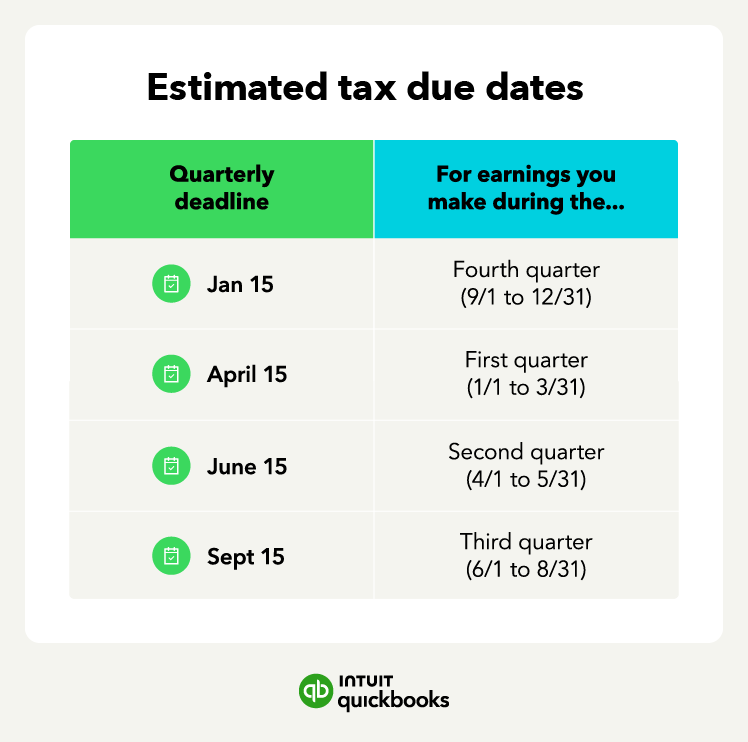
The tax year is divided into four payment periods, each with a specific due date:
-
Payment 1 (January 1 to March 31 income): Due April 15
-
Payment 2 (April 1 to May 31 income): Due June 15
-
Payment 3 (June 1 to August 31 income): Due September 15
-
Payment 4 (September 1 to December 31 income): Due January 15 of the next year
If any of these dates fall on a weekend or holiday, the due date shifts to the next business day. It’s important to note that these dates apply to the income earned during that period, not necessarily when the payment is physically made.
Adjusting Estimates Throughout the Year
Life happens, and your income or deductions may change unexpectedly. The IRS recognizes this and allows you to adjust your estimated tax payments throughout the year. If you find your income is higher than anticipated, you should increase your subsequent payments to avoid an underpayment penalty. Conversely, if your income decreases, you can lower your payments.
The critical point is that you don’t have to stick to your initial estimate if circumstances change. You can recalculate your projected annual tax liability at any point and adjust your remaining payments accordingly. This flexibility is key to managing estimated taxes effectively, especially for those with variable income.
Proactive Strategies for Managing Cash Flow
Managing estimated taxes effectively often comes down to sound financial planning. Consider these strategies:
-
Set aside a percentage of income: For self-employed individuals, a common practice is to immediately set aside 25-35% of every payment received into a separate savings account designated for taxes. This ensures funds are available when payment due dates arrive.
-
Use budgeting tools: Integrate your estimated tax payments into your overall budget. This helps you visualize and plan for these significant expenses.
-
Review periodically: Don’t just set it and forget it. Review your income and expenses at least quarterly (or more frequently if your income is volatile) to ensure your estimates remain accurate.
-
Automate payments: If using EFTPS, schedule your payments in advance to avoid missing deadlines.
Common Pitfalls and Best Practices
Even with the best intentions, taxpayers can stumble when it comes to estimated taxes. Being aware of common pitfalls and adopting best practices can streamline the process and minimize stress.
Ignoring Income Fluctuations
One of the biggest mistakes is failing to adjust estimates when income changes significantly. A sudden boost in business, a large capital gain, or an unexpected expense can throw off your initial calculations. Regularly reviewing and revising your estimates prevents surprises and potential penalties.
The Importance of Record-Keeping
Meticulous record-keeping is invaluable. Keep detailed records of all income and expenses, especially for self-employment. This data is crucial for accurately calculating your estimated taxes and will make preparing your annual return significantly easier. Digital tools, spreadsheets, or accounting software can simplify this process.
When to Seek Professional Guidance
While this guide provides a comprehensive overview, complex financial situations may warrant professional help. If you have multiple income streams, significant investment gains or losses, complex deductions, or are simply overwhelmed by the process, a qualified tax professional can provide tailored advice, help with calculations, and ensure compliance. Their expertise can save you time, stress, and potentially costly errors or penalties.

Conclusion
Paying quarterly estimated taxes is a fundamental responsibility for many taxpayers, crucial for maintaining compliance with the “pay-as-you-go” tax system. While it requires proactive planning and diligent record-keeping, it is far from an insurmountable challenge. By understanding who needs to pay, accurately calculating your liability using tools like Form 1040-ES, leveraging convenient online payment methods, and strategically managing your finances throughout the year, you can navigate the process with confidence. Remember to monitor your income, adjust your estimates as needed, and don’t hesitate to seek professional guidance when your situation becomes complex. Mastering quarterly estimated taxes is not just about avoiding penalties; it’s about empowering yourself with greater financial control and peace of mind.
aViewFromTheCave is a participant in the Amazon Services LLC Associates Program, an affiliate advertising program designed to provide a means for sites to earn advertising fees by advertising and linking to Amazon.com. Amazon, the Amazon logo, AmazonSupply, and the AmazonSupply logo are trademarks of Amazon.com, Inc. or its affiliates. As an Amazon Associate we earn affiliate commissions from qualifying purchases.