
In an increasingly digitized world, managing personal and business finances has become remarkably streamlined. For many individuals and entities, one crucial aspect of financial responsibility is the payment of estimated taxes. Far from the days of mailing physical checks, the process has largely migrated online, offering unparalleled convenience, speed, and accuracy. Understanding how to navigate these digital pathways is not just a matter of compliance but a smart financial practice that can save time, reduce errors, and ensure you remain in good standing with tax authorities. This comprehensive guide will walk you through the nuances of estimated taxes and the various online methods available for their payment, firmly planting you in the realm of modern financial management.
Understanding Estimated Taxes: Who Needs to Pay?
Before diving into the “how-to” of online payments, it’s essential to grasp the fundamental concept of estimated taxes and identify who is obligated to pay them. This understanding forms the bedrock of responsible financial planning for a significant portion of the workforce.
What Are Estimated Taxes?
Estimated taxes are a method used to pay taxes on income that isn’t subject to withholding. Unlike traditional employees who have taxes automatically deducted from their paychecks by their employers, individuals with other income sources are generally responsible for calculating and paying their taxes directly to the Internal Revenue Service (IRS) throughout the year. This system ensures that taxpayers meet their tax obligations on a “pay-as-you-go” basis, preventing a massive tax bill and potential penalties at year-end.
Who is Required to Pay?
The requirement to pay estimated taxes typically falls on individuals who expect to owe at least $1,000 in tax for the current year. This group predominantly includes:
- Self-employed individuals: Freelancers, independent contractors, consultants, and small business owners whose income isn’t subject to employer withholding.
- Gig economy workers: Those earning income through platforms like ridesharing, food delivery, or short-term rentals.
- Individuals with significant investment income: Dividends, interest, capital gains, or rental income that isn’t already being taxed at the source.
- Those with other unwithheld income: Alimony, prizes, awards, or income from certain trusts and estates.
- High-income earners: Even if employed, individuals with substantial supplementary income may need to pay estimated taxes if their employer withholding isn’t sufficient to cover their total tax liability.
The general rule of thumb is that you must pay estimated tax if you expect your withholding and refundable credits to be less than the smaller of (1) 90% of the tax to be shown on your current year’s tax return, or (2) 100% of the tax shown on your prior year’s tax return. For high-income earners (those with an Adjusted Gross Income exceeding $150,000 in the prior year), the prior year’s tax liability threshold increases to 110%.
The Rationale for Quarterly Payments
The IRS mandates quarterly payments for estimated taxes to maintain a steady flow of revenue and to prevent taxpayers from accumulating a large, unmanageable tax debt by April 15th of the following year. This “pay-as-you-earn” system minimizes the burden on individual taxpayers and helps the government manage its finances throughout the fiscal year. Failing to pay enough tax through withholding and estimated payments can result in underpayment penalties, making timely and accurate quarterly payments a critical component of sound financial planning.
The Advantages of Paying Estimated Taxes Online
The digital revolution has transformed nearly every facet of our lives, and tax payments are no exception. Opting for online methods to pay estimated taxes offers a multitude of advantages over traditional paper-based approaches, aligning perfectly with modern financial management principles.
Convenience and Accessibility
Perhaps the most significant benefit of online payments is the unparalleled convenience they offer. You can initiate a payment anytime, anywhere, as long as you have an internet connection. This eliminates the need to prepare checks, find stamps, or make a trip to the post office. Whether you’re at home, in the office, or even traveling, managing your tax obligations becomes a seamless process that fits into your schedule rather than dictating it. This 24/7 accessibility is invaluable for busy professionals and entrepreneurs.
Speed and Efficiency
Online payments are processed much faster than mailed checks. When you submit a payment electronically, the transaction is typically processed within a few business days, often almost instantly, depending on the platform. This speed is particularly advantageous when you’re nearing a deadline, as it provides peace of mind that your payment will be recorded on time, avoiding potential late-payment penalties. Immediate confirmation numbers are usually provided, offering verifiable proof of payment.
Enhanced Accuracy and Record-Keeping
Electronic payment systems are designed to minimize errors. By directly inputting information into secure government portals or reputable tax software, you reduce the chances of miswriting account numbers, payment amounts, or mailing addresses. Furthermore, online platforms provide an instant digital record of your transaction. This digital paper trail is invaluable for budgeting, tax planning, and auditing purposes. You can easily access payment histories, confirmation numbers, and transaction dates, simplifying your financial reconciliation and providing robust evidence of compliance.
Security
Reputable online payment platforms, especially those managed directly by the IRS, employ robust encryption and security protocols to protect your sensitive financial information. These systems are far more secure than sending checks through the mail, where they are susceptible to loss, theft, or tampering. While no system is entirely impervious, official government portals and well-established tax software providers invest heavily in cybersecurity to safeguard your data, making online payments a generally safer option for transmitting funds.
Your Digital Gateways: Official Online Payment Platforms
When it comes to paying estimated taxes online, the IRS offers several secure and reliable digital gateways. Each platform caters to slightly different needs, offering varying levels of functionality and ease of use. Understanding these options will help you choose the best fit for your financial workflow.
IRS Direct Pay
IRS Direct Pay is arguably the simplest and most straightforward method for making estimated tax payments directly from your checking or savings account. It’s a free service provided by the IRS, requiring no prior registration.
- Description: A quick, easy, and secure way to pay your individual tax bill or estimated tax payments directly from your bank account, without any fees.
- Steps:
- Visit the IRS Direct Pay website.
- Select the reason for your payment (e.g., Estimated Tax), the tax year, and your identity verification method (e.g., last year’s tax filing status and address).
- Enter your bank account information (routing and account numbers) and the payment amount.
- Review and submit your payment. You’ll receive an instant confirmation number.
- Pros: No registration required, free of charge, straightforward interface, instant confirmation.
- Cons: Limited to individual tax payments, no option to schedule recurring payments far in advance.
Electronic Federal Tax Payment System (EFTPS)
EFTPS is a more robust, government-run system that allows individuals and businesses to make all types of federal tax payments, including estimated taxes, electronically. While it requires a one-time enrollment process, it offers greater control and flexibility.
- Description: A free service from the U.S. Department of the Treasury that allows you to make federal tax payments electronically. It’s ideal for those who make frequent federal tax payments or manage business tax obligations.
- Steps:
- Enroll: Visit the EFTPS website and complete the enrollment process. This typically involves receiving a PIN via postal mail (which can take 5-7 business days).
- Activate: Once you receive your PIN, activate your account online.
- Schedule Payments: Log in, select “Make a Payment,” choose “Form 1040ES Estimated Tax,” enter the tax year, amount, and payment date. You can schedule payments up to 365 days in advance.
- Pros: Free, highly secure, allows scheduling payments in advance, supports all federal tax types, provides comprehensive payment history.
- Cons: Requires a one-time enrollment process that can take a few days, interface can be less intuitive for first-time users compared to IRS Direct Pay.
Paying via Tax Software Providers
Many popular tax preparation software programs integrate estimated tax payment functionalities directly into their platforms, streamlining the process for their users.
- Description: Tax software like TurboTax, H&R Block, and TaxAct often allow you to calculate and pay your estimated taxes as part of their service. They typically guide you through the process after helping you determine your estimated tax liability.
- Steps: Follow the prompts within your chosen tax software. After calculating your estimated tax, the software will usually offer an option to pay electronically through IRS Direct Pay or by generating payment vouchers if you prefer to mail a check.
- Pros: Seamless integration with tax calculation, user-friendly interface, often provides reminders for upcoming payments.
- Cons: May require a subscription or purchase of the software, often uses IRS Direct Pay or third-party processors in the background, which might involve a separate sign-in for confirmation.
Paying by Debit/Credit Card (Third-Party Processors)

The IRS also allows taxpayers to pay their estimated taxes using a debit or credit card through authorized third-party payment processors. While convenient, this option comes with a processing fee.
- Description: The IRS partners with several private companies that process tax payments by debit or credit card. These companies charge a convenience fee based on the payment amount.
- Steps:
- Visit the IRS website and navigate to the “Pay Your Taxes” section to find a list of authorized payment processors.
- Choose a processor and click on their link.
- Select “Estimated Tax” as the payment type, enter your personal and payment information (card details).
- Review and submit.
- Pros: Instant payment, option to use credit card rewards, useful if you need to defer payment from your bank account or earn rewards.
- Cons: Involves a convenience fee (typically a percentage of the payment for credit cards, or a flat fee for debit cards), which can add up for large payments.
Calculating and Scheduling Your Estimated Payments
Accurately calculating your estimated tax liability and adhering to the payment schedule are paramount to avoiding penalties. The process involves foresight, careful estimation, and timely action.
The Role of Form 1040-ES
The IRS provides Form 1040-ES, Estimated Tax for Individuals, as a critical tool for calculating your estimated tax. This form includes a worksheet designed to help you figure out your expected Adjusted Gross Income (AGI), deductions, credits, and ultimately, your total estimated tax for the year. It considers various income sources and helps you project your taxable income and corresponding tax liability. While the form provides a structured approach, many taxpayers now rely on tax software or the assistance of a financial professional to complete this calculation.
Key Factors in Your Calculation
Several dynamic factors influence your estimated tax calculation. These include:
- Income Sources: All taxable income, including self-employment earnings, investment gains, rental income, and any wages not subject to sufficient withholding.
- Deductions and Credits: Anticipated itemized or standard deductions, as well as any tax credits you expect to qualify for (e.g., child tax credit, education credits).
- Life Changes: Significant life events such as marriage, divorce, birth of a child, purchase of a home, or retirement can dramatically alter your tax situation and necessitate recalculation.
- Business Expenses: For the self-employed, tracking and projecting business expenses is crucial for reducing taxable income.
Regularly reviewing these factors and adjusting your estimates throughout the year is a smart financial strategy, especially if your income or expenses fluctuate.
The Quarterly Payment Schedule
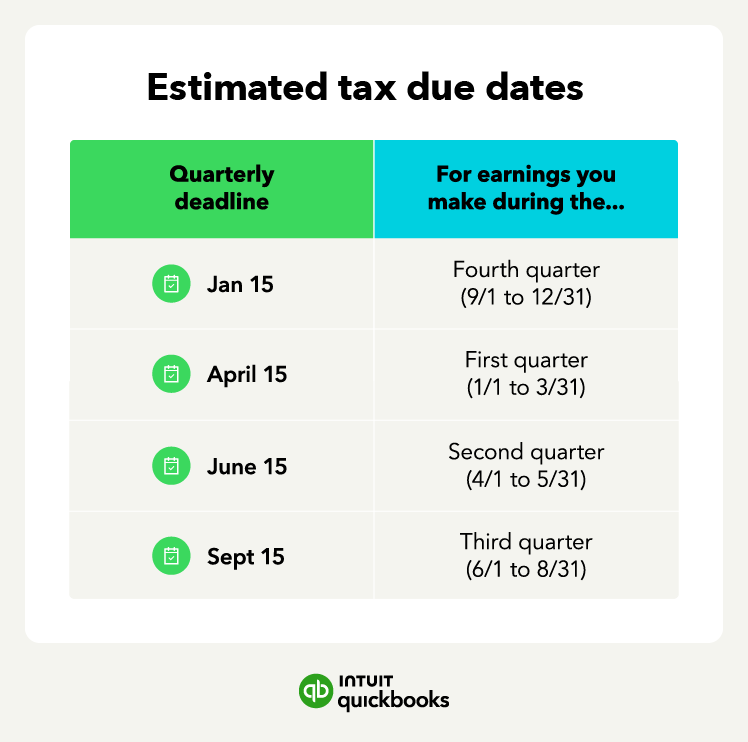
Estimated taxes are typically paid in four installments throughout the year. These deadlines are non-negotiable and are crucial for avoiding underpayment penalties. The standard schedule is:
- First Quarter (January 1 to March 31): Due April 15
- Second Quarter (April 1 to May 31): Due June 15
- Third Quarter (June 1 to August 31): Due September 15
- Fourth Quarter (September 1 to December 31): Due January 15 of the next year
If any of these dates fall on a weekend or holiday, the deadline is shifted to the next business day. It’s important to note that these payments are for specific income periods, not necessarily covering the calendar quarter in which they are due.
Strategies for Accurate Estimation
Achieving accurate estimated tax payments requires proactive planning:
- Annualized Income Method: If your income fluctuates significantly throughout the year (e.g., seasonal business), you can use the annualized income method. This method allows you to estimate your income and deductions more accurately for each payment period, rather than assuming an even income stream. This can help avoid overpaying in earlier quarters and underpaying in later ones.
- Review Previous Year’s Taxes: Your prior year’s tax return is an excellent starting point for estimating your current year’s income and deductions, assuming your financial situation hasn’t drastically changed.
- Regular Review and Adjustment: Don’t set your estimated payments once and forget them. Review your income and expenses periodically (e.g., quarterly) and adjust your future payments if your financial outlook changes. You can increase or decrease subsequent payments to compensate for earlier over or underpayments.
Essential Tips and Best Practices for Online Estimated Tax Payments
Successfully managing your estimated tax payments online goes beyond simply knowing which button to click. It involves adopting best practices that ensure accuracy, compliance, and peace of mind.
Don’t Miss Deadlines
The most critical rule for estimated taxes is to pay on time. Missing a deadline or underpaying a quarterly installment can result in penalties, which are calculated based on the amount of underpayment and the length of time it remains unpaid. Set calendar reminders well in advance of each due date, and if using EFTPS, schedule your payments proactively. Remember that electronic payments can sometimes take a day or two to fully process, so avoid waiting until the very last minute.
Keep Meticulous Records
Even with digital records, it’s imperative to maintain your own organized file of all estimated tax payments. This includes:
- Confirmation Numbers: Always save the confirmation number provided by IRS Direct Pay, EFTPS, or third-party processors.
- Payment Dates and Amounts: Record the exact date and amount of each payment.
- Bank Statements: Cross-reference your bank statements to ensure the funds were successfully debited.
- Calculation Worksheets: Keep copies of your Form 1040-ES worksheets or any calculations performed by your tax software.
These records are vital for reconciling your taxes at year-end and for responding to any inquiries from the IRS.
Review and Verify
Before submitting any online payment, take an extra moment to meticulously review all the information you’ve entered. Double-check:
- Tax Year: Ensure you’re applying the payment to the correct tax year.
- Payment Amount: Verify the accuracy of the amount.
- Bank Account Information: Confirm the routing and account numbers are correct to prevent payments from going to the wrong place or being rejected.
- Payment Type: Make sure you’ve selected “Estimated Tax” rather than a past due amount or a different tax form.
A small error can lead to significant headaches and potential delays in proper credit for your payment.
Seek Professional Guidance
While online tools make estimated tax payments more accessible, the calculation itself can be complex, especially if your income sources are varied, deductions are intricate, or you experience significant life changes. Don’t hesitate to consult a qualified tax professional, such as a CPA or enrolled agent. They can help you accurately calculate your estimated tax liability, advise on strategies to minimize your tax burden, and ensure you’re in full compliance with all tax laws. Their expertise can be invaluable for optimizing your financial health and avoiding costly mistakes.

Adjust as Needed
Life is dynamic, and so too can be your income and expenses. If your financial situation changes significantly after you’ve made your initial estimated tax calculations, don’t wait until year-end to adjust. For example, if you start a new, more lucrative side hustle, sell an investment with a large capital gain, or incur substantial unexpected business expenses, it’s wise to re-evaluate your remaining estimated payments. You can either increase or decrease subsequent quarterly payments to reflect these changes, preventing a large surprise tax bill or an underpayment penalty. The IRS provides methods for adjusting payments throughout the year, allowing for flexibility.
Paying estimated taxes online is no longer a niche option but the preferred, most efficient method for countless taxpayers. By understanding the underlying principles, leveraging the official digital platforms, diligently calculating your liabilities, and adhering to best practices, you can navigate your tax obligations with confidence and ease. This proactive approach to financial compliance is a hallmark of responsible money management in the digital age, ensuring you stay ahead of deadlines and maintain a healthy financial standing.
aViewFromTheCave is a participant in the Amazon Services LLC Associates Program, an affiliate advertising program designed to provide a means for sites to earn advertising fees by advertising and linking to Amazon.com. Amazon, the Amazon logo, AmazonSupply, and the AmazonSupply logo are trademarks of Amazon.com, Inc. or its affiliates. As an Amazon Associate we earn affiliate commissions from qualifying purchases.