
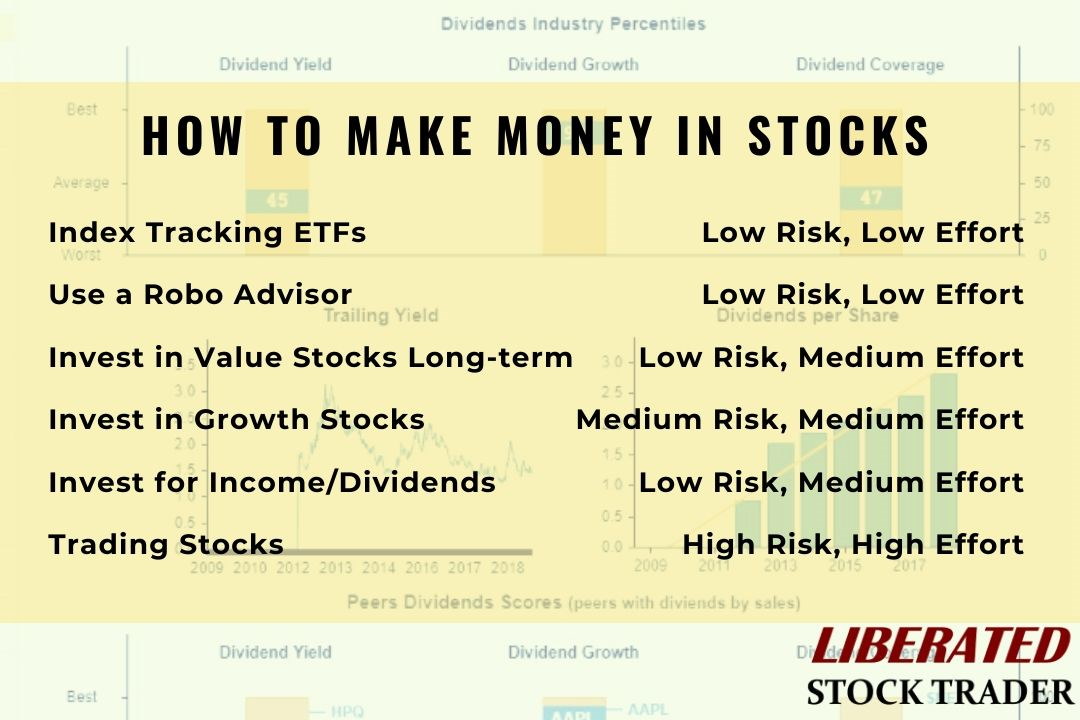
The stock market remains one of the most powerful engines for wealth creation in the modern financial landscape. For decades, it has provided a platform where individual investors can participate in the growth of global commerce, turning modest savings into significant capital through disciplined strategy and market participation. However, the path to profitability is not a singular route. Making money with stocks involves a combination of fundamental growth, income generation, and strategic risk management. To succeed, an investor must understand the diverse mechanisms through which equity investments translate into realized gains.
Capital Appreciation: The Core Driver of Equity Wealth
Capital appreciation is the most common method of making money in the stock market. Simply put, it is the increase in the market price of a security. When you purchase a share of a company at one price and sell it at a higher price, the difference represents your capital gain. While the concept of “buying low and selling high” sounds elementary, the execution requires a deep understanding of market dynamics and company valuation.

Understanding Growth Investing
Growth investing focuses on companies that are expected to grow at a rate significantly above the average for the market. These companies typically reinvest their earnings back into the business to fund research and development, expansion, or acquisitions, rather than paying dividends. Investors make money here by identifying businesses with a competitive “moat”—a unique advantage that protects their market share—and riding the upward trajectory of their valuation as the company scales. In this niche, profitability is often deferred in favor of revenue expansion, and the stock price reflects the market’s optimism about future earnings potential.
The Value Investing Philosophy
Value investing is the art of buying stocks that appear to be trading for less than their intrinsic or book value. Adherents of this strategy, famously practiced by legends like Benjamin Graham and Warren Buffett, believe that the market often overreacts to good or bad news, resulting in stock price swings that do not correspond with a company’s long-term fundamentals. By identifying undervalued companies with strong balance sheets and steady cash flows, investors can purchase shares at a discount. Profit is realized when the market eventually corrects its pricing error, and the stock price rises to meet the company’s true value.
The Role of Long-Term Compounding
The most potent force in capital appreciation is time. Compounding occurs when the returns on your investment begin to earn their own returns. In the stock market, this is achieved by staying invested through market cycles. A stock that grows by an average of 10% annually doesn’t just add 10% of the original principal each year; it adds 10% to the new, larger total. Over twenty or thirty years, this exponential growth can turn a small initial sum into a substantial fortune. Patience is, therefore, a literal financial asset.
Generating Passive Income through Dividend Yields
Beyond the rise and fall of stock prices, many investors make money through dividends. Dividends represent a portion of a company’s earnings distributed to shareholders, typically on a quarterly basis. This provides a stream of passive income that can be used to fund a lifestyle or, more effectively, be reinvested to purchase more shares.
Identifying Quality Dividend Stocks
Not all companies pay dividends. Typically, established, mature companies with predictable cash flows are the primary sources of dividend income. When searching for dividend-paying stocks, investors look at the “dividend yield”—the annual dividend payment divided by the stock price—and the “payout ratio,” which indicates what percentage of earnings the company is giving back to shareholders. A sustainable payout ratio suggests the company can maintain its dividend even during economic downturns, whereas an excessively high ratio might signal that the dividend is at risk of being cut.
The Power of Dividend Growth
Making money with dividends is not just about the current yield; it is about the growth of that yield over time. “Dividend Aristocrats” are companies that have not only paid but increased their dividends for at least 25 consecutive years. By investing in these entities, an investor benefits from an “inflation hedge.” As the company grows more profitable, the cash flow it sends to the investor increases, often outpacing the rising cost of living. This creates a rising yield on the original cost of the investment.
Reinvesting Dividends (DRIPs)
A Dividend Reinvestment Plan (DRIP) is a strategy where the cash dividends received from a company are automatically used to purchase additional shares or fractional shares of that same company. This is a critical mechanic for wealth building. Instead of taking the cash, you increase your ownership stake. Over time, you own more shares, which in turn pay more dividends, which buy even more shares. This cycle accelerates the process of compounding and is one of the most reliable ways to build a high-value portfolio without needing to inject new capital constantly.
Strategic Trading and Market Mechanics
While long-term investing is the cornerstone of wealth, many participants make money through more active, strategic approaches. These methods involve shorter time horizons and rely heavily on technical analysis, market sentiment, and specific financial instruments.
Swing Trading and Technical Analysis
Swing trading involves holding a stock for several days or weeks to profit from expected upward or downward price shifts. Unlike fundamental investors who look at balance sheets, swing traders often utilize technical analysis—the study of historical price movements and chart patterns. By identifying trends, support levels (where a stock price tends to stop falling), and resistance levels (where it tends to stop rising), traders aim to capture “swings” in the market. While higher risk, this method allows for more frequent profit-taking opportunities.
Generating Income through Options
Sophisticated investors often use options to generate income from their existing stock holdings. A common strategy is the “covered call.” In this scenario, an investor who owns shares of a stock sells a “call option” to another trader. The seller receives an upfront payment, known as a premium. If the stock price remains below a certain level, the investor keeps the premium and the stock. This effectively allows an investor to “rent out” their shares for a fee, creating an additional layer of income on top of any dividends or price appreciation.
Managing Volatility and Risk
To make money consistently, one must focus on not losing it. Professional traders use “stop-loss” orders to automatically sell a position if it drops to a certain price, thereby limiting the downside. They also pay close attention to “position sizing,” ensuring that no single investment is large enough to cause catastrophic damage to the overall portfolio. Understanding that the market moves in cycles of “bull” (rising) and “bear” (falling) markets allows an investor to adjust their strategy accordingly, perhaps moving into more defensive sectors like utilities or consumer staples during periods of high volatility.
Portfolio Diversification and the Collective Approach
One of the most effective ways to make money with stocks while minimizing the risk of individual company failure is through diversification. Instead of betting on a single horse, investors bet on the entire race.
Index Funds and ETFs
Exchange-Traded Funds (ETFs) and Index Funds allow an investor to buy a basket of hundreds or even thousands of stocks in a single transaction. For example, an S&P 500 index fund gives the investor a small piece of the 500 largest publicly traded companies in the United States. This “passive” investment strategy often outperforms active stock picking over long periods because it captures the total growth of the economy while keeping management fees extremely low. By lowering costs and spreading risk, the investor keeps a larger portion of the market’s natural returns.
Sector Allocation
The economy is composed of different sectors—technology, healthcare, energy, finance, and more—that often perform differently at different stages of the economic cycle. Making money involves rotating capital into sectors that are poised for growth. For instance, when interest rates rise, financial institutions often become more profitable; when the economy is expanding, consumer discretionary stocks might lead the way. A diversified portfolio ensures that even if one sector is underperforming, others may be thriving, stabilizing the overall growth of the investment.
The Financial Framework for Success
Ultimately, making money with stocks requires more than just picking the right ticker symbol; it requires a structured financial framework. This involves understanding the administrative and psychological aspects that influence net returns.
The Importance of an Exit Strategy
Profit is not real until it is “locked in” through a sale. Having a clear exit strategy is essential. This could be a price target (e.g., selling when the stock reaches a 50% gain) or a fundamental trigger (e.g., selling if the company’s debt exceeds a certain level). Without an exit strategy, investors often hold on to winning stocks for too long, watching their gains evaporate during a market correction, or hold on to losing stocks in the vain hope of “breaking even.”
Tax Efficiency and Capital Gains
A significant part of making money is keeping the money you make. Governments tax stock market profits differently based on how long the asset was held. In many jurisdictions, “long-term capital gains” (stocks held for more than a year) are taxed at a lower rate than “short-term gains” (held for less than a year), which are often taxed as ordinary income. Strategic investors often hold positions longer to qualify for these tax breaks, and they may use “tax-loss harvesting”—selling losing positions to offset the taxes owed on winning ones—to maximize their net annual return.

Emotional Discipline and the Long View
The greatest obstacle to making money in stocks is often the investor’s own psychology. Fear and greed drive market bubbles and crashes. Successful investors develop the discipline to ignore the “noise” of daily financial news and stick to their long-term plan. They understand that market downturns are not just risks, but opportunities to buy high-quality companies at a discount. By maintaining a professional, detached perspective and focusing on the underlying value of the businesses they own, investors can navigate the complexities of the market and achieve sustainable financial growth.
aViewFromTheCave is a participant in the Amazon Services LLC Associates Program, an affiliate advertising program designed to provide a means for sites to earn advertising fees by advertising and linking to Amazon.com. Amazon, the Amazon logo, AmazonSupply, and the AmazonSupply logo are trademarks of Amazon.com, Inc. or its affiliates. As an Amazon Associate we earn affiliate commissions from qualifying purchases.