
Percentages are more than just mathematical curiosities; they are the bedrock of financial understanding, influencing everything from the interest you pay on a loan to the return on your investments, the taxes you owe, and the profits a business generates. In the world of money, understanding how to “get a percentage of something” isn’t merely a skill; it’s a financial superpower. It empowers individuals and businesses to make informed decisions, track progress, and analyze performance with precision. This comprehensive guide will demystify percentage calculations, illustrating their critical applications across personal and business finance, and equip you with the knowledge to wield this powerful tool confidently.

The Fundamental Role of Percentages in Your Financial Life
At its core, a percentage represents a proportion or a share of a whole, expressed as a fraction of 100. The word “percent” literally means “per hundred.” This universal language allows for easy comparison and understanding across different scales and contexts, making it indispensable in finance.
Why Percentages Are Non-Negotiable in Money Matters
Imagine trying to compare the growth of a small startup with a massive multinational corporation without percentages. It would be an apples-to-oranges comparison. Percentages standardize these comparisons. They allow us to evaluate:
- Performance: How much did your stock portfolio grow this year? (e.g., 15% return).
- Cost: What is the interest rate on your mortgage? (e.g., 4.5% APR).
- Value: How much discount are you getting on that new car? (e.g., 10% off).
- Proportion: What percentage of your income goes towards housing? (e.g., 30%).
- Risk: What is the probability of a market downturn? (e.g., 20% chance).
Without percentages, financial communication would be muddled, decision-making would be guesswork, and true financial literacy would be unattainable.
The Basic Concept: What Exactly is a Percentage?
A percentage is essentially a fraction where the denominator is always 100. So, 25% is equivalent to 25/100, or 0.25 as a decimal. Converting between percentages, fractions, and decimals is a foundational skill.
- To convert a decimal to a percentage: Multiply by 100 and add the % sign (e.g., 0.75 x 100 = 75%).
- To convert a percentage to a decimal: Divide by 100 (e.g., 75% / 100 = 0.75).
- To convert a fraction to a percentage: Convert the fraction to a decimal first, then multiply by 100 (e.g., 3/4 = 0.75; 0.75 x 100 = 75%).
Understanding these conversions is the first step to mastering percentage calculations in any financial scenario.
Core Percentage Calculations: Essential Formulas for Financial Literacy
While the concept is simple, percentages are applied in several distinct ways in finance. Mastering these core calculation methods will equip you for almost any financial challenge.
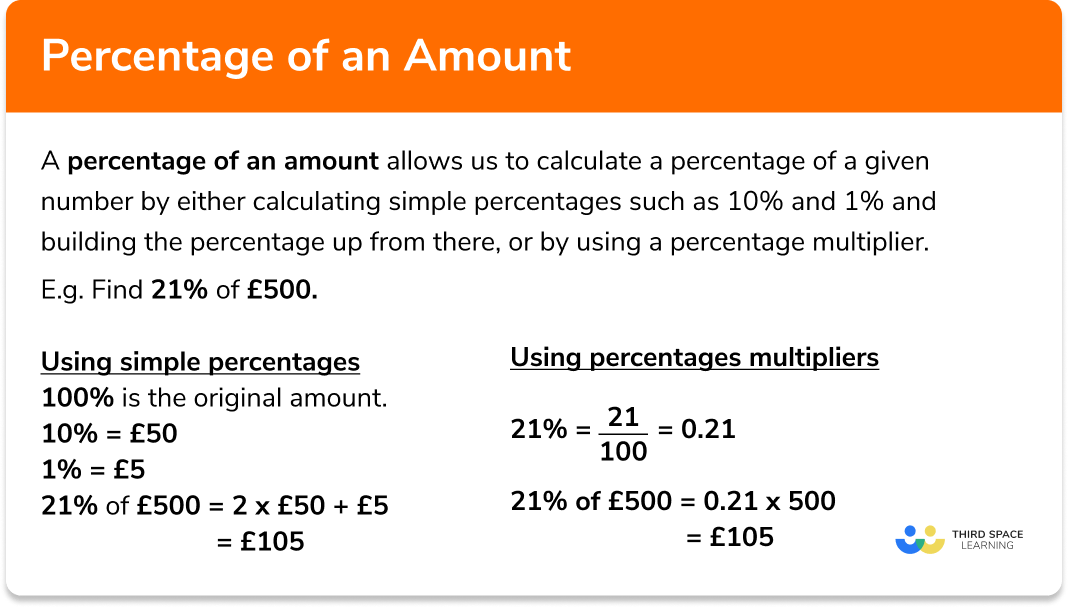
Finding a Percentage Of a Number (e.g., Discounts, Taxes)
This is perhaps the most common percentage calculation. You need to find a specific portion of a given total.
Formula: Percentage (as a decimal) x Whole Amount = Part
Examples:
- Discount: You see an item for $200 with a 15% discount. How much is the discount?
- 0.15 x $200 = $30. The discount is $30, so you pay $200 – $30 = $170.
- Sales Tax: Your bill is $50, and the sales tax is 8%. How much tax do you pay?
- 0.08 x $50 = $4. You pay $4 in tax, for a total of $54.
- Commission: You earn a 7% commission on a $10,000 sale. How much do you earn?
- 0.07 x $10,000 = $700.
Determining One Number As a Percentage Of Another (e.g., Profit Margins, ROI)
This calculation helps you understand what proportion one value represents in relation to another larger value.
Formula: (Part / Whole Amount) x 100 = Percentage
Examples:
- Profit Margin: A product costs you $50 to make and sells for $80. What is your gross profit margin?
- Profit = $80 – $50 = $30.
- ($30 / $80) x 100 = 37.5%. Your gross profit margin is 37.5%.
- Return on Investment (ROI): You invested $1,000 and gained $150. What is your ROI?
- ($150 / $1,000) x 100 = 15%.
- Budgeting Share: Your monthly income is $4,000, and your rent is $1,200. What percentage of your income goes to rent?
- ($1,200 / $4,000) x 100 = 30%.
Calculating Percentage Change: Growth, Decline, and Inflation
Understanding how values change over time is vital for financial analysis, from tracking investment growth to assessing inflation or depreciation.
Formula: ((New Value - Old Value) / Old Value) x 100 = Percentage Change
Examples:
- Investment Growth: Your stock went from $100 to $120. What is the percentage increase?
- (($120 – $100) / $100) x 100 = (20 / 100) x 100 = 20%.
- Price Decline: A car’s value dropped from $30,000 to $25,000. What is the percentage decrease?
- (($25,000 – $30,000) / $30,000) x 100 = (-$5,000 / $30,000) x 100 = -16.67%.
- Inflation: If the price of goods increased by 3% last year, and something cost $100, it now costs $103.
Working Backwards: Finding the Original Value After a Percentage Adjustment
Sometimes you know the final value after a discount or a tax, and you need to find the original amount.
Formula for Discounted Price: Original Price = Final Price / (1 - Discount Percentage as a decimal)
Formula for Price Including Tax: Original Price = Final Price / (1 + Tax Percentage as a decimal)
Examples:
- Pre-Discount Price: You bought a shirt for $40 after a 20% discount. What was the original price?
- Original Price = $40 / (1 – 0.20) = $40 / 0.80 = $50.
- Pre-Tax Price: Your total bill, including 7% sales tax, was $107. What was the price before tax?
- Original Price = $107 / (1 + 0.07) = $107 / 1.07 = $100.
Practical Applications of Percentages in Personal Finance
Percentages are not abstract concepts; they are the gears that drive your personal financial engine.
Budgeting and Financial Planning: The 50/30/20 Rule and Beyond
Budgeting is fundamentally about allocating percentages of your income. The popular 50/30/20 rule suggests:
- 50% of income for Needs (housing, utilities, groceries).
- 30% for Wants (dining out, entertainment).
- 20% for Savings and Debt Repayment.
This rule, or any personalized budget, relies heavily on calculating percentages of your take-home pay to ensure financial stability and growth. Debt-to-income ratio, a key metric for lenders, is also a percentage, assessing your ability to manage monthly payments.
Understanding Savings, Investments, and Compound Interest
- Savings Rate: How much of your income are you saving? A high savings rate (e.g., 15-20% or more) accelerates wealth accumulation.
- Investment Returns: Investment performance is almost always quoted as a percentage (e.g., “The S&P 500 returned 10% last year”).
- Compound Interest: The “eighth wonder of the world,” compound interest allows your money to grow exponentially. If you earn 5% interest per year, that 5% is calculated not just on your initial principal but also on the accumulated interest from previous years. Understanding this percentage growth is key to long-term wealth building.
- Portfolio Allocation: Deciding what percentage of your investment portfolio should be in stocks, bonds, or other assets is a critical risk management strategy.
Navigating Loans, Debts, and Interest Rates
- Annual Percentage Rate (APR): This is the true cost of borrowing money over a year, expressed as a percentage. Comparing APRs is crucial when shopping for loans or credit cards.
- Interest Payments: The interest portion of your loan payment is a percentage of your outstanding principal.
- Debt Repayment Strategy: Deciding to pay off the debt with the highest interest rate first (the “debt avalanche” method) is a percentage-driven decision to minimize total interest paid.
Deconstructing Taxes: From Income to Sales
- Income Tax Brackets: Your income is taxed at different percentage rates depending on how much you earn. Understanding your marginal and effective tax rates requires percentage calculations.
- Sales Tax, Property Tax, Capital Gains Tax: All these are percentages applied to various financial transactions or assets. Knowing how to calculate them ensures you fulfill your obligations and can budget accordingly.
Percentages in Business Finance and Wealth Building
For entrepreneurs, investors, and business owners, percentages are the vital signs of financial health and operational efficiency.
Analyzing Profitability: Gross vs. Net Profit Margins
- Gross Profit Margin:
(Gross Profit / Revenue) x 100. This percentage indicates how much profit a company makes from its sales after accounting for the direct costs of production. - Net Profit Margin:
(Net Profit / Revenue) x 100. This is the ultimate measure of a company’s profitability, showing how much profit is left after all expenses (including operating costs, interest, and taxes) have been deducted from revenue. These percentages are critical for assessing a business’s efficiency and pricing strategies.
Understanding Commission Structures and Royalties
Many compensation models, particularly in sales, real estate, and creative industries, are based on percentages.
- Sales Commissions: A salesperson might earn a 10% commission on every sale. Calculating this percentage directly impacts their take-home pay.
- Royalties: Authors, artists, and inventors often receive a percentage of the sales generated by their work. Understanding these percentage structures is key to projecting income.
Equity Ownership and Business Valuation
- Equity Share: When you invest in a company or start one with partners, your ownership stake is typically expressed as a percentage (e.g., “I own 25% of the company”). This percentage dictates your share of profits, voting rights, and eventual sale proceeds.
- Dilution: As companies raise more capital, new shares are issued, potentially reducing the percentage ownership of existing shareholders – a critical concept in venture capital and startups.
Performance Metrics: Tracking Business Growth and Efficiency
Businesses use a myriad of percentage-based metrics to track performance:
- Revenue Growth:
((Current Revenue - Previous Revenue) / Previous Revenue) x 100. - Customer Retention Rate: The percentage of customers a business retains over a period.
- Market Share: The percentage of a total market controlled by a specific company.
- Operating Expense Ratio: Operating expenses as a percentage of revenue, indicating efficiency.
These percentages provide actionable insights, guiding strategic decisions and operational improvements.
Leveraging Tools and Avoiding Common Percentage Pitfalls
While percentages are powerful, miscalculations or misinterpretations can lead to significant financial errors.
Essential Tools for Percentage Calculations: Calculators and Spreadsheets
- Basic Calculators: For simple “part of a whole” or percentage change calculations, a standard calculator is sufficient.
- Spreadsheets (Excel, Google Sheets): For more complex financial modeling, budgeting, or business analysis, spreadsheets are invaluable. They allow you to set up formulas once and apply them to large datasets, recalculating instantly when values change. They also provide functions for common financial calculations.
- Online Calculators: Many websites offer specialized calculators for mortgage payments, compound interest, tax estimations, and more, simplifying complex percentage-based scenarios.
Common Errors to Sidestep When Dealing with Percentages
- Incorrect Base: Always ensure you’re calculating the percentage of the correct base number. For instance, a 10% discount followed by a 10% increase does not get you back to the original price if the base for the increase is the discounted price.
- Example: $100 – 10% = $90. $90 + 10% = $99, not $100.
- Confusing Absolute vs. Relative Change: A 5% increase in a $1,000 portfolio is $50, while a 5% increase in a $1,000,000 portfolio is $50,000. Both are “5%,” but the absolute impact differs significantly.
- Ignoring Compounding: Underestimating the power of compound interest (or debt) by not fully grasping how percentages accumulate over time.
- Rounding Errors: Rounding too early in multi-step calculations can lead to inaccuracies.
- Misinterpreting Averages: An average percentage doesn’t always reflect individual components accurately.

The Importance of Context and Base Values
The most crucial aspect of percentage calculation in finance is understanding the context and the base value. A “2% rise” sounds small, but if it’s 2% of a national GDP, it’s enormous. If it’s a 2% rise in a tiny stock, it might be negligible. Always ask: “Percentage of what?” The base value dictates the absolute significance of any percentage figure.
In conclusion, the ability to calculate and interpret percentages is a cornerstone of financial literacy and success. Whether you’re managing your personal budget, evaluating an investment opportunity, understanding a loan, or steering a business, mastering these calculations will empower you to make smarter, more confident financial decisions. Embrace percentages as your trusted allies in navigating the intricate world of money.
aViewFromTheCave is a participant in the Amazon Services LLC Associates Program, an affiliate advertising program designed to provide a means for sites to earn advertising fees by advertising and linking to Amazon.com. Amazon, the Amazon logo, AmazonSupply, and the AmazonSupply logo are trademarks of Amazon.com, Inc. or its affiliates. As an Amazon Associate we earn affiliate commissions from qualifying purchases.