
In the world of personal finance, investing, and business, numbers tell a story. They reveal growth, stagnation, or decline, and understanding how to interpret these figures is paramount to making informed decisions. One of the most fundamental yet powerful calculations is determining the percent increase between two numbers. Whether you’re tracking your investment portfolio, evaluating salary raises, monitoring business revenue, or simply trying to understand the change in your monthly expenses, mastering this concept is an indispensable financial skill.
This article will delve into the mechanics of calculating percent increase, explore its multifaceted applications across various financial domains, and discuss how to leverage this insight to enhance your financial literacy and decision-making.
The Core Formula: Understanding Percent Increase
At its heart, percent increase is a measure of relative change. It quantifies how much a value has grown in proportion to its initial state, expressed as a percentage. Unlike a simple difference, which only tells you the absolute change, percent increase provides context, making it easier to compare growth across different scales.
Why Percent Increase Matters in Finance
Imagine an investment that grew by $100. Is that good? It depends. If your initial investment was $1,000, a $100 increase represents a 10% gain, which is significant. If your initial investment was $100,000, a $100 increase is a mere 0.1% gain, hardly impressive. Percent increase gives you this crucial context, allowing for meaningful comparisons and evaluations of performance, regardless of the absolute values involved. It helps you answer questions like:
- How much did my salary really grow this year?
- What was the actual return on my stock investment?
- Did my business’s revenue grow at a sustainable rate?
- How much more expensive is my grocery bill compared to last month?
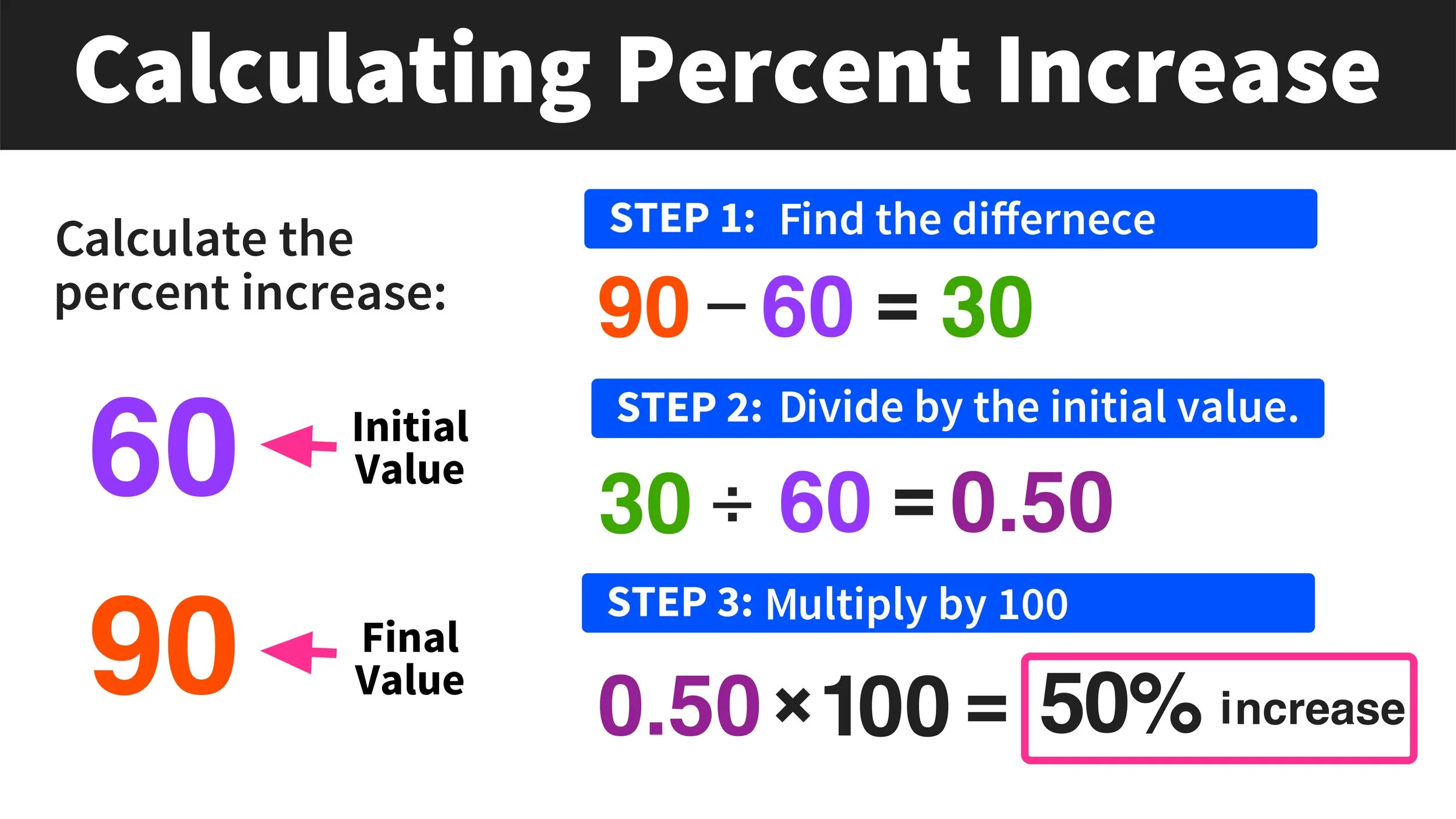
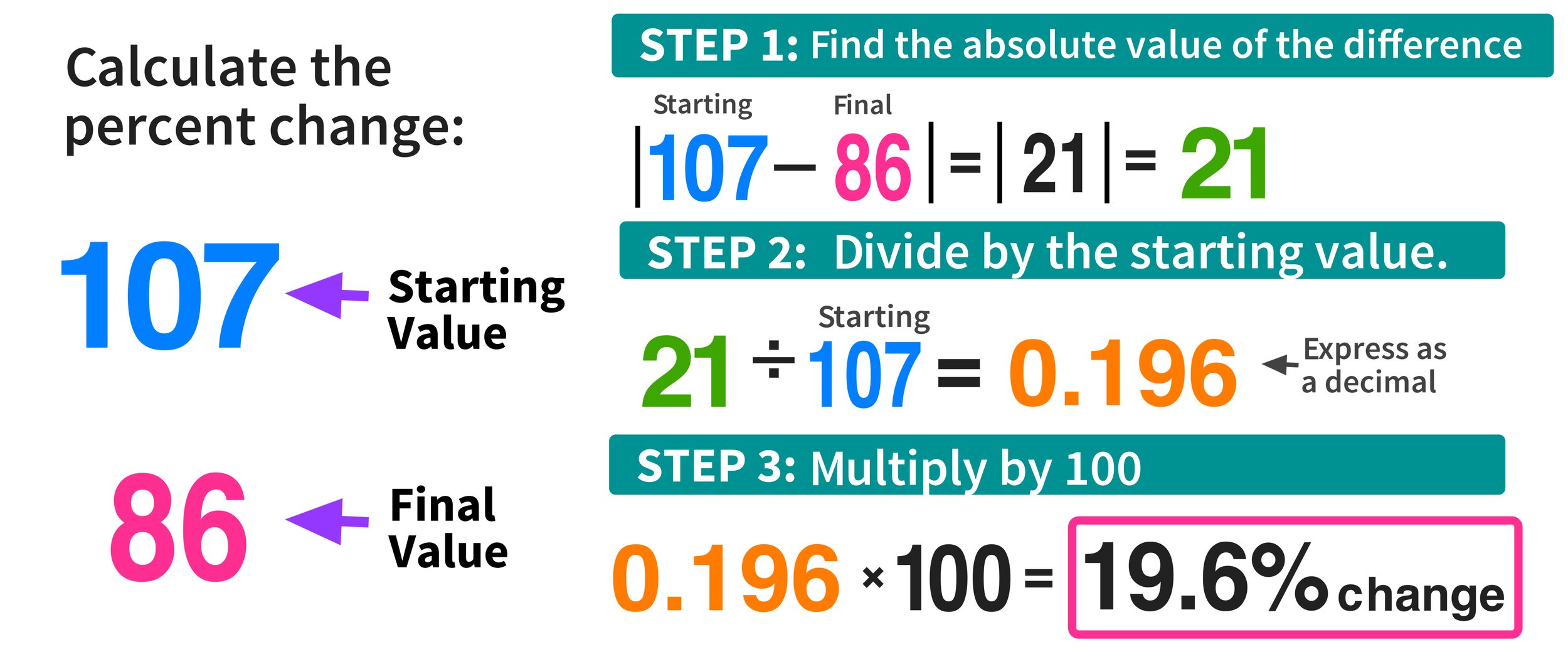
Deconstructing the Formula: (New Value – Old Value) / Old Value * 100%
The formula for percent increase is straightforward and intuitive once broken down:
- Find the Difference: Subtract the old value from the new value. This gives you the absolute amount of increase.
- Absolute Increase = New Value – Old Value
- Calculate the Relative Increase: Divide the absolute increase by the old value. This tells you what fraction of the old value the increase represents.
- Relative Increase = (New Value – Old Value) / Old Value
- Convert to Percentage: Multiply the relative increase by 100. This converts the fraction or decimal into a percentage, making it easier to interpret.
- Percent Increase = [(New Value – Old Value) / Old Value] * 100%
Let’s illustrate with a simple example: Suppose your savings account had $5,000 at the beginning of the year and now has $5,300.
- New Value = $5,300
- Old Value = $5,000
- Absolute Increase = $5,300 – $5,000 = $300
- Relative Increase = $300 / $5,000 = 0.06
- Percent Increase = 0.06 * 100% = 6%
Your savings grew by 6% over the year.
A Simple Example: Tracking Personal Savings
Applying this to personal finance, imagine you set a goal to increase your emergency fund.
- Last year, your emergency fund balance was $10,000.
- This year, through diligent saving, it’s grown to $12,500.
Using the formula:
- Percent Increase = [($12,500 – $10,000) / $10,000] * 100%
- Percent Increase = [$2,500 / $10,000] * 100%
- Percent Increase = 0.25 * 100% = 25%
This 25% increase clearly shows significant progress towards your financial security, providing a much clearer picture than just knowing you saved an extra $2,500.
Applications in Personal Finance: Growing Your Wealth
Percent increase is a ubiquitous tool in personal finance, enabling individuals to monitor their financial health and progress toward their goals.
Monitoring Salary Increases and Compensation Growth
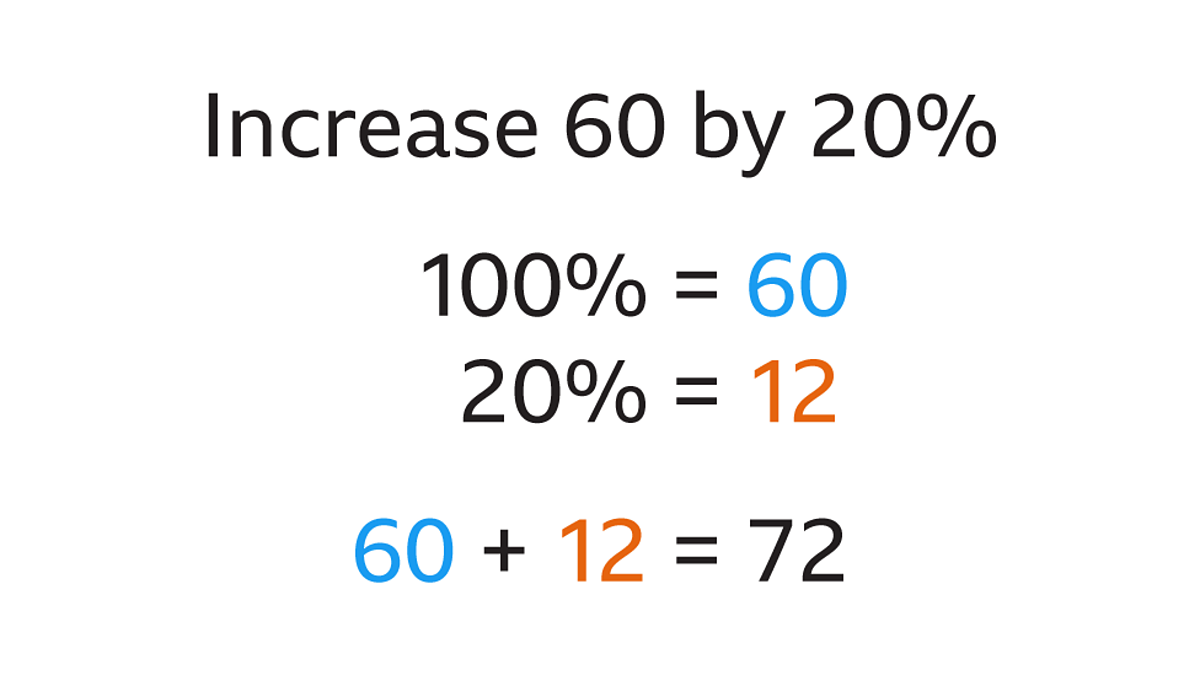
When you receive a pay raise, understanding the percentage increase allows you to evaluate its impact on your overall financial picture. A $5,000 raise on a $50,000 salary is a 10% increase, which is quite substantial. The same $5,000 raise on a $150,000 salary is only a 3.33% increase. This distinction helps you negotiate effectively, compare job offers, and assess your earning power over time. It also helps you gauge if your income is growing faster than inflation, which is crucial for maintaining purchasing power.
Assessing Expense Changes and Budgeting Effectively
Just as income can increase, so can expenses. Tracking the percent increase in categories like groceries, utilities, housing, or transportation costs is vital for effective budgeting. If your grocery bill jumped from $500 to $600 in a month, that’s a 20% increase. Identifying such spikes allows you to investigate the cause (e.g., inflation, changed habits, new subscriptions) and adjust your spending habits to stay within your budget. Understanding these percentage shifts can highlight areas where you might need to cut back or find more economical alternatives.
Evaluating Savings Account Interest and Emergency Fund Growth
Banks often advertise interest rates as a percentage. When your savings account earns interest, you can calculate the percent increase of your balance over time to confirm the effective rate or to see how compounding interest is working for you. For an emergency fund, regularly calculating its growth rate helps you confirm you’re on track to reach your target balance or highlight if your contributions or interest earnings are lagging.
Investing and Business Finance: Measuring Performance and Profitability
In the realms of investing and business, percent increase transforms into a critical metric for evaluating performance, profitability, and return on investment.
Analyzing Stock Market Returns and Portfolio Appreciation
Investors constantly use percent increase to measure the performance of individual stocks, mutual funds, or their entire portfolio. If you bought shares for $1,000 and they are now worth $1,250, that’s a 25% return on your investment. This metric is fundamental for comparing different investment opportunities, assessing the effectiveness of your investment strategy, and understanding your capital appreciation. For instance, comparing a 15% annual return on one fund versus a 7% return on another clearly indicates which performed better, regardless of the initial investment amounts. This is also how annualized returns are calculated, allowing for comparisons of investments held for different durations.
Tracking Business Revenue and Profit Growth
For businesses, percent increase is a cornerstone of financial reporting and strategic planning. Companies regularly track the percent increase in:
- Revenue: How much did sales grow this quarter compared to last quarter, or this year compared to last year? A strong percent increase in revenue signals market acceptance and business expansion.
- Gross Profit: The percentage growth of profit after deducting the cost of goods sold indicates pricing power and production efficiency.
- Net Profit: The bottom line percent increase tells stakeholders how effectively the company is turning revenue into profit after all expenses, including taxes, are accounted for.
These percentages are crucial for investors, managers, and employees to gauge the health and trajectory of the business. A consistent, healthy percent increase in these metrics often signals a well-managed and growing enterprise.
Understanding ROI (Return on Investment) and Project Viability
Return on Investment (ROI) is essentially a percent increase calculation, fundamental for evaluating the profitability of an investment or a project.
- ROI = [(Net Profit from Investment – Cost of Investment) / Cost of Investment] * 100%
Businesses use ROI to decide which projects to pursue, which marketing campaigns are effective, or whether a new piece of equipment is a worthwhile expenditure. If a new software system costs $10,000 but generates an additional $12,000 in net profit over its lifespan, the ROI is 20%. This clear percentage helps decision-makers allocate capital efficiently and prioritize initiatives that offer the highest financial returns.
Leveraging Tools for Financial Calculations
While the formula for percent increase is simple, in the complex world of finance, tools can streamline calculations and enhance accuracy.
Spreadsheet Power: Excel and Google Sheets for Automation
For managing personal budgets, tracking investments, or analyzing business financials, spreadsheets like Microsoft Excel or Google Sheets are invaluable. You can easily set up columns for ‘Old Value’ and ‘New Value’ and then use a simple formula to calculate the percent increase.
For example, if A2 contains the Old Value and B2 contains the New Value, the formula in C2 would be:
=(B2-A2)/A2*100
This allows for quick calculations across many data points, making it easy to track trends over time for multiple financial categories or investment holdings without repetitive manual calculations.
Financial Calculators and Online Tools for Quick Insights
Many dedicated financial calculators, both physical and online, can compute percent change with a few inputs. Websites offering financial tools often include percent change calculators specifically for investors or budgeters. These are useful for quick, ad-hoc calculations without needing to open a spreadsheet. While simple, they provide immediate results and can serve as a quick check for your manual calculations.
The Importance of Accurate Data Entry
Regardless of the tool used, the accuracy of your percent increase calculation hinges entirely on the accuracy of your input data. A typo in an old value or a mistaken new value will lead to an incorrect percentage, potentially misleading your financial analysis. Always double-check your figures, especially when dealing with significant financial decisions.
Beyond the Basics: Interpreting and Acting on Percent Increase
Calculating percent increase is just the first step. The true value lies in understanding what that percentage signifies and how it should influence your financial actions.
Differentiating Between Real vs. Nominal Growth (Considering Inflation)
A 5% increase in your salary sounds great, but if inflation was 3% during the same period, your real increase in purchasing power is only about 2%. This concept of real vs. nominal growth is critical in long-term financial planning, especially for investments and retirement savings. Always consider the inflation rate to understand the true impact of any financial growth. Nominal growth is the raw, unadjusted percentage increase, while real growth accounts for the erosion of purchasing power due to inflation.
Benchmarking Against Financial Goals and Market Averages
A 10% return on an investment might seem good, but how does it compare to your financial goals or market benchmarks? If your goal was a 15% return, then 10% indicates you fell short. If the broader market (e.g., S&P 500) returned only 5% during the same period, then your 10% return is outstanding. Benchmarking provides context and helps you assess performance relative to expectations and external factors. This applies equally to personal finance: is your savings growth rate sufficient to meet a down payment goal by a certain date?
Making Informed Decisions Based on Growth Trends
Consistent tracking of percent increase allows you to identify trends. Is your income consistently growing faster than your expenses? Are your investments consistently outperforming market averages? Or are certain expense categories growing disproportionately? These trends inform strategic decisions:
- If investment A consistently shows a higher percent increase than investment B, you might reallocate capital.
- If a particular business expense is consistently increasing at a high rate, it signals a need to investigate cost-cutting measures.
- If your income growth is stagnating, it might prompt you to seek new skills or career opportunities.
Ultimately, the ability to calculate and interpret percent increase empowers you to take control of your financial narrative. It transforms raw numbers into actionable insights, guiding you towards smarter financial planning, more profitable investments, and greater overall financial well-being. By embracing this fundamental mathematical tool, you equip yourself with a clearer lens through which to view and navigate your financial journey.
aViewFromTheCave is a participant in the Amazon Services LLC Associates Program, an affiliate advertising program designed to provide a means for sites to earn advertising fees by advertising and linking to Amazon.com. Amazon, the Amazon logo, AmazonSupply, and the AmazonSupply logo are trademarks of Amazon.com, Inc. or its affiliates. As an Amazon Associate we earn affiliate commissions from qualifying purchases.