
In the dynamic world of finance, where numbers tell stories of growth, decline, and opportunity, understanding how to calculate percentage increase is not just a mathematical exercise—it’s a fundamental skill. From evaluating investment performance and tracking personal savings growth to analyzing business profitability and market trends, the ability to quantify change in relative terms provides unparalleled clarity and insight. Unlike absolute differences, which can be misleading without context, percentage increase offers a standardized metric, revealing the true magnitude of change in proportion to the initial value. This article delves into the indispensable role of percentage increase within the financial realm, dissecting its calculation, exploring its myriad applications, and equipping you with the knowledge to leverage this powerful tool for smarter financial decision-making.
The Fundamental Importance of Percentage Increase in Finance
At its core, percentage increase is a yardstick for measuring progress and change. In finance, where decisions are often driven by comparisons over time or against benchmarks, this metric becomes incredibly potent. It allows individuals, investors, and businesses to move beyond raw figures and grasp the true scale of growth.
Understanding Growth and Decline
Financial narratives are rarely static. Income levels fluctuate, investment portfolios expand or contract, and business revenues rise and fall. Percentage increase provides a consistent framework to understand these shifts. For instance, knowing that your investment portfolio grew by $1,000 might sound good, but knowing it grew by 15% tells you much more about its performance relative to its initial value, and potentially compared to market averages or inflation. Similarly, a 5% increase in operational costs can highlight efficiency issues more acutely than a mere dollar figure. It normalizes the comparison, making it easier to see what areas are thriving and which need attention.
Making Informed Financial Decisions
Every financial decision, from allocating funds to different asset classes to adjusting a monthly budget, benefits from a solid understanding of growth rates. When considering a salary raise offer, a 7% increase provides clear insight into how your purchasing power might change, far more so than just the additional dollar amount. For entrepreneurs, understanding the percentage increase in customer acquisition costs or conversion rates is critical for optimizing marketing spend and scaling operations effectively. Investors rely on percentage increase to compare the historical returns of various stocks, bonds, or mutual funds, allowing them to make data-driven choices about where to place their capital for maximum potential growth.
Benchmarking Performance
Percentage increase serves as a critical benchmarking tool across all financial sectors. Individuals can benchmark their savings growth against inflation rates or personal financial goals. Investment managers routinely compare their portfolio’s percentage increase against industry benchmarks like the S&P 500 to demonstrate their performance. Businesses use it to measure market share growth against competitors, or to track year-over-year revenue growth against industry averages. Without this standardized measure, comparing disparate financial entities or time periods would be a complex and often misleading endeavor, hindering effective performance evaluation and strategic planning.
The Core Formula: Deconstructing Percentage Increase
The beauty of calculating percentage increase lies in its simplicity, yet its application unlocks profound financial insights. The formula is straightforward and universally applicable.
Step-by-Step Calculation for Financial Scenarios
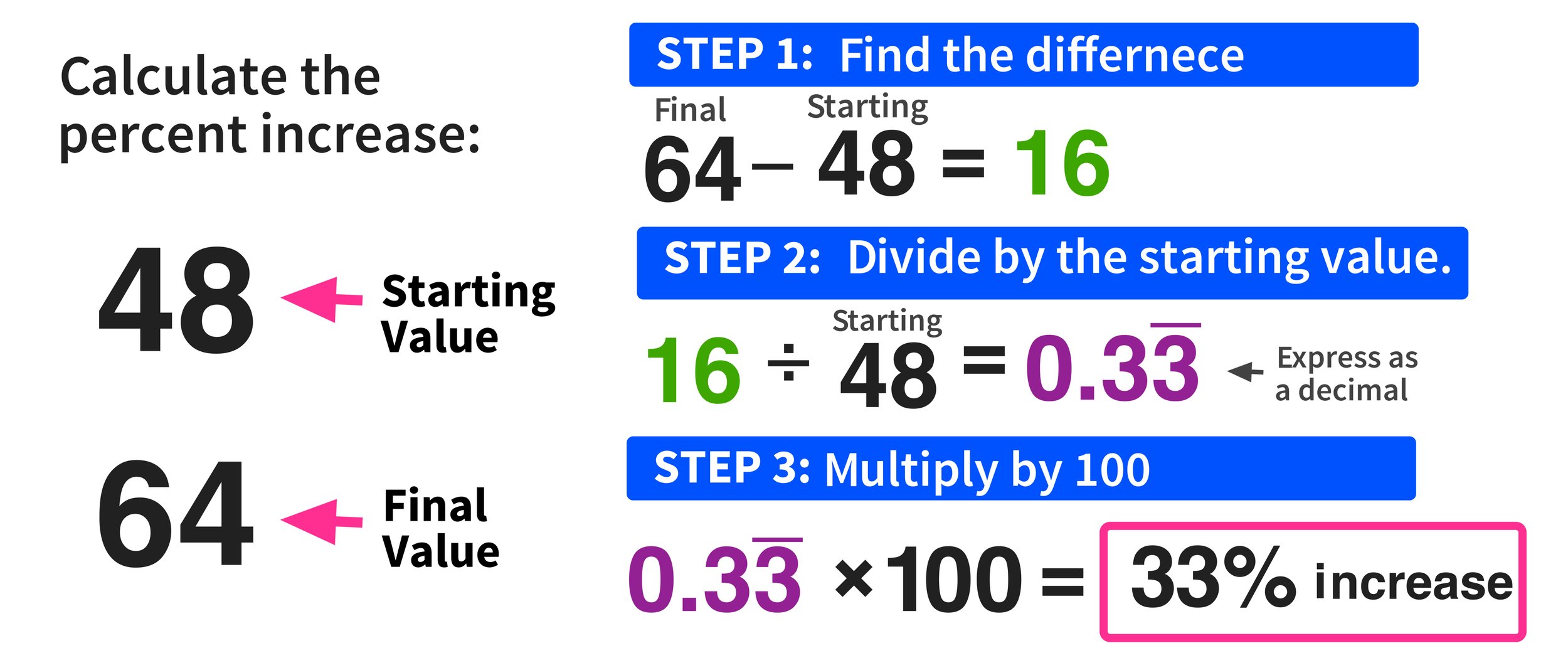
To find the percentage increase between two numbers, you need two values: an “original” or “starting” number and a “new” or “ending” number. The process involves three simple steps:
- Find the Difference: Subtract the original number from the new number. This gives you the absolute amount of increase.
Difference = New Number - Original Number
- Divide by the Original Number: Divide the difference by the original number. This converts the absolute increase into a decimal representation of the increase relative to the starting point.
Relative Increase = Difference / Original Number
- Multiply by 100: Multiply the result by 100 to express it as a percentage.
Percentage Increase = (Relative Increase) * 100
Combined, the formula is:
Percentage Increase = ((New Number - Original Number) / Original Number) * 100
Illustrative Examples: Personal Finance & Investments
Let’s bring this formula to life with practical financial examples:
-
Personal Savings: Imagine your savings account balance was $5,000 at the start of the year and grew to $5,750 by year-end.
- Difference = $5,750 – $5,000 = $750
- Relative Increase = $750 / $5,000 = 0.15
- Percentage Increase = 0.15 * 100 = 15%
Your savings grew by 15%.
-
Investment Portfolio: Suppose an initial investment of $10,000 in a stock portfolio is now worth $12,500.
- Difference = $12,500 – $10,000 = $2,500
- Relative Increase = $2,500 / $10,000 = 0.25
- Percentage Increase = 0.25 * 100 = 25%
Your investment yielded a 25% return.
These examples clearly demonstrate how a single, digestible percentage can convey significant financial performance at a glance.
Common Pitfalls to Avoid
While the calculation is straightforward, several common errors can lead to misinterpretations:
- Using the Wrong Base Number: Always divide by the original or starting number. Dividing by the new number will yield an incorrect percentage change. For instance, if a stock went from $100 to $150, the increase is 50%. If you mistakenly divided by $150, you’d get 33.33%, which is incorrect for an increase from $100.
- Confusing Increase with Decrease: The same formula can be used for percentage decrease; the result will simply be a negative percentage. However, it’s crucial to correctly identify whether you’re looking for an increase or decrease. When the “new number” is smaller than the “original number,” the result will naturally be negative, indicating a decrease.
- Ignoring Contextual Factors: A 10% increase in profit sounds great, but if inflation was 8% during the same period, the real (inflation-adjusted) increase is much smaller. Always consider external factors that might influence the perceived value of a percentage increase.
Practical Applications Across the Financial Spectrum

The utility of percentage increase extends far beyond simple calculations, permeating every facet of financial analysis and planning.
Personal Finance: Tracking Income, Expenses, and Savings
For individuals, percentage increase is a powerful tool for managing personal finances. You can track:
- Income Growth: Monitor your salary increases year-over-year. A 5% annual raise might feel modest, but understanding its percentage value helps in long-term financial planning and negotiation.
- Expense Inflation: Calculate how much specific expenses, like groceries or utilities, have increased over time. This helps in budgeting and identifying areas where cost-cutting might be necessary.
- Savings Growth: As shown earlier, tracking the percentage growth of your savings or emergency fund provides a clear picture of how effectively your money is compounding or how close you are to reaching a financial goal.
Investing: Measuring Returns and Portfolio Growth
In the investment world, percentage increase is the lingua franca for performance measurement:
- Return on Investment (ROI): The most common application. It tells you the profitability of an investment relative to its cost. If you invested $1,000 and it’s now worth $1,200, you have a 20% ROI.
- Portfolio Performance: Investors regularly calculate the percentage increase of their entire portfolio over various periods (monthly, quarterly, annually) to assess its overall health and compare it against market benchmarks or personal targets.
- Stock/Asset Appreciation: Understanding the percentage increase in a stock’s value over time is crucial for evaluating its historical performance and potential for future growth.
Business Finance: Analyzing Sales, Profit, and Market Share
Businesses leverage percentage increase for critical strategic and operational insights:
- Sales Growth: A fundamental metric for business health. Tracking month-over-month or year-over-year sales percentage increase indicates market demand, marketing effectiveness, and overall business momentum.
- Profitability Analysis: Calculating the percentage increase in net profit or gross profit margins helps assess operational efficiency and pricing strategies. A higher percentage increase in profit often signifies better cost management or increased revenue generation.
- Market Share: Businesses measure the percentage increase in their share of the total market to understand their competitive position and growth trajectory within their industry.
- Cost Control: Monitoring the percentage increase in operational costs helps identify inefficiencies or escalating expenses that need to be addressed.
Online Income & Side Hustles: Scaling Your Ventures
Even for those pursuing online income or managing side hustles, percentage increase is invaluable:
- Website Traffic Growth: If your blog traffic went from 10,000 visitors to 15,000 visitors, that’s a 50% increase—a clear indicator of content effectiveness or SEO improvements.
- Revenue from Digital Products: Tracking the percentage increase in sales of an e-book or online course can validate marketing efforts and product market fit.
- Freelance Income: Analyzing the percentage increase in your monthly or quarterly freelance earnings helps you set higher rates, acquire more clients, or diversify your income streams.
- Conversion Rates: For e-commerce or lead generation, monitoring the percentage increase in visitors who convert into customers provides direct feedback on the effectiveness of your sales funnel.
Beyond the Basics: Interpreting and Leveraging Percentage Increase
While calculating percentage increase is straightforward, truly harnessing its power requires a nuanced understanding of its interpretation and application.
Annualized Growth Rates vs. Period-Specific Increases
It’s crucial to distinguish between a one-time, period-specific percentage increase and an annualized growth rate. A stock that jumped 10% in one month might seem impressive, but to compare it fairly with an investment that yielded 12% over a year, you’d need to annualize the monthly gain. Annualized growth rates (like Compound Annual Growth Rate – CAGR) provide a standardized way to compare investments over different timeframes, offering a clearer picture of consistent performance. Financial decisions often benefit more from understanding sustainable annual growth than from volatile short-term spikes.
The Impact of Compounding
Percentage increase is the engine of compounding, particularly in investments and savings. When you earn a percentage increase on an initial amount, and then subsequently earn a percentage increase on that new, larger amount (original + first increase), you’re experiencing compounding. Understanding how a seemingly small annual percentage increase, like 7% on an investment, can lead to substantial wealth accumulation over decades is a cornerstone of long-term financial planning. It highlights the importance of consistent saving and early investing.
Using Percentage Increase for Forecasting and Goal Setting
Looking backward at past percentage increases provides critical data for looking forward. Businesses use historical sales growth percentages to forecast future revenues. Individuals can project their savings growth based on their current contribution rate and expected annual returns. This forward-looking application of percentage increase is essential for:
- Financial Goal Setting: If you want to double your savings in five years, you can use the percentage increase formula in reverse to determine the average annual percentage return you need to achieve.
- Budgeting and Planning: Understanding the historical percentage increase in your living expenses can help you create more realistic budgets for the future, accounting for inflation.
- Strategic Business Planning: Projecting market share growth or profit increases based on achievable percentage targets is fundamental to developing sound business strategies.
Tools and Technologies for Seamless Calculation
While manual calculation is simple, modern financial management is often augmented by technology that automates these computations, reducing error and enhancing efficiency.
Spreadsheet Software (Excel, Google Sheets)
Spreadsheet programs like Microsoft Excel and Google Sheets are indispensable financial tools. They allow users to quickly calculate percentage increases across large datasets. With simple formulas (=(New_Value - Original_Value) / Original_Value), you can track hundreds of metrics, visualize trends, and even create dashboards that automatically update. These platforms are crucial for detailed budgeting, investment tracking, and business financial analysis, enabling complex scenario planning and “what-if” analyses based on various percentage growth assumptions.

Online Calculators and Financial Apps
For quick, ad-hoc calculations, a plethora of online percentage increase calculators and financial apps are available. These tools are perfect for immediate insights without setting up a full spreadsheet. Many personal finance apps also automatically track and display percentage increases for your income, expenses, and investment accounts, providing real-time financial health checks right at your fingertips. From assessing the growth of your crypto portfolio to understanding the yield on a bond, these digital aids make financial analysis accessible to everyone.
In conclusion, the ability to find and interpret percentage increase between two numbers is far more than a mathematical skill; it is a vital financial competency. Whether you are managing your personal wealth, making investment decisions, or steering a business, this fundamental calculation provides the clarity and context necessary to understand financial performance, benchmark progress, and make informed choices that drive growth and prosperity. By mastering this simple yet powerful tool, you unlock a deeper understanding of the financial world around you.
aViewFromTheCave is a participant in the Amazon Services LLC Associates Program, an affiliate advertising program designed to provide a means for sites to earn advertising fees by advertising and linking to Amazon.com. Amazon, the Amazon logo, AmazonSupply, and the AmazonSupply logo are trademarks of Amazon.com, Inc. or its affiliates. As an Amazon Associate we earn affiliate commissions from qualifying purchases.