
In the landscape of personal finance, the ability to calculate and understand “percent off” is more than a simple shopping skill; it is a fundamental pillar of financial literacy. Whether you are managing a household budget, calculating the ROI of a business investment, or simply trying to navigate a seasonal sale, understanding the mechanics of discounts allows you to make informed decisions that preserve your capital. To find “percent off” is to master the art of value assessment, ensuring that every dollar spent is optimized for maximum purchasing power.

The Fundamentals of Percentage-Based Savings
At its core, calculating a discount is a straightforward mathematical exercise, yet many consumers find themselves overwhelmed by the pressure of quick decision-making in a retail environment. Understanding the underlying formula is the first step toward financial confidence.
Understanding the “Percent Off” Formula
To find the amount of money you are saving (the discount), the standard formula is:
Original Price × (Discount Rate / 100) = Savings Amount
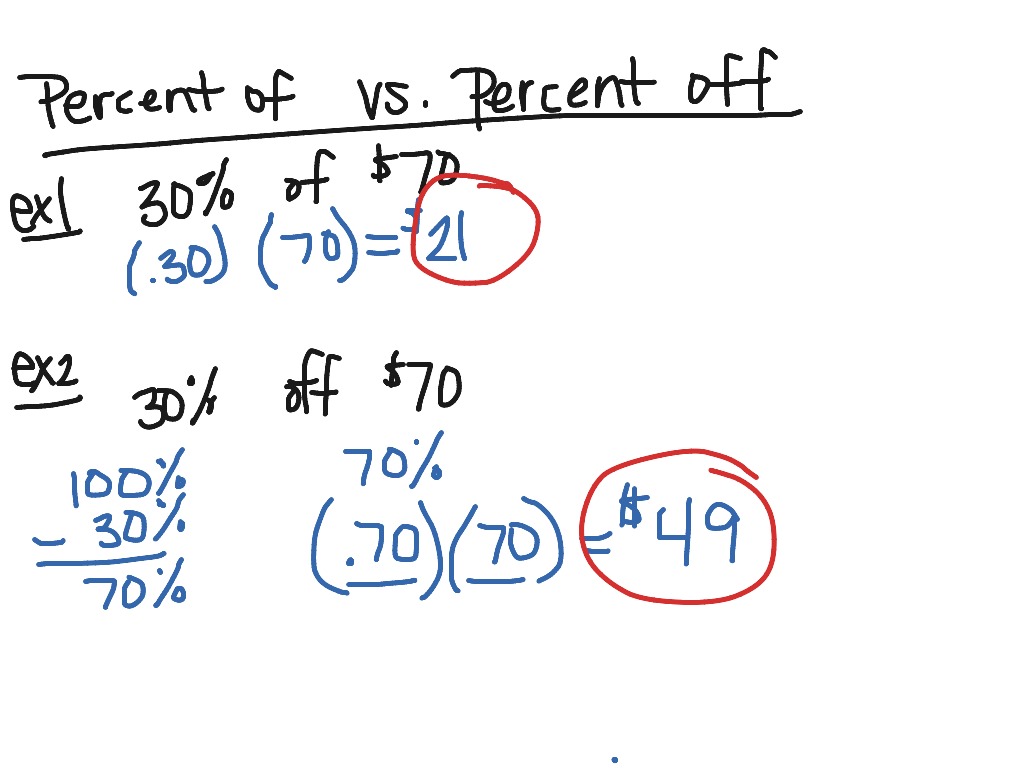
To find the final price you will pay, you subtract that savings amount from the original price. Alternatively, you can calculate the “complement” of the discount. For example, if an item is 30% off, you are paying 70% of the original price. Multiplying the original price by 0.70 gives you the final cost in one single step. This method is often preferred by financial analysts because it focuses on the cash outflow—the most critical metric in any budget.
Mental Math Shortcuts for Quick Savings Estimation
In a fast-paced environment, you may not always have a calculator handy. Mastering mental math shortcuts is a hallmark of a savvy financial mind. The most effective method is the “10% Rule.”
- Find 10%: Move the decimal point one place to the left. For an item costing $85.00, 10% is $8.50.
- Scale up or down: If the discount is 20%, double the 10% figure ($17.00). If it is 5%, halve it ($4.25).
- Combine: For a 15% discount, add the 10% and the 5% figures together ($8.50 + $4.25 = $12.75).
By internalizing these shortcuts, you transform from a passive consumer into an active auditor of your own expenses, capable of verifying advertised savings in real-time.
Advanced Strategies for Strategic Consumerism
Finding a percentage off is only beneficial if the purchase aligns with your broader financial goals. Strategic consumerism involves looking beyond the red “Sale” tag to evaluate the true economic impact of a transaction.
The Difference Between Discount and Value
A common pitfall in personal finance is the “false savings” trap. If a luxury watch is discounted by 50% from $2,000 to $1,000, you have not “saved” $1,000; you have spent $1,000. If that $1,000 was not already allocated in your budget for a timepiece, the “percent off” served as a catalyst for unnecessary capital depletion.
True value is found when a discount is applied to a “needs-based” purchase or a planned “wants-based” purchase. Financial experts recommend the “24-hour rule”: if you see a significant percent off, wait 24 hours to ensure the purchase is driven by utility rather than the dopamine hit of a perceived bargain.
Seasonal Cycles and Inventory Management Trends
To maximize the percentage off you receive, you must understand the inventory cycles of the businesses you frequent. Retailers operate on fiscal quarters and seasonal transitions.
- End-of-Season Clearances: Buying winter coats in March or patio furniture in September often yields discounts of 70% or more.
- Fiscal Year-End Sales: Many companies offer deep discounts at the end of their fiscal year to clear old stock and improve their balance sheets for shareholders.
By aligning your high-cost purchases with these cycles, you effectively increase your net worth by reducing the cost basis of your lifestyle.
Leveraging Financial Tools to Automate Savings
In the modern digital economy, finding a percent off no longer requires manual hunting through circulars. A variety of financial tools and platforms can automate the process of price optimization.
Cash-Back Platforms vs. Direct Discounts
While a “percent off” at the point of sale reduces your immediate cost, cash-back platforms offer a secondary layer of financial efficiency. By using services that offer 2% to 10% back on purchases, you are essentially creating a delayed discount.

From a wealth-building perspective, these small percentages should be treated as “found money” and redirected into savings or investment accounts. Over a decade, the compounding effect of 5% cash back on all household expenses can result in a significant capital asset.
Utilizing Price Tracking and Comparison Engines
Technology has democratized access to pricing data. Tools that track the price history of an item (such as CamelCamelCamel for Amazon or various browser extensions) allow you to see if a “40% off” claim is legitimate. Often, retailers will inflate the “original price” shortly before a sale to make the discount appear larger—a tactic known as “price anchoring.” Using data-driven tools ensures that you are only transacting when the percent off represents a genuine historical low.
The Psychology of Sales: Avoiding the “Spending to Save” Trap
Understanding how to find a percent off also requires an understanding of why companies offer them. Marketing psychology is designed to bypass our rational financial planning.
Marketing Tactics and the Anchoring Effect
The “anchoring effect” is a cognitive bias where the first piece of information offered (the original price) serves as a mental benchmark for everything that follows. When a brand shows you a $500 price tag crossed out for $250, your brain focuses on the $250 “gain” rather than the $250 “cost.”
To remain financially disciplined, you must consciously “reset” the anchor. Ask yourself: “If this item were $250 today with no mention of a previous price, would I still consider it a good use of my capital?” If the answer is no, the percent off is a marketing illusion rather than a financial opportunity.
Budgeting for Discounts: The Sinking Fund Approach
One of the most sophisticated ways to handle discounts in personal finance is the use of “Sinking Funds.” If you know a major expense is coming—such as a new laptop or a car—calculate the expected “percent off” you hope to find during a sale and save toward that specific goal.
If the item is $1,000 and you expect a 20% discount, your sinking fund goal is $800. If you find a 30% discount instead, you have successfully “found” an extra 10% that stays in your pocket. This proactive approach turns “finding a percent off” into a structured financial victory rather than an impulsive spending event.
Business Finance Perspective: When “Percent Off” Impacts Your Bottom Line
For entrepreneurs and side-hustlers, the “percent off” equation works in reverse. Understanding how to offer discounts without eroding your profit margins is essential for business sustainability.
Calculating Profit Margins for Small Business Owners
Before offering a percentage off to customers, a business owner must understand their “Contribution Margin.” If your product costs $50 to make and you sell it for $100, you have a 50% margin. Offering a “20% off” discount reduces the sale price to $80, but it reduces your profit from $50 to $30—a 40% decrease in actual profit.
Small business owners must find the balance where the increased volume of sales generated by the “percent off” outweighs the reduction in per-unit profit. This is the difference between a strategic promotion and a financial drain.
The Long-term ROI of Customer Acquisition Discounts
In the world of online income and startups, the “percent off” is often viewed as a Customer Acquisition Cost (CAC). Offering a significant discount on the first month of a subscription or a first-time purchase is an investment in the “Lifetime Value” (LTV) of a customer.
The financial goal here is not to make a profit on the first discounted transaction, but to secure a recurring revenue stream. However, this strategy requires a deep understanding of your “Churn Rate.” If customers only stay for the discounted period and leave before paying full price, the “percent off” strategy is a net loss for the business.
Conclusion: The Wealth-Building Power of the Percentage
Finding a percent off is not merely about clipping coupons or waiting for Black Friday. It is a fundamental exercise in resource management. By mastering the math, understanding the psychology of marketing, and utilizing modern financial tools, you can ensure that your money works as hard for you as you did to earn it.
Every time you successfully navigate a discount, you are effectively giving yourself a tax-free raise. In the long journey of wealth accumulation, these small wins—calculated, deliberate, and strategic—compound into the foundation of financial freedom. Whether you are a consumer looking to stretch a paycheck or a business owner looking to scale, the ability to accurately find and evaluate “percent off” remains one of the most versatile tools in your financial toolkit.
aViewFromTheCave is a participant in the Amazon Services LLC Associates Program, an affiliate advertising program designed to provide a means for sites to earn advertising fees by advertising and linking to Amazon.com. Amazon, the Amazon logo, AmazonSupply, and the AmazonSupply logo are trademarks of Amazon.com, Inc. or its affiliates. As an Amazon Associate we earn affiliate commissions from qualifying purchases.