
In the intricate world of finance, from personal budgeting to large-scale investing, percentages serve as an indispensable language. They are the numerical backbone defining discounts, interest rates, investment returns, taxes, and countless other financial metrics that shape our economic lives. Understanding how to find out percentages isn’t just a mathematical exercise; it’s a fundamental skill for financial literacy and empowerment. Without a firm grasp of percentages, navigating everything from a sale at your favorite store to evaluating the performance of your retirement portfolio becomes a guessing game.

This guide will demystify percentages, providing you with practical methods and real-world financial examples to master this crucial concept. By the end, you’ll be equipped to confidently calculate, interpret, and leverage percentages to make smarter financial decisions.
The Foundation: Understanding What a Percentage Is
Before diving into calculations, it’s essential to grasp the fundamental nature of a percentage. At its core, a percentage is simply a way of expressing a number as a fraction of 100. The term “percent” literally means “per hundred” or “out of every hundred.” This standardizes comparisons, allowing us to easily understand proportions regardless of the total quantity involved.
Percentage as a Fraction of 100
Imagine you have a pie cut into 100 slices. If you eat 25 slices, you’ve consumed 25% of the pie. If you earn $100 and spend $30, you’ve spent 30% of your earnings. This concept scales universally. Whether we’re talking about a small amount or a large one, expressing it as a percentage provides a common reference point. It allows financial professionals to compare a company’s profit margin against its competitors, or for individuals to understand the proportion of their income allocated to housing, even if incomes vary greatly. This standardization is why percentages are so powerful in financial analysis and communication.
Converting Between Decimals, Fractions, and Percentages
To perform calculations involving percentages, you often need to convert them into decimals or sometimes even fractions. This interconversion is a foundational skill.
- From Fraction to Decimal: Divide the numerator by the denominator.
- Example: 1/4 = 0.25
- From Decimal to Percentage: Multiply the decimal by 100 and add the percent symbol (%).
- Example: 0.25 × 100 = 25%
- From Percentage to Decimal: Divide the percentage by 100 (simply move the decimal point two places to the left).
- Example: 25% ÷ 100 = 0.25
- From Percentage to Fraction: Place the percentage over 100 and simplify if possible.
- Example: 25% = 25/100 = 1/4
Mastering these conversions is crucial because most percentage calculations, especially with calculators or spreadsheets, require the percentage to be in its decimal form.
Core Percentage Calculations for Everyday Finance
With the foundational understanding established, we can now explore the most common percentage calculations you’ll encounter in your daily financial life. These methods are versatile and applicable across a wide range of scenarios, from shopping to budgeting.
Finding a Percentage of a Number
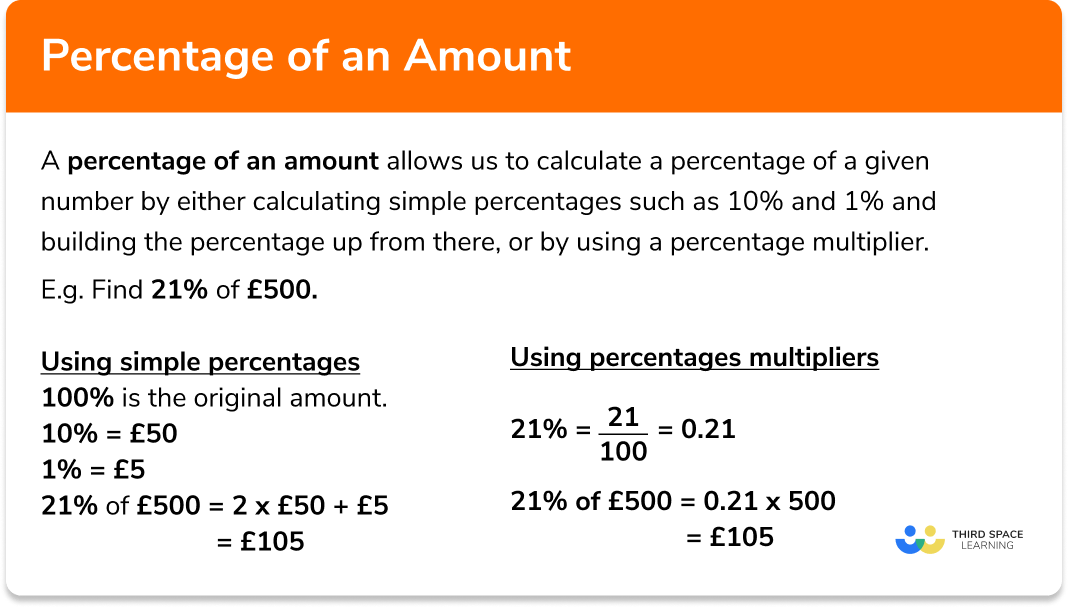
This is perhaps the most frequent percentage calculation. You often need to determine a specific portion of a total value. This applies to calculating sales tax, discounts, tips, or commission earnings.
Formula: Percentage (as a decimal) × Whole Number
Examples:
- Sales Tax: You buy an item for $50, and the sales tax is 7%.
- Convert 7% to a decimal: 0.07
- Calculate the tax amount: 0.07 × $50 = $3.50
- Total cost: $50 + $3.50 = $53.50
- Discount: A jacket is priced at $120, with a 20% discount.
- Convert 20% to a decimal: 0.20
- Calculate the discount amount: 0.20 × $120 = $24
- New price: $120 – $24 = $96
- Commission: A salesperson earns a 15% commission on a $1,000 sale.
- Convert 15% to a decimal: 0.15
- Calculate commission: 0.15 × $1,000 = $150
Finding the Percentage One Number Is of Another
This calculation helps you understand the proportion of a part relative to a whole. It’s useful for analyzing your spending habits, determining your debt-to-income ratio, or evaluating success rates.
Formula: (Part ÷ Whole) × 100
Examples:
- Budgeting: Your monthly income is $4,000, and your rent is $1,200. What percentage of your income goes to rent?
- ($1,200 ÷ $4,000) × 100 = 0.30 × 100 = 30%
- Tip Calculation: A restaurant bill is $60, and you leave a $12 tip. What percentage was the tip?
- ($12 ÷ $60) × 100 = 0.20 × 100 = 20%
- Investment Portfolio Allocation: You have $10,000 in stocks and your total portfolio is $25,000. What percentage of your portfolio is in stocks?
- ($10,000 ÷ $25,000) × 100 = 0.40 × 100 = 40%
Calculating Percentage Increase or Decrease
This is a critical calculation for tracking financial performance over time. It shows the relative change between two values, which is far more insightful than just looking at the absolute difference. This applies to investment returns, inflation rates, salary changes, or price fluctuations.
Formula: ((New Value - Old Value) ÷ Old Value) × 100

Important Note: Always divide by the original or old value, as this is the base from which the change occurred.
Examples:
- Investment Growth: Your investment started at $5,000 and grew to $5,500. What is the percentage increase?
- (($5,500 – $5,000) ÷ $5,000) × 100 = ($500 ÷ $5,000) × 100 = 0.10 × 100 = 10% increase.
- Price Drop: A stock was $100 and dropped to $90. What is the percentage decrease?
- (($90 – $100) ÷ $100) × 100 = (-$10 ÷ $100) × 100 = -0.10 × 100 = -10% (or a 10% decrease).
- Inflation: If the cost of living index went from 200 to 206 in a year, what’s the inflation rate?
- ((206 – 200) ÷ 200) × 100 = (6 ÷ 200) × 100 = 0.03 × 100 = 3% increase.
Advanced Applications in Personal Finance and Investing
Beyond everyday transactions, percentages form the backbone of more complex financial concepts that are crucial for long-term wealth building and financial security.
Interest Rates: Simple vs. Compound Interest
Interest is fundamentally a percentage charged for the use of money, whether you’re borrowing it or lending it. Understanding how interest is calculated is paramount for loans, savings, and investments.
- Simple Interest: Calculated only on the principal amount.
- Formula:
Principal × Rate × Time - Example: A $1,000 loan at 5% simple interest for 3 years: $1,000 × 0.05 × 3 = $150 in interest.
- Formula:
- Compound Interest: The “interest on interest” phenomenon, where interest earned (or charged) is added to the principal, and subsequent interest calculations are based on this new, larger principal. This is the engine of long-term wealth growth in savings and investments, but also the reason debt can spiral.
- While the full formula
A = P(1 + r/n)^(nt)can look daunting, the concept is straightforward: your money grows faster because your earnings start earning too. - Key terms like APR (Annual Percentage Rate) for loans and APY (Annual Percentage Yield) for savings/investments are often used. APY accounts for compounding and gives a more accurate picture of effective annual return than APR, which typically doesn’t.
- While the full formula
Investment Returns and Portfolio Allocation
Percentages are the primary metric for evaluating investment performance and structuring your portfolio.
- Return on Investment (ROI): This tells you the profitability of an investment.
- Formula:
((Current Value - Original Cost) ÷ Original Cost) × 100 - Example: You bought stock for $1,000 and sold it for $1,200. ROI = (($1,200 – $1,000) ÷ $1,000) × 100 = 20%.
- Formula:
- Portfolio Allocation: Investors use percentages to distribute their assets among different classes (e.g., stocks, bonds, real estate) to manage risk and target returns. A common rule of thumb might be “60% stocks, 40% bonds,” where these percentages refer to the proportion of your total investment capital.
- Expense Ratios: In mutual funds or ETFs, expense ratios are expressed as percentages (e.g., 0.50%). This represents the annual fee charged as a percentage of your total investment. Even seemingly small percentages can significantly impact long-term returns due to compounding.
Budgeting and Debt Management
Percentages are invaluable tools for gaining control over your finances and managing debt effectively.
- Budgeting Rules: Many popular budgeting strategies rely on percentages, such as the 50/30/20 rule (50% needs, 30% wants, 20% savings/debt repayment). You use the “finding the percentage one number is of another” calculation to see if your spending aligns with these targets.
- Debt-to-Income (DTI) Ratio: Lenders often assess your DTI ratio to determine your ability to manage monthly payments and repay new debts.
- Formula:
(Total Monthly Debt Payments ÷ Gross Monthly Income) × 100 - A lower DTI (e.g., below 36%) is generally favorable.
- Formula:
- Credit Card Interest: Understanding the Annual Percentage Rate (APR) on your credit cards is crucial for managing debt. High APRs mean a larger percentage of your balance goes towards interest, making it harder to pay off the principal.
Tools and Tips for Accurate Percentage Calculations
While the underlying math is straightforward, practical application often benefits from the right tools and an awareness of common pitfalls.
Leveraging Calculators and Spreadsheets
For most percentage calculations, especially in a financial context, you don’t need to do complex mental math.
- Standard Calculators: Basic calculators have a ‘%’ button that can simplify some calculations (e.g., type 50 * 20 % to find 20% of 50). However, it’s often safer and clearer to convert percentages to decimals first (e.g., 50 * 0.20).
- Online Percentage Calculators: Many websites offer dedicated percentage calculators for specific scenarios (e.g., tip calculators, loan interest calculators).
- Spreadsheet Software (Excel, Google Sheets): For budgeting, investment tracking, or business finance, spreadsheets are indispensable. They allow you to set up formulas once and apply them to changing data, recalculating percentages automatically. For example,
=A2*0.07calculates 7% of the value in cell A2, or=(B2-A2)/A2calculates percentage change. Learning basic spreadsheet functions is a powerful financial skill.
Common Pitfalls and How to Avoid Them
Even simple percentage calculations can lead to errors if care isn’t taken.
- Forgetting to Convert: The most common mistake is using the percentage value directly in multiplication/division without converting it to its decimal form (e.g., multiplying by 20 instead of 0.20 for 20%).
- Incorrect Base Value: When calculating percentage increase/decrease, ensure you are always dividing by the original or starting value. Using the new value will give an incorrect result.
- Percentage Points vs. Percentage Change: These terms are often confused. If an interest rate goes from 5% to 7%, that’s a 2 percentage point increase. However, it’s a 40% percentage change ((7-5)/5 * 100). Be precise in your language and understanding.
- Chained Percentages: Successive percentage changes are not additive. For example, a 10% increase followed by a 10% decrease does not bring you back to the original value (e.g., $100 + 10% = $110; $110 – 10% = $99). Each percentage change applies to the new current value.
The Importance of Context and Financial Literacy
While mastering the mechanics of percentage calculations is vital, truly understanding them in a financial context goes deeper. A 10% return on investment sounds great, but is it good given the market conditions or the risk taken? A 3% inflation rate might seem small, but what does it mean for your purchasing power over a decade? Percentages are tools; financial literacy provides the framework for interpreting what those percentages actually mean for your wealth and well-being. Continuously educating yourself on economic principles, market dynamics, and personal finance strategies will allow you to leverage your percentage calculation skills to their fullest potential.
Conclusion
Percentages are far more than just mathematical curiosities; they are the bedrock of informed financial decision-making. From deciphering discounts at the store to calculating your net worth growth, understanding how to find out percentages empowers you with clarity and control over your money. By mastering the fundamental conversions, core calculation methods, and their nuanced applications in budgeting, investing, and debt management, you equip yourself with an invaluable skill set. Remember to use the right tools, avoid common pitfalls, and always seek to understand the broader financial context behind the numbers. With these skills, you’re not just calculating percentages; you’re building a stronger foundation for your financial future.
aViewFromTheCave is a participant in the Amazon Services LLC Associates Program, an affiliate advertising program designed to provide a means for sites to earn advertising fees by advertising and linking to Amazon.com. Amazon, the Amazon logo, AmazonSupply, and the AmazonSupply logo are trademarks of Amazon.com, Inc. or its affiliates. As an Amazon Associate we earn affiliate commissions from qualifying purchases.