
In the realm of finance, numbers are more than just figures on a screen; they are the pulse of an investment’s health, the trajectory of a business’s success, and the roadmap to personal financial freedom. While basic addition and subtraction allow us to track our balances, the concept of “percentage increase” is the fundamental metric used to measure growth, volatility, and performance. Whether you are analyzing the quarterly gains of a S&P 500 index fund, evaluating a salary offer, or measuring the scalability of a startup, understanding how to calculate and interpret percentage increase is an essential skill for any investor or professional.
The Fundamental Formula for Financial Growth
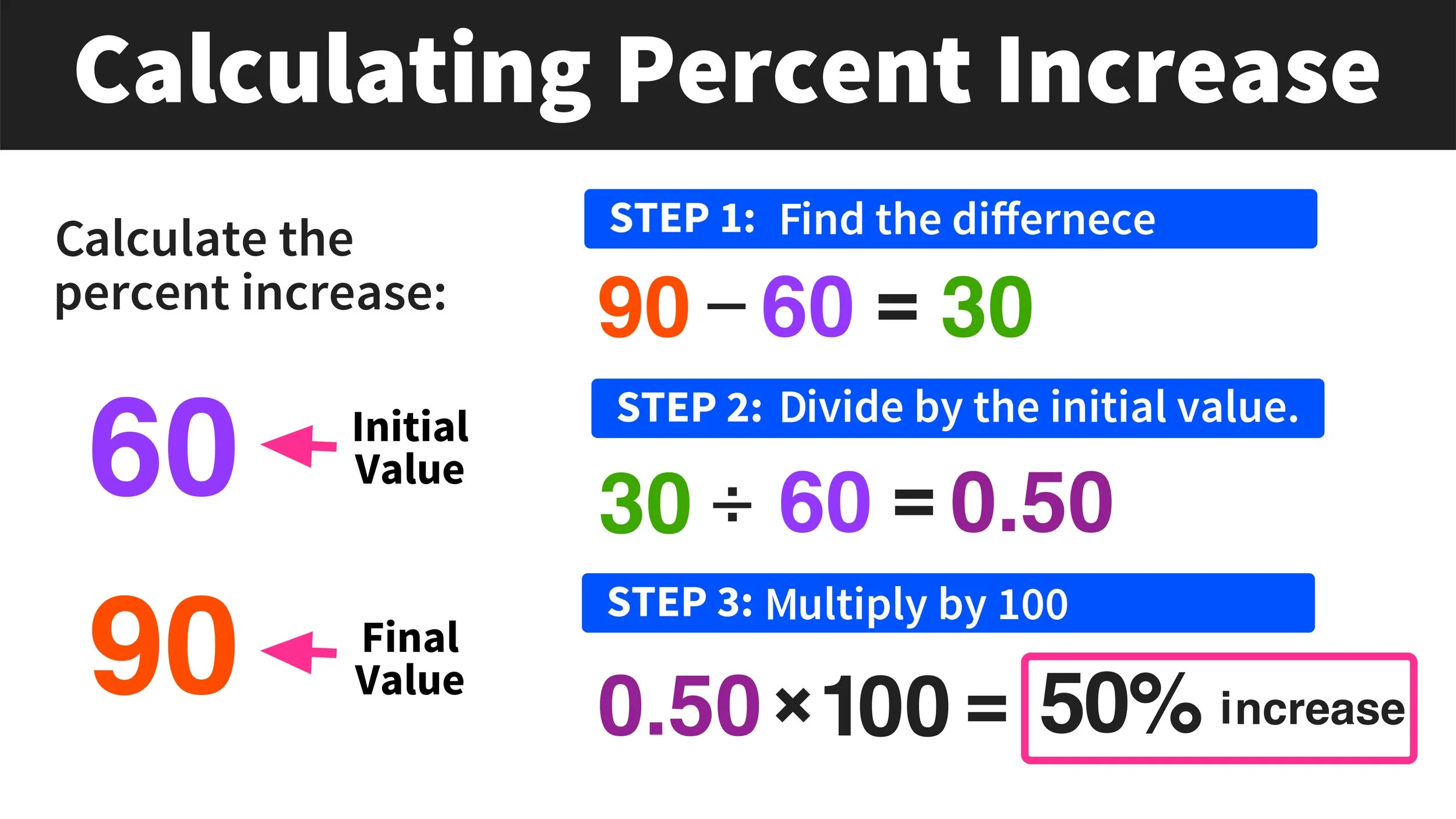
Before diving into complex market analysis, one must master the basic mechanics of the percentage increase formula. At its core, a percentage increase represents the relative change between an initial value and a final value, expressed as a fraction of 100. This allows for a standardized comparison across different asset classes, regardless of their absolute price.
The Step-by-Step Breakdown
To calculate the percentage increase, you follow a simple three-step mathematical process:
- Find the Absolute Change: Subtract the original (old) value from the new value.
- Divide by the Original: Take that difference and divide it by the original value.
- Convert to a Percentage: Multiply the result by 100.
The formula looks like this:
[(New Value – Original Value) / Original Value] × 100 = Percentage Increase
For example, if you purchased a share of a tech company at $150 and it rose to $180, your absolute gain is $30. To find the percentage increase, you divide $30 by the original $150, resulting in 0.2. Multiplying by 100 gives you a 20% increase. This figure is far more descriptive than the $30 gain alone, as it tells you the efficiency of your capital.
Real-World Investment Examples
In the world of investing, percentage increase is the primary tool for comparing disparate assets. Suppose you have $1,000 invested in gold and $10,000 invested in a mutual fund. If the gold investment increases by $100 and the mutual fund increases by $500, the mutual fund has a higher absolute gain. However, the gold investment yielded a 10% increase, while the mutual fund yielded only a 5% increase. By focusing on the percentage, an investor can identify which asset is performing more efficiently relative to the capital deployed.
Gauging Portfolio Performance and ROI
For the individual investor, the percentage increase is the ultimate yardstick for Return on Investment (ROI). It provides a clear picture of whether a financial strategy is beating inflation or outperforming market benchmarks like the Dow Jones Industrial Average.
Understanding Capital Gains
Capital gains are the most common application of percentage increase in personal finance. When you sell an asset—be it real estate, stocks, or cryptocurrency—for more than you paid for it, the percentage increase determines your profit margin. Calculating this accurately is vital for tax purposes and for rebalancing your portfolio. If an investor sees that one sector of their portfolio has experienced a 50% increase while another has remained stagnant, they may choose to “trim their winners” to lock in gains and redistribute capital into undervalued assets.
Tracking Dividend Growth
Beyond the price appreciation of a stock, “Dividend Growth” is a specific type of percentage increase that passive income seekers watch closely. If a company paid a dividend of $1.00 per share last year and raises it to $1.10 this year, that represents a 10% increase in yield on cost. For long-term investors, consistent percentage increases in dividends are a sign of a company’s financial maturity and commitment to shareholder value. Over decades, these incremental percentage increases compound, leading to exponential growth in cash flow.
Evaluating Total Return
It is important to distinguish between simple percentage increase in price and “Total Return.” Total return accounts for the percentage increase in the asset’s price plus any dividends or interest earned, reinvested back into the asset. In the context of wealth building, focusing on the total return percentage provides a more holistic view of how your money is working for you.
Business Finance and Strategic Scaling
In the corporate world, percentage increase is the language of “Key Performance Indicators” (KPIs). For a business to be considered “healthy,” it must demonstrate a consistent upward trajectory in several core areas.
Year-Over-Year (YoY) Revenue Analysis
Business owners and analysts use Year-Over-Year (YoY) comparisons to smooth out seasonal fluctuations and identify long-term trends. By calculating the percentage increase in revenue from Q3 of the previous year to Q3 of the current year, a company can gauge its growth velocity. A 5% increase might indicate a stable, mature company, while a 50% increase suggests a high-growth startup in its scaling phase.
This metric is also crucial for budgeting. If a company’s expenses are increasing at a higher percentage than its revenue, the business is heading toward a liquidity crisis, even if absolute revenue numbers are rising.
Measuring Profit Margin Expansion
Efficiency in business is often measured by the percentage increase in profit margins. If a company implements a new AI-driven supply chain tool that reduces costs, the “Gross Profit Margin” (calculated as a percentage) will increase. Investors look for “operating leverage,” which occurs when a company’s revenue increases at a faster percentage than its operating expenses. This disparity indicates that the business can scale without a linear increase in costs, making it a highly attractive investment.
Customer Acquisition and Retention Metrics
In the modern digital economy, growth isn’t just about dollars; it’s about users. Tech-heavy businesses track the percentage increase in “Monthly Active Users” (MAU) or “Customer Lifetime Value” (CLV). A high percentage increase in user growth is often a leading indicator of future revenue growth, especially for platform-based businesses like SaaS (Software as a Service) providers.
The Mathematics of Recovery: Why Percentages Can Be Deceptive
One of the most critical lessons in finance is understanding the “asymmetry of loss.” While percentage increases are exhilarating, they do not function the same way as percentage decreases due to the changing “base” value. This is a trap that many novice investors fall into.
The Break-Even Hurdle
The math of recovery reveals that if an investment drops in value, it requires a much larger percentage increase to return to the original “break-even” point.
- If your portfolio drops by 10%, you need an 11.1% increase to get back to even.
- If your portfolio drops by 20%, you need a 25% increase to get back to even.
- If your portfolio drops by 50%, you need a 100% increase just to recover your initial capital.
Understanding this dynamic highlights the importance of risk management. In professional wealth management, avoiding a 50% loss is often considered more valuable than chasing a 50% gain, because the mathematical hill to climb after a crash is significantly steeper.
Inflation’s Impact on Purchasing Power
Percentage increase must also be viewed through the lens of “Real vs. Nominal” returns. If your savings account offers a 4% annual interest rate (a 4% percentage increase in your balance), but inflation is running at 6%, your “real” percentage increase is actually negative 2%. In this scenario, while the number of dollars in your account has increased, your actual purchasing power has decreased. Successful financial planning requires ensuring that your assets’ percentage increase consistently outpaces the percentage increase of the Consumer Price Index (CPI).

Conclusion: Mastery of the Metric
The ability to calculate and interpret percentage increase is not merely an academic exercise; it is a vital tool for navigating the complexities of the financial world. It allows an investor to strip away the noise of raw numbers and see the underlying efficiency of their capital. From measuring the success of a side hustle to analyzing the global expansion of a multinational corporation, the percentage increase serves as the universal benchmark for progress.
By mastering this metric, you gain the ability to set realistic financial goals, recognize the true impact of market volatility, and make data-driven decisions that foster long-term wealth. In the world of money, those who understand the math of growth are the ones most likely to achieve it. Always remember that in finance, it isn’t just about how much the numbers change—it’s about the percentage of that change and what it signals for your future.
aViewFromTheCave is a participant in the Amazon Services LLC Associates Program, an affiliate advertising program designed to provide a means for sites to earn advertising fees by advertising and linking to Amazon.com. Amazon, the Amazon logo, AmazonSupply, and the AmazonSupply logo are trademarks of Amazon.com, Inc. or its affiliates. As an Amazon Associate we earn affiliate commissions from qualifying purchases.