
Navigating the landscape of higher education finance can often feel like a complex journey, with the Free Application for Federal Student Aid (FAFSA) standing as one of its most critical milestones. The FAFSA is the gateway to billions of dollars in federal grants, scholarships, work-study funds, and low-interest loans, making its successful submission and processing paramount for aspiring students and their families. However, merely submitting the application is only half the battle; the other, equally vital half involves diligently checking its status to ensure everything is on track. Proactive monitoring of your FAFSA status isn’t just about curiosity; it’s a strategic financial move that can prevent costly delays, identify errors, and ultimately secure the financial aid you need to achieve your educational dreams. This guide will walk you through the essential steps and insights for effectively checking your FAFSA status, empowering you to stay informed and in control of your financial future.

The Critical Importance of Monitoring Your FAFSA Application
The FAFSA is more than just a form; it’s the cornerstone of your financial aid package. Given its significance, the act of checking its status transcends a simple procedural step to become an indispensable component of sound financial planning for college. Without diligent oversight, potential issues can easily derail your application, leading to missed opportunities and increased financial burdens. Understanding why continuous monitoring is crucial will underscore the value of the steps outlined in this article.
Ensuring Timely Financial Aid Disbursement
Financial aid deadlines are notoriously strict, and often, aid is awarded on a first-come, first-served basis, particularly for state and institutional grants. An unaddressed error or a delayed processing status can push your application to the back of the queue, potentially meaning the difference between receiving full funding and receiving a partial award – or no award at all. By regularly checking your FAFSA status, you ensure that any “action required” notifications are addressed promptly, keeping your application in prime position for timely review and, crucially, timely disbursement of funds. This proactive approach safeguards your eligibility for maximum financial support, directly impacting your ability to cover tuition, housing, books, and other educational expenses without incurring unnecessary debt.
Avoiding Application Pitfalls and Delays
The FAFSA, while designed to be user-friendly, involves numerous data points and occasionally complex financial information. Mistakes, omissions, or discrepancies can happen, ranging from incorrect social security numbers to mismatched income figures from tax returns. If left uncorrected, these errors can hold up your application for weeks or even months. A vigilant check of your status will immediately highlight any issues, often presented as specific “action required” messages. Addressing these promptly can prevent your application from being rejected or significantly delayed, thereby protecting your eligibility for financial assistance. It’s an investment of your time that pays dividends by ensuring a smoother, more efficient path to receiving the aid you deserve.
Understanding Your Eligibility and Award Opportunities
Beyond just ensuring your application is processed, checking your FAFSA status is also about understanding what comes next. Once processed, your FAFSA data is used to calculate your Student Aid Index (SAI), formerly Expected Family Contribution (EFC), which is a key determinant of your financial need. Knowing your application has been successfully processed and reviewing your Student Aid Report (SAR) – which contains your SAI – provides clarity on the level of financial assistance you might expect. This early insight allows you to plan your finances more effectively, compare financial aid offers from different institutions, and make informed decisions about your college choices, all from a strong financial standing.
Step-by-Step Guide to Accessing Your FAFSA Status Online
The most efficient and common way to check your FAFSA status is through the official Federal Student Aid website. This online portal is a centralized hub for all your federal student aid information, providing real-time updates and essential documentation. Familiarizing yourself with its navigation is a fundamental step in managing your financial aid journey.
Creating or Logging into Your FSA ID Account
Your FSA ID is your digital signature and the key to accessing your federal student aid information, including your FAFSA. If you haven’t already, you’ll need to create an FSA ID, which consists of a username and password. This ID is used to log in to the Federal Student Aid website, sign your FAFSA electronically, and access your Student Aid Report (SAR). If you already have one, ensure you remember your login credentials. If you’ve forgotten them, the website offers clear recovery options, but it’s always best to keep this information secure and accessible. Both the student and one parent (if the student is dependent) will need their own FSA IDs to sign the FAFSA.
Navigating to the FAFSA Application Status Page
Once you’ve successfully logged into the Federal Student Aid website using your FSA ID, you’ll be directed to your dashboard. From there, locate the section related to “My FAFSA” or “Check My Application Status.” The exact wording might vary slightly over time as the website is updated, but the general pathway remains consistent. Clicking on this link will take you to a dedicated page that displays a summary of your submitted FAFSA applications and their current status. This page is your primary resource for real-time updates.
Deciphering Your Application Status: What Each Term Means
Upon reaching the status page, you’ll see a current status indicator. It’s crucial to understand what these various statuses signify:
- “Processing”: This generally means your FAFSA has been received and is being reviewed. No action is typically required from you at this stage, but it’s a good sign that your application is moving forward.
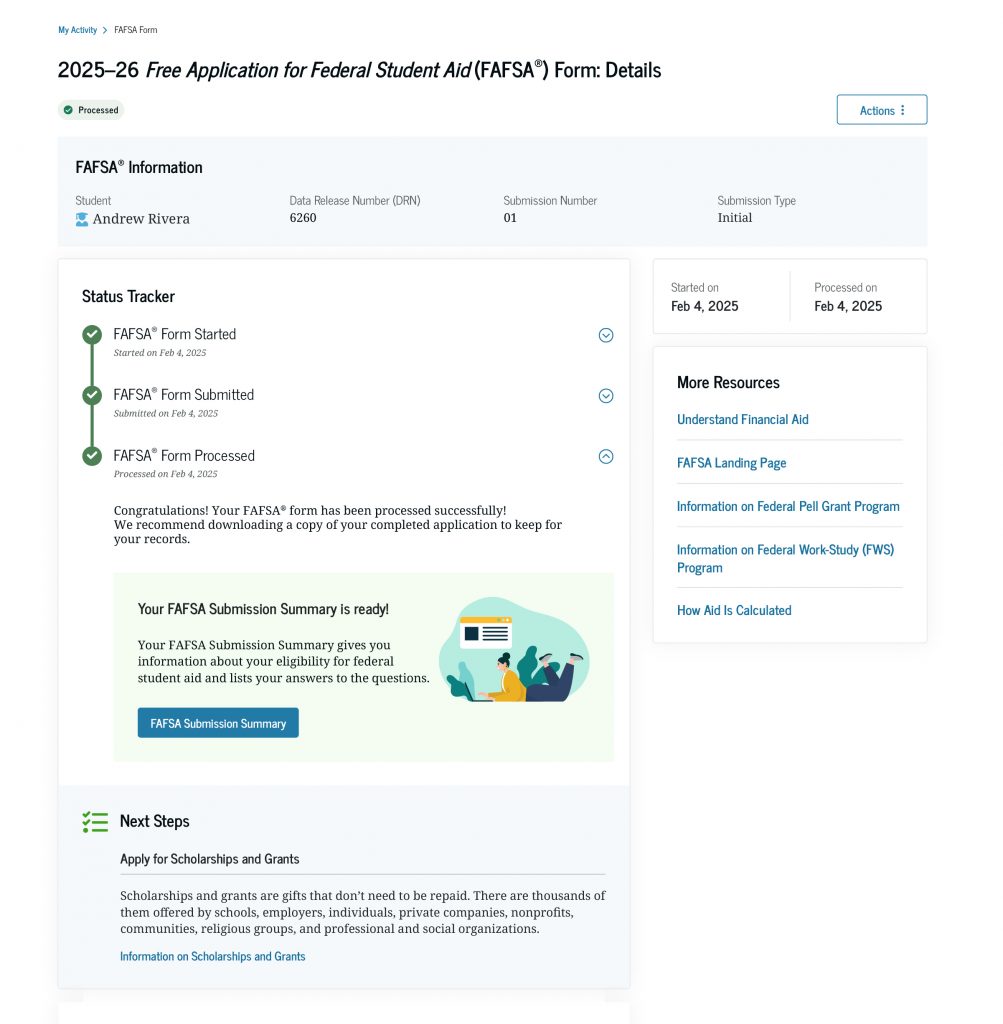
- “Processed Successfully”: Congratulations! Your FAFSA has been fully processed, and your Student Aid Report (SAR) is available for review. This is the green light, indicating that your information has been sent to the colleges you listed.
- “Action Required” / “Incomplete Application”: This is a critical status. It means there’s missing information, an error, or a signature issue that needs your immediate attention. Details on what specific action is required will usually be provided on the page or in your SAR.
- “Rejected”: This indicates a significant problem that has led to your application being denied. This is rare but typically means a major error, like an incorrect Social Security number, preventing it from being processed. You will need to correct and resubmit.
- “In Review” (by institution): While not a direct FAFSA status, some institutional portals will show this. It means the colleges you listed have received your FAFSA data and are now reviewing it to determine your aid package.
Common FAFSA Statuses and What They Imply
Understanding the nuances of each status update is essential for effective financial planning. Each status carries specific implications for your next steps and overall financial aid timeline. Misinterpreting a status could lead to unnecessary anxiety or, worse, missed deadlines.
“Processing” and “Processed Successfully”
When your FAFSA shows as “Processing,” it’s a waiting game. The Federal Student Aid processors are reviewing your information. This phase usually doesn’t last long. Once it shifts to “Processed Successfully,” you’ve cleared a major hurdle. This status confirms that your application is complete, verified by federal standards, and your Student Aid Report (SAR) is available. Your SAR details your submitted information and calculates your Student Aid Index (SAI). It’s imperative to review your SAR thoroughly for any inaccuracies, as even a minor error could affect your aid eligibility. If you find errors, you’ll need to make corrections on the FAFSA website.
“Action Required” or “Incomplete Application”
This is arguably the most important status to monitor closely. An “Action Required” or “Incomplete Application” message means there’s a problem that needs your immediate attention. This could stem from various issues:
- Missing Signatures: Both the student and a parent (for dependent students) must electronically sign the FAFSA using their respective FSA IDs.
- Unanswered Questions: Specific required fields may have been left blank.
- Discrepancies: Information on your FAFSA might not match data from the IRS, leading to a flag.
- Verification: Sometimes, this status indicates your application has been selected for verification, meaning your school requires additional documentation to confirm the information you provided.

Ignoring this status can lead to indefinite delays or even the cancellation of your application, directly impacting your access to financial aid. The website will usually specify the exact nature of the required action, guiding you on how to resolve the issue.
“Rejected” or “Application Not Submitted”
A “Rejected” status is severe and means your FAFSA could not be processed due to a critical error, often related to an invalid Social Security number or other fundamental identification issues. If your application shows as “Application Not Submitted,” it means you started the FAFSA but never fully completed the submission process, including the final signature. Both statuses require immediate and often significant corrective action, usually involving reviewing your input carefully, making necessary corrections, and then resubmitting the entire application. These scenarios underscore the importance of double-checking all details before final submission and monitoring your status shortly thereafter.
“In Review” by Your Chosen Institutions
While this isn’t a direct FAFSA status displayed on the federal website, once your FAFSA is “Processed Successfully,” your data is sent to the colleges you listed. Each institution then takes your FAFSA information and combines it with any institutional aid applications (if applicable) to determine your financial aid package. Many colleges will provide their own portal or communication methods to inform you that they have received your FAFSA data and are in the process of reviewing it. At this stage, your communication shifts from the federal government to the individual colleges. It’s prudent to check each college’s financial aid portal and emails for updates.
Beyond the Online Portal: Other Avenues for Status Inquiry
While the official Federal Student Aid website is your primary resource, there are alternative methods for checking your FAFSA status or getting assistance, particularly if you encounter persistent issues or need personalized guidance. These additional avenues provide crucial support and ensure you have multiple ways to stay informed.
Contacting the Federal Student Aid Information Center (FSAIC)
For questions that aren’t easily answered by the online portal or for assistance with technical issues related to your FSA ID or FAFSA submission, the Federal Student Aid Information Center (FSAIC) is an invaluable resource. You can reach them by phone, and their representatives are equipped to help you understand your FAFSA status, troubleshoot problems, and guide you through the correction process. Having your FSA ID and FAFSA confirmation number ready when you call will expedite the process. This direct line to federal aid experts can often resolve complex issues more quickly than trying to navigate them independently.
Reaching Out to Your College’s Financial Aid Office
Once your FAFSA has been processed and your SAR is available, your relationship with the federal government regarding your FAFSA typically shifts to your selected colleges. Each college’s financial aid office is your go-to resource for specific questions about your aid package, institutional deadlines, and any additional documentation they might require (especially if you’ve been selected for verification). They can confirm if they’ve received your FAFSA data, provide insights into their own review process, and explain how federal aid combines with state and institutional aid. Building a good rapport with your college’s financial aid office can be incredibly beneficial throughout your academic career.
Utilizing Email Notifications and Correspondence
After you submit your FAFSA, both the Federal Student Aid office and the colleges you listed will often communicate important updates via email. Ensure that the email address you provided on your FAFSA is active and that you regularly check your inbox (including spam or junk folders). These emails might include notifications that your FAFSA has been processed, that your SAR is available, or that “action is required.” Similarly, colleges will use email to notify you of your financial aid offer, requests for additional information, or updates to your status with them. Being diligent about checking these communications is a passive yet effective way to monitor your status without constantly logging into portals.
What to Do Once Your FAFSA Status is Confirmed
Once your FAFSA is “Processed Successfully” and you’ve confirmed its status, the next phase of your financial aid journey begins. This phase involves reviewing critical documents, responding to further requests, and ultimately understanding and accepting your financial aid offers. These steps are crucial for leveraging your FAFSA effectively and securing your educational funding.
Reviewing Your Student Aid Report (SAR) for Accuracy
The Student Aid Report (SAR) is a summary of the information you provided on your FAFSA, including your Student Aid Index (SAI). It’s imperative to review your SAR carefully for any errors or discrepancies. Even minor mistakes, such as an incorrect income figure or an oversight in reporting assets, can significantly impact your financial aid eligibility. If you find any errors, you must log back into your FAFSA application on the Federal Student Aid website and make the necessary corrections. Correcting errors promptly ensures that your financial need is accurately assessed, maximizing your potential aid.
Responding to Requests for Additional Documentation (Verification)
A certain percentage of FAFSA applications are selected for a process called “verification.” If your application is chosen, your colleges will require you to submit additional documents—such as tax transcripts, W-2 forms, or household information—to verify the data you reported on your FAFSA. This is a routine process and not an indication of wrongdoing. However, it’s a critical step that must be completed accurately and promptly. Failure to submit required verification documents by the college’s deadline will result in the forfeiture of your financial aid. Respond to these requests as quickly as possible to avoid any delays in receiving your aid package.
Understanding and Accepting Your Financial Aid Offer
Once your FAFSA is processed and your colleges have reviewed your information, they will send you a financial aid offer, often called an award letter. This letter details the mix of grants, scholarships, work-study, and loans you are eligible to receive from federal, state, and institutional sources. Carefully review each component of the offer. Understand the difference between “gift aid” (grants, scholarships that don’t need to be repaid) and “self-help aid” (loans that must be repaid, and work-study). Compare offers from different schools if you applied to multiple. You’ll typically need to formally accept or decline each component of the aid package through the college’s financial aid portal or by returning a signed form.
Planning Your Next Financial Steps for College
With your financial aid secured, the final step involves integrating this information into your broader financial plan for college. Calculate your net cost of attendance (total costs minus gift aid) and determine how you will cover any remaining balance. This might involve student loans (federal direct loans should be considered first due to better terms), savings, or other resources. If you’ve accepted loans, understand the disbursement process, interest rates, and repayment terms. Proactive financial planning will help you manage your educational expenses effectively, minimize debt, and focus on your studies with peace of mind.
The journey through the FAFSA process, from application to aid disbursement, is a critical component of funding your higher education. By diligently checking your FAFSA status, understanding what each update means, and proactively addressing any issues, you empower yourself to navigate the complexities of financial aid with confidence. This strategic approach not only secures your access to vital funding but also lays a solid financial foundation for your academic and professional future.
aViewFromTheCave is a participant in the Amazon Services LLC Associates Program, an affiliate advertising program designed to provide a means for sites to earn advertising fees by advertising and linking to Amazon.com. Amazon, the Amazon logo, AmazonSupply, and the AmazonSupply logo are trademarks of Amazon.com, Inc. or its affiliates. As an Amazon Associate we earn affiliate commissions from qualifying purchases.