
Compound interest is often referred to as the “eighth wonder of the world,” a testament to its transformative power in the realm of personal finance and wealth building. Unlike simple interest, which is calculated only on the initial amount of money deposited or borrowed, compound interest is calculated on the principal amount plus all of the accumulated interest from previous periods. This creates a “snowball effect,” where your money generates earnings, and those earnings in turn generate their own earnings.
Understanding how to calculate compound interest is not merely an academic exercise; it is a fundamental skill for any investor, saver, or borrower. Whether you are planning for retirement, saving for a down payment on a home, or managing a high-interest credit card balance, knowing how the math works allows you to make informed decisions that can lead to significant long-term financial advantages.
Understanding the Fundamentals of Compound Interest
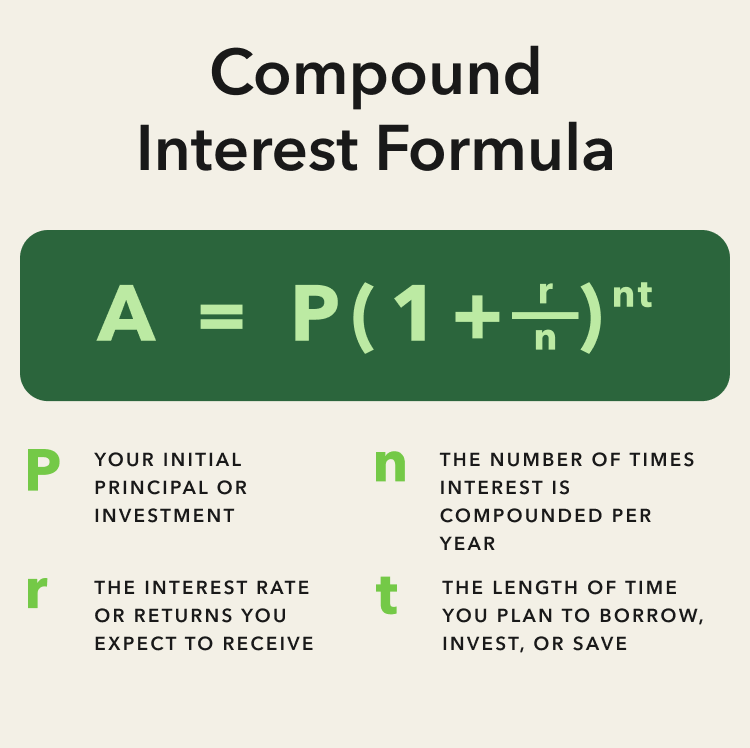
To calculate compound interest effectively, one must first grasp the core components that drive the equation. The process hinges on four critical variables: the principal, the interest rate, the compounding frequency, and the time horizon.
The Difference Between Simple and Compound Interest
Simple interest is straightforward: it is calculated by multiplying the principal by the interest rate and the time. For example, if you invest $1,000 at a 5% simple interest rate for three years, you would earn $50 each year, totaling $150 in interest. Your final balance would be $1,150.
Compound interest, however, reinvests those earnings. Using the same $1,000 at a 5% rate compounded annually, you would earn $50 in the first year. In the second year, the 5% interest is applied to $1,050, resulting in $52.50 in interest. By the third year, the interest is calculated on $1,102.50. While the difference seems small over three years, over thirty years, the gap between simple and compound interest becomes a chasm.
Key Variables: Principal, Rate, Time, and Frequency
Every compound interest calculation requires these specific data points:
-
Principal (P): This is the initial amount of money you start with—the amount you invest or the amount of the loan.
-
Annual Interest Rate (r): This is the nominal interest rate, expressed as a decimal (e.g., 5% becomes 0.05).
-
Compounding Frequency (n): This represents how many times interest is applied during a single time period (usually a year). It could be annually, semi-annually, quarterly, monthly, or even daily.
-
Time (t): The number of years the money is invested or borrowed for.
The interplay between these variables determines the final growth. Specifically, the frequency of compounding—the “n” in our equation—plays a much larger role than many novice investors realize.
The Mathematical Formula and How to Use It
While there are many online tools available to perform these calculations, understanding the manual formula provides deep insight into how your wealth grows over time.
Breaking Down the Standard Formula
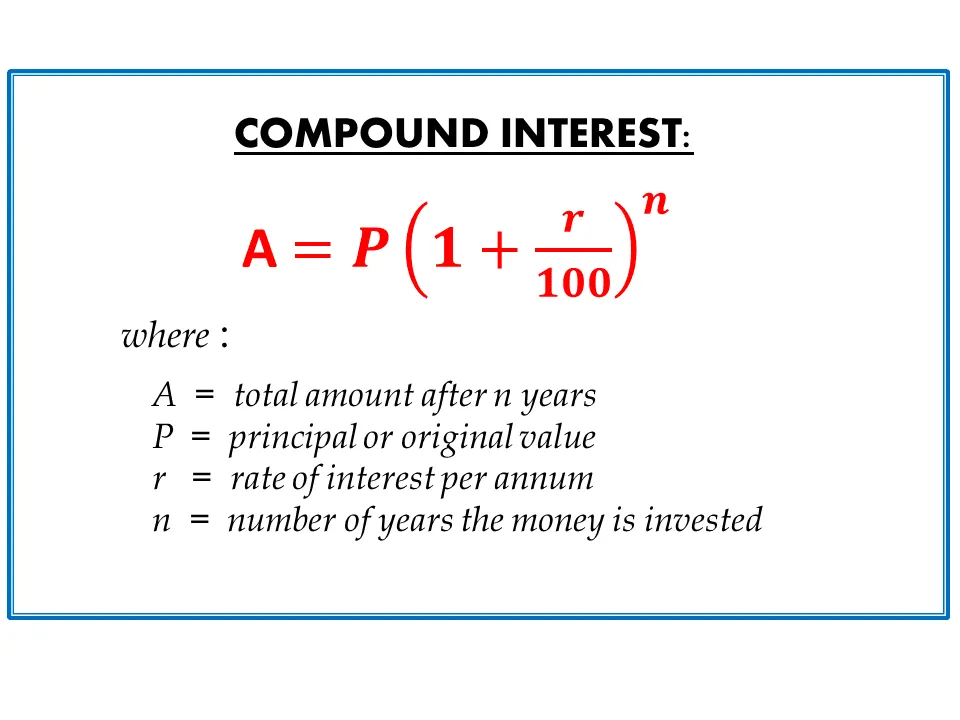
The standard formula for calculating the future value of an investment with compound interest is:
A = P(1 + r/n)^(nt)
Where:
-
A = The final amount (the future value of the investment, including interest).
-
P = The principal investment amount.
-
r = The annual interest rate (decimal).
-
n = The number of times that interest is compounded per unit t.
-
t = The time the money is invested for (in years).
By looking at this formula, we can see that interest is added to the principal (1 + r/n), and that entire sum is raised to the power of the total number of compounding periods (nt). This exponential growth is why compound interest is so powerful over long durations.
The Impact of Compounding Frequency
The frequency with which interest is added to the balance can change the outcome significantly. The more frequently interest is compounded, the higher the final amount will be. Common frequencies include:
-
Annually: n = 1
-
Semi-annually: n = 2
-
Quarterly: n = 4
-
Monthly: n = 12
-
Daily: n = 365
If you have $10,000 at a 10% interest rate for 10 years, annual compounding results in $25,937. Monthly compounding results in $27,070. Daily compounding results in $27,179. While the jump from monthly to daily is relatively small, the shift from annual to monthly can represent a meaningful difference in total yield.
Real-World Example: A Step-by-Step Calculation
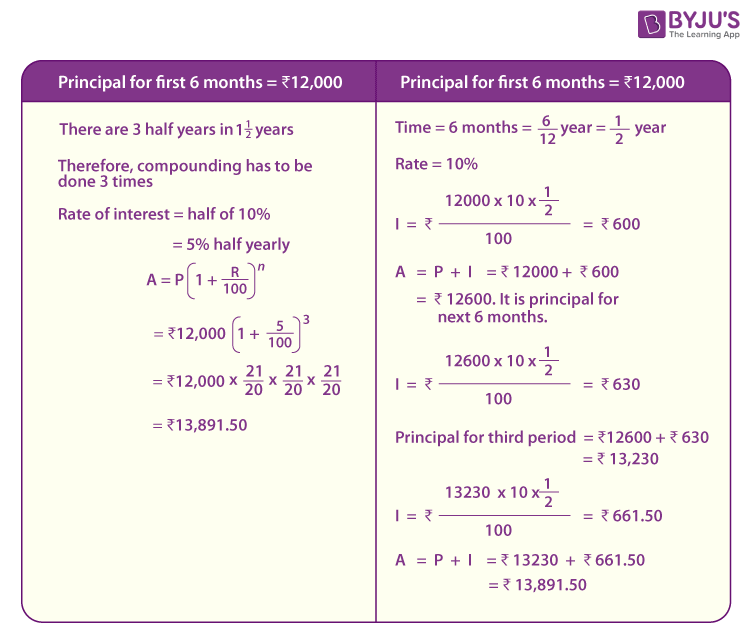
Let’s walk through a practical example. Imagine you invest $5,000 in a high-yield savings account with an interest rate of 4% (0.04) compounded monthly (n=12) for a period of 5 years (t=5).
-
Identify the variables: P=5000, r=0.04, n=12, t=5.
-
Calculate the inner part of the formula: (1 + 0.04/12) = 1.003333.
-
Calculate the exponent: (nt) = 12 * 5 = 60.
-
Raise the inner sum to the power of the exponent: (1.003333)^60 ≈ 1.221.
-
Multiply by the principal: 5000 * 1.221 = $6,105.
In this scenario, you earned $1,105 in interest over five years simply by letting your money sit and compound.
Practical Tools and Rules for Faster Estimation
Calculating precise figures is necessary for financial planning, but sometimes you need a “napkin math” approach to evaluate an investment opportunity on the fly.
The Rule of 72
The Rule of 72 is a quick way to estimate how long it will take for your money to double at a given fixed annual rate of interest. To use it, simply divide 72 by the annual interest rate. For example, if your investment earns 6% annually, it will take approximately 12 years (72 / 6 = 12) for your principal to double. If you earn 12%, your money will double in just 6 years. This rule illustrates how even small increases in interest rates can dramatically shorten the time needed to build significant wealth.
Utilizing Technology for Complex Scenarios
While the basic formula works for a single lump sum, most people invest through regular contributions (an annuity). Calculating the future value of a series of monthly deposits requires a more complex formula:
FV = PMT * [((1 + r/n)^(nt) – 1) / (r/n)]
In this case, PMT is the monthly payment. Because these calculations can become cumbersome, financial professionals rely on spreadsheet software like Microsoft Excel or Google Sheets. The function =FV(rate, nper, pmt, [pv], [type]) is a standard tool that allows you to calculate compound growth with regular contributions in seconds.
Strategies to Maximize Compounding in Your Portfolio
Calculating compound interest is only the first step. The goal is to use this knowledge to maximize your financial returns. Wealth is not just a factor of how much you earn, but how long you allow that money to work for you.
The Power of Time: Starting Early
The most significant factor in the compound interest equation is “t” (time). Because time is the exponent in the formula, it has a disproportionate impact on the result. This is why financial advisors emphasize starting early.
Consider two investors: Investor A starts at age 20, investing $200 a month for ten years and then stops entirely. Investor B starts at age 30 and invests $200 a month for thirty years. Despite Investor B contributing much more total capital, Investor A will often end up with a larger portfolio at age 60, simply because the initial funds had an extra decade to compound.
Reinvesting Dividends and Returns
To truly benefit from compounding, you must reinvest your earnings. In the context of the stock market, this means setting up a Dividend Reinvestment Plan (DRIP). Instead of taking the quarterly dividend as cash, it is used to buy more shares of the stock or fund. This increases your principal (P) for the next period, ensuring that the interest is calculated on an ever-growing base.
Minimizing Fees and Taxes
High fees and taxes are the “anti-compounding” forces. A 1% management fee might seem small, but when applied to the compound interest formula, it acts as a reduction in the interest rate (r). Over thirty years, a 1% fee can erode nearly a third of your total potential portfolio value. Similarly, utilizing tax-advantaged accounts like IRAs or 401(k)s allows your interest to compound without being reduced by the government each year, significantly accelerating the growth curve.
Compound Interest in Debt and Credit Management
While compounding is a friend to the saver, it is a formidable enemy to the debtor. Understanding the calculation is essential for managing liabilities like credit cards and loans.
How Compounding Works Against You
Most credit cards compound interest daily. This means that every single day, the bank calculates interest on your balance (including previously accrued interest) and adds it to the total. This is why credit card debt can spiral out of control so quickly. Even a modest balance can grow into an unmanageable sum if only the minimum payments are made, as the minimum payment often barely covers the interest being added that month.
Strategies for Accelerated Debt Repayment
When you understand that interest is compounding against you, the strategy for repayment changes. Making payments more frequently than once a month (for example, paying every two weeks) can reduce the average daily balance on which interest is calculated. Additionally, focusing on the highest-interest debt first (the “Debt Avalanche” method) targets the accounts where the “n” and “r” variables are most damaging, saving you the most money over time.
In conclusion, calculating compound interest is more than just a mathematical formula; it is a lens through which you can view your entire financial life. By mastering the variables of principal, rate, time, and frequency, you can position yourself to take full advantage of the exponential growth that builds lasting wealth. Whether you are calculating the growth of a retirement fund or the cost of a mortgage, the math remains the same: time and consistency are the keys to financial success.
aViewFromTheCave is a participant in the Amazon Services LLC Associates Program, an affiliate advertising program designed to provide a means for sites to earn advertising fees by advertising and linking to Amazon.com. Amazon, the Amazon logo, AmazonSupply, and the AmazonSupply logo are trademarks of Amazon.com, Inc. or its affiliates. As an Amazon Associate we earn affiliate commissions from qualifying purchases.