
Purchasing a new or used vehicle is a significant financial decision for most individuals. Beyond the excitement of choosing the perfect car, understanding the financial mechanics of an auto loan is paramount. Far too many car buyers focus solely on the alluring “monthly payment” figure without truly grasping how it’s derived or its implications for their overall financial health. Calculating auto loan payments isn’t merely an academic exercise; it’s a vital step in budgeting, comparing offers, and ensuring you secure a deal that aligns with your financial capacity rather than stretching it.
An auto loan is essentially an installment loan, meaning you borrow a lump sum and repay it, plus interest, over a predetermined period through regular, typically monthly, installments. While lenders are adept at presenting attractive payment scenarios, being equipped with the knowledge to calculate these payments yourself empowers you to negotiate confidently, avoid common pitfalls, and ultimately make an informed decision that serves your best interests. This comprehensive guide will demystify the process, breaking down the components of an auto loan and providing you with the tools and understanding to calculate your payments effectively.
Understanding the Core Components of an Auto Loan
Before diving into the formulas, it’s crucial to grasp the fundamental elements that determine your auto loan payment. Each component plays a significant role in the final monthly figure and the total cost of your vehicle.
Principal Amount
The principal amount is the actual sum of money you borrow to finance your vehicle. It’s not simply the sticker price of the car. Rather, it’s derived by taking the vehicle’s purchase price and subtracting any down payment you make, the value of any trade-in vehicle, and potentially adding other costs like sales tax, registration fees, and extended warranty plans if you choose to finance them. A larger down payment or a valuable trade-in directly reduces your principal, which in turn lowers your monthly payments and the total interest you’ll pay over the life of the loan. Conversely, financing additional fees increases your principal, making your loan more expensive.
Interest Rate (APR)
The interest rate, often expressed as an Annual Percentage Rate (APR), is perhaps the most critical factor influencing the overall cost of your loan. It represents the cost of borrowing money from the lender, expressed as a percentage of the principal amount. A higher APR means you’ll pay more in interest over the life of the loan, significantly increasing both your monthly payment and the total cost of the vehicle. Your credit score is the primary determinant of the APR you qualify for; individuals with excellent credit typically secure lower rates, while those with fair or poor credit will face higher rates. Other factors include the loan term, current market rates, and sometimes the type of vehicle.
Loan Term
The loan term is the duration over which you agree to repay the loan, typically expressed in months (e.g., 36, 48, 60, 72, or even 84 months). The loan term has a direct inverse relationship with your monthly payment and a direct relationship with the total interest paid. A longer loan term will result in lower monthly payments, making the car seem more affordable in the short term. However, stretching out the repayment period means you’ll pay more in total interest over the life of the loan because the lender has more time to charge interest on the outstanding principal. Conversely, a shorter loan term will result in higher monthly payments but significantly reduce the total interest paid, making the car less expensive in the long run.
Other Fees and Charges
While the principal, interest rate, and loan term are the primary drivers of your monthly payment, it’s important to be aware of other potential fees and charges that can affect the total cost of your vehicle. These can include:
-
Sales Tax: Varies by state and is usually calculated on the vehicle’s selling price. It can often be financed into the loan.
-
Registration and License Plate Fees: Required to legally operate your vehicle.
-
Documentation Fees (Doc Fees): Charged by dealerships for processing paperwork.
-
Lender Fees: Such as loan origination fees, though less common with auto loans than other types of personal loans.
-
GAP Insurance: Covers the difference between what you owe on your loan and the car’s actual cash value if it’s totaled or stolen.
-
Extended Warranty: Often offered by dealerships, these can significantly increase the financed amount if rolled into the loan.
Always scrutinize the breakdown of these charges and understand which ones are mandatory versus optional, and whether financing them is the most financially prudent choice.
The Formula Behind Your Monthly Payment
While many online calculators can provide you with your monthly payment in seconds, understanding the underlying formula empowers you to truly grasp how your payment is derived and to manipulate variables for different scenarios. The standard formula used for calculating fixed-rate installment loan payments, including auto loans, is based on the amortization schedule.
The Amortization Formula Explained
The formula for calculating your monthly auto loan payment (M) is:
$M = P [i(1 + i)^n] / [(1 + i)^n – 1]$
Where:
-
M = Your monthly loan payment
-
P = The principal loan amount (the amount you borrow)
-
i = Your monthly interest rate (your annual APR divided by 12)
-
n = The total number of payments (your loan term in years multiplied by 12)
Breaking Down the Variables
Let’s clarify each variable with practical considerations:
-
P (Principal Loan Amount): As discussed, this is the purchase price minus your down payment and trade-in value, plus any financed taxes or fees. Make sure this figure is accurate before plugging it into the formula.
-
i (Monthly Interest Rate): This is crucial. Lenders quote an Annual Percentage Rate (APR). To use it in the monthly payment formula, you must convert it to a monthly rate by dividing it by 12. For example, if your APR is 6%, your monthly interest rate (i) would be 0.06 / 12 = 0.005. Always use the decimal equivalent of the percentage.
-
n (Total Number of Payments): This is your loan term expressed in months. If you have a 5-year loan, ‘n’ would be 5 years * 12 months/year = 60 payments. For a 7-year loan, ‘n’ would be 84 payments.
A Step-by-Step Calculation Example
Let’s walk through an example to illustrate the formula in action:
Suppose you want to finance a car with the following details:
-
Vehicle Price: $30,000
-
Down Payment: $5,000
-
APR: 4.5%
-
Loan Term: 60 months (5 years)
Step 1: Calculate the Principal (P)
P = Vehicle Price – Down Payment = $30,000 – $5,000 = $25,000
Step 2: Calculate the Monthly Interest Rate (i)
i = APR / 12 = 4.5% / 12 = 0.045 / 12 = 0.00375
Step 3: Determine the Total Number of Payments (n)
n = Loan Term in Months = 60

Step 4: Plug the values into the formula
M = P [i(1 + i)^n] / [(1 + i)^n – 1]
M = $25,000 [0.00375(1 + 0.00375)^60] / [(1 + 0.00375)^60 – 1]
M = $25,000 [0.00375(1.00375)^60] / [(1.00375)^60 – 1]
First, calculate (1.00375)^60: Approximately 1.2505
Now, substitute this back:
M = $25,000 [0.00375 * 1.2505] / [1.2505 – 1]
M = $25,000 [0.004689375] / [0.2505]
M = $117.234375 / 0.2505
M ≈ $467.98
So, your estimated monthly payment would be approximately $467.98. This manual calculation provides a clear understanding of how each factor influences the final payment.
Practical Tools for Auto Loan Calculation
While the formula is powerful, for quick comparisons and scenario planning, practical tools can be invaluable. These tools automate the complex calculations, allowing you to focus on adjusting variables and understanding their impact.
Online Auto Loan Calculators
The most accessible and user-friendly tools are online auto loan calculators. Almost every bank, credit union, and reputable financial website offers one. These calculators typically require you to input the loan amount, interest rate (APR), and loan term. Some advanced versions also allow for down payments, trade-ins, sales tax, and other fees, providing a more comprehensive payment estimate.
Benefits:
-
Ease of Use: Simple interface, quick results.
-
Scenario Planning: Easily adjust variables (APR, term, down payment) to see how they impact your monthly payment and total cost.
-
Accessibility: Available 24/7 from any device with internet access.
When using these, always ensure you’re entering the correct annual interest rate as an APR and the loan term in months or years as specified by the calculator.
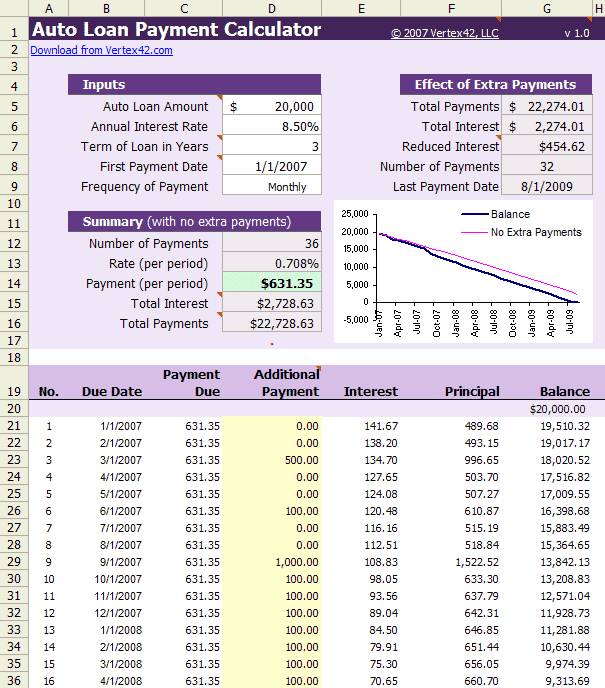
Spreadsheet Software (Excel/Google Sheets)
For those who prefer a more hands-on approach or need to perform complex comparative analyses, spreadsheet software like Microsoft Excel or Google Sheets is an excellent tool. Spreadsheets allow you to build your own calculation models using built-in financial functions.
Key Functions:
-
PMT Function: This is the most direct function for calculating loan payments. The syntax is
PMT(rate, nper, pv, [fv], [type]).-
rate: Monthly interest rate (APR/12) -
nper: Total number of payments (loan term in months) -
pv: Present value or the principal loan amount -
fv: Future value (usually 0 for a fully amortized loan) -
type: When payments are due (0 for end of period, 1 for beginning)
-
Benefits:
-
Customization: Create detailed amortization schedules.
-
Comparative Analysis: Easily set up tables to compare different loan offers side-by-side.
-
“What-If” Scenarios: Experiment with different down payments, trade-ins, or interest rates to see the precise impact on your budget.
The Importance of the Amortization Schedule
An amortization schedule is a table detailing each periodic payment on an amortizing loan (like an auto loan). It breaks down how much of each payment goes towards interest and how much goes towards paying down the principal. Early in the loan term, a larger portion of your payment goes towards interest, while later, more goes towards the principal.
What it shows:
-
Principal vs. Interest Breakdown: Helps you visualize how your debt is being paid off.
-
Remaining Balance: Shows your outstanding loan balance after each payment.
-
Total Interest Paid: Provides a clear sum of all interest paid over the life of the loan.
Understanding an amortization schedule can be highly insightful, especially if you’re considering making extra payments, as it highlights how additional principal payments can dramatically reduce the total interest and shorten the loan term.
Beyond the Monthly Payment: Key Considerations
While the monthly payment is the figure you’ll see most often, it’s crucial to look beyond it to truly understand the financial implications of your auto loan. A low monthly payment might seem attractive, but it could mask a much larger total cost over the loan’s lifetime.
Total Cost of the Loan
Always calculate the total amount you will pay over the entire loan term. This is simply your monthly payment multiplied by the total number of payments (M * n). Then, compare this total amount to your principal loan amount. The difference is the total interest you will pay. A longer loan term or a higher APR will significantly increase this total cost, even if the monthly payments appear manageable. Focusing on the total cost helps prevent “payment shock” and ensures you’re getting a good deal in the long run.
The Impact of Down Payment and Trade-in
As highlighted earlier, a substantial down payment or a valuable trade-in directly reduces the principal amount you need to borrow. This has a cascading positive effect: lower principal leads to lower monthly payments and significantly less total interest paid over the loan term. It also builds immediate equity in your vehicle, protecting you from being “upside down” (owing more than the car is worth) early in the loan.
Credit Score’s Role
Your credit score is arguably the single most influential factor in determining the interest rate you’ll qualify for. Lenders use credit scores to assess your creditworthiness and the likelihood of you repaying the loan. A higher credit score (generally 700+) signals lower risk and can unlock the most competitive interest rates. Conversely, a lower score will result in higher rates, increasing both your monthly payment and the total cost of the loan. It’s always advisable to check your credit report and score before applying for an auto loan to understand where you stand and potentially take steps to improve it if needed.
Budgeting for Car Ownership
Remember that the auto loan payment is just one piece of the car ownership puzzle. When budgeting, always factor in other recurring costs such as:
-
Auto Insurance Premiums: Often a significant monthly expense.
-
Fuel Costs: Varies based on vehicle efficiency and driving habits.
-
Maintenance and Repairs: Regular servicing, unexpected repairs, tires.
-
Registration and Licensing Renewals: Annual or biennial costs.
-
Parking Fees/Tolls: Depending on your location and commute.
Overlooking these additional expenses can quickly lead to financial strain, even if your loan payment seems affordable.

Conclusion
Calculating auto loan payments might seem daunting at first, but by understanding the core components – principal, interest rate, and loan term – and familiarizing yourself with the amortization formula, you gain invaluable financial literacy. Whether you use a manual calculation, an online tool, or a spreadsheet, the ability to derive and verify these figures empowers you to approach car financing with confidence.
Moving beyond the appealing monthly payment to consider the total cost of the loan, the impact of your down payment, and the crucial role of your credit score will enable you to make a truly informed decision. Ultimately, a thorough understanding of auto loan calculations is not just about finding the cheapest car, but about securing a vehicle that fits comfortably within your financial strategy, preventing undue stress, and paving the way for a smoother, more predictable ownership experience. Equip yourself with this knowledge, and drive away with peace of mind.
aViewFromTheCave is a participant in the Amazon Services LLC Associates Program, an affiliate advertising program designed to provide a means for sites to earn advertising fees by advertising and linking to Amazon.com. Amazon, the Amazon logo, AmazonSupply, and the AmazonSupply logo are trademarks of Amazon.com, Inc. or its affiliates. As an Amazon Associate we earn affiliate commissions from qualifying purchases.