
In the intricate world of finance, few concepts are as ubiquitous and fundamental as the humble percent. From understanding the discount on a new purchase to deciphering interest rates on a loan, evaluating investment returns, or even calculating your savings rate, percentages are the universal language that quantifies proportions, changes, and relationships within financial data. Mastering the art of percentage calculation isn’t just an academic exercise; it’s a critical life skill that empowers individuals and businesses alike to make informed decisions, manage wealth effectively, and navigate the economic landscape with confidence.
Despite its pervasive presence, many find themselves fumbling with percentage calculations, often relying on intuition or approximation when precision is paramount. This comprehensive guide aims to demystify percentages, breaking down their core principles and demonstrating their indispensable role across personal finance, investing, and business operations. By the end, you’ll not only understand how to calculate a percent but also why it’s an invaluable tool in your financial arsenal.
The Foundation: Understanding Percents
Before diving into complex financial scenarios, it’s crucial to grasp the basic definition and representation of a percent. This foundational understanding is the bedrock upon which all subsequent calculations and financial insights are built.
What Exactly is a Percent?
The word “percent” originates from the Latin phrase “per centum,” meaning “by the hundred.” Fundamentally, a percent is a way of expressing a number or ratio as a fraction of 100. It’s denoted by the symbol “%” and essentially answers the question: “How many parts out of a hundred?” For instance, 50% means 50 out of every 100, which is equivalent to the fraction 50/100 or the decimal 0.50. It’s a standardized way to compare parts of a whole, making different quantities relatable regardless of their original scale.
Why Percentages Matter in Finance
The ubiquity of percentages in finance cannot be overstated. They provide a clear and concise method for comparison and analysis. Imagine trying to compare a discount of “$20 off” on a $50 item versus “$20 off” on a $500 item without percentages. The absolute value is the same, but the relative value (and impact on your wallet) is vastly different. Expressed as percentages, the first is a 40% discount, while the second is only 4%.
From personal budgeting, where you might allocate a certain percentage of your income to housing or savings, to the national economic indicators like inflation rates, GDP growth, or unemployment rates, percentages offer a consistent framework for understanding financial magnitudes and changes. For investors, annual returns are almost always expressed as percentages, allowing for easy comparison across diverse investment vehicles. Businesses rely on percentages for profit margins, market share analysis, and growth projections. Without this common language, financial communication and decision-making would be significantly more convoluted.
Converting Between Decimals, Fractions, and Percents
The ability to fluidly convert between fractions, decimals, and percents is key to performing accurate calculations. Each form offers a different utility, and knowing how to transition between them is essential.
- Percent to Decimal: To convert a percent to a decimal, simply divide the percentage by 100 (or move the decimal point two places to the left).
- Example: 25% = 25 ÷ 100 = 0.25
- Decimal to Percent: To convert a decimal to a percent, multiply the decimal by 100 (or move the decimal point two places to the right) and add the percent symbol.
- Example: 0.75 = 0.75 × 100 = 75%
- Fraction to Percent: First, convert the fraction to a decimal by dividing the numerator by the denominator. Then, convert the resulting decimal to a percent.
- Example: 1/4 = 1 ÷ 4 = 0.25 = 25%
- Percent to Fraction: To convert a percent to a fraction, place the percentage value over 100 and simplify the fraction if possible.
- Example: 40% = 40/100 = 2/5
Core Calculation Methods for Percents
With a solid understanding of what percentages are, we can now explore the fundamental calculations that underpin most financial applications. These three methods form the backbone of nearly all percentage-related financial analyses.
Finding a Percentage of a Number
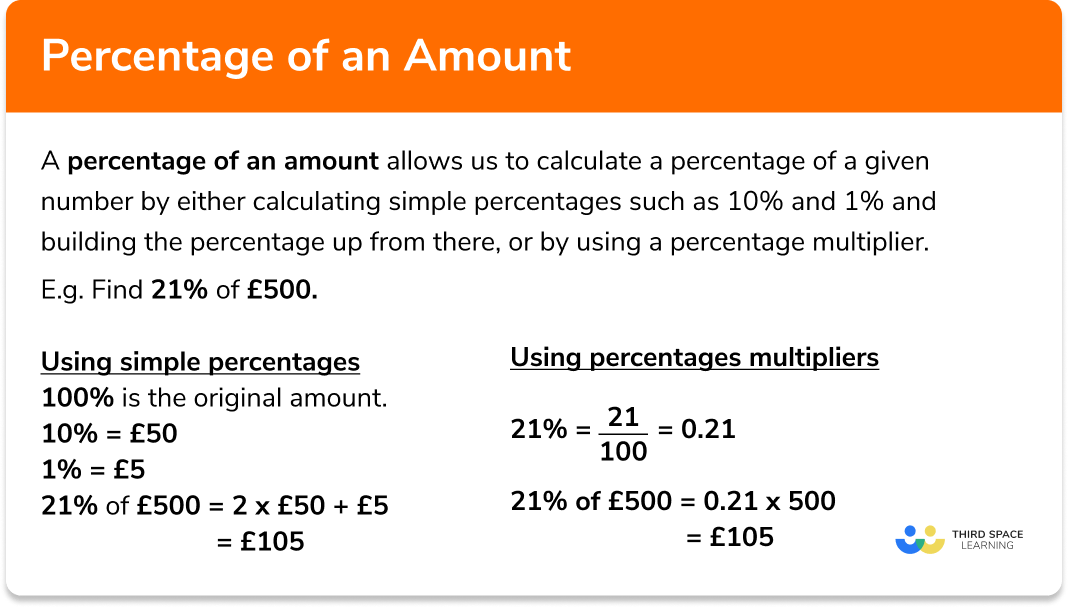
This is perhaps the most common percentage calculation. It’s used when calculating discounts, interest earned, taxes, or commissions.
The formula is: Percent (as a decimal) × Whole Number = Part
- Example 1 (Discount): You want to find 20% off a $150 item.
- Convert 20% to a decimal: 0.20
- Multiply by the whole: 0.20 × $150 = $30
- The discount is $30. The final price would be $150 – $30 = $120.
- Example 2 (Sales Tax): You need to calculate 7% sales tax on a $50 purchase.
- Convert 7% to a decimal: 0.07
- Multiply: 0.07 × $50 = $3.50
- The sales tax is $3.50. The total cost is $50 + $3.50 = $53.50.
Calculating Percentage Change
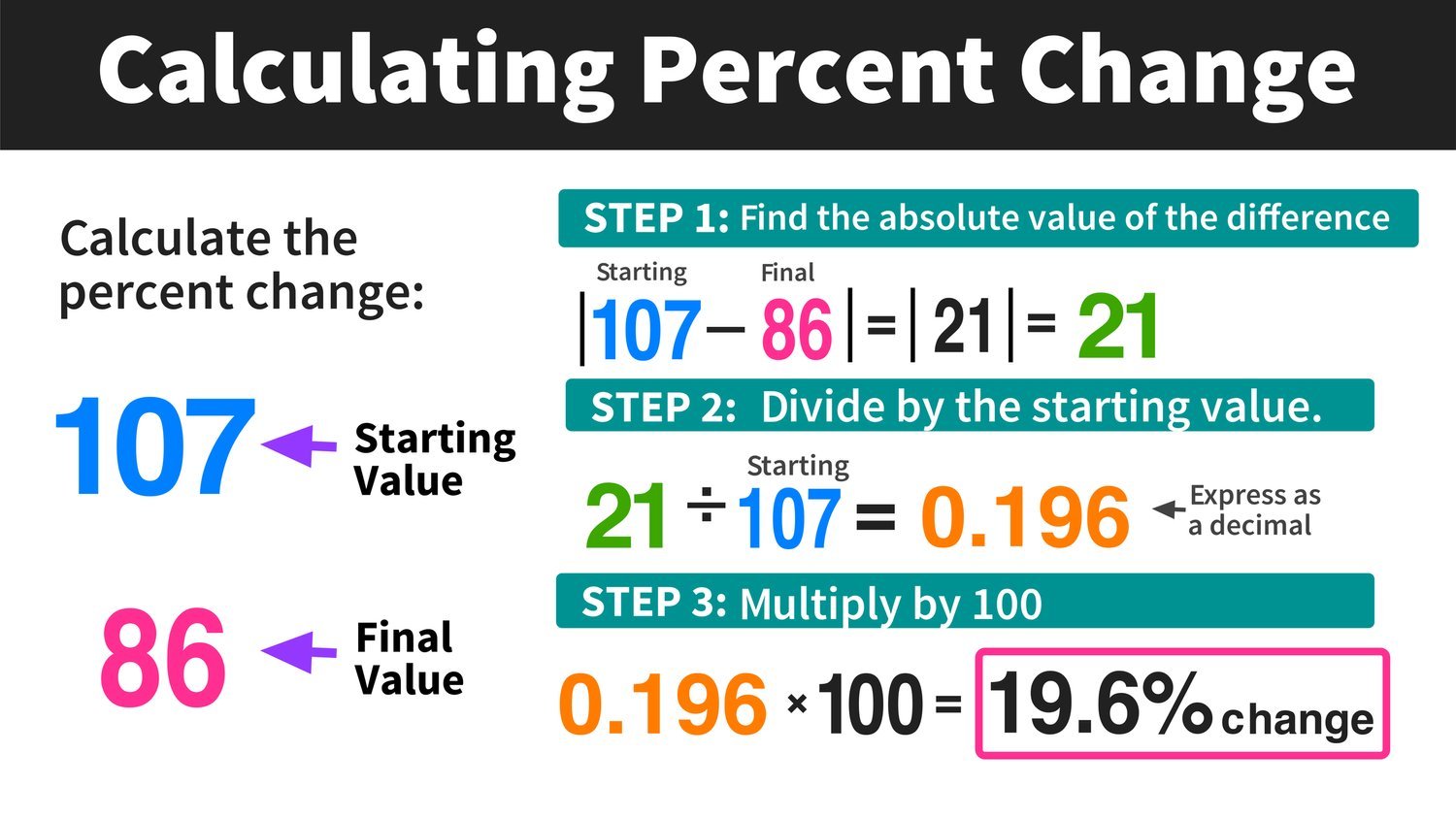
Percentage change is crucial for understanding growth, decline, profit increases, or budget reductions over time. It measures the relative difference between an old value and a new value.
The formula is: ((New Value – Old Value) / Old Value) × 100%
- Example 1 (Investment Growth): Your investment grew from $1,000 to $1,200.
- Difference: $1,200 – $1,000 = $200
- Divide by old value: $200 / $1,000 = 0.20
- Multiply by 100%: 0.20 × 100% = 20% increase.
- Example 2 (Expense Decrease): Your monthly utility bill decreased from $80 to $60.
- Difference: $60 – $80 = -$20
- Divide by old value: -$20 / $80 = -0.25
- Multiply by 100%: -0.25 × 100% = -25% decrease.
Determining What Percent One Number Is of Another
This calculation helps you understand what proportion one number represents relative to a total. It’s useful for calculating profit margins, contribution to a portfolio, or spending allocations.
The formula is: (Part / Whole) × 100%
- Example 1 (Portfolio Allocation): You have $2,500 invested in tech stocks and your total portfolio is $10,000. What percentage of your portfolio is in tech stocks?
- Part / Whole: $2,500 / $10,000 = 0.25
- Multiply by 100%: 0.25 × 100% = 25%
- Example 2 (Budget Allocation): Your monthly income is $4,000, and you spend $1,200 on housing. What percentage of your income goes to housing?
- Part / Whole: $1,200 / $4,000 = 0.30
- Multiply by 100%: 0.30 × 100% = 30%
Practical Applications in Personal Finance
Mastering percentage calculations unlocks a deeper understanding of your personal financial situation, enabling you to make more astute decisions regarding spending, saving, and borrowing.
Budgeting and Expense Tracking
Effective budgeting hinges on understanding the proportional allocation of your income. Rather than just seeing absolute dollar amounts, percentages allow you to view your spending relative to your income. A common budgeting rule, the 50/30/20 rule, uses percentages: 50% for needs, 30% for wants, and 20% for savings and debt repayment. Calculating your actual percentages for each category helps you assess adherence to your budget and identify areas for adjustment. Your savings rate, often expressed as a percentage of your income, is a critical metric for long-term financial health.
Understanding Loans and Investments
From the interest rate on a credit card or mortgage to the annual percentage yield (APY) on a savings account or the return on investment (ROI) from your stock portfolio, percentages are the primary language of debt and investing. Compound interest, a powerful force for wealth creation or debt accumulation, is calculated using percentage rates applied over time. Understanding how these percentages translate into actual dollar amounts is vital for choosing the right financial products and evaluating the performance of your assets.
Sales, Discounts, and Taxes
As consumers, we encounter percentages daily in sales ads and at the checkout. Knowing how to quickly calculate a 25% discount or a 6% sales tax allows you to verify totals, compare deals, and ensure you’re paying the correct amount. This skill prevents overspending and empowers you to be a more discerning shopper. Similarly, understanding tax brackets and how your income percentage is taxed is essential for financial planning.
Inflation and Purchasing Power
Inflation, defined as the rate at which the general level of prices for goods and services is rising, is expressed as a percentage. A 3% inflation rate means that on average, things cost 3% more than they did last year. Understanding this helps you gauge the real return on your investments (adjusted for inflation) and assess how your purchasing power erodes over time if your income doesn’t keep pace.
Percentages in Business and Side Hustles
For entrepreneurs, small business owners, and those engaged in side hustles, percentage calculations are indispensable for setting prices, analyzing profitability, and understanding market dynamics.
Profit Margins and Markups
Businesses live and die by their profit margins. Gross profit margin (Gross Profit / Revenue) and net profit margin (Net Profit / Revenue) are expressed as percentages and provide crucial insights into a company’s efficiency and financial health. Markups, the percentage added to the cost of a product to determine its selling price, are also vital for pricing strategies and ensuring profitability.
Commission Structures and Royalties
Many sales roles and creative professions operate on commission or royalty structures, which are almost always defined by percentages. Calculating your potential earnings from a 10% commission on a $1,000 sale, or a 5% royalty on a book’s net revenue, requires a solid grasp of percentage calculation. This helps in setting income goals and evaluating compensation packages.
Analyzing Business Growth and Performance
Key performance indicators (KPIs) for businesses are frequently expressed as percentages. Year-over-year revenue growth, customer churn rates, conversion rates, and market share are all percentage-based metrics that allow businesses to track progress, identify trends, and make strategic decisions. Understanding percentage change is particularly critical here to evaluate performance against targets and competitors.
Tax Implications for Businesses
Beyond income tax, businesses often deal with sales tax (VAT), payroll taxes, and other levies calculated as a percentage of revenue, profit, or wages. Accurate percentage calculations are paramount for compliance and managing cash flow. Miscalculations can lead to penalties or missed opportunities for deductions.
Tools and Tips for Accurate Percentage Calculations
While the underlying principles remain constant, leveraging modern tools and developing mental shortcuts can significantly enhance your efficiency and accuracy when dealing with percentages.
Leveraging Calculators and Spreadsheets
For complex calculations or when dealing with large datasets, a scientific calculator or spreadsheet software like Microsoft Excel or Google Sheets is invaluable. Spreadsheets, in particular, can automate percentage calculations, allowing you to easily adjust variables and see the impact in real-time. Formulas like =A2/B2 for “part of a whole” or =(B2-A2)/A2 for “percentage change” make light work of extensive financial analysis. Many online percentage calculators are also available for quick, specific tasks.
Mental Math Shortcuts for Common Percents
Developing the ability to quickly estimate common percentages can be incredibly useful in everyday financial situations.
- 10%: Move the decimal point one place to the left (e.g., 10% of $250 is $25).
- 5%: Find 10% and then halve it (e.g., 5% of $250 is $25 / 2 = $12.50).
- 1%: Move the decimal point two places to the left (e.g., 1% of $250 is $2.50).
- 25%: Divide by 4 (e.g., 25% of $100 is $25).
- 50%: Halve the number (e.g., 50% of $100 is $50).
These shortcuts allow for quick mental checks and estimates, which are valuable before committing to a purchase or when reviewing financial statements.
Avoiding Common Errors
A common pitfall is confusing the base value for the percentage calculation. For example, when calculating a tip, is it 20% of the bill before tax or after tax? Or when calculating a profit margin, is it based on the cost or the selling price? Always clarify what the “whole” or “old value” refers to. Another error is incorrect rounding; while estimations are useful, precise financial decisions often require greater accuracy. Lastly, simply forgetting to convert a percentage to its decimal form before multiplying is a frequent oversight that leads to wildly incorrect results.

Conclusion
The ability to calculate and interpret percentages is far more than a mathematical skill; it’s a cornerstone of financial literacy. From navigating personal budgets and comparing investment returns to analyzing business profits and understanding economic trends, percentages provide the indispensable framework for quantitative financial understanding. By internalizing the core calculation methods – finding a percentage of a number, calculating percentage change, and determining what percent one number is of another – you equip yourself with the tools necessary to make smarter, more confident financial decisions. Embrace the power of the percent, and unlock a deeper, more insightful perspective on your financial world.
aViewFromTheCave is a participant in the Amazon Services LLC Associates Program, an affiliate advertising program designed to provide a means for sites to earn advertising fees by advertising and linking to Amazon.com. Amazon, the Amazon logo, AmazonSupply, and the AmazonSupply logo are trademarks of Amazon.com, Inc. or its affiliates. As an Amazon Associate we earn affiliate commissions from qualifying purchases.