
Understanding how loan payments are calculated is a fundamental pillar of personal finance and responsible borrowing. Whether you’re contemplating a mortgage, an auto loan, a student loan, or a personal loan, the monthly payment is the most tangible and immediate financial commitment you’ll make. Grasping the mechanics behind this calculation empowers you to make informed decisions, negotiate better terms, and manage your debt effectively. This comprehensive guide will demystify the process, breaking down the core formula, exploring influencing factors, and providing practical tools to help you confidently calculate and understand your loan payments.
The Fundamental Formula: Understanding Amortization
At the heart of most installment loans is the concept of amortization – the process of paying off debt over time through a series of regular, equal payments. Each payment consists of both principal (the original amount borrowed) and interest (the cost of borrowing). Early in the loan term, a larger portion of your payment goes towards interest, while later payments allocate more towards the principal.
Deconstructing the Loan Payment Formula
The standard formula used to calculate a fixed-rate, amortizing loan payment is as follows:
M = P [ i(1 + i)^n ] / [ (1 + i)^n – 1 ]
Let’s break down each variable:
- M: This is your Monthly Payment. It’s the amount you’ll pay each period (typically monthly) until the loan is fully repaid.
- P: This represents the Principal Loan Amount. It’s the initial sum of money you borrowed.
- i: This is the Periodic Interest Rate. It’s crucial to use the interest rate per payment period. If your annual interest rate is 6% and payments are monthly, you would divide 0.06 by 12 (0.005). If payments were quarterly, you’d divide by 4.
- n: This is the Total Number of Payments over the life of the loan. If you have a 30-year loan with monthly payments, ‘n’ would be 30 years * 12 months/year = 360 payments. Similarly, for a 5-year loan with monthly payments, ‘n’ would be 5 * 12 = 60 payments.
- ^n: This denotes “raised to the power of n.”
Example Calculation:
Let’s say you take out a personal loan of $10,000 at an annual interest rate of 7% for a term of 5 years.
- P (Principal Loan Amount): $10,000
- Annual Interest Rate: 7%
- Loan Term: 5 years
Now, convert the annual rate and term to periodic values:
- i (Periodic Interest Rate): 7% / 12 months = 0.07 / 12 = 0.0058333 (approx.)
- n (Total Number of Payments): 5 years * 12 months/year = 60 payments
Plug these values into the formula:
M = 10,000 [ 0.0058333 (1 + 0.0058333)^60 ] / [ (1 + 0.0058333)^60 – 1 ]
First, calculate (1 + i)^n:
(1 + 0.0058333)^60 = (1.0058333)^60 ≈ 1.39345
Now, substitute back into the formula:
M = 10,000 [ 0.0058333 * 1.39345 ] / [ 1.39345 – 1 ]
M = 10,000 [ 0.0081285 ] / [ 0.39345 ]
M = 81.285 / 0.39345
M ≈ $206.60
So, your estimated monthly payment would be approximately $206.60. Over 60 payments, this amounts to $12,396, meaning you would pay $2,396 in interest over the life of the loan.
Practical Application and Key Considerations
When using this formula, precision is paramount, especially for the periodic interest rate. Rounding too early can lead to discrepancies in your final payment amount. Most financial calculators or spreadsheet functions handle these decimals with high accuracy. Remember, the ‘i’ and ‘n’ values must correspond to the payment period. If you make quarterly payments, ‘i’ would be the annual rate divided by 4, and ‘n’ would be the loan term in years multiplied by 4.
Key Factors Influencing Your Monthly Payment
While the formula provides the mathematical framework, three primary variables dictate the actual size of your monthly loan payment: the principal amount, the interest rate, and the loan term. Understanding how each impacts your payment is crucial for effective financial planning.
Principal Amount: The Core Debt
The principal is the starting point of your debt – the actual money you borrow from the lender. Naturally, a larger principal amount will result in a higher monthly payment, assuming all other factors (interest rate and loan term) remain constant. This is a direct relationship: borrow more, pay more each month.
- Impact: A $200,000 mortgage will have a significantly lower monthly payment than a $400,000 mortgage with the same interest rate and term.
- Strategy: Be realistic about how much you need to borrow. Over-borrowing can strain your budget and increase your financial risk. Minimizing the principal amount through larger down payments (for assets like homes or cars) or simply borrowing only what’s absolutely necessary is a powerful way to reduce your monthly obligation and total interest paid.

Interest Rate: The Cost of Borrowing
The interest rate is arguably the most critical factor influencing the total cost of your loan and, consequently, your monthly payment. It represents the percentage charged by the lender for the use of their money.
- Types:
- Fixed-Rate Loans: The interest rate remains the same for the entire life of the loan, providing predictable monthly payments.
- Variable-Rate Loans: The interest rate can fluctuate over time based on a benchmark index, meaning your monthly payments can change.
- Impact: Even a seemingly small difference in interest rates can have a substantial impact over the loan’s duration. For example, a 6% interest rate versus a 7% interest rate on a 30-year mortgage could translate to thousands of dollars in difference over the loan’s life and significantly impact your monthly payment. Higher interest rates lead to higher monthly payments and a greater total cost of borrowing.
- Strategy: Improve your credit score, shop around for competitive rates from multiple lenders, and consider the annual percentage rate (APR), which includes fees and other costs beyond just the stated interest rate, for a more accurate comparison of loan costs.
Loan Term: The Repayment Horizon
The loan term is the period over which you agree to repay the loan. This factor presents a direct trade-off between the size of your monthly payment and the total interest you’ll pay.
- Shorter Terms:
- Higher Monthly Payments: You’re paying back the principal over fewer periods.
- Less Total Interest Paid: The money is borrowed for a shorter time, so less interest accrues.
- Example: A 15-year mortgage will have higher monthly payments than a 30-year mortgage for the same principal and interest rate, but you’ll pay off the loan faster and save a significant amount on interest.
- Longer Terms:
- Lower Monthly Payments: The principal is spread out over more periods, making each payment smaller.
- More Total Interest Paid: The money is borrowed for a longer time, allowing more interest to accumulate.
- Example: A 60-month car loan will have lower monthly payments than a 36-month loan for the same amount, but you’ll pay more interest over the longer period.
- Strategy: Choose a loan term that balances affordability with your financial goals. While lower payments might seem attractive, consider the total cost. If you can comfortably afford a shorter term, you’ll save money in the long run.
Beyond the Formula: Tools and Practical Approaches
While knowing the formula is empowering, in practice, most people rely on readily available tools to calculate loan payments quickly and accurately. These tools also offer additional insights beyond just the monthly payment figure.
Leveraging Online Calculators and Financial Spreadsheets
The internet is replete with free online loan calculators offered by banks, financial news sites, and specialized calculator websites. These tools are incredibly user-friendly: you simply input the principal, interest rate, and loan term, and they instantly provide your monthly payment.
- Benefits of Online Calculators:
- Speed and Convenience: Get immediate results without manual calculation.
- “What-If” Scenarios: Easily adjust variables to see how changes in interest rate or term affect your payment, helping you explore different borrowing options.
- Amortization Schedules: Many advanced calculators generate a full amortization schedule, showing how much principal and interest are paid with each installment over the loan’s life.
- Financial Spreadsheets (e.g., Excel, Google Sheets):
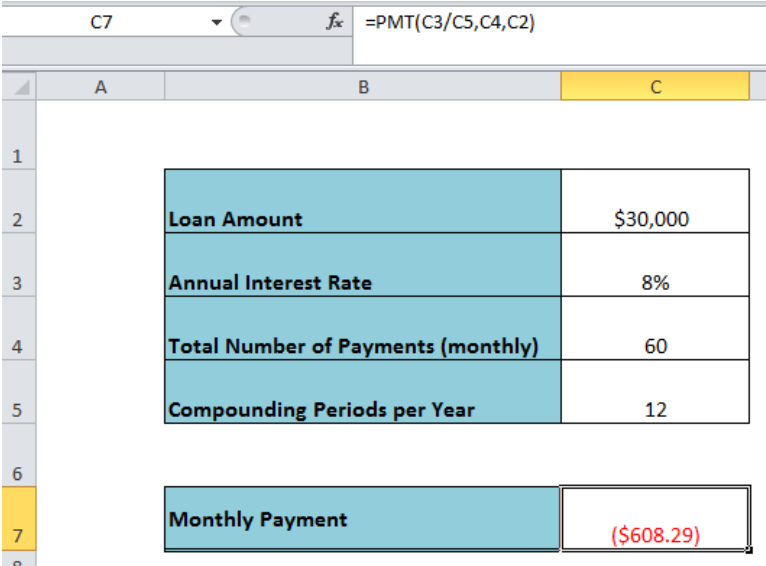
- For those comfortable with spreadsheets, functions like
PMT(Payment) in Excel or Google Sheets offer powerful and precise loan payment calculations. - PMT(rate, nper, pv, [fv], [type])
rate: The interest rate per period (e.g., annual rate / 12).nper: The total number of payments (e.g., loan term * 12).pv: The present value or principal loan amount.[fv]: Optional future value (usually 0 for a fully amortized loan).[type]: Optional, indicating when payments are due (0 for end of period, 1 for beginning).
- Spreadsheets also allow you to build custom amortization tables, giving you complete control and understanding of the repayment breakdown.
- For those comfortable with spreadsheets, functions like
Understanding Amortization Schedules
An amortization schedule is a table detailing each periodic loan payment. It shows the amount of principal and interest contained within each payment, as well as the remaining balance after each payment.
- What They Are: These schedules offer a transparent view of your loan’s progression. You’ll notice that early payments are heavily weighted towards interest, with only a small portion going to reduce the principal. As the loan matures, the proportion shifts, and more of each payment reduces the principal.
- Why They Are Valuable:
- Transparency: Clearly shows how your money is being allocated.
- Tracking Progress: Helps you see your debt diminishing over time.
- Impact of Extra Payments: An amortization schedule can vividly illustrate how making extra payments towards the principal can dramatically shorten your loan term and reduce total interest paid. By reducing the principal faster, you reduce the base on which future interest is calculated.
Strategic Implications for Borrowers
Understanding loan payment calculations isn’t just about crunching numbers; it’s about making smarter financial decisions that can save you money and reduce stress over the long term.
Informed Decision-Making and Budgeting
Before committing to any loan, calculating the monthly payment is the first step in assessing its affordability. Can this payment comfortably fit into your existing budget without jeopardizing other financial obligations or savings goals?
- Budget Alignment: Use the calculated payment to refine your budget. Ensure you have sufficient disposable income to cover the payment consistently.
- Avoiding Over-Borrowing: If a calculated payment feels too high, it’s a clear signal to reconsider the loan amount, seek a lower interest rate, or explore a longer term (if the total cost isn’t prohibitive). It prevents you from taking on more debt than you can realistically manage.
The Power of Extra Payments
Once you understand how the principal and interest are broken down through an amortization schedule, the benefit of making extra payments becomes incredibly clear. Even small, consistent additional payments can have a profound impact.
- Reducing Total Interest: When you make an extra payment, and specify it to be applied directly to the principal, you reduce the base on which future interest is calculated. This snowball effect can shave years off a loan term and save you thousands in interest over time.
- Accelerating Debt Freedom: Paying off a loan faster frees up cash flow for other financial goals, such as saving for retirement, investing, or achieving true financial independence.
- Prepayment Penalties: Be aware that some loans, particularly certain mortgages or personal loans, may have prepayment penalties. Always check your loan agreement for such clauses before making significant extra payments.

Refinancing and Loan Restructuring
The ability to calculate loan payments is indispensable when considering refinancing existing debt or restructuring a loan. Refinancing involves taking out a new loan, typically with a lower interest rate or a different term, to pay off an existing one.
- Comparing New Terms: When evaluating a refinance offer, you’ll need to calculate the new monthly payment based on the proposed interest rate and term. Compare this to your current payment to see the immediate savings.
- Total Cost Analysis: Don’t just look at the monthly payment. Calculate the total interest paid under the new loan versus the remaining interest on your old loan. Factor in any closing costs or fees associated with refinancing. Sometimes, a lower monthly payment might come with a longer term, leading to more interest paid overall.
- Debt Consolidation: For consolidating multiple debts (e.g., credit cards) into a single personal loan, calculating the new consolidated payment is essential to ensure it’s manageable and genuinely reduces your overall interest burden.
In conclusion, understanding “how do you calculate a loan payment” is more than just a mathematical exercise; it’s a cornerstone of financial literacy. By mastering the formula, appreciating the impact of principal, interest, and term, and utilizing available tools, you gain the power to manage your debt intelligently. This knowledge empowers you to make wise borrowing decisions, budget effectively, and strategically pay down your debt, ultimately paving the way for greater financial stability and freedom.
aViewFromTheCave is a participant in the Amazon Services LLC Associates Program, an affiliate advertising program designed to provide a means for sites to earn advertising fees by advertising and linking to Amazon.com. Amazon, the Amazon logo, AmazonSupply, and the AmazonSupply logo are trademarks of Amazon.com, Inc. or its affiliates. As an Amazon Associate we earn affiliate commissions from qualifying purchases.