
In the world of commerce, a business plan is often misunderstood as a mere administrative hurdle or a creative exercise in branding. However, through the lens of high-level finance, a business plan is something far more critical: it is a technical manual for capital allocation. Whether you are launching a side hustle, scaling a startup, or seeking a multi-million dollar venture capital injection, your business plan serves as the ultimate roadmap for how a specific set of inputs (capital, time, and labor) will be transformed into significant outputs (profit, equity value, and dividends).

Writing a business plan is, at its core, an exercise in risk mitigation and financial forecasting. It requires the entrepreneur to move beyond abstract ideas and confront the hard reality of unit economics, burn rates, and market volatility. To build a sustainable enterprise, one must treat the business plan as a living financial document designed to prove one central thesis: that the business is a viable vehicle for wealth creation.
Establishing the Fiscal Framework: The Strategic Purpose of Your Plan
Before a single word is typed, the entrepreneur must understand the financial objective of the document. A business plan written for a local bank to secure a small business loan looks very different from one written for an angel investor seeking a 10x return. Understanding the “Money” behind the plan is the first step toward success.
Defining Your Funding Requirements
Every business plan must begin with a clear understanding of its capital needs. Are you bootstrapping the venture using personal savings, or are you looking for external equity? You must calculate your “start-up runway”—the amount of time your business can operate before it needs to become self-sustaining. This involves a granular breakdown of initial capital expenditures (CapEx), such as equipment and licensing, versus operating expenses (OpEx), such as rent and payroll. A plan that fails to specify exactly how much money is needed, and exactly how that money will be spent, is a plan that will fail to secure investment.
The Role of Financial Projections in Risk Mitigation
Projections are not just “best-case scenarios”; they are a mathematical exploration of the future. A sophisticated business plan includes three-to-five-year financial projections that account for various market conditions. This includes a “base case,” a “best case,” and a “conservative case.” By modeling these scenarios, you demonstrate to yourself and your potential investors that you have accounted for financial risk. You must be able to answer: What happens to our solvency if the cost of raw materials increases by 20%? or How long can we survive if sales targets are missed by half in the first year?
Designing the Revenue Model: How Your Business Will Generate Wealth
A business that does not make money is not a business; it is a hobby. The most critical section of your business plan is the description of your revenue model. This is where you explain the mechanics of your “Money” machine. It is not enough to say you will sell a product; you must explain the financial logic behind every transaction.
Revenue Streams and Profitability Models
How, precisely, does money flow from the customer to your bank account? There are several models to consider, each with different financial implications. A subscription model provides recurring revenue, which increases the lifetime value (LTV) of a customer and makes cash flow more predictable. A one-time sales model requires a high volume and lower customer acquisition costs (CAC) to remain viable. In your plan, you must detail these streams. If you have multiple streams—such as a product sale combined with a service contract—explain the margin on each. High-margin revenue is the lifeblood of growth, as it provides the excess capital necessary for reinvestment.
Cost Structure and Break-Even Analysis
To understand your profit, you must first master your costs. A professional business plan categorizes costs into fixed (those that stay the same regardless of output, like insurance) and variable (those that fluctuate with production, like shipping). This leads to the “Break-Even Point”—the exact moment when your total revenue equals your total expenses. For any investor or finance-minded founder, the break-even analysis is the “Golden Ratio.” It tells you how much volume you must move before you move from “spending money” to “making money.”
Mastering the Financial Appendix: Projections, Cash Flow, and Balance Sheets

While the narrative portion of your business plan tells the story, the financial appendix provides the evidence. This is the section where professional investors spend 90% of their time. It requires a level of fiscal discipline that separates successful entrepreneurs from dreamers.
Cash Flow Management and the Statement of Cash Flows
It is a common financial adage that “Profit is an opinion, but cash is a fact.” Many profitable businesses go bankrupt because they run out of cash. This happens when there is a mismatch between when expenses are paid and when revenue is received. Your business plan must include a detailed Statement of Cash Flows. This tracks the movement of money in and out of the business on a monthly basis. It accounts for accounts receivable (money owed to you) and accounts payable (money you owe). Demonstrating a mastery of cash flow shows that you understand how to maintain liquidity and keep the business operational during lean months.
The Balance Sheet and Income Statement
The Income Statement (P&L) provides a snapshot of your performance over a specific period, showing your net income after all expenses and taxes. The Balance Sheet, conversely, shows the financial health of the business at a specific point in time by listing assets, liabilities, and equity. Together, these documents provide a holistic view of the company’s value. If you are seeking a side hustle income, these documents help you track your personal ROI. If you are building a corporate entity, they are the standard by which your business will be valued by the market.
The Investor Perspective: Pitching for Capital and Long-Term Value
If the goal of your business plan is to attract outside money, you must write through the lens of an investor. Investors are not buying your product; they are buying a piece of your future cash flows. Your plan must articulate why your business is a better investment than the stock market or real estate.
The Executive Summary as a Pitch for ROI
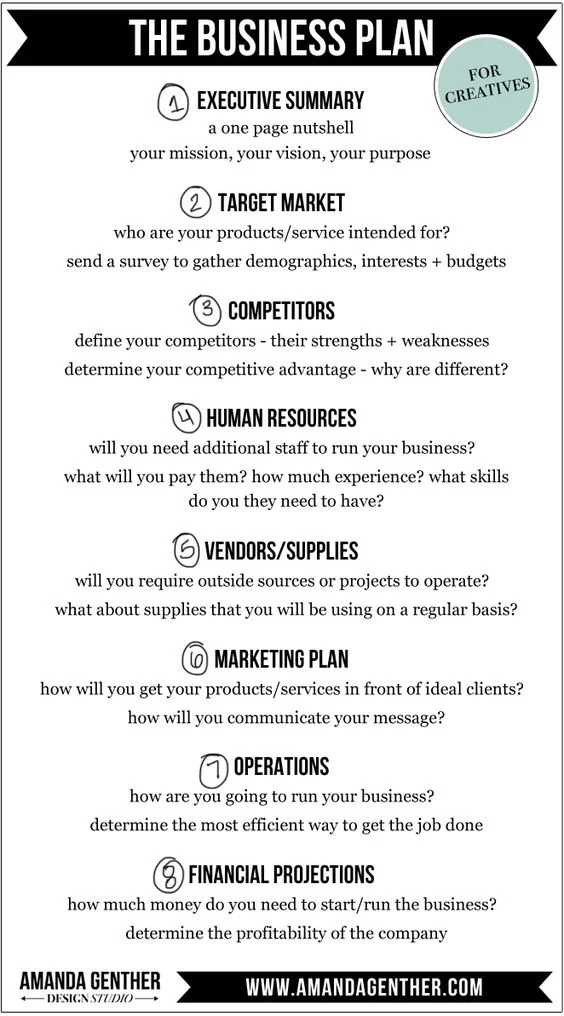
The Executive Summary is the most important two pages of the document. From a financial perspective, it should lead with the “Ask” and the “Offer.” What is the valuation of the company? What percentage of equity are you giving up for the capital? What is the projected Internal Rate of Return (IRR)? By framing the summary around Return on Investment (ROI), you immediately signal that you are a fiscally responsible leader who prioritizes the growth of capital.
Exit Strategies and Valuation
Every financial investment requires an exit. Whether it is an Initial Public Offering (IPO), an acquisition by a larger competitor, or a management buyout, your business plan should contemplate the “end game.” How will the people who put money in today get their money out (plus a profit) in five to ten years? Providing a clear exit strategy demonstrates that you are focused on the ultimate financial goal: liquidity and wealth realization. This section should also discuss your valuation—how you calculated the worth of the company using methods like Discounted Cash Flow (DCF) or Comparable Company Analysis.
Financial Controls and Sustainable Growth
The final stage of writing a business plan involves detailing how you will protect the money once it starts flowing. A business that grows too fast without financial controls will inevitably collapse under the weight of its own inefficiencies.
Scaling and Reinvestment Strategies
Growth requires capital. In your plan, you must outline your strategy for “retained earnings.” Will you take profits as a dividend, or will you reinvest them into the business to trigger exponential growth? High-growth companies often operate at a loss initially to capture market share, a strategy known as “capital intensity.” Your plan must justify this approach by showing how increased scale will eventually lead to higher margins through “economies of scale.”
Fiscal Discipline and Auditing
Finally, your plan should mention your internal financial controls. Who manages the books? How will you prevent fraud and waste? By mentioning your commitment to regular audits and the use of modern financial tools (such as automated accounting software and expense tracking), you build trust with lenders and partners. Fiscal discipline is the hallmark of a mature business. It ensures that every dollar spent is an investment in the company’s future, rather than a leak in the boat.
In conclusion, writing a business plan is the first and most important financial decision you will make as an entrepreneur. By focusing on the “Money”—the capital requirements, the revenue models, the cash flow, and the eventual ROI—you transform a simple idea into a robust financial asset. A well-written plan doesn’t just ask for money; it proves that the money will be handled with the precision and strategy required to generate a fortune.
aViewFromTheCave is a participant in the Amazon Services LLC Associates Program, an affiliate advertising program designed to provide a means for sites to earn advertising fees by advertising and linking to Amazon.com. Amazon, the Amazon logo, AmazonSupply, and the AmazonSupply logo are trademarks of Amazon.com, Inc. or its affiliates. As an Amazon Associate we earn affiliate commissions from qualifying purchases.