
Facing a tax bill you can’t pay immediately can be a daunting experience, triggering anxiety and uncertainty about potential repercussions. However, the Internal Revenue Service (IRS) offers various solutions designed to help taxpayers manage their obligations when immediate full payment isn’t feasible. Understanding these options, from short-term extensions to long-term installment agreements and even offers in compromise, is crucial for maintaining compliance and avoiding further penalties. Proactively addressing your tax debt with the IRS demonstrates good faith and can prevent more severe collection actions.
Understanding Your Options When You Can’t Pay Your Tax Bill
Ignoring a tax bill is arguably the worst approach you can take. The IRS is a powerful collection agency, and their enforcement mechanisms can significantly impact your financial well-being. Recognizing that taxpayers sometimes face genuine financial hardship, the IRS has established clear pathways for those who need more time or a different payment structure.

Why Payment Plans Are Necessary
Tax payment plans serve as a vital financial safety net. They allow individuals and businesses to fulfill their tax liabilities without facing immediate bankruptcy or liquidating essential assets. By formally agreeing to a payment plan, you not only manage your cash flow more effectively but also mitigate the accumulation of severe penalties and interest that can quickly inflate your original debt. These plans provide a structured approach to resolving tax debt, bringing predictability to an otherwise stressful situation. They are a testament to the IRS’s policy of working with taxpayers rather than against them, provided the taxpayer is willing to engage and cooperate.
Consequences of Ignoring Your Tax Bill
The repercussions of neglecting your tax obligations can be severe and escalate over time. Initially, the IRS will send a series of notices outlining your tax due, the penalties accrued, and the interest charged. If these notices are ignored, the IRS can proceed with more aggressive collection actions. These include issuing levies on bank accounts, wages, and other financial assets, or placing liens on real estate and personal property, which can impact your credit rating and ability to sell or refinance assets. The agency can also seize assets to satisfy the debt. In extreme cases, and particularly with willful evasion, criminal charges are a possibility. Engaging with the IRS to set up a payment plan is a proactive step that can halt or prevent these severe enforcement actions, protecting your assets and financial future.
Navigating the IRS Payment Plan Landscape
The IRS offers several distinct payment arrangements, each suited to different financial circumstances and debt amounts. Choosing the right option depends on the size of your debt, your ability to pay, and how quickly you can resolve the outstanding amount.
Short-Term Payment Plans (Up to 180 Days)
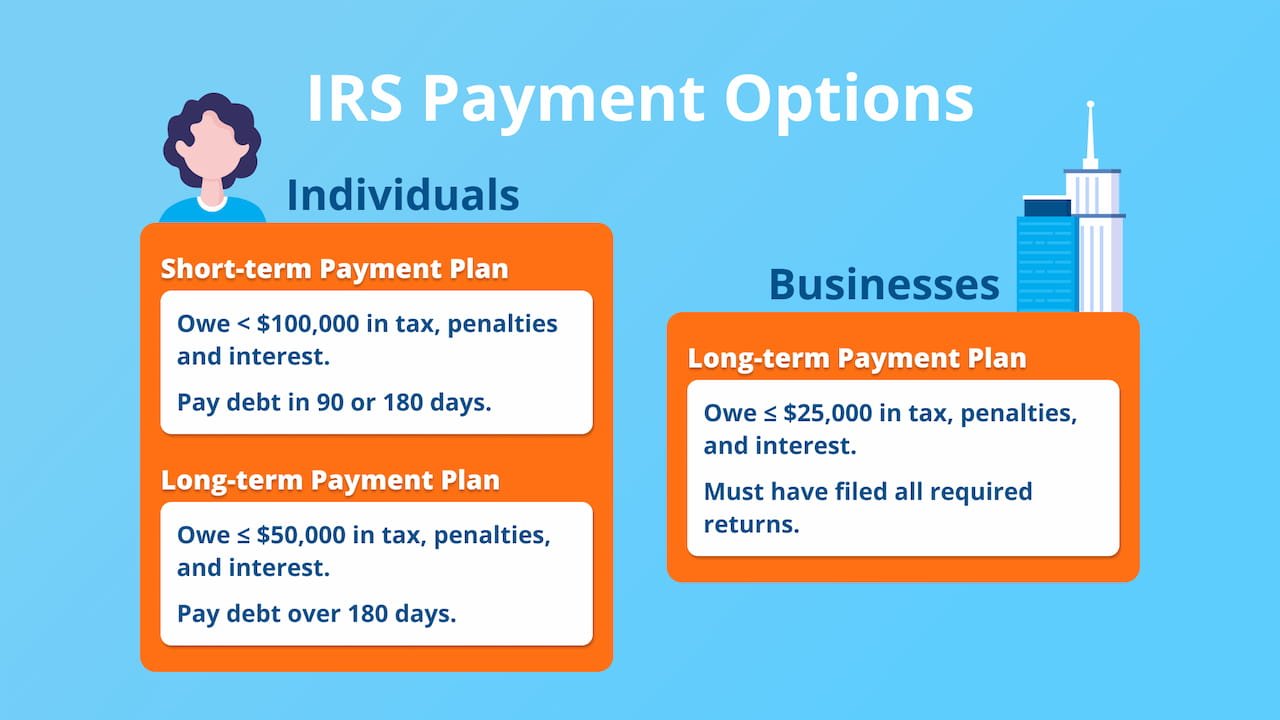
If you can pay your full tax liability within 180 days, but just need a little more time, a short-term payment plan might be appropriate. This option allows you to extend the time to pay your tax bill in full, usually for up to 180 days, though interest and penalties continue to accrue until the balance is paid. There is no fee to set up a short-term payment plan. To request this, you typically don’t need to formally apply; you can often get an extension simply by calling the IRS or responding to a tax notice. This is generally the easiest option if your financial crunch is temporary.
Installment Agreements (Longer-Term Payment Plans)
For those who need more than 180 days, an installment agreement is the most common and robust solution. This allows taxpayers to make monthly payments for up to 72 months (six years).
What is an Installment Agreement?
An installment agreement is a formal contract with the IRS where you agree to make a series of monthly payments over an extended period. During the term of the agreement, the IRS generally won’t take enforced collection actions like levies or liens, provided you adhere to the terms. However, interest and late-payment penalties continue to accrue, albeit often at a reduced rate compared to failing to file an agreement. The goal is to pay off your tax debt in full, plus any accrued interest and penalties, by the end of the agreement term.
How to Apply for an Installment Agreement
The process for applying for an installment agreement is relatively straightforward for many taxpayers:
- Online Payment Agreement (OPA) Application: This is the quickest and easiest method for most individuals and businesses. If your combined tax, penalties, and interest are under $50,000 for individuals (or $25,000 for businesses for quarterly income tax, penalties, and interest), you can apply online. The system allows you to propose a monthly payment amount and view an estimated payout schedule. If approved, the agreement is generally effective immediately.
- By Phone: You can call the IRS directly to discuss your options and potentially set up an agreement. Have your tax information handy, as the representative will need to verify your identity and tax liabilities.
- By Mail: For those who prefer paper or don’t qualify for the OPA (e.g., higher debt amounts), you can complete and mail Form 9465, Installment Agreement Request. Depending on the amount owed, you may also need to submit Form 433-F, Collection Information Statement, or Form 433-A, Collection Information Statement for Wage Earners and Self-Employed Individuals, to provide a detailed snapshot of your financial situation. This helps the IRS determine your ability to pay.
Key Considerations for Installment Agreements
- Fees: There is a one-time setup fee for an installment agreement, which can be reduced if you opt for direct debit payments or if you are a low-income taxpayer.
- Interest and Penalties: Interest continues to accrue on the unpaid balance. The late-payment penalty may be reduced by half (to 0.25% per month) if an installment agreement is in effect.
- Compliance: You must remain compliant with all tax filings and payments while the agreement is active. This means filing all future tax returns on time and paying any new taxes due by the deadline. Failure to do so can result in defaulting on your installment agreement.
Offer in Compromise (OIC) – When It’s Your Last Resort
An Offer in Compromise (OIC) is a more complex and less common option. It allows certain taxpayers to resolve their tax liability with the IRS for a lower amount than what they originally owe. An OIC is typically granted when there’s serious doubt that the taxpayer will ever be able to pay the full amount, or when paying the full amount would cause significant financial hardship.
Eligibility Criteria for OIC
The IRS considers three main grounds for an OIC:
- Doubt as to Collectibility: There is doubt that you could ever pay the full amount of tax owed. This is the most common reason. The IRS assesses your ability to pay based on your assets, income, expenses, and future earning potential.
- Doubt as to Liability: There is doubt that you actually owe the tax liability. This is rare and usually means you dispute the validity of the tax assessment itself.
- Effective Tax Administration (ETA): Although you could pay the full amount, doing so would cause you significant financial hardship. This could be due to serious health issues, or other unique circumstances that would leave you unable to provide for basic living expenses.
The OIC Process and What to Expect
Applying for an OIC is an involved process. You must submit Form 656, Offer in Compromise, along with a detailed financial statement (Form 433-A (OIC) for individuals or 433-B (OIC) for businesses). A non-refundable application fee is usually required, and you must make an initial payment with your offer, unless you qualify for an exception. The IRS will review your financial situation thoroughly, including income, expenses, and asset equity, to determine your “reasonable collection potential” – the most the IRS can expect to collect from you. The review process can take several months, and the IRS might request additional documentation. It’s advisable to seek professional help for an OIC due to its complexity and the high bar for acceptance.
Currently Not Collectible (CNC) Status
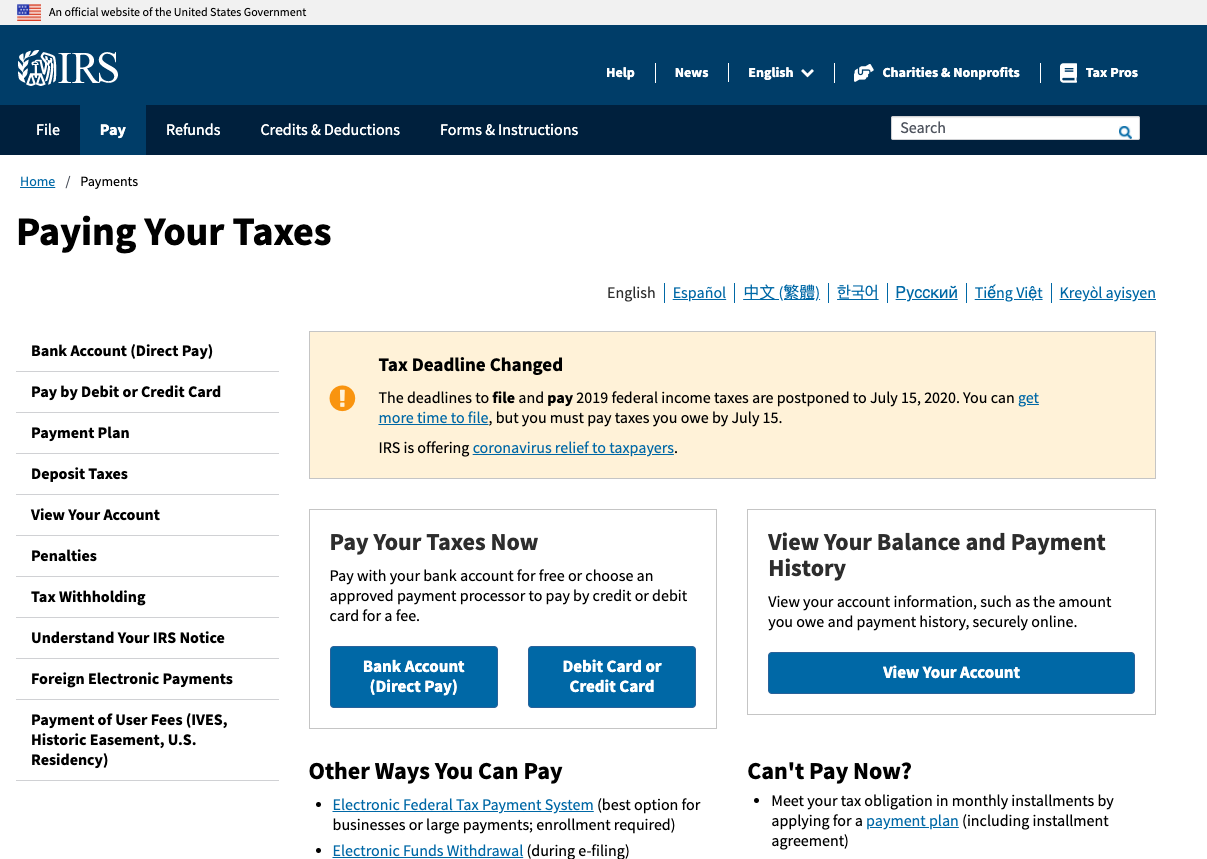
In situations of extreme financial hardship, the IRS may place your account in “Currently Not Collectible” (CNC) status. This means the IRS has determined you have no ability to pay any of your tax debt at the present time, after considering your income, expenses, and asset equity. While in CNC status, the IRS will temporarily stop collection efforts, but interest and penalties will continue to accrue. Your account will be reviewed periodically, typically annually, to see if your financial situation has improved. This status is generally temporary and doesn’t eliminate the tax debt; it merely postpones collection.
Preparing Your Application and What to Expect
Regardless of the payment plan you pursue, thorough preparation is key to a smoother process and a higher chance of approval.
Essential Information and Documentation
For any formal payment arrangement, the IRS will require documentation to verify your financial standing. Be prepared to provide:
- Taxpayer Identification Number (TIN): Your Social Security Number (SSN) or Employer Identification Number (EIN).
- Past Tax Returns: Information from the tax returns associated with the debt.
- Income Documentation: Recent pay stubs, profit and loss statements (for self-employed individuals), or other proof of income.
- Expense Documentation: Bills for rent/mortgage, utilities, food, transportation, medical expenses, and other necessary living costs.
- Asset Information: Bank statements, investment account balances, and information on real estate, vehicles, and other valuable assets.
- Account Balances: If applying online for an Installment Agreement, knowing your exact tax liability (tax, penalties, and interest) is important.
Calculating Your Ability to Pay
The IRS uses a standardized set of national and local standards for certain expense categories (e.g., food, housing, transportation, healthcare) to determine your allowable living expenses. Your ability to pay is calculated by subtracting your necessary living expenses from your net income. The remaining amount is what the IRS expects you to pay towards your tax debt monthly. It’s important to be honest and accurate in your financial disclosures; misrepresentation can lead to severe penalties. While the IRS uses these standards, they may also consider your actual expenses if they are reasonable and necessary and you can provide justification.
The Review Process and Communication with the IRS
Once you submit your application, the IRS will review your financial information. For online installment agreements, approval is often immediate. For more complex arrangements like an OIC or a mail-in installment agreement requiring financial statements, the review process can take weeks or even months. During this time, the IRS may contact you for additional information or clarification. It’s crucial to respond promptly and fully to any requests. Maintain clear records of all correspondence and documentation exchanged with the IRS.
Maintaining Your Payment Plan and Avoiding Default
Securing a payment plan is only half the battle; successfully adhering to its terms is paramount to resolving your tax debt and avoiding future complications.
Adhering to Payment Schedules
Once an agreement is in place, consistent and timely payments are non-negotiable. Missing a payment or making a late payment can result in the IRS defaulting your agreement. Most plans offer direct debit options, which are often the most reliable way to ensure payments are made on time and can sometimes reduce setup fees. If you foresee a temporary inability to make a payment, contact the IRS immediately to discuss your options. They may be willing to temporarily adjust your payment or allow a brief deferral, but communication is key.
Filing Future Tax Returns on Time
A critical component of any IRS payment plan is the requirement to remain compliant with all future tax obligations. This means filing all required tax returns on time and paying any new taxes due in full by the deadline. If you incur new tax debt or fail to file future returns, the IRS can default your existing payment plan. This would immediately make the full original debt, plus accumulated interest and penalties, due and payable, potentially leading to renewed collection actions.
What Happens If You Default?
Defaulting on a payment plan has serious consequences. The IRS will typically send a notice of intent to terminate your agreement. If the agreement is terminated, the full outstanding balance of your tax debt becomes immediately due. The IRS will then resume or initiate aggressive collection efforts, including issuing levies and liens, often with increased interest and penalties. Reinstating a defaulted agreement can be challenging and may require demonstrating a significant change in financial circumstances or providing a larger down payment.
Seeking Professional Assistance
While many basic payment plans can be set up by taxpayers directly, some situations warrant the expertise of a tax professional.
When to Consult a Tax Professional
Consider consulting a tax professional, such as an Enrolled Agent (EA), Certified Public Accountant (CPA), or tax attorney, if:
- Your tax debt is substantial or complex.
- You’re pursuing an Offer in Compromise (OIC). These are notoriously difficult to get approved.
- Your financial situation is complicated or unstable.
- You’ve defaulted on a previous payment plan.
- You disagree with the amount the IRS says you owe.
- You’re facing severe collection actions like levies or liens.
- You need help navigating the nuances of tax law and IRS procedures.
Benefits of Expert Guidance
A qualified tax professional can provide invaluable assistance by:
- Evaluating your situation: Helping you determine the most appropriate payment option.
- Preparing documentation: Ensuring all forms are completed accurately and completely, reducing delays.
- Negotiating with the IRS: Acting as your representative, which can reduce stress and ensure your best interests are advocated.
- Protecting your rights: Ensuring the IRS adheres to proper procedures and protecting you from unfair collection practices.
- Developing a long-term strategy: Advising on how to avoid future tax issues and manage your financial health.
Navigating tax debt can be stressful, but the IRS offers pathways to resolution. By understanding your options, preparing diligently, and maintaining open communication, you can effectively manage your tax obligations and regain financial stability.
aViewFromTheCave is a participant in the Amazon Services LLC Associates Program, an affiliate advertising program designed to provide a means for sites to earn advertising fees by advertising and linking to Amazon.com. Amazon, the Amazon logo, AmazonSupply, and the AmazonSupply logo are trademarks of Amazon.com, Inc. or its affiliates. As an Amazon Associate we earn affiliate commissions from qualifying purchases.