
In the complex world of personal finance, investing, and business, numbers often tell a story – but percentages are the language that gives that story context and meaning. From evaluating a discount on a new purchase to understanding the interest rate on a loan, assessing your investment growth, or analyzing your budget, percentages are an omnipresent and indispensable tool. They allow us to compare, allocate, measure change, and make informed decisions with precision.
Far from being mere academic constructs, percentages are the practical bedrock upon which sound financial literacy is built. This guide will demystify the concept of percentages, walk you through essential calculations, and illustrate their profound impact on your financial well-being, helping you translate raw numbers into actionable insights. Mastering percentages isn’t just about math; it’s about gaining clarity and control over your financial destiny.

The Foundational Concepts: What is a Percentage?
Before we delve into intricate financial scenarios, it’s crucial to establish a solid understanding of what a percentage truly represents. Stripped of jargon, a percentage is simply a way to express a part of a whole in terms of 100. The term “percent” itself originates from the Latin “per centum,” meaning “by the hundred.”
Defining the Basics
At its core, a percentage is a fraction where the denominator is 100. For instance, 25% literally means 25 out of 100. This makes percentages incredibly useful for comparison because they standardize the “whole” to a common base of 100.
You can seamlessly convert between percentages, fractions, and decimals:
- Percentage to Decimal: Divide the percentage by 100. (e.g., 25% = 25 / 100 = 0.25)
- Decimal to Percentage: Multiply the decimal by 100. (e.g., 0.25 = 0.25 * 100 = 25%)
- Fraction to Percentage: Divide the numerator by the denominator, then multiply by 100. (e.g., 1/4 = 0.25 * 100 = 25%)
- Percentage to Fraction: Place the percentage over 100 and simplify. (e.g., 25% = 25/100 = 1/4)
The most fundamental formula for finding a percentage is:
Percentage = (Part / Whole) × 100
Where:
- Part is the specific amount or quantity you are interested in.
- Whole is the total amount or quantity from which the part is taken.
This simple formula is the gateway to understanding a vast array of financial calculations.
Why Percentages Matter in Your Finances
The relevance of percentages in finance cannot be overstated. They are the universal language for measuring:
- Interest: Whether you’re earning interest on your savings or paying it on a loan, interest rates are almost always expressed as percentages (e.g., 3% APR on a credit card, 0.5% APY on a savings account).
- Discounts and Sales: A “20% off” sign instantly communicates savings.
- Taxes: Income tax brackets, sales tax, property tax – all utilize percentages to determine your obligation.
- Investment Returns: The performance of stocks, bonds, and mutual funds is quantified by percentage gains or losses.
- Budgeting: Allocating a certain percentage of your income to housing, food, or savings helps manage your money effectively.
- Inflation: The rate at which prices for goods and services rise, eroding purchasing power, is measured in percentages.
Understanding how to calculate and interpret percentages empowers you to assess financial opportunities, avoid pitfalls, and make choices that align with your financial goals. Without this understanding, you’d be navigating your financial life with a significant handicap, unable to truly gauge the impact of various transactions and economic shifts.
Essential Calculations: Practical Applications in Personal Finance
With the foundational understanding in place, let’s explore the most common percentage calculations you’ll encounter in your financial life. Each scenario demands a slightly different approach, but all stem from the core concept of part, whole, and percentage.
Calculating a Percentage of a Number (e.g., Discounts, Taxes, Tips)
This is perhaps the most frequent percentage calculation people perform daily. You have a whole amount, and you want to find a specific percentage of that amount.
Formula: Percentage of a Number = (Percentage / 100) × Whole Number
Alternatively, convert the percentage to a decimal first and then multiply:
Percentage of a Number = Decimal Equivalent × Whole Number
Examples:
- Finding a Discount: You want to buy a jacket for $150, and it’s 20% off.
- Discount amount = (20 / 100) × $150 = 0.20 × $150 = $30.
- Final price = $150 – $30 = $120.
- Calculating Sales Tax: Your grocery bill is $75, and the sales tax rate is 8%.
- Tax amount = (8 / 100) × $75 = 0.08 × $75 = $6.
- Total cost = $75 + $6 = $81.
- Estimating a Tip: Your restaurant bill is $60, and you want to leave a 15% tip.
- Tip amount = (15 / 100) × $60 = 0.15 × $60 = $9.
- Total to pay = $60 + $9 = $69.
Determining Percentage Change (e.g., Investment Growth, Inflation, Salary Increases)
Percentage change helps you understand the relative increase or decrease between two values over time. This is invaluable for tracking the performance of investments, assessing inflation, or negotiating salary raises.
Formula: Percentage Change = ((New Value – Old Value) / Old Value) × 100
- A positive result indicates a percentage increase.
- A negative result indicates a percentage decrease.
Examples:
- Investment Growth: Your investment portfolio grew from $10,000 to $11,500.
- Percentage change = (($11,500 – $10,000) / $10,000) × 100
- = ($1,500 / $10,000) × 100 = 0.15 × 100 = 15% increase.
- Inflation: The price of a gallon of milk increased from $3.00 last year to $3.30 this year.
- Percentage change = (($3.30 – $3.00) / $3.00) × 100
- = ($0.30 / $3.00) × 100 = 0.10 × 100 = 10% increase.
- Salary Increase: Your annual salary increased from $50,000 to $53,000.
- Percentage change = (($53,000 – $50,000) / $50,000) × 100
- = ($3,000 / $50,000) × 100 = 0.06 × 100 = 6% increase.
Finding the Whole When You Know the Part and Percentage (e.g., Reverse Calculations)
Sometimes, you know a specific part of a whole and what percentage that part represents, but you need to determine the total (the whole). This is useful for working backward in various financial planning scenarios.
Formula: Whole = Part / (Percentage / 100)
Alternatively, convert the percentage to a decimal first:
Whole = Part / Decimal Equivalent
Examples:
- Budgeting: You know that $300 represents 15% of your total monthly income. What is your total monthly income?
- Total income = $300 / (15 / 100) = $300 / 0.15 = $2,000.
- Commission: If your commission on a sale was $500, and your commission rate is 10%, what was the total value of the sale?
- Total sale value = $500 / (10 / 100) = $500 / 0.10 = $5,000.
- Goal Setting: You’ve saved $7,500, which is 25% of your down payment goal for a house. What is the total down payment you need?
- Total down payment = $7,500 / (25 / 100) = $7,500 / 0.25 = $30,000.
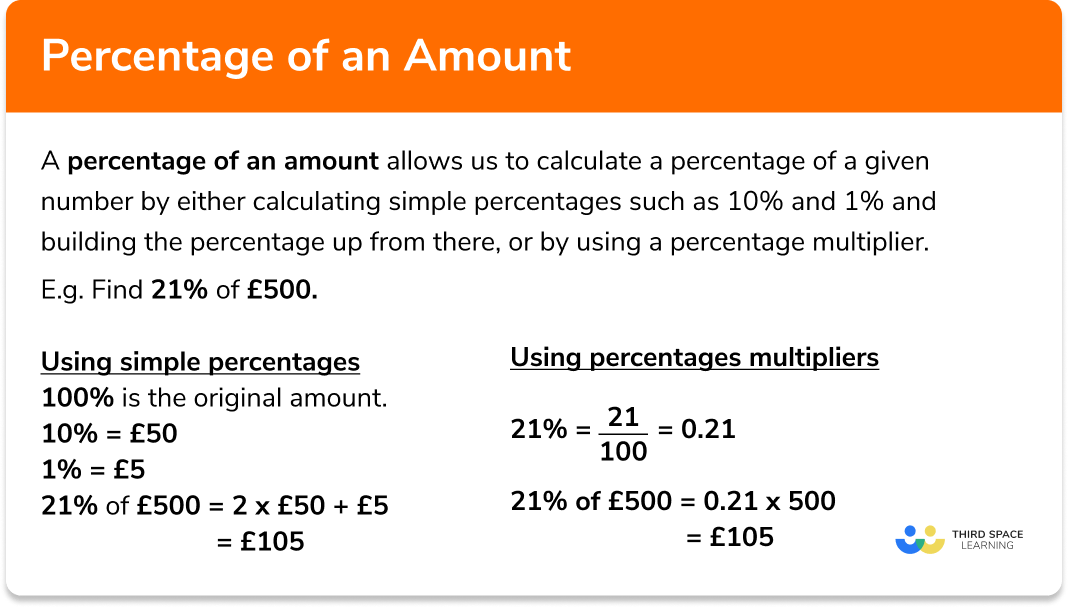
These three core calculation types cover the vast majority of percentage-related financial questions you’ll encounter. Practice with them, and you’ll find your financial intuition sharpening considerably.
Percentages in Action: Key Financial Scenarios
Understanding percentages in theory is one thing; seeing them applied to real-world financial situations solidifies their value. Here’s how percentages play a pivotal role across various aspects of your financial life.
Budgeting and Expense Analysis
Effective budgeting is fundamentally a percentage exercise. It’s not just about tracking dollars, but about understanding what proportion of your income goes to different categories.
- The 50/30/20 Rule: A popular budgeting guideline suggests allocating 50% of your after-tax income to needs (housing, food, utilities), 30% to wants (entertainment, dining out), and 20% to savings and debt repayment. These percentages provide a clear framework for financial allocation.
- Expense Ratios: By calculating what percentage of your income each expense category consumes (e.g., housing is 35% of my income, groceries are 12%), you can quickly identify areas where you might be overspending or where there’s room for optimization. This visual and proportional understanding is far more impactful than just seeing raw dollar figures.
Saving and Investing Returns
The power of percentages is perhaps most evident in the realm of savings and investments, particularly with the phenomenon of compound interest.
- Compound Interest: Often called the “eighth wonder of the world,” compound interest refers to earning interest on your initial principal and on the accumulated interest from previous periods. This exponential growth is purely a function of percentages applied repeatedly over time. A 7% annual return, compounded over decades, can turn modest savings into substantial wealth.
- Return on Investment (ROI): Investors constantly calculate ROI, expressed as a percentage, to evaluate the profitability of their investments. If you invest $1,000 and it grows to $1,100, your ROI is 10%. This percentage allows for easy comparison across different investment opportunities, regardless of their initial cost.
- Expense Ratios in Funds: When investing in mutual funds or ETFs, you’ll encounter an “expense ratio,” which is the annual percentage fee taken from your investment to cover management and operating costs. Even a seemingly small percentage (e.g., 0.5% vs. 1.5%) can have a significant cumulative impact on your returns over the long term due to the compounding effect.
Debt Management and Loan Interest
Percentages are central to understanding the true cost of borrowing and the mechanics of debt.
- Annual Percentage Rate (APR): This is the yearly rate of interest charged on loans, credit cards, or mortgages. A credit card with a 19% APR means you’ll be charged 19% of your outstanding balance annually if not paid in full. Understanding this percentage is critical for minimizing interest payments.
- Interest Calculation: For any loan, the interest you pay is a percentage of the principal amount. Whether it’s simple interest (calculated only on the principal) or compound interest (calculated on principal plus accumulated interest), the percentage rate is the key determinant of how much your debt will cost you over time.
- Debt-to-Income Ratio (DTI): Lenders use DTI, a percentage calculated by dividing your total monthly debt payments by your gross monthly income, to assess your ability to manage monthly payments and repay debts. A lower DTI percentage often means you’re a less risky borrower.
Discounts, Sales, and Financial Planning
Beyond budgeting and investments, percentages are woven into everyday consumer decisions and broader financial planning.
- Evaluating “Percentage Off” Sales: A 30% discount on a $200 item is a $60 saving. But sometimes, a smaller percentage off a more expensive item might be a larger absolute saving. Understanding the calculation ensures you’re always getting the best deal.
- Understanding Tax Brackets and Effective Tax Rates: Income tax systems often use progressive tax brackets, meaning different portions of your income are taxed at different percentage rates. Your “effective tax rate” is the total tax you pay as a percentage of your total taxable income, offering a more accurate picture than simply looking at your highest marginal bracket.
- Retirement Savings Goals: Financial advisors often recommend saving a certain percentage of your income for retirement, perhaps 10-15%, to ensure you accumulate sufficient funds. This percentage approach provides a scalable and consistent strategy for long-term wealth building.
Tools and Tips for Mastering Percentage Calculations
While the underlying math is simple, efficiency and accuracy in percentage calculations are paramount for sound financial management. Fortunately, you don’t need to be a math wizard; various tools and mental shortcuts can significantly aid your efforts.
Leveraging Everyday Tools
The modern world offers an abundance of resources to simplify percentage calculations, transforming complex tasks into quick computations.
- Calculators (Physical and Digital): Your smartphone’s calculator app, a desktop calculator, or even a basic scientific calculator can perform percentage calculations instantly. Most have a dedicated “%” button, which can simplify steps like finding a percentage of a number or calculating tax. Just be sure you understand how your specific calculator handles percentages (e.g., does “100 + 10%” mean 100 + 0.10, or 100 + 10% of 100?).
- Spreadsheets (Excel, Google Sheets): For more complex financial modeling, budgeting, or tracking investments, spreadsheets are indispensable. They allow you to set up formulas (e.g.,
=A1*0.20for 20% of the value in cell A1, or=(B2-A2)/A2*100for percentage change) that automatically update as your data changes. This is incredibly powerful for “what-if” scenarios and long-term financial planning. - Online Percentage Calculators: Numerous free websites offer specialized percentage calculators (e.g., for tips, discounts, percentage change, or reverse percentages). These are excellent for quick, one-off calculations and can confirm your manual efforts.
Mental Math Shortcuts and Estimations
While tools are great, developing a knack for mental estimation can significantly speed up everyday financial decisions and help you spot errors.
- The 10% Rule: This is your best friend. To find 10% of any number, simply move the decimal point one place to the left.
- Example: 10% of $250 = $25.
- From there, you can easily find other percentages:
- 20% = 10% × 2 (e.g., $25 × 2 = $50)
- 5% = 10% / 2 (e.g., $25 / 2 = $12.50)
- 1% = 10% / 10 (or move decimal two places left)
- Breaking Down Complex Percentages: For percentages like 17%, you can break it into easier parts: 10% + 5% + 2%.
- Example: 17% of $200.
- 10% of $200 = $20
- 5% of $200 = $10
- 2% of $200 = $4 (since 1% of $200 = $2)
- Total = $20 + $10 + $4 = $34.
- Example: 17% of $200.
- Rounding and Approximating: For quick estimates, round numbers to make the percentages easier to calculate.
- Example: Estimate 18% tax on $98. Round to 20% on $100. 20% of $100 is $20. This gives you a quick ballpark figure.
Avoiding Common Pitfalls
Even with tools and shortcuts, certain errors in percentage calculations are common. Being aware of them can save you from costly mistakes.
- Confusing Percentage “Of” with Percentage “Point” Change: If your interest rate goes from 5% to 6%, that’s a 1 percentage point increase. However, it’s a (6-5)/5 * 100 = 20% increase in the interest rate itself. These are very different measures and contexts.
- Incorrectly Applying Sequential Percentage Changes: A 10% increase followed by a 10% decrease does not bring you back to the original amount.
- Example: $100 + 10% = $110. $110 – 10% = $110 – $11 = $99. You end up with $99. Each percentage is applied to the current amount, not the original.
- Always Ensuring You’re Using the Correct ‘Whole’ Value: When calculating percentage change, always divide by the original (old) value. When finding a percentage of something, ensure your “whole” is the correct base amount. A common mistake is to confuse gross income with net income when calculating budget percentages.
By applying these tips and remaining vigilant, you can master percentage calculations and use them to your significant financial advantage.

Conclusion
The question “how do I find the percentage of something?” transcends a simple mathematical query; it is a fundamental step toward achieving financial fluency and empowerment. Percentages are not just abstract numbers; they are the bedrock of informed financial decisions, serving as the universal language for assessing value, managing resources, and projecting future outcomes.
From understanding the true cost of debt and the growth potential of your investments to optimizing your budget and spotting the best deals, mastering percentage calculations equips you with an invaluable toolkit. We’ve explored the basic definitions, practical applications in discounts, taxes, investment returns, and salary increases, and delved into their critical role in budgeting, debt management, and long-term financial planning.
By diligently practicing these calculations, leveraging readily available tools, and being mindful of common pitfalls, you can transform complex financial data into clear, actionable insights. Embrace the power of percentages – they are the lens through which you can gain unparalleled clarity and control over your financial journey, enabling you to make smarter, more confident choices for a secure and prosperous future.
aViewFromTheCave is a participant in the Amazon Services LLC Associates Program, an affiliate advertising program designed to provide a means for sites to earn advertising fees by advertising and linking to Amazon.com. Amazon, the Amazon logo, AmazonSupply, and the AmazonSupply logo are trademarks of Amazon.com, Inc. or its affiliates. As an Amazon Associate we earn affiliate commissions from qualifying purchases.