
Percentages are the universal language of finance. From understanding discounts on a new purchase to calculating investment returns, managing debt, or analyzing business growth, mastering percentage calculations is fundamental to informed financial decision-making. Far more than just a mathematical concept, percentages provide critical context for numbers, allowing us to compare values, track changes, and assess financial health across diverse scenarios. Without a solid grasp of how to find and interpret percentages, navigating the complexities of personal finance, investing, and business would be akin to flying blind.
The Core Concept: What a Percentage Really Means for Your Wallet
At its heart, a percentage is simply a way to express a part of a whole as a fraction of 100. The term “percent” originates from the Latin “per centum,” meaning “by the hundred.” When you see 25%, it means 25 out of every 100. This standardization to a base of 100 is precisely what makes percentages so powerful and pervasive in the financial world.
Understanding the “Per Cent”
Imagine a pie cut into 100 slices. If you have 25 slices, you have 25% of the pie. If your investment account grew by $100 and its initial value was $1,000, that $100 gain represents 10% of the initial value. This simple framework allows for easy comparison. A $100 gain might be negligible for a multi-million-dollar portfolio but transformative for a $500 savings account. Expressed as a percentage, the impact becomes clear: 0.001% versus 20%.
Why Percentages Are Indispensable in Finance
Percentages provide a common metric for comparison, even when the underlying absolute numbers vary wildly.
- Budgeting: What percentage of your income goes to housing, food, or savings? This helps you visualize your spending habits and identify areas for adjustment.
- Investing: Annual returns are almost always expressed as percentages (e.g., 8% annual growth). This allows you to compare the performance of different assets or funds regardless of their initial value.
- Debt Management: Interest rates on loans and credit cards are percentages (e.g., 5% APR). Understanding these rates is crucial for calculating the true cost of borrowing.
- Discounts and Sales Tax: When you buy something, you encounter percentages for price reductions and additional charges.
- Economic Indicators: Inflation rates, unemployment rates, and GDP growth are all reported as percentages, giving a snapshot of the economy’s health.
Mastering Basic Percentage Calculations for Everyday Financial Decisions
The ability to calculate percentages accurately is a fundamental skill that underpins sound financial management. While complex scenarios exist, most everyday financial decisions rely on a few core calculations.
Calculating a Percentage of a Number (e.g., Discounts, Commissions, Interest)
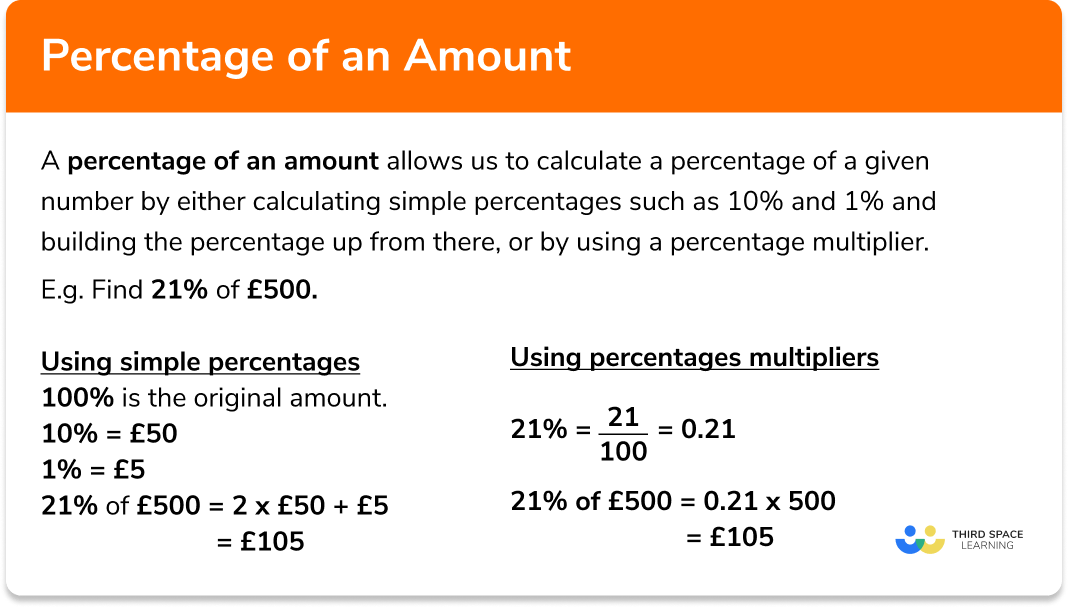
This is perhaps the most common application: finding out what a certain percentage of a given value is. The formula is straightforward:
- Percentage Value = (Percentage / 100) × Whole Number
Alternatively, convert the percentage to a decimal first (divide by 100) and then multiply:
- Percentage Value = Decimal Equivalent × Whole Number
Example: Sales Tax
If an item costs $250 and the sales tax is 8%, how much tax will you pay?
- Tax Amount = (8 / 100) × $250 = 0.08 × $250 = $20
- Total Cost = $250 + $20 = $270
Example: Investment Gains
You invested $5,000, and it grew by 15%. What is your profit?
- Profit = (15 / 100) × $5,000 = 0.15 × $5,000 = $750
- New Investment Value = $5,000 + $750 = $5,750
Finding the Percentage One Number Is of Another (e.g., Budget Allocation, Market Share)
This calculation helps you understand proportions and ratios. It answers the question: “What percentage is A of B?”
- Percentage = (Part / Whole) × 100
Example: Spending Ratios
Your monthly income is $4,000, and you spend $1,200 on rent. What percentage of your income goes to rent?
- Percentage for Rent = ($1,200 / $4,000) × 100 = 0.30 × 100 = 30%
Example: Portfolio Diversification
You have $10,000 in stocks and your total investment portfolio is $25,000. What percentage of your portfolio is in stocks?
- Percentage in Stocks = ($10,000 / $25,000) × 100 = 0.40 × 100 = 40%
Calculating Percentage Increase or Decrease (e.g., Growth, Inflation, Depreciation)
This calculation measures the relative change between two numbers, invaluable for tracking growth, losses, or inflation.
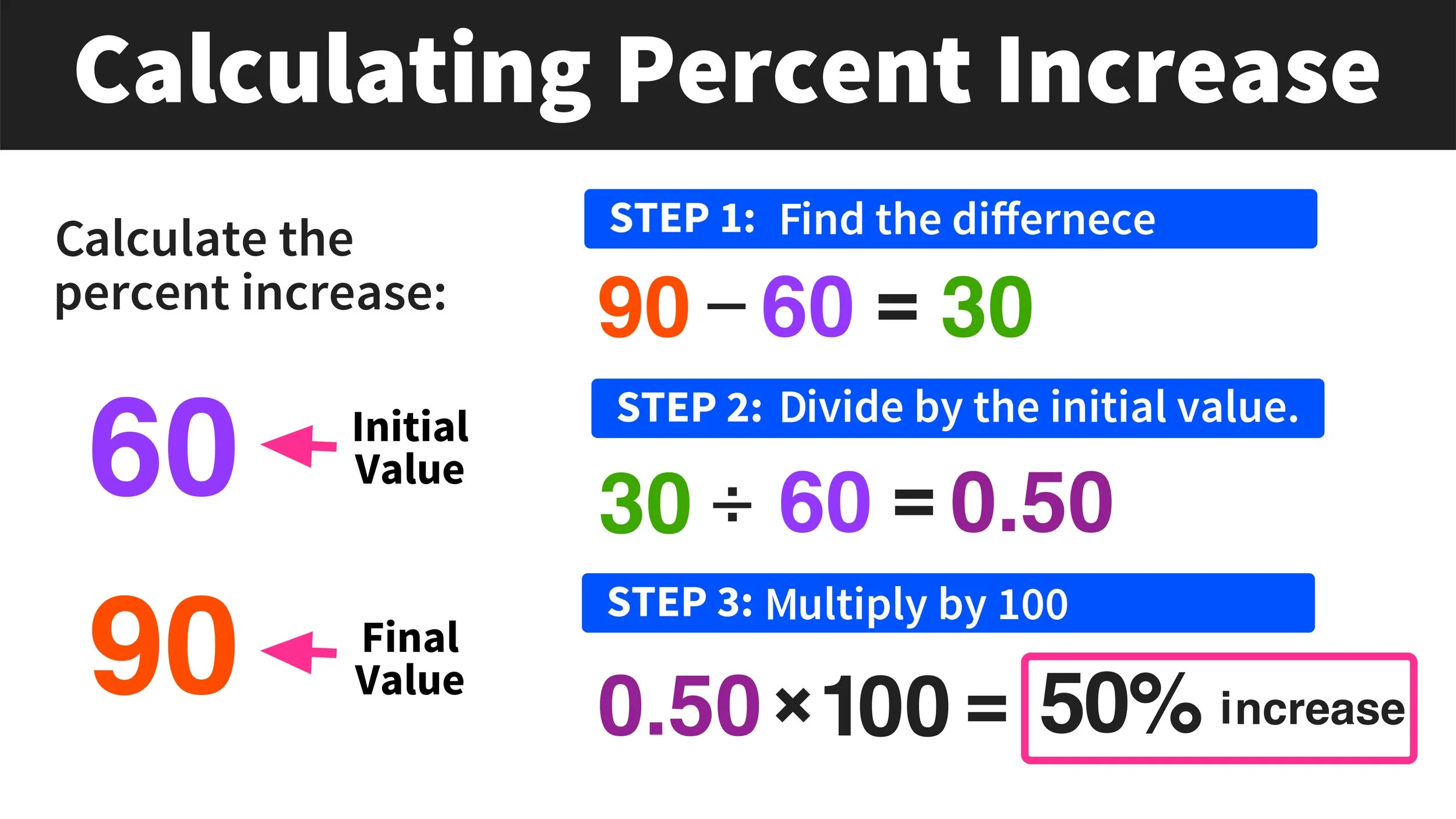
- Percentage Change = [(New Value – Old Value) / Old Value] × 100
If the result is positive, it’s an increase; if negative, it’s a decrease.
Example: Salary Increase
Last year, your salary was $60,000. This year, it’s $63,000. What is your percentage salary increase?
- Percentage Increase = [($63,000 – $60,000) / $60,000] × 100
- = ($3,000 / $60,000) × 100 = 0.05 × 100 = 5%
Example: Investment Loss
An investment was valued at $10,000 and is now worth $9,200. What is the percentage decrease?
- Percentage Decrease = [($9,200 – $10,000) / $10,000] × 100
- = (-$800 / $10,000) × 100 = -0.08 × 100 = -8% (an 8% decrease)
Advanced Percentage Applications in Personal Finance and Investing
Beyond basic calculations, percentages form the bedrock of more sophisticated financial analysis.
Compound Interest: The Power of Percentages Over Time

Compound interest is often called the “eighth wonder of the world” because it allows your money to grow exponentially. It’s interest calculated on the initial principal and on the accumulated interest from previous periods. Understanding this concept is crucial for long-term saving, retirement planning, and even grasping the true cost of debt.
The formula for compound interest (compounded annually) is:
- A = P (1 + r)^t
- Where A = the future value of the investment/loan, including interest
- P = the principal investment amount (the initial deposit or loan amount)
- r = the annual interest rate (as a decimal)
- t = the number of years the money is invested or borrowed for
Understanding APR and APY
- APR (Annual Percentage Rate): The annual rate charged for borrowing or earned by an investment. It does not factor in compounding.
- APY (Annual Percentage Yield): The effective annual rate of return, taking into account the effect of compounding interest. APY is always equal to or higher than APR when compounding occurs more than once a year. For savings accounts, always compare APY. For loans, focus on APR but understand the total cost due to compounding.
Return on Investment (ROI): Measuring Financial Success
ROI is a key metric used to evaluate the efficiency of an investment or to compare the efficiency of several different investments. It directly measures the amount of return on a particular investment, relative to the investment’s cost.
- ROI = [(Current Value of Investment – Cost of Investment) / Cost of Investment] × 100
A positive ROI indicates a gain, while a negative ROI indicates a loss. This percentage helps you decide where to allocate your capital for the best returns.
Profit Margins and Markups: Essential for Side Hustles and Small Businesses
For entrepreneurs and small business owners, percentages are vital for pricing products, analyzing profitability, and making strategic decisions.
- Gross Profit Margin: Measures the percentage of revenue that exceeds the cost of goods sold (COGS).
- Gross Profit Margin = [(Revenue – COGS) / Revenue] × 100
- Net Profit Margin: Measures the percentage of revenue left after all expenses, including taxes and interest, have been deducted.
- Net Profit Margin = (Net Profit / Revenue) × 100
- Markup: The percentage by which the cost of a product is increased to determine its selling price.
- Markup Percentage = [(Selling Price – Cost) / Cost] × 100
Understanding these percentages ensures your business is priced competitively and remains profitable.
Debt-to-Income Ratio and Other Key Financial Health Metrics
Banks and financial institutions use various percentage-based ratios to assess your creditworthiness and financial health.
- Debt-to-Income (DTI) Ratio: The percentage of your gross monthly income that goes toward paying your monthly debt payments. Lenders use this to gauge your ability to manage monthly payments and repay debts.
- DTI = (Total Monthly Debt Payments / Gross Monthly Income) × 100
- Typically, a DTI of 36% or less is considered good, while over 43% indicates high risk.
Other critical ratios include savings rate (percentage of income saved), emergency fund coverage (months of expenses saved), and asset allocation percentages in your investment portfolio.
Tools and Strategies for Seamless Percentage Management
While manual calculations are good for understanding, leveraging modern tools makes percentage management efficient and less prone to error.
Leveraging Spreadsheets for Financial Analysis
Software like Microsoft Excel or Google Sheets are indispensable for financial calculations. They allow you to set up formulas once and apply them across large datasets.
- Cell Formatting: You can format cells as percentages directly.
- Built-in Functions: Easily perform calculations for interest, growth rates, and more.
- Scenario Planning: Model different financial scenarios (e.g., what if interest rates rise by 1%?) by simply changing a percentage value.
Financial Calculators and Apps
Dedicated financial calculators (both physical and online) and smartphone apps are designed to handle complex percentage-based calculations quickly and accurately. These are particularly useful for:
- Mortgage payments and amortization schedules.
- Retirement planning with compound interest projections.
- Loan comparisons with varying APRs and compounding periods.
Mental Math Shortcuts for Quick Estimates
For on-the-go estimations, knowing a few mental math tricks for percentages can be very useful.
- Finding 10%: Move the decimal one place to the left (e.g., 10% of $500 is $50).
- Finding 1%: Move the decimal two places to the left (e.g., 1% of $500 is $5).
- Using 10% as a base: To find 20%, multiply 10% by 2. To find 5%, divide 10% by 2. For 15%, add 10% and 5%.
- Estimating discounts: If something is 30% off $80, take 10% ($8) and multiply by 3 ($24). The new price is $80 – $24 = $56.
Avoiding Common Percentage Pitfalls
Even with the right tools, misinterpreting or miscalculating percentages can lead to significant financial errors.
The Difference Between Percentage Points and Percentage Change
This is a subtle but crucial distinction. If an interest rate increases from 4% to 5%, that’s a 1 percentage point increase. However, the percentage change in the interest rate itself is [(5-4)/4] × 100 = 25%. Confusing these two can lead to wildly inaccurate conclusions about the magnitude of a change.
Misinterpreting Sequential Discounts
When multiple discounts are applied, they are usually applied sequentially, not cumulatively. A “20% off, then an additional 10% off” does not mean 30% off the original price.
- Original Price: $100
- First Discount (20% off): $100 – (0.20 × $100) = $80
- Second Discount (10% off the new price): $80 – (0.10 × $80) = $72
- Total discount: $100 – $72 = $28, or 28% off, not 30%.
Always calculate sequential discounts step by step.
Understanding the Base Value
The “whole” or “original value” in a percentage calculation is critically important. A 5% increase in your $50,000 salary is a $2,500 raise, but a 5% increase in a $500 investment is only $25. The percentage means nothing without understanding the base from which it is calculated. Similarly, be wary of statistics that quote percentages without specifying the total number they represent, as this can be misleading.
Mastering percentages isn’t just about crunching numbers; it’s about gaining clarity and control over your financial narrative. By understanding how to find, apply, and interpret these vital ratios, you empower yourself to make smarter decisions, grow your wealth, and navigate the financial world with confidence.
aViewFromTheCave is a participant in the Amazon Services LLC Associates Program, an affiliate advertising program designed to provide a means for sites to earn advertising fees by advertising and linking to Amazon.com. Amazon, the Amazon logo, AmazonSupply, and the AmazonSupply logo are trademarks of Amazon.com, Inc. or its affiliates. As an Amazon Associate we earn affiliate commissions from qualifying purchases.