
In the bustling marketplace of today, sales, discounts, and promotional offers are ubiquitous. From seasonal clearances to daily deals, the promise of saving money through a “percentage off” is a constant lure. Yet, for many, the actual calculation of these discounts can feel like a daunting mathematical puzzle, leading to confusion, missed savings, or even overspending. Understanding how to precisely calculate a percentage off is not just a shopper’s trick; it’s a foundational skill in personal finance, empowering you to make informed decisions, maximize your purchasing power, and ultimately, bolster your financial well-being.

This comprehensive guide will demystify the process. We’ll break down the simple math behind discounts, explain why this skill is invaluable for your personal finance journey, equip you with practical methods for quick calculations, and help you navigate the complexities of multi-tiered sales. By the end, you’ll not only be able to confidently determine the true cost of a discounted item but also apply this core percentage thinking to a broader spectrum of financial situations, transforming you into a savvier consumer and a more effective money manager.
The Fundamental Math Behind Discounts
At its core, calculating a percentage off is a straightforward application of basic arithmetic. Understanding the components and formulas involved is the first step towards mastering discount calculations and taking control of your spending.
Understanding the Basics: Original Price, Discount Amount, and Percentage
Before diving into formulas, let’s clearly define the key terms you’ll encounter:
- Original Price (or List Price/Regular Price): This is the full price of an item before any discount is applied. It’s the benchmark from which your savings are calculated.
- Percentage Off (% Off): This indicates the rate of reduction from the original price, expressed as a percentage. For example, “20% off” means you save 20 cents for every dollar of the original price.
- Discount Amount: This is the actual monetary value you save due to the percentage off. It’s the difference between the original price and the final, discounted price.
- Final Price (or Sale Price): This is the price you actually pay after the discount has been applied.
The Core Formulas: Calculating Amount Saved and Final Price
There are two primary approaches to calculating percentage off, both leading to the same accurate result.
Method 1: Calculate the Discount Amount First, Then Subtract
This method is intuitive and breaks down the process into two clear steps:
-
Calculate the Discount Amount:
Discount Amount = Original Price × (Percentage Off / 100)- Example: If an item costs $200 and is 25% off, the discount amount is $200 × (25 / 100) = $200 × 0.25 = $50.
-
Calculate the Final Price:
Final Price = Original Price - Discount Amount- Example: Using the above, the final price is $200 – $50 = $150.
Method 2: Calculate the Remaining Percentage, Then Multiply
This method is often more efficient, especially with a calculator, as it combines the steps:
-
Determine the Remaining Percentage: If you’re getting, say, 25% off, you are essentially paying for 100% – 25% = 75% of the original price.
Remaining Percentage = 100% - Percentage Off
-
Calculate the Final Price Directly:
Final Price = Original Price × (Remaining Percentage / 100)- Example: If an item costs $200 and is 25% off, the remaining percentage is 75%. So, the final price is $200 × (75 / 100) = $200 × 0.75 = $150.
Both methods yield the same result, so choose the one that feels most comfortable and logical to you.
Practical Examples for Clarity
Let’s put these formulas into practice with a couple of common scenarios:
-
Scenario 1: A new appliance is listed at $799.99 and is 15% off.
- Using Method 1:
- Discount Amount = $799.99 × 0.15 = $120.00 (rounded)
- Final Price = $799.99 – $120.00 = $679.99
- Using Method 2:
- Remaining Percentage = 100% – 15% = 85%
- Final Price = $799.99 × 0.85 = $679.99 (rounded)
- Using Method 1:
-
Scenario 2: Your favorite pair of jeans is $60 and on sale for 30% off.
- Using Method 1:
- Discount Amount = $60 × 0.30 = $18
- Final Price = $60 – $18 = $42
- Using Method 2:
- Remaining Percentage = 100% – 30% = 70%
- Final Price = $60 × 0.70 = $42
- Using Method 1:
With these fundamental calculations, you’re now equipped to tackle most single-level discounts with confidence.
Why Calculating Percentage Off Matters for Your Wallet
Beyond the simple math, the ability to quickly and accurately calculate percentage off is a crucial skill for intelligent money management. It transforms you from a passive consumer into an active participant in your financial journey, fostering smarter spending habits and strengthening your overall financial literacy.
Maximizing Savings and Spotting True Deals
The most obvious benefit of mastering percentage calculations is the ability to maximize your savings. Knowing the exact discount allows you to:
- Compare Deals Effectively: When two stores offer similar items with different percentage discounts, you can instantly determine which offer provides the greater value. Is 20% off a $100 item better than $15 off the same item? ($80 vs $85).
- Identify Genuine Bargains: Retailers sometimes inflate “original” prices before applying a discount, making a 50% off tag seem more impressive than it is. By focusing on the final price and comparing it to what you know is a fair market value (perhaps through historical price tracking), you can discern a true bargain from a clever marketing ploy.
- Avoid Overpayment: Ignorance of the true discount can lead to paying more than you should, or thinking you got a better deal than you actually did.
Avoiding Marketing Gimmicks and Impulse Buys
Retailers are masters of psychological marketing, and “percentage off” is a powerful tool in their arsenal. Large discount percentages are designed to evoke excitement and urgency, often leading to impulse purchases.
- Rational Decision-Making: By understanding the actual dollar amount you’re saving and the final price you’re paying, you shift from an emotional response to a rational assessment. You can ask yourself: “Is this item worth $X even at the discounted price, and do I truly need it?”
- Resisting the “Fear of Missing Out” (FOMO): Knowing how to calculate a discount on the fly empowers you to make a reasoned decision without succumbing to the pressure of a limited-time offer. You understand the numbers, not just the perceived urgency.
- Budget Alignment: Even a great discount isn’t a good deal if the item isn’t within your budget or if it replaces a more essential purchase. Accurate calculation helps you stay aligned with your financial plan.
Empowering Your Budget and Financial Planning
Your budget is the cornerstone of effective personal finance. The ability to precisely calculate discounts significantly contributes to its strength and accuracy.
- Accurate Expense Prediction: When planning for specific purchases, knowing how to calculate discounts means you can more accurately predict your outflow, preventing budget overruns.
- Effective Fund Allocation: If you’re allocating funds for specific categories like “clothing” or “home goods,” understanding discounts helps you make your allocated money stretch further, or frees up funds for other priorities.
- Long-Term Savings Compounding: Small savings on individual purchases, consistently applied over time, can accumulate into substantial amounts. This discipline, fueled by accurate percentage calculations, contributes to your long-term financial goals, whether it’s building an emergency fund, saving for a down payment, or investing.
Methods for Quick and Easy Calculations

While understanding the formulas is key, practical application often requires speed and convenience. Fortunately, several methods can help you calculate percentages off quickly, whether you’re in a store aisle or browsing online.
Mental Math Shortcuts for Common Percentages
Developing mental math prowess can save you time and the hassle of reaching for a calculator for frequent discounts.
- 10% Off: This is the easiest. Simply move the decimal point one place to the left. For a $75 item, 10% off is $7.50. Then subtract this from the original price ($75 – $7.50 = $67.50).
- 20% Off: Calculate 10% off, then double it. For a $75 item, 10% is $7.50, so 20% is $15 ($7.50 x 2). Final price: $75 – $15 = $60.
- 25% Off (or 1/4 Off): Divide the original price by 4. For a $75 item, $75 / 4 = $18.75. Final price: $75 – $18.75 = $56.25.
- 50% Off (or Half Off): Simply divide the original price by 2. For a $75 item, $75 / 2 = $37.50.
- Other Percentages (e.g., 30%, 40%): Use the 10% rule and multiply. For 30% off $75, find 10% ($7.50) and multiply by 3 ($22.50). Final price: $75 – $22.50 = $52.50.
- Combining for Tricky Percentages (e.g., 35%): Calculate 10% (x3) and add 5% (half of 10%). For 35% off $75, 30% is $22.50, and 5% is $3.75. Total discount = $26.25. Final price: $75 – $26.25 = $48.75.
Using a Calculator or Smartphone App
For more complex numbers or when precision is paramount, a calculator is your best friend.
- Standard Calculator: Most modern smartphones have a built-in calculator.
- To find the discount amount:
Original Price × Percentage Off (as a decimal)(e.g., $123.45 × 0.17). - To find the final price directly:
Original Price × (1 - Percentage Off as a decimal)(e.g., $123.45 × 0.83).
- To find the discount amount:
- Dedicated Discount Calculator Apps: Many apps are specifically designed to calculate discounts, often allowing you to input the original price, the percentage off, and even sales tax, giving you the final price with just a few taps. While we don’t recommend specific brands, a quick search on your app store will reveal many options.
Online Tools and Browser Extensions for Instant Savings
The digital age offers even more sophisticated ways to handle percentage calculations, especially for online shopping.
- E-commerce Websites: Many online stores automatically display the discounted price alongside the original price, doing the calculation for you. However, it’s still prudent to double-check.
- Browser Extensions: Numerous browser extensions can automatically apply coupon codes, track price history, and even perform discount calculations for you while you browse. Some also include sales tax calculations. While convenient, always be mindful of privacy concerns when installing extensions.
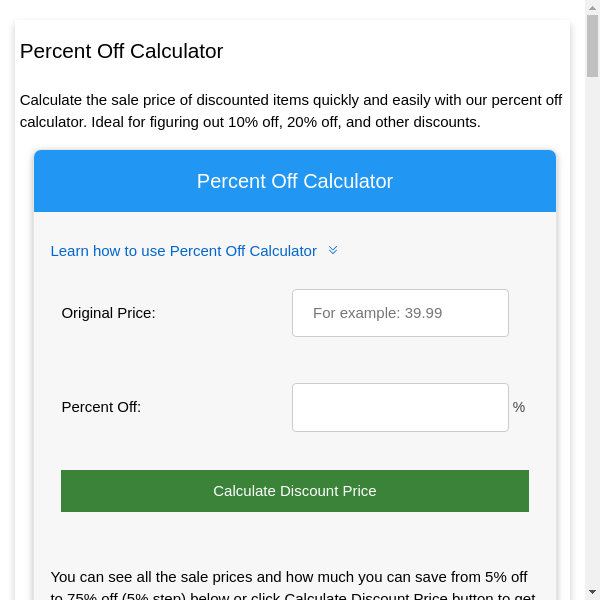
- Online Discount Calculators: A quick web search for “percentage off calculator” will yield many free online tools where you can input the values and get instant results.
These tools are incredibly helpful, but remember that understanding the underlying math ensures you can always verify their results and aren’t entirely reliant on technology.
Navigating Complex Discounts and Multi-Tiered Sales
Retail promotions aren’t always straightforward. Sometimes, you’ll encounter scenarios involving multiple discounts or additional costs that complicate the final price calculation. Knowing how to handle these situations is crucial for true financial savvy.
“Stacking” Discounts: Order of Operations Matters
A common trick in retail is offering multiple discounts that appear to stack but must be applied sequentially. For example, “20% off entire store, plus an extra 10% off sale items.” It’s tempting to think this is 30% off, but it’s not.
- Always Apply Discounts Sequentially: The “extra” discount is applied to the already discounted price, not the original price.
- Example: An item costs $100.
- First, apply the 20% off: $100 – ($100 × 0.20) = $100 – $20 = $80.
- Then, apply the extra 10% off to the new price of $80: $80 – ($80 × 0.10) = $80 – $8 = $72.
- Total Savings: In this case, your total discount is $28 ($100 – $72), which is 28%, not 30%. Understanding this sequence is vital to accurately assessing the final price.
Sales Tax and Shipping: The True Final Cost
A percentage off applies to the item’s price before sales tax and shipping fees are added. For a complete understanding of your expenditure, these additional costs must always be factored in.
- Sales Tax: Sales tax is typically calculated on the discounted price.
Final Price (with tax) = Discounted Price × (1 + Sales Tax Rate as a decimal)- Example: An item is $100, 20% off (final price $80). If sales tax is 7%, then the tax is $80 × 0.07 = $5.60. Your true total is $80 + $5.60 = $85.60.
- Shipping Costs: Shipping charges are usually fixed or based on the order total (after discount, before tax), and they are added after all discounts and sometimes after tax. Always check the shipping policy.
- Comparing “Total” Costs: When comparing deals from different retailers, especially online, always calculate the total cost, including discounts, tax, and shipping, to determine the genuinely cheapest option. A higher percentage off might be negated by expensive shipping or higher sales tax.
Loyalty Programs and Cash Back: Adding Layers of Value
Many retailers offer loyalty programs, points, or cash-back incentives that can further enhance your savings, but these are typically applied after the initial percentage off calculations.
- Points Accumulation: Loyalty points are usually earned based on the net amount spent (the final price after discounts and before tax).
- Cash Back: Cash back offers (from credit cards, apps, or retailer programs) are generally calculated on the final purchase amount, after all discounts have been applied.
- Consider as Additional Value: View these as extra layers of savings or benefits that augment your initial discount, but don’t confuse them with the percentage off the item itself. Always prioritize the upfront discount and the final price you pay.
Beyond the Sale Tag: Applying Percentage Thinking to Other Financial Areas
The ability to understand and calculate percentages extends far beyond merely figuring out discounts on consumer goods. It’s a fundamental mathematical skill with profound implications across various facets of personal finance, empowering you to make more informed decisions in almost every financial transaction.
Understanding Interest Rates and Loan Payments
Interest rates are essentially percentages that represent the cost of borrowing money or the return on lending/saving money.
- Loans and Credit Cards: When you take out a loan or use a credit card, the Annual Percentage Rate (APR) dictates how much extra you’ll pay on top of the principal. Just as a discount reduces a price, interest adds to the principal. Understanding these percentages is crucial for assessing the true cost of debt and avoiding excessive interest payments.
- Savings Accounts and Investments: Similarly, the interest rate on a savings account or the yield on a bond is a percentage representing your return. Knowing how to calculate these helps you evaluate which savings vehicles offer the best growth for your money.
Analyzing Investment Returns and Portfolio Performance
For investors, percentages are the language of performance.
- Return on Investment (ROI): Whether you’re tracking the growth of stocks, mutual funds, or real estate, your ROI is expressed as a percentage. This allows you to compare the profitability of different investments over various time frames.
- Portfolio Allocation: Managing your investment portfolio often involves allocating assets by percentage (e.g., 60% stocks, 30% bonds, 10% cash). Understanding these percentages helps you maintain your desired risk profile and diversification.
- Gains and Losses: When an investment increases or decreases in value, these changes are often presented as percentages, providing a standardized way to measure impact regardless of the initial investment amount.
Budgeting and Tracking Spending Reductions
Percentages are invaluable tools for creating, maintaining, and analyzing your personal budget.
- Category Allocation: Many budgeting strategies recommend allocating a certain percentage of your income to different categories (e.g., 50% for needs, 30% for wants, 20% for savings). This provides a flexible framework that scales with your income.
- Tracking Progress: Instead of just saying “I want to spend less on dining out,” you can set a tangible goal like “I want to reduce my dining-out expenses by 15% this month.” Tracking your spending and seeing a percentage reduction provides clear, measurable progress and motivation.
- Financial Health Metrics: Assessing your debt-to-income ratio, savings rate, or investment growth rate are all percentage-based calculations that provide a snapshot of your financial health and help you identify areas for improvement.
Conclusion
The seemingly simple act of figuring out a percentage off transcends basic arithmetic; it’s a cornerstone of financial literacy and a powerful tool for personal empowerment. By mastering the core formulas, understanding the behavioral economics behind discounts, and leveraging both mental math and modern tools, you equip yourself to navigate the complexities of consumerism with confidence and precision.
From spotting true bargains and avoiding impulse buys to accurately budgeting and stacking complex promotions, the ability to calculate percentages empowers you to make smarter spending decisions today. Moreover, this fundamental skill extends far beyond the sale aisle, proving invaluable in understanding interest rates, analyzing investments, and tracking your progress toward broader financial goals.
Embrace percentage thinking as an essential element of your financial toolkit. Practice these calculations, question advertised deals, and make every dollar work harder for you. In doing so, you’ll not only save money but also gain invaluable control over your financial destiny, moving ever closer to your goals with every informed decision.
aViewFromTheCave is a participant in the Amazon Services LLC Associates Program, an affiliate advertising program designed to provide a means for sites to earn advertising fees by advertising and linking to Amazon.com. Amazon, the Amazon logo, AmazonSupply, and the AmazonSupply logo are trademarks of Amazon.com, Inc. or its affiliates. As an Amazon Associate we earn affiliate commissions from qualifying purchases.