
In the intricate world of personal finance, investing, and business operations, few concepts are as ubiquitous and critical as percentages. From understanding interest rates on loans and calculating investment returns to budgeting your monthly income and spotting the best discounts, percentages are the silent language spoken by every financial decision. Yet, for many, the very mention of percentages can evoke a sense of trepidation, a lingering echo from school days filled with complex equations. This doesn’t have to be the case.
Mastering percentages is not about becoming a math wizard; it’s about acquiring a fundamental financial literacy that empowers you to make informed decisions, avoid costly mistakes, and unlock opportunities for growth. This article will demystify percentages, breaking down the core concepts and illustrating their practical applications across your financial life, ensuring you can confidently “do percentages” and wield them as a powerful tool for financial empowerment.

The Foundational Math: What is a Percentage, Really?
Before diving into complex financial scenarios, it’s crucial to solidify our understanding of what a percentage truly represents. At its heart, a percentage is simply a way to express a proportion or a fraction of a whole, specifically “per one hundred.” The word “percent” literally comes from the Latin “per centum,” meaning “by the hundred.”
Understanding the Basic Concept
Imagine you have a pie cut into 100 equal slices. If you eat 25 of those slices, you’ve eaten 25% of the pie. If a test has 100 questions and you answer 90 correctly, your score is 90%. It’s a standardized way to compare parts to a whole, making different quantities comparable regardless of the original total. For instance, knowing you scored 90% on a 100-question test tells you the same thing as scoring 90% on a 50-question test (45 correct answers), or a 20-question test (18 correct answers). The “per hundred” base provides a universal benchmark.
In financial terms, this concept is invaluable. If your income increases by 10%, you immediately grasp the magnitude relative to your previous earnings, regardless of the absolute dollar amounts. If a mutual fund charges an expense ratio of 0.5%, you know it’s half a dollar for every hundred dollars invested, a key detail for understanding the true cost of your investments.
Converting Between Forms: Decimals, Fractions, and Percentages
To work effectively with percentages, especially in financial calculations, you’ll frequently need to convert between percentages, decimals, and fractions. This is a simple yet crucial skill.
-
Percentage to Decimal: To convert a percentage to a decimal, simply divide by 100 (or move the decimal point two places to the left).
- Example: 25% = 25 / 100 = 0.25
- Example: 3.5% = 3.5 / 100 = 0.035
- Example: 120% = 120 / 100 = 1.20
This conversion is essential because most financial calculations involving percentages require them to be in decimal form.
-
Decimal to Percentage: To convert a decimal to a percentage, multiply by 100 (or move the decimal point two places to the right and add the ‘%’ symbol).
- Example: 0.75 = 0.75 * 100 = 75%
- Example: 0.015 = 0.015 * 100 = 1.5%
- Example: 1.5 = 1.5 * 100 = 150%
This is useful for interpreting raw data, such as a spreadsheet showing a return of 0.08, and immediately understanding it as an 8% return.
-
Fraction to Percentage: Convert the fraction to a decimal first by dividing the numerator by the denominator, then convert the decimal to a percentage.
- Example: 1/4 = 1 ÷ 4 = 0.25 = 25%
- Example: 3/5 = 3 ÷ 5 = 0.60 = 60%
While less common in direct financial calculations than decimal conversions, understanding this helps reinforce the fundamental “part of a whole” concept.
Core Percentage Calculations for Everyday Finance
With the basics established, let’s explore the most common percentage calculations you’ll encounter in your financial life. Mastering these three types of calculations will equip you for a vast array of financial tasks.
Calculating a Percentage of a Number
This is perhaps the most frequent calculation. You need to find what a certain percentage of a given value is. The formula is straightforward:
Percentage (as a decimal) × Whole Amount = Part Amount
-
Discounts: You see a shirt for $50, and it’s 20% off.
- Convert 20% to 0.20.
- Discount amount = 0.20 × $50 = $10.
- Final price = $50 – $10 = $40.
Knowing this helps you quickly evaluate sales and ensure you’re getting the advertised deal.
-
Sales Tax: Your new gadget costs $200, and the sales tax is 7%.
- Convert 7% to 0.07.
- Tax amount = 0.07 × $200 = $14.
- Total cost = $200 + $14 = $214.
Essential for budgeting and understanding the true cost of purchases.
-
Tips: You had a great meal for $80, and you want to leave a 15% tip.
- Convert 15% to 0.15.
- Tip amount = 0.15 × $80 = $12.
- Total bill = $80 + $12 = $92.
A crucial social and financial courtesy, easily calculated.
Finding the Percentage One Number Is of Another
This calculation helps you understand the proportional relationship between two numbers, often used for performance analysis or budget allocation. The formula is:
(Part Amount / Whole Amount) × 100 = Percentage
-
Investment Returns: You invested $1,000 and it grew to $1,150. What was your percentage return?
- Gain = $1,150 – $1,000 = $150.
- Percentage return = ($150 / $1,000) × 100 = 0.15 × 100 = 15%.
This is how you measure the success of your investments.
-
Budget Allocation: Your monthly income is $4,000, and your rent is $1,200. What percentage of your income goes to rent?
- Percentage for rent = ($1,200 / $4,000) × 100 = 0.30 × 100 = 30%.
Critical for understanding your spending habits and adherence to budget rules like the 50/30/20 rule.
- Percentage for rent = ($1,200 / $4,000) × 100 = 0.30 × 100 = 30%.
-
Profit Margins: Your business sold a product for $100 that cost $70 to produce. What is your gross profit margin?
- Gross Profit = $100 – $70 = $30.
- Gross Profit Margin = ($30 / $100) × 100 = 30%.
A key metric for business health and pricing strategies.
Percentage Increase and Decrease
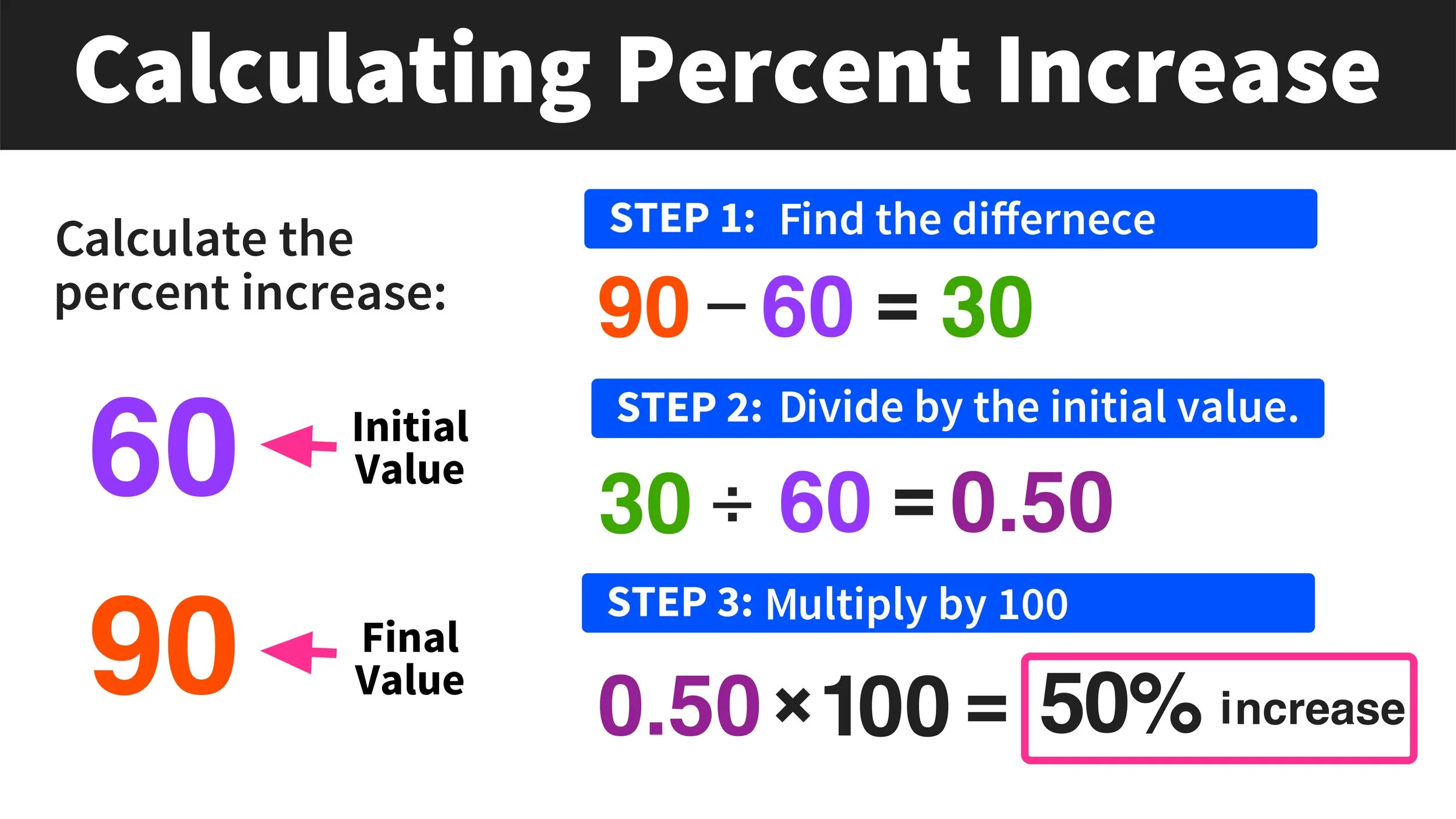
These calculations are vital for tracking changes over time, whether it’s your salary, investment growth, or inflation.
1. Calculate the actual change: Subtract the old value from the new value.
2. Divide the actual change by the old value.
3. Multiply by 100 to get the percentage.
-
Salary Increase: Your old salary was $50,000, and your new salary is $53,000.
- Actual change = $53,000 – $50,000 = $3,000.
- Percentage increase = ($3,000 / $50,000) × 100 = 0.06 × 100 = 6%.
Helps you evaluate compensation offers and negotiate effectively.
-
Stock Price Drop: A stock was trading at $100 and dropped to $95.
- Actual change = $95 – $100 = -$5 (a decrease of $5).
- Percentage decrease = (-$5 / $100) × 100 = -0.05 × 100 = -5%.
Essential for tracking portfolio performance and understanding market movements.
-
Inflation: If the cost of living index was 100 last year and is 103 this year, that’s a 3% inflation rate ( (103-100)/100 * 100 = 3%).
Percentages in Action: Key Financial Applications
Understanding the mechanics of percentages is one thing; seeing them in practical financial scenarios is where their true power becomes evident.
Budgeting and Saving
Percentages are the backbone of effective budgeting. Many financial advisors recommend allocating your income by percentages, such as the popular 50/30/20 rule (50% for needs, 30% for wants, 20% for savings and debt repayment).
- If your take-home pay is $3,500:
- Needs: 50% of $3,500 = $1,750
- Wants: 30% of $3,500 = $1,050
- Savings/Debt: 20% of $3,500 = $700
This simple percentage-based framework helps ensure you’re directing your money towards your financial goals. Setting a goal to save “15% of every paycheck” makes saving a consistent, achievable habit.
Debt Management and Interest Rates
Interest rates, whether on credit cards, mortgages, or personal loans, are expressed as percentages. Understanding them is paramount to managing debt wisely.
- Annual Percentage Rate (APR): This is the annual cost of borrowing expressed as a percentage. A credit card with a 24% APR means you’ll pay approximately 2% interest per month on your outstanding balance if you carry one.
- Mortgage Rates: A 6% mortgage rate dictates a significant portion of your monthly housing payment. Even a slight percentage point difference can save or cost you tens of thousands of dollars over the loan’s lifetime.
- Compound Interest: The concept of compound interest is where percentages truly shine (or sting). With savings and investments, it’s the “eighth wonder of the world,” where your interest earns interest. With debt, especially high-interest credit card debt, it’s a compounding nightmare that can rapidly escalate your balance. Understanding these dynamics is crucial for making smart borrowing and saving decisions.
Investing and Returns
Percentages are the universal metric for investment performance.
- Return on Investment (ROI): As calculated earlier, this percentage tells you how much profit you made relative to your initial investment.
- Dividend Yield: For income-generating stocks, the dividend yield (annual dividends per share / share price) tells you the percentage return you get from dividends.
- Expense Ratios: Mutual funds and ETFs charge expense ratios, expressed as a percentage of your assets under management. Even seemingly small percentages (e.5% vs. 1.5%) can significantly impact your long-term returns due to compounding.
- Portfolio Allocation: Deciding to allocate 60% of your portfolio to stocks and 40% to bonds is a percentage-based strategy fundamental to risk management and diversification.
Discounts, Sales Tax, and Tipping
Beyond major financial decisions, percentages are part of almost every daily transaction.
- Discounts: Accurately calculating “30% off” helps you verify advertised savings and compare deals.
- Sales Tax: Knowing how to add sales tax to a purchase allows you to budget correctly and avoid surprises at the checkout.
- Tipping: From restaurants to services, accurate percentage calculations ensure you are tipping appropriately.
Advanced Tips and Common Pitfalls
While the core calculations are straightforward, a few nuances and common mistakes can trip up even experienced individuals.
The Power of Compound Interest (and why it matters)
We touched on compound interest, but it warrants a deeper dive. It’s not just about percentages, but percentages applied repeatedly over time. If you invest $10,000 at a 7% annual return, after one year, you have $10,700. The next year, you earn 7% not just on the original $10,000, but on the $10,700, yielding more interest. This snowball effect is why starting to save and invest early, even small amounts, can lead to substantial wealth accumulation. Conversely, compound interest on debt can be devastating, making minimum payments on high-interest credit cards a losing battle.
Avoiding Percentage Misinterpretations
- Percentage Points vs. Percentage Change: This is a common source of confusion. If an interest rate increases from 5% to 6%, it’s a 1 percentage point increase. However, it’s a (1/5) * 100 = 20% percentage increase in the rate itself. Always clarify which is being discussed.
- Misunderstanding the Base: Ensure you’re calculating a percentage from the correct starting point (the “whole”). For example, a “30% off” sale is calculated on the original price, not the discounted price.
- Successive Percentages: If an item is 20% off, and then an additional 10% off, it’s not 30% off. You calculate the 20% discount first, then the 10% discount on the reduced price. E.g., $100 – 20% ($20) = $80. Then $80 – 10% ($8) = $72. The total discount is $28, or 28%.
Leveraging Technology
While understanding the manual calculations is crucial, don’t shy away from using tools.
- Calculators: Standard and scientific calculators are your best friends.
- Spreadsheets (Excel, Google Sheets): These are incredibly powerful for financial modeling, budgeting, and calculating complex percentages over time. Functions like
=(A1/B1)*100or=PERCENTAGE()simplify calculations. - Financial Apps: Many budgeting and investing apps automatically calculate percentages for you, showing your spending as a percentage of income or your investment returns.
The key is to use these tools to verify your understanding, not to replace it.

Conclusion
The question “how do I do percentages?” is more than just a mathematical query; it’s an inquiry into financial literacy. Percentages are the bedrock upon which sound financial decisions are built, from the mundane task of calculating a tip to the monumental decisions of managing debt, planning investments, and securing your financial future.
By grasping the fundamental concepts—what a percentage is, how to convert between forms, and the core calculation types—you gain an invaluable skill set. When you can confidently calculate a discount, understand an interest rate, or assess an investment return, you are no longer a passive observer of your finances but an active, empowered participant. Embrace the simplicity and power of percentages; they are not just numbers, but keys to unlocking greater financial control and opportunity. Practice these skills, apply them consistently, and watch your financial acumen grow exponentially.
aViewFromTheCave is a participant in the Amazon Services LLC Associates Program, an affiliate advertising program designed to provide a means for sites to earn advertising fees by advertising and linking to Amazon.com. Amazon, the Amazon logo, AmazonSupply, and the AmazonSupply logo are trademarks of Amazon.com, Inc. or its affiliates. As an Amazon Associate we earn affiliate commissions from qualifying purchases.