
In the intricate world of finance, few concepts are as fundamental and frequently encountered as percentages. From personal budgeting and investment returns to understanding interest rates on loans and dissecting business financial statements, percentages are the universal language that helps us quantify change, compare values, and make informed financial decisions. Far from being a mere academic exercise, mastering percentage calculations is an essential life skill that empowers individuals and businesses alike to navigate their financial landscapes with confidence and clarity.
Yet, despite their ubiquity, many find themselves puzzled by percentages, struggling to apply them correctly in real-world scenarios. This comprehensive guide aims to demystify percentage calculations, breaking down the core concepts and illustrating their practical applications specifically within the realm of personal and business finance. By the end, you’ll not only know how to calculate percentages but also why they are indispensable tools for managing and growing your money.

The Ubiquitous Role of Percentages in Finance
Percentages are more than just numbers; they are powerful comparative tools that provide context and scale. In finance, where absolute figures can often be misleading or difficult to compare across different scales, percentages offer a standardized way to express proportions, changes, and relationships.
Understanding the Basics: What is a Percentage?
At its heart, a percentage represents a fraction of 100. The word “percent” literally means “per hundred” or “out of one hundred.” So, 50% means 50 out of 100, which can also be expressed as the fraction 50/100 or the decimal 0.50. This conversion between percentages, fractions, and decimals is the cornerstone of all percentage calculations.
-
From Percentage to Decimal: Divide the percentage by 100 (e.g., 25% = 25/100 = 0.25).
-
From Decimal to Percentage: Multiply the decimal by 100 (e.g., 0.75 = 0.75 * 100 = 75%).
-
From Fraction to Percentage: Divide the numerator by the denominator, then multiply by 100 (e.g., 1/4 = 0.25 = 25%).
This simple conversion ability is vital because most percentage calculations are easier to perform using their decimal equivalents.
Why Percentages Matter for Your Money
Imagine trying to compare the growth of a small startup that made $10,000 profit last year to a multinational corporation that made $1 million. While the absolute numbers are vastly different, expressing their profit growth as a percentage provides a fair basis for comparison. The startup might have grown its profit by 500% from the previous year, while the corporation only grew by 5%, despite the corporation’s absolute increase being far larger. Percentages allow us to evaluate relative performance and efficiency, regardless of scale.
Common Financial Scenarios Requiring Percentage Skills
Almost every financial decision or analysis involves percentages:
-
Budgeting: Allocating a percentage of income to savings, housing, or entertainment.
-
Saving & Investing: Understanding interest rates on savings accounts, calculating investment returns, or assessing portfolio diversification.
-
Borrowing: Deciphering the Annual Percentage Rate (APR) on loans, mortgages, and credit cards.
-
Shopping: Calculating discounts, sales tax, and tips.
-
Business: Determining profit margins, revenue growth, cost reductions, and market share.
-
Economics: Interpreting inflation rates, unemployment rates, and GDP growth.
Without a solid grasp of percentage calculations, navigating these scenarios becomes akin to flying blind.
Mastering the Core Percentage Calculations
While the applications are diverse, the fundamental types of percentage calculations are relatively few. Understanding these core mechanics will equip you for almost any financial situation.
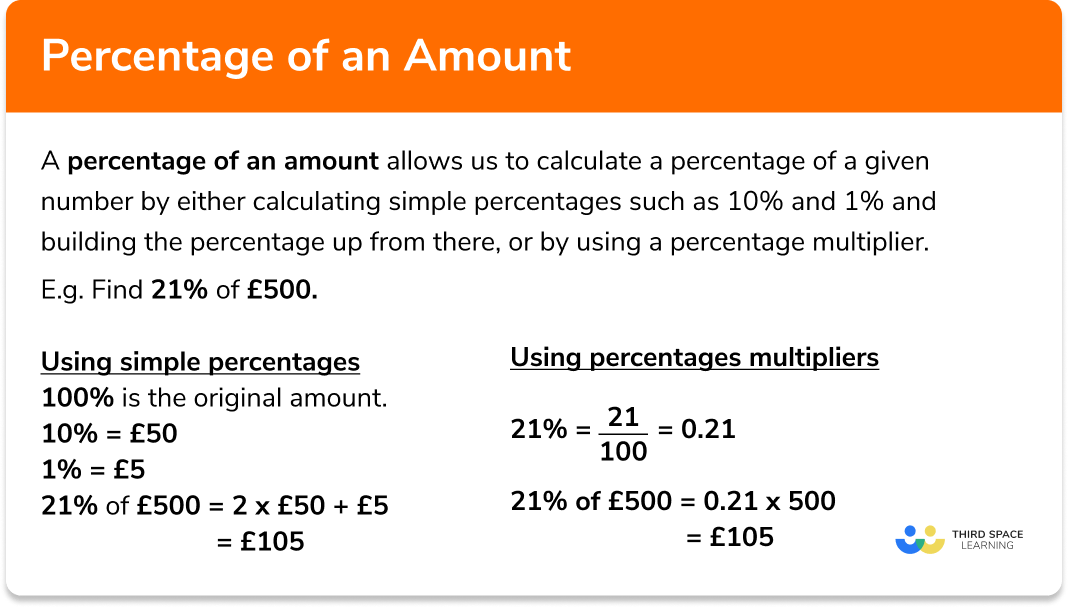
Calculating a Percentage of a Number (Finding the Part)
This is perhaps the most common calculation: determining a specific portion of a total value.
Formula: Part = Percentage (as a decimal) × Whole
Examples:
-
Discounts: You want to buy a $200 item, and there’s a 15% discount.
-
Discount amount = 0.15 × $200 = $30.
-
Final price = $200 – $30 = $170.
-
-
Sales Tax: An item costs $50, and the sales tax is 8%.
-
Tax amount = 0.08 × $50 = $4.
-
Total cost = $50 + $4 = $54.
-
-
Budgeting: You earn $4,000 per month and want to allocate 20% to savings.
- Savings amount = 0.20 × $4,000 = $800.
Finding the Percentage One Number Is of Another (Finding the Rate)
This calculation helps you understand what proportion one value represents in relation to a larger total.
Formula: Percentage = (Part / Whole) × 100
Examples:
-
Expense Ratio: You spent $500 on dining out this month from your $3,000 income. What percentage of your income went to dining?
- Percentage = ($500 / $3,000) × 100 = 0.1667 × 100 ≈ 16.67%.
-
Profit Margin: A business made $20,000 profit on $100,000 in revenue.
- Profit Margin = ($20,000 / $100,000) × 100 = 0.20 × 100 = 20%.
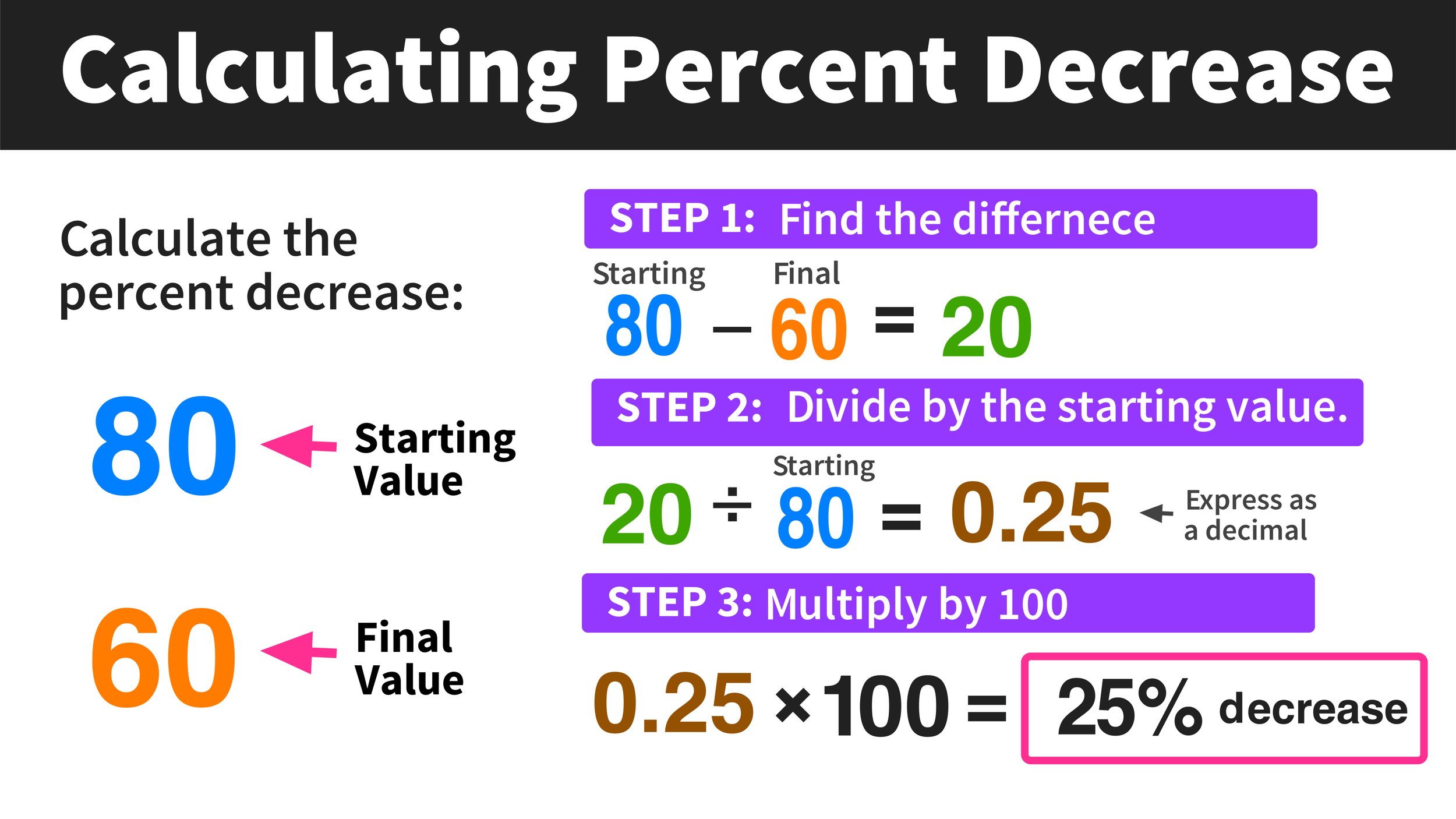
Percentage Increase and Decrease (Measuring Change)
These calculations are crucial for tracking growth, depreciation, inflation, and investment performance.
Formula: Percentage Change = ((New Value - Old Value) / Old Value) × 100
-
If the result is positive, it’s a percentage increase.
-
If the result is negative, it’s a percentage decrease.
Examples:
-
Investment Growth: Your investment grew from $10,000 to $12,000.
- Percentage Increase = (($12,000 – $10,000) / $10,000) × 100 = ($2,000 / $10,000) × 100 = 0.20 × 100 = 20%.
-
Depreciation: An asset purchased for $5,000 is now valued at $4,500.
- Percentage Decrease = (($4,500 – $5,000) / $5,000) × 100 = (-$500 / $5,000) × 100 = -0.10 × 100 = -10%. (A 10% decrease).
The Concept of Percentage Points vs. Percentage Change
A common point of confusion arises when comparing two percentages. It’s vital to distinguish between a “percentage point” change and a “percentage” change.
-
Percentage Point Change: This is the absolute difference between two percentage values. If an interest rate increases from 4% to 5%, that’s a 1 percentage point increase.
-
Percentage Change (Relative Change): This refers to the rate of change of the percentage value itself. If an interest rate increases from 4% to 5%, the relative percentage increase is: ((5 – 4) / 4) × 100 = (1 / 4) × 100 = 25%. This means the rate itself increased by 25%.
Understanding this distinction is critical, especially when discussing market volatility or changes in interest rates, as misinterpreting the terms can lead to significant misunderstandings of financial impact.
Practical Applications: Percentages in Personal Finance
Percentages are the bedrock of sound personal financial management, enabling you to optimize your spending, saving, and investing strategies.
Budgeting and Expense Tracking
Effective budgeting often involves allocating percentages of your income to various categories. The popular “50/30/20 rule,” for instance, suggests dedicating 50% of your income to needs, 30% to wants, and 20% to savings and debt repayment. Calculating these percentages helps you visualize your financial priorities and stick to your plan. Similarly, tracking your expenses as a percentage of your income or total spending can highlight areas where you might be overspending.
Interest Rates: Loans, Savings, and Credit Cards
Interest rates are almost universally expressed as percentages.
-
Savings Accounts: A 1.5% annual interest rate means your savings will grow by 1.5% of your balance each year (compounding effects notwithstanding for simplicity).
-
Loans and Mortgages: An APR (Annual Percentage Rate) of 6% means you’ll pay 6% of the loan principal (plus any fees) in interest over a year. Understanding how this percentage translates into monthly payments and total interest paid over the loan term is crucial.
-
Credit Cards: High interest rates (e.g., 20% APR) on credit cards can quickly escalate debt if balances aren’t paid in full, making percentage calculations vital for understanding the true cost of credit.
Investment Returns and Portfolio Performance
The performance of your investments is almost always measured in percentages.
-
Individual Stocks/Funds: A stock gaining 10% or a mutual fund returning 8% provides a clear metric of performance.
-
Portfolio Returns: Calculating the overall percentage return of your entire investment portfolio allows you to assess its health and compare it against benchmarks.
-
Asset Allocation: Financial advisors often recommend allocating a certain percentage of your portfolio to different asset classes (e.g., 60% stocks, 40% bonds) based on your risk tolerance and age.
Understanding Taxes and Deductions
Tax rates, whether for income, capital gains, or property, are typically expressed as percentages. Understanding your effective tax rate (total tax paid as a percentage of taxable income) is more insightful than just knowing your marginal tax bracket. Deductions and credits also reduce your taxable income or directly lower your tax liability, and their impact can be quantified as a percentage of your original obligation.
Percentages in Business Finance and Beyond
For entrepreneurs, business owners, and financial professionals, percentages are indispensable for analyzing performance, making strategic decisions, and communicating financial health.
Profit Margins and Revenue Growth
-
Gross Profit Margin: (Gross Profit / Revenue) × 100. This tells a business how efficiently it produces goods or services.
-
Net Profit Margin: (Net Profit / Revenue) × 100. This indicates the percentage of revenue left after all expenses, including taxes.
-
Revenue Growth: A key indicator of a business’s expansion is its year-over-year percentage increase in revenue.
These percentages allow businesses to compare their performance over time, against competitors, and within their industry.
Discounts, Markups, and Sales Tax
Businesses regularly use percentages for pricing strategies.
-
Markups: If a product costs a business $10 and they want a 50% markup, they’ll sell it for $10 + ($10 * 0.50) = $15.
-
Discounts: Offering a 20% discount on a product that costs $50 to the customer means a $10 reduction.
-
Sales Tax: Businesses must correctly calculate and collect sales tax as a percentage of the sale price.
Accurate percentage calculations ensure correct pricing, healthy profit margins, and compliance with tax regulations.
Financial Ratios and Business Health
Many critical financial ratios, used by investors and analysts to gauge a company’s financial health, are expressed as percentages:
-
Debt-to-Equity Ratio: (Total Debt / Shareholder Equity) – often expressed as a percentage, indicating leverage.
-
Return on Equity (ROE): (Net Income / Shareholder Equity) × 100 – shows how much profit a company generates for each dollar of shareholder equity.
-
Current Ratio: (Current Assets / Current Liabilities) – while not a percentage, it relates to the percentage of short-term obligations a company can cover.
These ratios provide a standardized snapshot of liquidity, profitability, and solvency, allowing for meaningful comparisons across different companies and industries.
Leveraging Tools and Avoiding Common Pitfalls
While understanding the underlying math is crucial, you don’t always need to do percentage calculations by hand. Modern tools can simplify the process, but vigilance is still required.
Digital Tools for Percentage Calculations
-
Calculators: Basic and scientific calculators universally have a percentage function (often “%”).
-
Spreadsheets (Excel, Google Sheets): These are powerful tools for complex financial analysis involving percentages. You can set up formulas (e.g.,
=A1*0.15for 15% of cell A1, or=(B1/A1)*100for the percentage B1 is of A1) that automatically update. -
Online Calculators and Apps: Numerous websites and mobile apps offer specialized calculators for mortgage payments, investment returns, tips, and discounts.
Double-Checking Your Work
Even with tools, errors can occur. Always sense-check your results. If you calculate a 15% discount on a $200 item and get a discount amount of $3,000, you know something is wrong. The result should be logically proportional to the input.
The Importance of Context and Base Numbers
The most significant percentage pitfalls often stem from misinterpreting the “base” number from which the percentage is calculated.
-
“Of What?”: Always ask, “A percentage of what?” A 10% increase from a base of $100 is $10. A 10% increase from a base of $1,000,000 is $100,000. The numerical value of the percentage remains the same, but its impact varies drastically with the base.
-
Sequential Percentage Changes: Be cautious when applying multiple percentage changes. A 10% increase followed by a 10% decrease does not return you to the original value. If you start with $100:
-
Increase by 10%: $100 * 1.10 = $110.
-
Decrease by 10%: $110 * 0.90 = $99.
Always apply sequential percentages to the new base after each change.
-
Conclusion
Percentages are more than just mathematical curiosities; they are the lingua franca of finance, offering unparalleled clarity and context in a world of complex numbers. Whether you’re managing your personal budget, evaluating investment opportunities, dissecting a business’s financial statements, or simply navigating daily transactions involving discounts and taxes, a robust understanding of how to calculate and interpret percentages is non-negotiable. By mastering the core calculation methods and recognizing their widespread applications within the financial domain, you empower yourself to make smarter, more informed decisions, ultimately leading to greater financial literacy and success.
aViewFromTheCave is a participant in the Amazon Services LLC Associates Program, an affiliate advertising program designed to provide a means for sites to earn advertising fees by advertising and linking to Amazon.com. Amazon, the Amazon logo, AmazonSupply, and the AmazonSupply logo are trademarks of Amazon.com, Inc. or its affiliates. As an Amazon Associate we earn affiliate commissions from qualifying purchases.