
Understanding how to calculate percentages is a cornerstone of financial literacy, essential for making informed decisions in personal finance, investing, and business. From deciphering discounts and interest rates to analyzing investment returns and budgeting expenses, percentages provide a universal language for expressing proportions and changes. Mastering this fundamental skill empowers you to confidently navigate a wide array of financial scenarios.
The Fundamental Concept: What is a Percent?
At its core, a percent represents a portion of a whole, expressed as a fraction of 100. The word “percent” originates from the Latin “per centum,” meaning “by the hundred.” When you see a number followed by the “%” symbol, it indicates that number out of every hundred. For example, 25% means 25 out of 100, or 25/100.
Understanding the Basics: Parts of a Whole
Think of a whole as 100%. If you have a pie and eat half of it, you’ve consumed 50% of the pie. If you save a quarter of your income, you’re setting aside 25% of your total earnings. This concept of a part relative to a whole is crucial for all percentage calculations. It allows for standardized comparison, regardless of the absolute numbers involved. For instance, comparing a $10 discount on a $100 item (10%) to a $100 discount on a $1,000 item (also 10%) shows that while the absolute savings differ, the proportional saving is identical.
The Decimal Connection
Before performing most calculations, it’s often easiest to convert percentages into their decimal equivalents. To do this, simply divide the percentage by 100 (or move the decimal point two places to the left).
- 50% = 50 / 100 = 0.50
- 25% = 25 / 100 = 0.25
- 7% = 7 / 100 = 0.07
- 125% = 125 / 100 = 1.25
This conversion simplifies calculations, especially when using calculators or spreadsheets, as it transforms percentage problems into straightforward multiplication or division operations.
Essential Percentage Calculations for Financial Success
While the concept is simple, percentages are applied in several distinct ways in financial contexts. Understanding these variations is key to accurate analysis.
Calculating a Percentage of a Number
This is perhaps the most common percentage calculation, used for things like sales tax, tips, commissions, or discounts.
Formula: Part = Whole × (Percentage / 100) or Part = Whole × Decimal Percentage
Example: You want to calculate a 7% sales tax on an item costing $150.
- Convert 7% to a decimal: 0.07
- Multiply the whole by the decimal: $150 × 0.07 = $10.50
- The sales tax is $10.50. The total cost would be $150 + $10.50 = $160.50.
Financial Application:
- Discounts: A 20% discount on a $50 item means you save $50 × 0.20 = $10.
- Commissions: A salesperson earning a 5% commission on a $10,000 sale earns $10,000 × 0.05 = $500.
- Loan Interest: If you pay 0.5% interest on a $2,000 loan balance this month, the interest amount is $2,000 × 0.005 = $10.
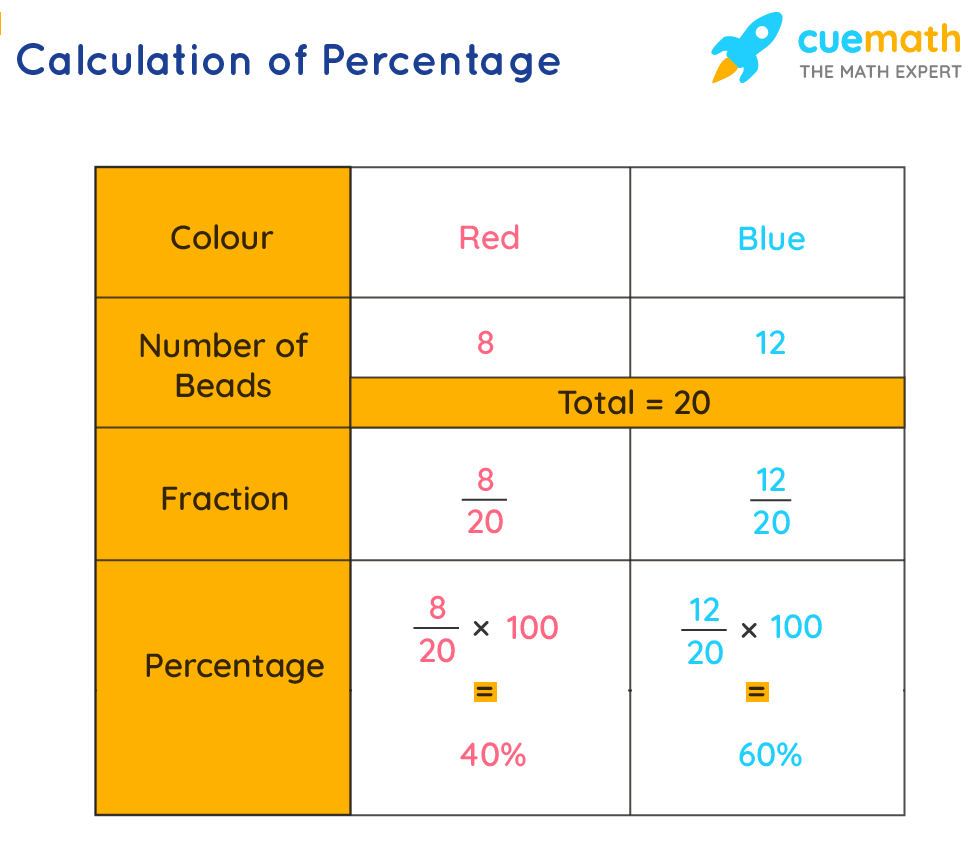
Finding the Percentage One Number Is of Another
This calculation helps you determine what proportion one value represents of a larger total. It’s crucial for understanding ratios, allocations, and performance metrics.
Formula: Percentage = (Part / Whole) × 100
Example: You spent $300 on groceries in a month, and your total income for the month was $3,000. What percentage of your income did you spend on groceries?
- Divide the part by the whole: $300 / $3,000 = 0.10
- Multiply by 100 to convert to a percentage: 0.10 × 100 = 10%
- You spent 10% of your income on groceries.
Financial Application:
- Expense Ratios: If your annual expenses are $25,000 and your income is $50,000, your expense ratio is ($25,000 / $50,000) × 100 = 50%.
- Profit Margins: A business that makes $20,000 in profit on $100,000 in revenue has a profit margin of ($20,000 / $100,000) × 100 = 20%.
- Portfolio Allocation: If you have $2,500 invested in a specific stock within a total $10,000 portfolio, that stock makes up ($2,500 / $10,000) × 100 = 25% of your portfolio.
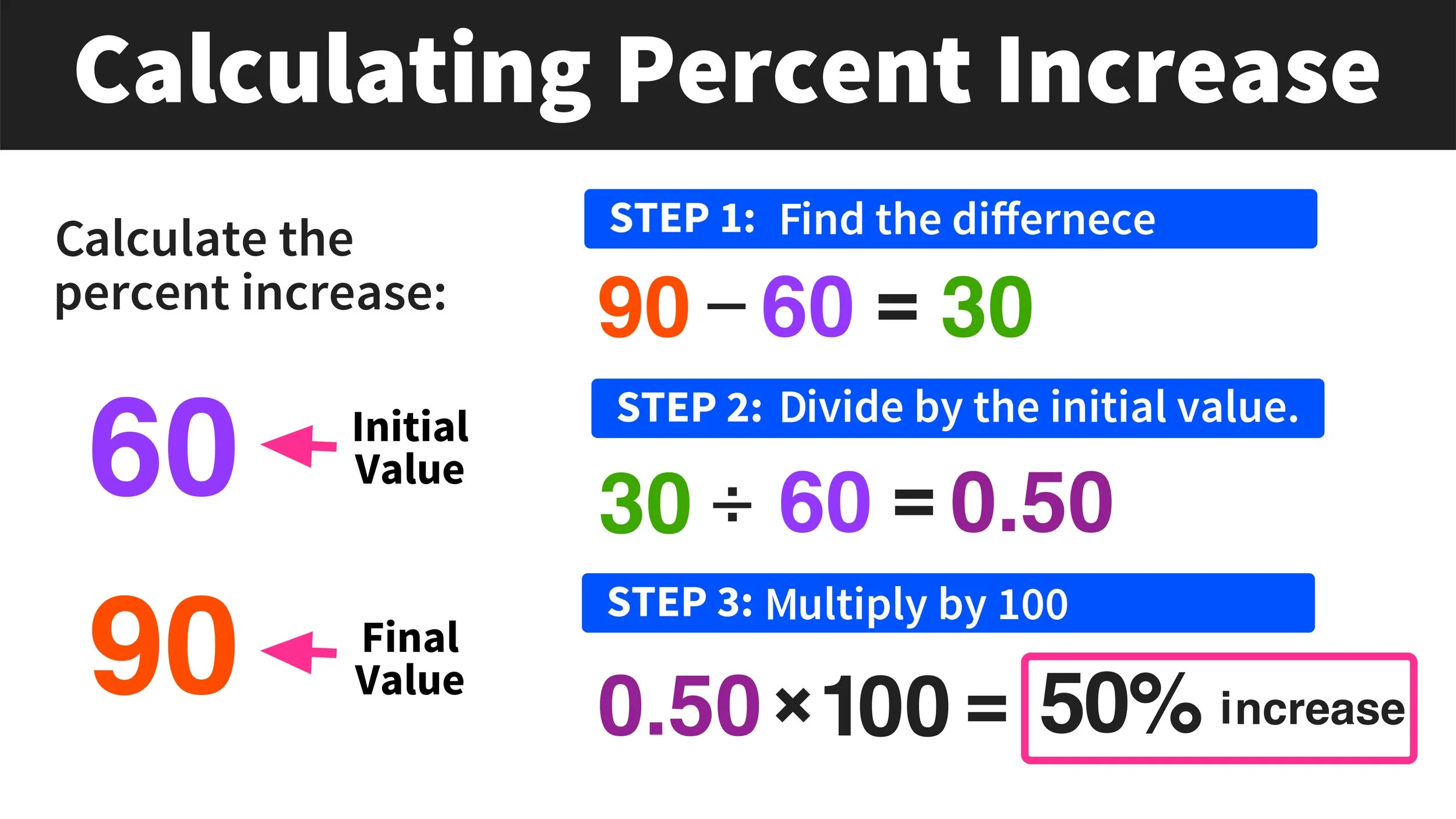
Determining Percentage Increase or Decrease

This calculation measures the relative change between two values, indicating growth or reduction over time or between different points. It’s fundamental for analyzing investment performance, inflation, and salary adjustments.
Formula: Percentage Change = ((New Value - Original Value) / Original Value) × 100
Example (Increase): Your investment account grew from $10,000 to $12,000. What is the percentage increase?
- Calculate the difference: $12,000 – $10,000 = $2,000
- Divide by the original value: $2,000 / $10,000 = 0.20
- Multiply by 100: 0.20 × 100 = 20%
- Your investment increased by 20%.
Example (Decrease): A stock you own dropped from $50 per share to $45 per share. What is the percentage decrease?
- Calculate the difference: $45 – $50 = -$5
- Divide by the original value: -$5 / $50 = -0.10
- Multiply by 100: -0.10 × 100 = -10%
- The stock decreased by 10%. (Note: A negative result indicates a decrease.)
Financial Application:
- Investment Returns: If your stock gained 15% in a year, you can quickly understand its performance relative to others.
- Inflation: If the cost of living increased by 3% last year, it helps you assess the erosion of your purchasing power.
- Salary Negotiation: Understanding your percentage increase helps you benchmark against industry standards or inflation.
Practical Financial Applications of Percentage Calculations
Percentages are not just abstract numbers; they are powerful tools for managing and understanding your money.
Budgeting and Expense Management
Creating a budget often involves allocating a certain percentage of your income to different categories like housing, food, transportation, savings, and entertainment. For example, the 50/30/20 rule suggests allocating 50% of your income to needs, 30% to wants, and 20% to savings and debt repayment. Calculating these percentages helps you visualize where your money goes and identify areas for adjustment. If your housing costs consume 40% of your income, you might recognize a need to reduce that percentage to align with your financial goals.
Understanding Loans, Interest, and Savings Growth
Interest rates are almost universally expressed as percentages.
- Loan interest: Whether it’s a mortgage, car loan, or credit card, the Annual Percentage Rate (APR) tells you the cost of borrowing money over a year. Calculating the monthly interest payment on a loan balance involves applying the monthly equivalent of this percentage. For example, a 6% APR loan means you’re paying approximately 0.5% interest per month (6% / 12 months).
- Savings accounts: The Annual Percentage Yield (APY) on a savings account or certificate of deposit (CD) indicates how much your money will grow over a year, considering compounding interest. Understanding this percentage helps you compare different savings products and project your future wealth.
Investment Performance and Risk Assessment
In the world of investing, percentages are paramount for evaluating performance and understanding risk.
- Returns on investment (ROI): Expressing gains or losses as a percentage allows for direct comparison between different investments, regardless of their initial cost. A 10% return on a $1,000 investment is proportionally the same as a 10% return on a $100,000 investment.
- Portfolio diversification: Investors often allocate percentages of their portfolio to different asset classes (e.g., 60% stocks, 30% bonds, 10% cash) to manage risk. Regularly checking the percentage allocation ensures your portfolio remains aligned with your strategy.
- Expense ratios of funds: Mutual funds and Exchange Traded Funds (ETFs) charge an expense ratio, expressed as a percentage of the assets managed. Even a small percentage can significantly impact long-term returns.
Decoding Discounts and Sales
Shopping wisely often involves quickly calculating discounts. A “25% off” sale means you pay 75% of the original price. Being able to mentally (or quickly with a calculator) figure out the final price or the amount saved can help you determine the true value of a deal. This is especially useful during major sales events, allowing you to maximize your savings.
Tools and Tips for Accurate Percentage Calculations
While the underlying math is straightforward, technology can greatly assist in complex or frequent percentage calculations.
Using Calculators and Spreadsheets Effectively
- Basic calculators: Most scientific or even simple calculators have a “%” button, which can automate some steps. However, understanding the manual calculation is crucial to ensure you’re using it correctly. Typically,
[Number] x [Percent] %will give you the percentage amount, and[Number] + [Percent] %or[Number] - [Percent] %will add or subtract the percentage from the original number. - Spreadsheets (Excel, Google Sheets): These are invaluable for financial analysis.
- To calculate a percentage of a number: If cell A1 contains the whole number and B1 contains the percentage (e.g., 7 for 7%), you’d use
=A1 * (B1/100)or if B1 contains 0.07, then=A1 * B1. - To find what percentage one number is of another: If A1 is the part and B1 is the whole, use
=(A1/B1)*100. - To calculate percentage change: If A1 is the original value and B1 is the new value, use
=((B1-A1)/A1)*100. - Spreadsheets allow you to quickly apply these formulas across large datasets, making budgeting, investment tracking, and sales analysis much more efficient.
- To calculate a percentage of a number: If cell A1 contains the whole number and B1 contains the percentage (e.g., 7 for 7%), you’d use
Mental Math Shortcuts for Quick Estimates
For everyday financial decisions, a quick mental estimate can be very helpful.
- Finding 10%: To find 10% of any number, simply move the decimal point one place to the left. (e.g., 10% of $250 is $25; 10% of $80 is $8).
- Using 10% as a base: Once you know 10%, you can easily estimate other percentages:
- 20% is double 10%. (e.g., 20% of $250 = $25 × 2 = $50)
- 5% is half of 10%. (e.g., 5% of $250 = $25 / 2 = $12.50)
- 1% is 10% of 10%. (e.g., 1% of $250 = $2.50)
- Approximating: For complex percentages like 18% or 32%, round to the nearest 5% or 10% to get a quick idea. For instance, for 18% off $70, you can quickly estimate 20% off $70, which is $14.
Mastering percentage calculations is a fundamental financial skill that pays dividends across all aspects of your monetary life. By understanding the core concepts and practicing their application, you gain a powerful tool for informed decision-making and greater financial control.
aViewFromTheCave is a participant in the Amazon Services LLC Associates Program, an affiliate advertising program designed to provide a means for sites to earn advertising fees by advertising and linking to Amazon.com. Amazon, the Amazon logo, AmazonSupply, and the AmazonSupply logo are trademarks of Amazon.com, Inc. or its affiliates. As an Amazon Associate we earn affiliate commissions from qualifying purchases.