
In the intricate world of personal finance, understanding how your money grows – or how much it costs to borrow – is paramount. Among the various metrics used to measure this growth or cost, Annual Percentage Yield (APY) stands out as one of the most crucial. Often confused with its cousin, Annual Percentage Rate (APR), APY offers a more accurate, holistic picture by factoring in the power of compounding interest. For anyone looking to make informed decisions about savings accounts, certificates of deposit (CDs), or even certain investment vehicles, mastering the calculation and implications of APY is an indispensable skill.

This guide will demystify APY, breaking down its definition, its critical difference from APR, and, most importantly, provide you with the exact formula and step-by-step examples to calculate it yourself. By the end, you’ll not only know “how do I calculate APY” but also understand why this knowledge is a cornerstone of sound financial planning.
Understanding the Fundamentals of APY
Before diving into the mechanics of calculation, it’s essential to grasp the foundational concepts that underpin APY. This clarity will empower you to interpret financial product offerings with greater confidence and insight.
What is APY?
APY, or Annual Percentage Yield, represents the real rate of return earned on an investment, or paid on a savings account, over a year, taking into account the effect of compounding interest. Unlike a simple interest rate, which only applies to the initial principal, APY reflects how interest earned itself begins to earn interest. This “interest on interest” phenomenon means that the effective return on your money will be higher than the stated nominal interest rate if compounding occurs more frequently than once a year.
Financial institutions prominently display APY for products like savings accounts, money market accounts, and certificates of deposit (CDs) because it provides a standardized way for consumers to compare the true earning potential across different offerings. A higher APY generally means greater returns for the saver or investor.
APY vs. APR: Clarifying the Distinction
One of the most common points of confusion in personal finance is the difference between APY and APR (Annual Percentage Rate). While both are expressed as annual percentages, they serve distinct purposes and convey different information, primarily due to how they treat compounding interest.
- APR (Annual Percentage Rate): This is the simple interest rate charged on a loan or earned on an investment over a year, without taking into account the effect of compounding. APR is typically used for products where interest is calculated simply, or for loans where the interest is applied once a year. For example, many credit cards and mortgages initially quote an APR. If a loan has an APR of 10% and interest is compounded monthly, the effective cost to the borrower will be higher than 10% because interest will be added to the principal each month, and subsequent interest will be calculated on that larger amount. APR is the nominal rate.
- APY (Annual Percentage Yield): As discussed, APY does incorporate the effect of compounding. It is the effective annual rate of return. If you have an account with a 5% nominal interest rate compounded monthly, the APY will be slightly higher than 5% because the interest earned in month one will start earning interest in month two, and so on. This makes APY a more accurate measure of the actual earnings on an investment or the true cost of borrowing (though for borrowing, APY is less commonly explicitly stated; the focus is often on the effective annual rate based on the APR and compounding frequency).
The key takeaway is this: When evaluating savings or investment products, always look at the APY to understand your true annual return. When evaluating loans, be mindful of the APR and the compounding frequency, as this will determine your actual cost.
The Power of Compounding Interest
Compounding interest is often hailed as the “eighth wonder of the world” for good reason. It’s the process where the interest earned on an initial principal amount is reinvested, becoming part of the principal for the next interest calculation period. This leads to exponential growth over time, as your money starts earning money, and then that earned money starts earning even more money.
Imagine you deposit $1,000 into a savings account with a 5% annual interest rate.
- Simple Interest: After one year, you earn $50 ($1,000 * 0.05). If it were simple interest, you’d earn $50 each year, and your principal would remain $1,000 for calculation purposes.
- Compounding Interest: If the interest compounds annually, after one year you have $1,050. In the second year, the 5% interest is calculated on $1,050, yielding $52.50. This small difference grows significantly over longer periods, illustrating why even a slight difference in APY can have a profound impact on your long-term wealth accumulation. The more frequently interest compounds (e.g., daily vs. monthly vs. annually), the higher the APY will be, given the same nominal interest rate.
The Core Formula for Calculating APY
Now that we understand the ‘why,’ let’s tackle the ‘how.’ Calculating APY involves a relatively straightforward formula that accounts for the nominal interest rate and the frequency of compounding.
Deconstructing the APY Formula
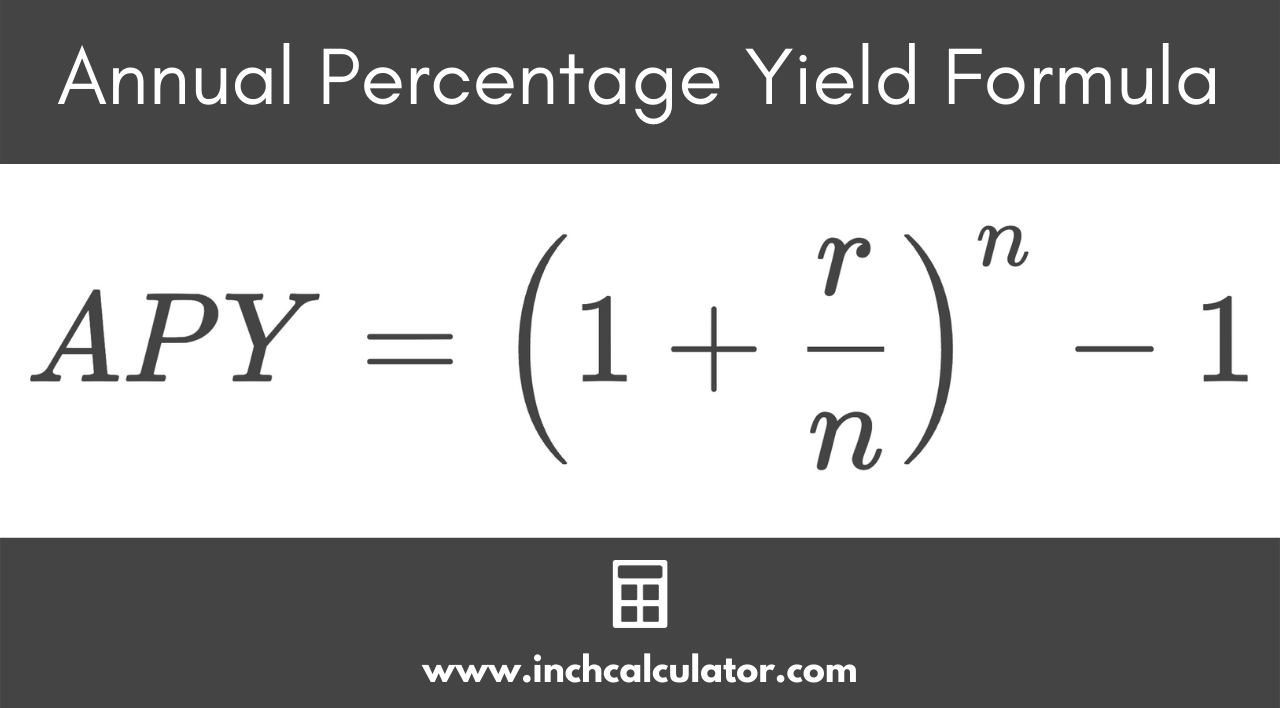
The universal formula for calculating Annual Percentage Yield is:
APY = (1 + r/n)^n – 1
Let’s break down each component of this formula:
- r: This represents the nominal interest rate (or stated annual interest rate) expressed as a decimal. To convert a percentage to a decimal, divide it by 100. For example, if the nominal interest rate is 5%, then r = 0.05.
- n: This denotes the number of times the interest is compounded per year. This is a crucial factor, as more frequent compounding leads to a higher APY.
- Annually: n = 1
- Semi-annually: n = 2
- Quarterly: n = 4
- Monthly: n = 12
- Weekly: n = 52
- Daily: n = 365 (or 360 for some financial institutions, but 365 is more common now)
- – 1: This subtracts the initial principal portion to isolate only the yield, giving you the net percentage return.
Step-by-Step Calculation Examples
Let’s put the formula into practice with a few common scenarios.
Example 1: Annual Compounding
Suppose you have a savings account with a nominal annual interest rate of 4%, compounded annually.
- r = 0.04
- n = 1
APY = (1 + 0.04/1)^1 – 1
APY = (1 + 0.04)^1 – 1
APY = (1.04)^1 – 1
APY = 1.04 – 1
APY = 0.04
APY = 4.00%
In this simple case, where interest compounds only once a year, the APY is identical to the nominal interest rate.
Example 2: Monthly Compounding
Now, consider a savings account with the same nominal annual interest rate of 4%, but compounded monthly.
- r = 0.04
- n = 12
APY = (1 + 0.04/12)^12 – 1
APY = (1 + 0.00333333)^12 – 1
APY = (1.00333333)^12 – 1
APY = 1.0407415 – 1
APY = 0.0407415
APY ≈ 4.07%
Notice how monthly compounding results in a slightly higher APY (4.07%) than the nominal rate (4.00%). This seemingly small difference can add up significantly over large sums and long periods.
Example 3: Daily Compounding
Let’s take it a step further. What if that 4% nominal annual interest rate is compounded daily?
- r = 0.04
- n = 365
APY = (1 + 0.04/365)^365 – 1
APY = (1 + 0.000109589)^365 – 1
APY = (1.000109589)^365 – 1
APY = 1.0408085 – 1
APY = 0.0408085
APY ≈ 4.08%
As expected, daily compounding yields an even slightly higher APY (4.08%) than monthly compounding. While the difference between monthly and daily compounding might seem negligible in percentages, for very large sums or over very long investment horizons, it becomes quite substantial.
Practical Considerations for Input Values
When calculating APY for a real-world financial product, accurately identifying ‘r’ and ‘n’ is crucial.
- Finding ‘r’ (Nominal Interest Rate): This rate is usually clearly stated in the terms and conditions of a savings account, CD, or investment. It might be referred to as the “stated interest rate,” “annual interest rate,” or “contractual rate.” Always ensure you’re using the annual rate.
- Finding ‘n’ (Compounding Frequency): The compounding frequency will also be specified in the product’s terms. Look for phrases like “interest compounded daily,” “interest paid monthly,” or “compounding semi-annually.” If it’s not explicitly stated, assume it’s at least annual, but always clarify with the financial institution to ensure accuracy.
Why APY Matters in Your Financial Decisions
Understanding and calculating APY isn’t just an academic exercise; it’s a practical skill that directly impacts your financial well-being. It empowers you to make smarter choices that maximize your returns and effectively manage your money.
Comparing Savings Accounts and CDs
This is perhaps the most direct application of APY. When you’re shopping for a savings account or a Certificate of Deposit (CD), you’ll often see various nominal interest rates and compounding frequencies. Without APY, comparing these products accurately would be challenging.
For instance, Bank A might offer a 3.95% interest rate compounded daily, while Bank B offers 4.00% compounded semi-annually. At first glance, Bank B’s 4.00% might seem better. However, let’s calculate their APYs:
- Bank A (3.95% compounded daily):
APY = (1 + 0.0395/365)^365 – 1 ≈ 0.04028 or 4.03% - Bank B (4.00% compounded semi-annually):
APY = (1 + 0.04/2)^2 – 1 = (1.02)^2 – 1 = 1.0404 – 1 = 0.0404 or 4.04%
In this scenario, Bank B actually offers a slightly higher APY, meaning you’d earn marginally more. This illustrates why APY is the definitive metric for an “apples-to-apples” comparison among similar financial products. Always compare the APY, not just the nominal rate.
Evaluating Loan Products (Indirectly)
While APY is primarily associated with earnings, the principle of compounding that APY highlights is equally crucial when evaluating the true cost of borrowing. Loan products typically quote an APR, but understanding the compounding frequency (which might not be explicitly reflected as an “APY” for a loan) is vital. For example, a loan with an 8% APR compounded monthly will effectively cost you more than 8% over the year because interest accrues on previous interest. The effective annual rate on such a loan would be calculated using the same logic as APY, just applied to the cost rather than the yield. This deep understanding of compounding empowers you to scrutinize loan terms more effectively and identify the true financial burden.
Investment Growth and Long-Term Planning
For long-term investors, the concept of APY, and specifically the impact of compounding, is foundational. Even a modest difference in the APY of an investment can lead to vastly different outcomes over decades. Small increases in APY early in an investment journey amplify returns significantly due to the extended period over which compounding can work its magic. This principle underscores the importance of starting to save and invest early, as time is a critical component in maximizing compound growth. When assessing investment opportunities that offer predictable returns, using APY helps you project future growth more accurately, aiding in retirement planning, saving for a down payment, or funding other significant life goals.
Advanced Considerations and Tools
While the basic APY formula is powerful, a few additional factors can influence your real-world returns and are worth considering.
The Impact of Fees and Charges
The advertised APY on a financial product might not always reflect the net yield after all costs are considered. Some accounts may have monthly maintenance fees, withdrawal fees, or other charges that can eat into your earnings. For instance, if an account has a high APY but also charges a monthly fee that significantly reduces your overall balance, your effective personal APY might be lower than the advertised rate. Always read the fine print and factor in any potential fees when comparing products. While APY doesn’t directly account for fees, knowing your potential fee burden allows you to adjust your expectations of the true return.
Tax Implications on APY Earnings
It’s also important to remember that interest earned from savings accounts and CDs, as reflected by the APY, is generally considered taxable income in most jurisdictions. This means that the “money you earn” isn’t entirely yours; a portion will go to taxes. The APY tells you the gross return, but your after-tax yield will be lower. For significant savings, considering tax-advantaged accounts or understanding your tax bracket can help you better estimate your true net financial gain. This isn’t a factor in calculating APY, but it is a critical consideration for understanding your actual take-home earnings.
Using Online APY Calculators
While knowing the formula is empowering, for quick calculations or to double-check your work, numerous reputable online APY calculators are available. These tools allow you to input the nominal interest rate and compounding frequency and instantly provide the APY. They can be particularly useful when comparing many different products or when dealing with complex compounding schedules. However, always ensure you understand the inputs and outputs, so you’re not blindly trusting a calculator without grasping the underlying principles. These tools are excellent for efficiency but should complement, not replace, your foundational understanding.

Conclusion
Understanding “how do I calculate APY” is a fundamental step towards becoming a more financially savvy individual. By internalizing the APY formula – APY = (1 + r/n)^n – 1 – and recognizing the profound impact of compounding interest, you gain the power to accurately assess the true earning potential of your savings and investments.
APY is more than just a number; it’s a critical tool for making informed comparisons between different financial products, maximizing your returns over time, and planning effectively for your financial future. Whether you’re opening a new savings account, investing in a CD, or simply trying to comprehend the growth trajectory of your money, always prioritize the Annual Percentage Yield. It’s the most transparent and accurate reflection of how effectively your money is working for you, ensuring that you truly harness the “eighth wonder of the world” – compounding interest. Embrace this knowledge, and take control of your financial destiny.
aViewFromTheCave is a participant in the Amazon Services LLC Associates Program, an affiliate advertising program designed to provide a means for sites to earn advertising fees by advertising and linking to Amazon.com. Amazon, the Amazon logo, AmazonSupply, and the AmazonSupply logo are trademarks of Amazon.com, Inc. or its affiliates. As an Amazon Associate we earn affiliate commissions from qualifying purchases.