
In the intricate world of personal finance, business operations, and investment strategies, numbers reign supreme. Yet, raw figures alone often tell an incomplete story. To truly grasp the significance of financial data, whether it’s understanding a discount, evaluating an investment return, or planning a budget, we frequently turn to percentages. A percentage offers a standardized way to express a part of a whole, providing clarity, comparability, and powerful insights that absolute numbers cannot always convey. Mastering the calculation of a percentage of a number isn’t merely a mathematical exercise; it’s a fundamental skill that empowers individuals and businesses alike to make informed, strategic decisions about their money.
From the everyday act of calculating a sales tax or a tip to more complex financial analyses like determining a portfolio’s growth rate or a company’s profit margin, percentages are ubiquitous. They allow us to contextualize financial information, simplifying complex relationships and making them easier to interpret. For instance, knowing that your income grew by $5,000 is good, but knowing it grew by 10% provides a relative measure that can be compared against inflation or other investment returns. This article will demystify the process of calculating a percentage of a number, embedding it firmly within the context of money management, and illustrating its indispensable role in navigating the financial landscape.
The Fundamentals: Understanding Percentages in Finance
Before diving into the mechanics of calculation, it’s crucial to establish a solid understanding of what percentages represent, particularly through a financial lens. This foundational knowledge will not only make calculations easier but also highlight why this skill is so vital for sound money management.
What Exactly is a Percentage?
At its core, a percentage is a fraction of 100. The word “percent” literally means “per hundred.” When we say 25%, we are referring to 25 out of 100 parts of a whole. This concept can be expressed in three primary forms:
- As a percentage: 25%
- As a fraction: 25/100
- As a decimal: 0.25
In financial calculations, converting percentages to decimals is often the most practical first step. For example, if you’re dealing with a 5% interest rate, thinking of it as 0.05 makes it readily usable in formulas. Similarly, a 75% discount becomes 0.75 when you’re calculating the reduction. This conversion is straightforward: simply divide the percentage by 100 (or move the decimal point two places to the left). Understanding this interrelationship between percentages, fractions, and decimals is the gateway to accurate financial computations.
Why Percentages Matter in Your Financial Life
Percentages are not abstract mathematical concepts confined to textbooks; they are the lingua franca of finance. They appear in nearly every financial transaction and decision we make, providing critical context and comparability.
- Interest Rates: Whether it’s the interest you earn on savings (e.g., 0.5% APY), the interest you pay on a loan (e.g., 6% mortgage rate, 20% credit card APR), or the return on your investments (e.g., a stock growing by 12%), percentages define the cost of borrowing and the reward for saving or investing.
- Discounts and Sales: Black Friday deals, clearance sales, and promotional offers are all expressed as percentages off the original price (e.g., “Save 30% today!”). Understanding how to calculate these helps you determine actual savings.
- Taxes: Income tax brackets, sales tax, property tax rates, and capital gains taxes are all percentage-based. Correctly calculating them ensures you meet your obligations and can budget effectively.
- Tips and Gratuities: In many service industries, tipping is customary, typically ranging from 15% to 20% of the bill.
- Financial Performance: Businesses use percentages to track profit margins, revenue growth, and market share. Investors use them to assess return on investment (ROI) and dividend yields.
- Budgeting: Understanding what percentage of your income goes towards housing, food, transportation, and savings is crucial for effective personal budgeting and achieving financial goals.
- Inflation: This economic indicator is expressed as a percentage, indicating how much the cost of living has risen over a period, directly impacting the purchasing power of your money.
Without a grasp of percentage calculations, navigating these financial scenarios effectively becomes challenging, potentially leading to overspending, missed savings opportunities, or misinformed investment choices.
The Core Calculation: Finding a Percentage of a Number
The fundamental task, “how do I calculate a percentage of a number,” boils down to a simple, elegant formula. Once understood, this formula can be applied across countless financial situations.
The Basic Formula
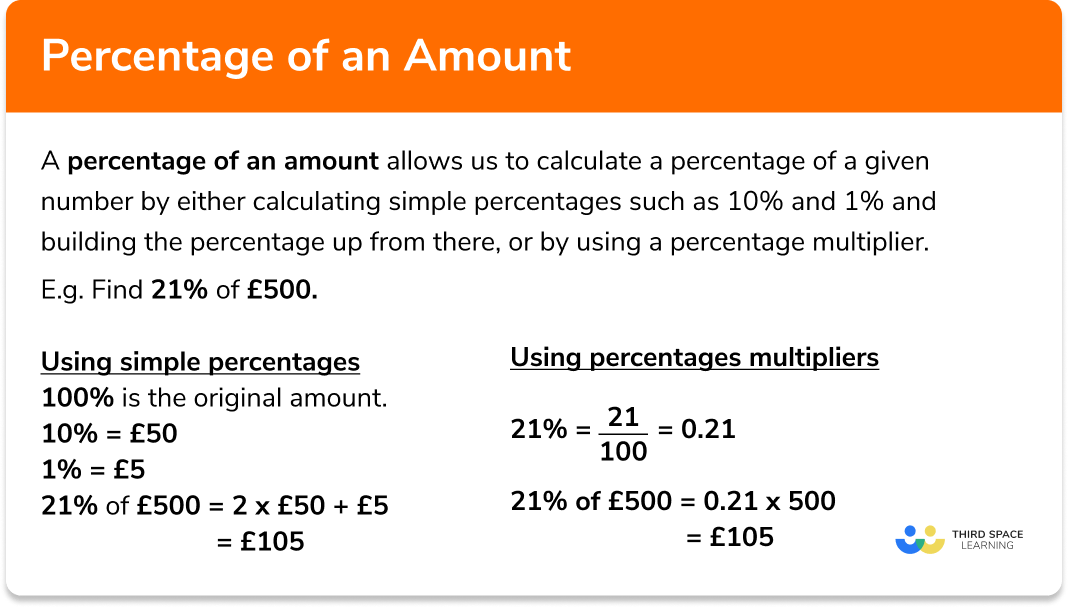
To find a percentage of a number, you convert the percentage to its decimal equivalent and then multiply it by the number.
Formula:
Part = (Percentage / 100) * Whole Number
Or, more simply:
Part = Decimal Equivalent of Percentage * Whole Number
Let’s break this down with practical financial examples.
Step-by-Step Example: Calculating a Discount
Imagine you’re shopping, and you see an item priced at $150 with a “20% Off!” sticker. How much money will you save, and what’s the final price?
- Identify the percentage: 20%
- Identify the whole number (original price): $150
- Convert the percentage to a decimal: 20 / 100 = 0.20
- Multiply the decimal by the whole number: 0.20 * $150 = $30
You will save $30. To find the final price, subtract the discount from the original price: $150 – $30 = $120.
Alternatively, if you’re saving 20%, you are paying 80% of the original price (100% – 20% = 80%).
0.80 * $150 = $120 (This directly gives you the final price).
Step-by-Step Example: Calculating Sales Tax
You’re buying a new gadget for $50, and the local sales tax rate is 7%. How much sales tax will you pay, and what’s the total cost?
- Identify the percentage: 7%
- Identify the whole number (item price): $50
- Convert the percentage to a decimal: 7 / 100 = 0.07
- Multiply the decimal by the whole number: 0.07 * $50 = $3.50
You will pay $3.50 in sales tax. The total cost will be the item price plus the sales tax: $50 + $3.50 = $53.50.
Step-by-Step Example: Simple Interest Calculation
Suppose you deposit $1,000 into a savings account that offers a simple annual interest rate of 5%. How much interest will you earn in one year?
- Identify the percentage (interest rate): 5%
- Identify the whole number (principal amount): $1,000
- Convert the percentage to a decimal: 5 / 100 = 0.05
- Multiply the decimal by the whole number: 0.05 * $1,000 = $50
You will earn $50 in simple interest for that year. Your total balance would then be $1,000 + $50 = $1,050.
These examples illustrate the core calculation. The beauty of this method lies in its versatility; once you grasp it, you can apply it to virtually any scenario where you need to find a percentage of a given monetary value.
Beyond the Basics: Practical Applications in Money Management
With the core calculation under your belt, let’s explore how percentages are dynamically applied in various facets of personal and business finance, offering deeper insights and strategic advantages.
Budgeting and Expense Tracking

Effective budgeting hinges on understanding where your money goes. Percentages provide a clear framework for allocating funds and identifying areas for adjustment. For instance, many financial advisors suggest following the 50/30/20 rule: 50% of your income for needs, 30% for wants, and 20% for savings and debt repayment.
- Example: If your monthly net income is $4,000:
- Needs (50%): 0.50 * $4,000 = $2,000
- Wants (30%): 0.30 * $4,000 = $1,200
- Savings/Debt (20%): 0.20 * $4,000 = $800
You can also use percentages to analyze your current spending. If you spend $1,000 on housing and your income is $4,000, what percentage of your income goes to housing? ($1,000 / $4,000) * 100 = 25%. This allows you to benchmark your spending against recommendations or your own financial goals.
Investment Returns and Growth
For investors, percentages are the primary language for discussing performance. Whether it’s stocks, bonds, mutual funds, or real estate, returns are almost always quoted as a percentage.
- Example: You invest $5,000 in a stock that grows by 15% in a year.
- Growth amount: 0.15 * $5,000 = $750
- New value: $5,000 + $750 = $5,750
Conversely, if your investment loses 5% of its value:
- Loss amount: 0.05 * $5,000 = $250
- New value: $5,000 – $250 = $4,750
Understanding these calculations is critical for tracking portfolio performance, comparing different investment opportunities, and making informed decisions about buying, holding, or selling assets.
Debt Management and Interest
Managing debt effectively requires a clear understanding of interest calculations. Loan interest is almost always expressed as an Annual Percentage Rate (APR).
- Example: You have a credit card balance of $2,500 with an APR of 18%. To estimate monthly interest, you might divide the APR by 12 (for 12 months).
- Monthly interest rate: 18% / 12 = 1.5%
- Monthly interest charged: 0.015 * $2,500 = $37.50
This simple calculation helps illustrate how quickly interest can accrue and why paying down high-interest debt is often a financial priority. For mortgages and other installment loans, understanding how much of your payment goes toward principal versus interest (which varies over the loan’s life) involves more complex amortisation schedules, but the underlying percentage calculations remain fundamental.
Understanding Financial Statements
For business owners and savvy investors, percentages are key to dissecting a company’s financial health through its statements. Metrics like gross profit margin, net profit margin, and return on equity are all percentage-based.
- Gross Profit Margin: (Gross Profit / Revenue) * 100
- If a company has $1,000,000 in revenue and $400,000 in gross profit, its gross profit margin is ($400,000 / $1,000,000) * 100 = 40%. This tells you how efficiently a company makes its products.
These percentage-based ratios allow for easy comparison between companies of different sizes or across different periods for the same company, providing insights into operational efficiency and profitability trends.
Savings Goals
Setting and achieving savings goals often benefits from a percentage-based approach. Instead of aiming to save a fixed dollar amount, saving a percentage of your income can be more flexible and sustainable, especially as your income fluctuates.
- Example: If your goal is to save 10% of every paycheck. If you earn $2,000 bi-weekly, you would save 0.10 * $2,000 = $200 from each check.
This systematic approach makes saving a consistent part of your financial routine and helps you visualize progress towards larger financial milestones like a down payment on a home or retirement.
Leveraging Tools for Accurate Percentage Calculations
While manual calculation is essential for understanding, modern financial life benefits immensely from tools that automate and simplify percentage computations, reducing the risk of errors and saving time.
The Ubiquitous Calculator
From the basic four-function calculator on your smartphone to dedicated scientific calculators, these devices are designed to handle percentage calculations with ease. Most have a dedicated “%” button, though knowing the decimal conversion method ensures you can calculate percentages even without it.
- Using a ‘%’ button (varies by calculator): To find 20% of $150, you might type
150 * 20 % =. Some calculators require20 % * 150 =. Always test your calculator’s functionality. - Decimal method (universal): Type
150 * 0.20 =
Spreadsheets (Excel, Google Sheets) for Complex Scenarios
For more involved financial planning, budgeting, or business analysis, spreadsheet software like Microsoft Excel or Google Sheets is indispensable. They allow you to set up dynamic calculations where percentages can be applied across numerous figures, automatically updating results as numbers change.
- Basic Percentage Formula in a Spreadsheet:
- To find 20% of a number in cell A1, you would enter
=A1 * 0.20into another cell. - To calculate a sales tax of 7% on a value in B2, you would use
=B2 * 0.07. - To apply a general percentage from cell C1 (e.g., C1 contains “20%”) to a number in A1, you could use
=A1 * C1. (Note: in some spreadsheets, if C1 literally says “20%”, it might interpret it as 0.20 automatically; otherwise, you’d use=A1 * (C1/100)).
- To find 20% of a number in cell A1, you would enter
- More Advanced: You can set up entire budget sheets that automatically calculate percentage allocations, or investment trackers that show percentage gains/losses.
Spreadsheets are particularly powerful for “what-if” scenarios, allowing you to quickly see how changing a percentage (like an interest rate or a discount) impacts your final financial outcome.
Online Calculators and Financial Apps
The internet abounds with specialized calculators and financial applications tailored for specific percentage-based needs.
- Mortgage Calculators: These compute your monthly payments based on interest rates (a percentage), loan amounts, and terms.
- Tip Calculators: Automatically determine tip amounts and split bills based on a chosen percentage.
- Loan Interest Calculators: Help you understand the total interest paid over the life of a loan or the impact of different interest rates.
- Budgeting Apps: Many personal finance apps like Mint, YNAB, or PocketGuard offer features that visualize your spending as percentages of your income, providing actionable insights.
These tools streamline calculations, making complex financial planning more accessible, but they rely on your understanding of the underlying percentages to input correct values and interpret results accurately.

Conclusion: Empowering Your Financial Decisions with Percentages
Understanding how to calculate a percentage of a number is far more than a simple arithmetic skill; it’s a critical component of financial literacy. From navigating everyday purchases and managing personal budgets to making strategic investment decisions and analyzing business performance, percentages provide the context, clarity, and comparability essential for informed financial choices. They transform raw numbers into meaningful insights, empowering you to evaluate opportunities, identify risks, and plan for a secure financial future.
By mastering the basic formula—converting a percentage to a decimal and multiplying it by the whole number—you gain a versatile tool applicable across virtually every financial scenario. Coupled with the judicious use of calculators, spreadsheets, and dedicated financial apps, this fundamental skill becomes a powerful asset in your financial toolkit. Embrace the world of percentages, practice applying them to your own financial situations, and watch as your confidence and acumen in managing money grow, paving the way for greater financial empowerment and success.
aViewFromTheCave is a participant in the Amazon Services LLC Associates Program, an affiliate advertising program designed to provide a means for sites to earn advertising fees by advertising and linking to Amazon.com. Amazon, the Amazon logo, AmazonSupply, and the AmazonSupply logo are trademarks of Amazon.com, Inc. or its affiliates. As an Amazon Associate we earn affiliate commissions from qualifying purchases.