
Understanding how to calculate a percent increase is an indispensable skill in the realm of finance, whether you’re managing personal savings, tracking investments, or analyzing business performance. It allows us to quantify growth, assess the impact of changes over time, and compare different financial scenarios on a level playing field. Unlike absolute changes, which merely tell you the raw numerical difference, a percentage increase provides context, revealing the proportional shift relative to an initial value. This is crucial for interpreting everything from the performance of a stock portfolio to the growth of a company’s revenue or even the change in your household budget.
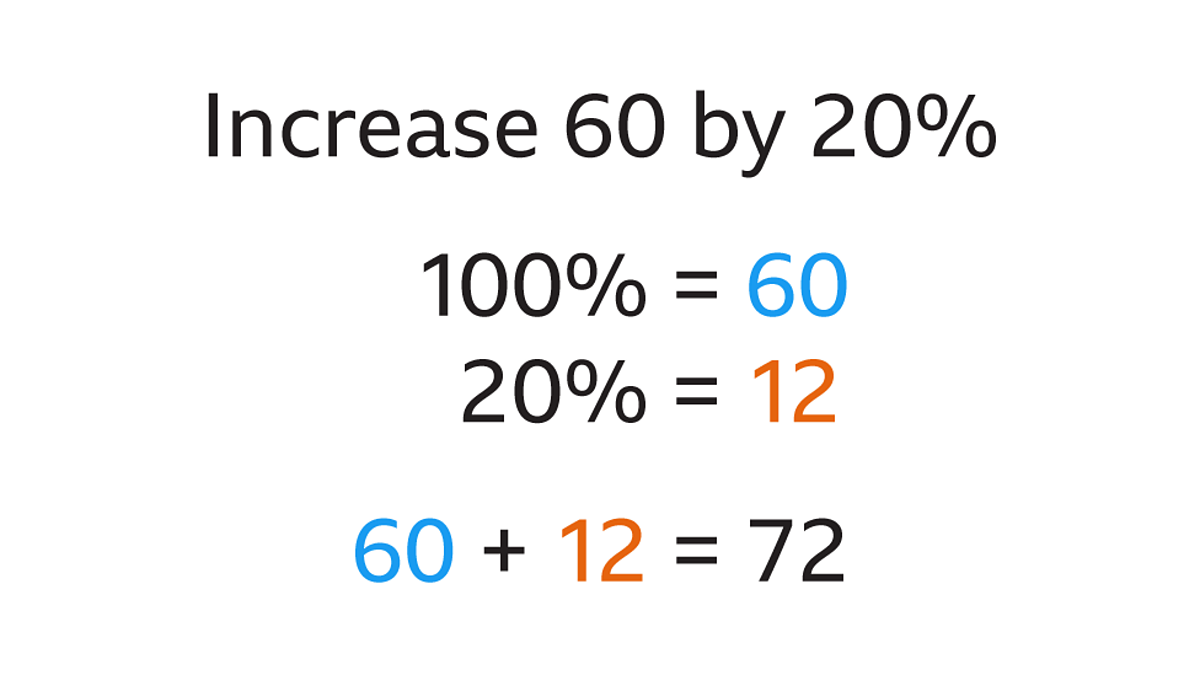
In this comprehensive guide, we’ll demystify the process, breaking down the calculation into simple, actionable steps. We’ll then explore its wide-ranging applications across various financial contexts, demonstrating why this seemingly simple mathematical operation is a cornerstone of sound financial analysis.
Understanding the Core Concept: Why Percentages Matter in Finance
Before diving into the mechanics, it’s vital to grasp why percent increases are so critical. In finance, raw numbers alone often tell an incomplete story. A $100 increase in your daily coffee budget is significant, but a $100 increase in a multi-million-dollar investment portfolio is negligible. Percentages provide the necessary perspective.
The Power of Relative Change
Relative change, expressed as a percentage, allows for meaningful comparisons regardless of the scale of the initial values. For instance, if an investment of $1,000 grows by $100, that’s a 10% increase. If an investment of $100,000 grows by $1,000, that’s only a 1% increase. While the absolute increase in the second case is larger, the relative growth in the first case is significantly higher, indicating better performance proportionally.
This relative understanding is fundamental when evaluating:
- Investment Returns: Comparing the annual percentage return (APR) of different assets, irrespective of their initial cost.
- Inflation: Understanding how much the purchasing power of money has decreased relative to a previous period.
- Salary Adjustments: Determining the true impact of a raise, not just its dollar amount.
- Business Growth: Assessing how much revenue or profit has grown as a proportion of previous performance.
Differentiating Absolute vs. Relative Growth
An absolute change is simply the difference between two values (New Value – Old Value). It tells you how much something has changed in raw terms.
A relative change (percent increase or decrease) tells you how much something has changed in proportion to its original value. It answers the question, “What percentage of the original value does this change represent?”
Consider two scenarios:
- A small business increases its monthly profit from $500 to $750. (Absolute change: +$250)
- A large corporation increases its monthly profit from $1,000,000 to $1,000,250. (Absolute change: +$250)
In both cases, the absolute change is the same ($250). However, the relative change (percent increase) is vastly different. For the small business, it’s a 50% increase, which is phenomenal. For the corporation, it’s a mere 0.025% increase, which is almost negligible. This distinction underscores why percent increase is often the preferred metric in financial analysis.
The Step-by-Step Formula for Percent Increase
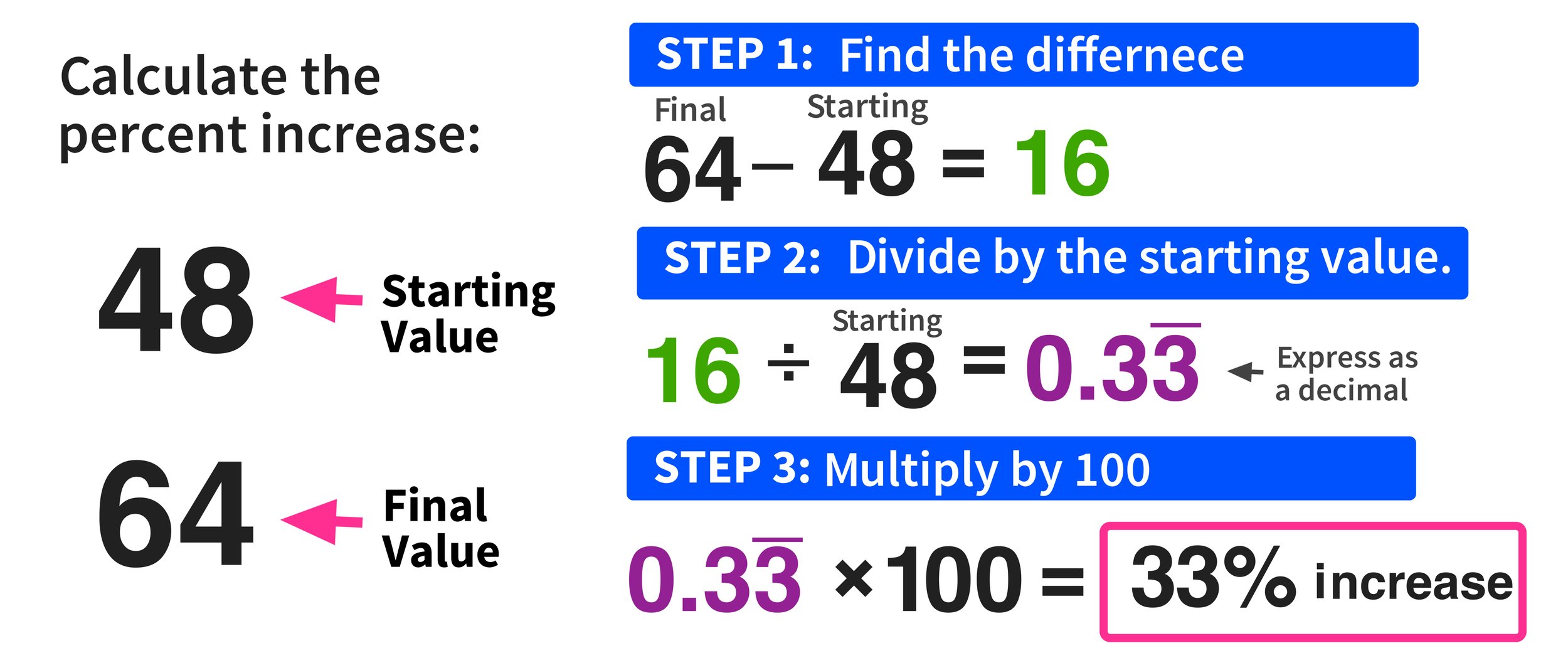
Calculating a percent increase involves a straightforward three-step process. You’ll need two values: an “old” or “original” value and a “new” or “current” value.
The general formula is:
Percent Increase = ((New Value – Old Value) / Old Value) * 100
Let’s break down each step.
Step 1: Find the Difference (New Value – Old Value)
The first step is to determine the absolute change between the two values. Subtract the original value from the new value. If the new value is greater than the old value, the result will be positive, indicating an increase. If the new value is smaller, the result will be negative, indicating a decrease (which would lead to a percent decrease calculation).
Formula for Step 1: Difference = New Value – Old Value
-
Example 1 (Personal Finance): Your investment portfolio grew from $10,000 to $11,500.
- Difference = $11,500 (New Value) – $10,000 (Old Value) = $1,500
-
Example 2 (Business Finance): A company’s quarterly sales increased from $500,000 to $625,000.
- Difference = $625,000 (New Value) – $500,000 (Old Value) = $125,000
Step 2: Divide by the Old Value
Once you have the difference, divide it by the original (or old) value. This step converts the absolute difference into a decimal representing the proportional change. It’s crucial to always divide by the original value, as this is the base from which the increase is measured.
Formula for Step 2: Decimal Change = Difference / Old Value
-
Example 1 (Continued):
- Decimal Change = $1,500 (Difference) / $10,000 (Old Value) = 0.15
-
Example 2 (Continued):
- Decimal Change = $125,000 (Difference) / $500,000 (Old Value) = 0.25
Step 3: Convert to a Percentage
The final step is to convert the decimal obtained in Step 2 into a percentage. You do this by multiplying the decimal by 100. This makes the number more intuitive and easier to compare.
Formula for Step 3: Percent Increase = Decimal Change * 100
-
Example 1 (Continued):
- Percent Increase = 0.15 * 100 = 15%
- Conclusion: Your investment portfolio increased by 15%.
-
Example 2 (Continued):
- Percent Increase = 0.25 * 100 = 25%
- Conclusion: The company’s quarterly sales increased by 25%.
Practical Applications in Personal Finance and Investing

The ability to calculate percent increases is not just a theoretical exercise; it has immediate, tangible benefits in managing your personal finances and investments.
Tracking Investment Growth
One of the most common applications is evaluating the performance of your investments. Whether it’s a stock, a mutual fund, a cryptocurrency, or real estate, understanding its percentage growth is vital.
Scenario: You bought 100 shares of a company for $50 per share (total $5,000). A year later, the shares are worth $57.50 each (total $5,750).
- Old Value = $5,000
- New Value = $5,750
- Difference = $5,750 – $5,000 = $750
- Decimal Change = $750 / $5,000 = 0.15
- Percent Increase = 0.15 * 100 = 15%
This tells you your investment yielded a 15% return, allowing you to compare it against other investment opportunities or market benchmarks.
Analyzing Budget Changes
Budgeting is dynamic. Income and expenses fluctuate. Percent increases help you understand the magnitude of these changes relative to your overall financial picture.
Scenario: Your monthly grocery bill increased from $400 last year to $460 this year.
- Old Value = $400
- New Value = $460
- Difference = $460 – $400 = $60
- Decimal Change = $60 / $400 = 0.15
- Percent Increase = 0.15 * 100 = 15%
A 15% increase in groceries might signal the need to adjust other budget categories or look for ways to cut costs in that area.
Evaluating Salary Increases and Inflation
When you receive a pay raise, the percentage increase tells you its real impact. Comparing this to the inflation rate (which is also expressed as a percentage increase in the cost of goods and services) helps you gauge if your purchasing power has truly increased.
Scenario: Your annual salary increased from $60,000 to $63,000.
- Old Value = $60,000
- New Value = $63,000
- Difference = $63,000 – $60,000 = $3,000
- Decimal Change = $3,000 / $60,000 = 0.05
- Percent Increase = 0.05 * 100 = 5%
If the inflation rate for the same period was 3%, your real (after-inflation) purchasing power increased by 2%. If inflation was 6%, despite your raise, your purchasing power effectively decreased.
Business Finance Insights: Beyond the Basics
In the corporate world, percent increases are fundamental to financial reporting, strategic planning, and performance evaluation. They offer concise insights into growth trends and efficiency changes.
Measuring Revenue and Profit Growth
Companies constantly track their revenue and profit growth quarter-over-quarter or year-over-year. These percentages are key indicators of a company’s health and market position.
Scenario: A company’s annual revenue rose from $1.2 million to $1.5 million.
- Old Value = $1,200,000
- New Value = $1,500,000
- Difference = $1,500,000 – $1,200,000 = $300,000
- Decimal Change = $300,000 / $1,200,000 = 0.25
- Percent Increase = 0.25 * 100 = 25%
This 25% revenue growth would be a positive signal to investors and stakeholders.
Assessing Cost Escalation
Just as revenues can increase, so can costs. Monitoring the percent increase in operating expenses, raw material costs, or labor costs is crucial for maintaining profitability.
Scenario: A manufacturing company’s raw material costs per unit increased from $25 to $28.
- Old Value = $25
- New Value = $28
- Difference = $28 – $25 = $3
- Decimal Change = $3 / $25 = 0.12
- Percent Increase = 0.12 * 100 = 12%
A 12% increase in raw material costs would necessitate a review of pricing strategies, supply chain efficiencies, or product design to absorb or pass on the additional expense.
Understanding Market Share Dynamics
Companies use percent changes to understand shifts in their market share, customer base, or product penetration.
Scenario: A new product line increased its market share from 8% to 10%.
- Old Value = 8%
- New Value = 10%
- Difference = 10% – 8% = 2% (This is an absolute percentage point change)
- Decimal Change = 2% / 8% = 0.25 (Note: when calculating percent increase of a percentage, treat the percentages as regular numbers in the formula)
- Percent Increase = 0.25 * 100 = 25%
This indicates a significant 25% growth in the product’s market share relative to its previous standing. Be careful not to confuse an increase in percentage points with a percent increase of that percentage. For example, going from 8% to 10% is a 2 percentage point increase, but a 25% increase relative to the original 8%.
Common Pitfalls and Considerations
While straightforward, there are a few nuances to keep in mind when calculating and interpreting percent increases.
The Importance of the Base Value
Always double-check that you are dividing by the correct original value. Using the new value by mistake will yield an incorrect and misleading result. The original value serves as the essential baseline for comparison.
When Percentages Can Be Misleading
Percentages are powerful, but they can be misinterpreted, especially with very small initial values. For example, if a small startup’s profit increases from $10 to $100, that’s a 900% increase. While numerically correct, the absolute dollar amount ($90) is still small, and such a large percentage might exaggerate the company’s overall financial strength without context. Always consider the absolute values alongside the percentages.
Negative Increases and Decreases
If your “new value” is less than your “old value,” you’re calculating a percent decrease, not an increase. The formula remains the same, but the resulting difference will be negative, leading to a negative percentage. For clarity, it’s often better to express a negative percentage as a “percent decrease” (e.g., -10% is a 10% decrease).
Example (Percent Decrease): Your crypto investment dropped from $5,000 to $4,500.
- Difference = $4,500 – $5,000 = -$500
- Decimal Change = -$500 / $5,000 = -0.10
- Percent Change = -0.10 * 100 = -10% (or a 10% decrease)
Conclusion
Calculating a percent increase is a foundational skill that empowers individuals and businesses to make sense of financial data. From tracking personal savings and investment returns to analyzing corporate growth and cost efficiencies, the ability to quantify relative change provides clarity and actionable insights. By mastering the simple three-step formula – finding the difference, dividing by the original value, and converting to a percentage – you gain a critical tool for navigating the complexities of the financial world with greater confidence and precision. Always remember the importance of context, the correct base value, and the distinction between absolute and relative changes to ensure your financial assessments are both accurate and insightful.
aViewFromTheCave is a participant in the Amazon Services LLC Associates Program, an affiliate advertising program designed to provide a means for sites to earn advertising fees by advertising and linking to Amazon.com. Amazon, the Amazon logo, AmazonSupply, and the AmazonSupply logo are trademarks of Amazon.com, Inc. or its affiliates. As an Amazon Associate we earn affiliate commissions from qualifying purchases.