
In the intricate world of personal finance, business operations, and investment strategies, understanding percentages is not merely an academic exercise; it’s a fundamental skill that underpins sound decision-making. Among the myriad percentage calculations, determining “20 percent of a number” stands out as particularly prevalent. From budgeting and savings to understanding discounts, taxes, and investment returns, the ability to quickly and accurately calculate 20% empowers individuals and businesses to navigate their financial landscape with greater confidence and insight. This guide will demystify the process, provide practical methodologies, and illustrate the widespread financial applications of this seemingly simple calculation.
The Ubiquity of Percentages in Your Financial Life
Percentages are the universal language of proportionality, and 20% is a particularly frequent player in various financial scenarios. Recognizing its pervasive presence is the first step towards appreciating its importance.
Everyday Applications: Discounts, Tips, and Taxes
Think about your daily expenditures. When you shop, you’re constantly evaluating discounts, many of which are advertised as a percentage off. A 20% off sale can represent significant savings, but only if you can quickly grasp its monetary equivalent. Dining out often involves calculating a tip, where 15-20% is a common benchmark for good service. Understanding how to calculate 20% rapidly allows for fair compensation without overspending. Furthermore, various taxes, from sales tax in some regions to capital gains tax rates, can often hover around or include a 20% component, making this calculation vital for understanding your actual costs or liabilities.
Personal Finance Planning: Budgeting and Savings Goals
The “pay yourself first” principle, a cornerstone of effective personal finance, often advocates for saving or investing at least 10-20% of your income. Knowing exactly how much 20% of your monthly salary equates to is critical for setting realistic savings goals, tracking progress, and ensuring you’re allocating sufficient funds to your financial future. Whether it’s saving for a down payment on a house, building an emergency fund, or contributing to a retirement account, the 20% calculation is a constant companion in your budgeting journey.
Investing and Returns: Understanding Growth and Fees
In the investment world, percentages are paramount. Investment gains or losses are almost always expressed as percentages. If your portfolio grows by 20% in a year, or a particular stock yields a 20% return, you need to calculate the actual profit to assess your financial health. Conversely, understanding advisory fees or expense ratios, which might be a fraction of a percent but accumulate significantly over time, also relies on this foundational understanding. Projecting compound interest or future values often involves calculating successive percentage increases, making the ability to handle 20% a valuable starting point.
Fundamental Methods for Calculating 20 Percent
While the concept is straightforward, there are several effective methods to calculate 20% of any given number, each suited to different situations and preferences.
The Decimal Conversion Method: Simple and Precise
This is arguably the most common and universally applicable method, especially when using a calculator. The core idea is to convert the percentage into its decimal equivalent and then multiply.
-
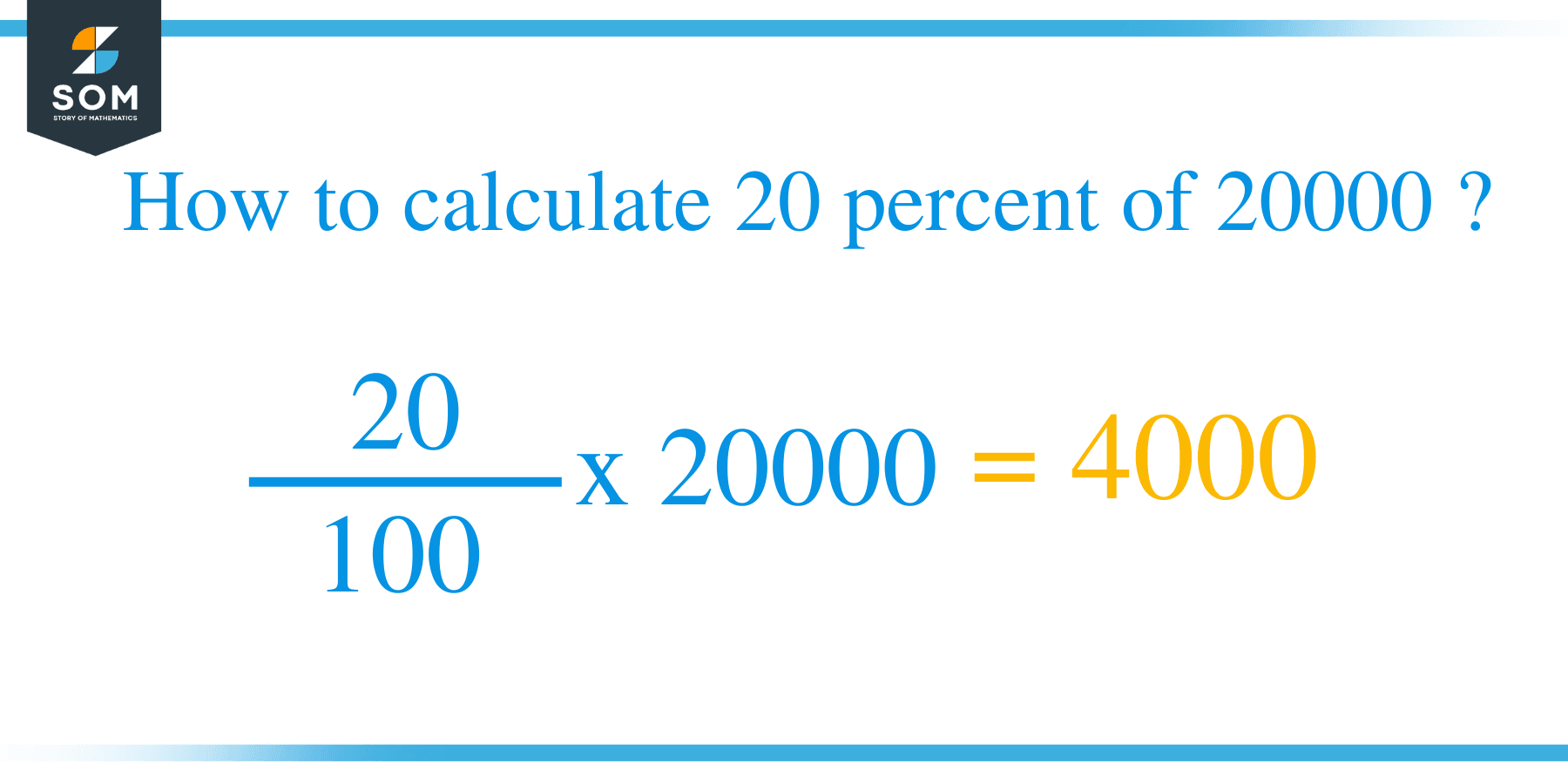
Step 1: Convert the percentage to a decimal. To do this, divide the percentage by 100. So, 20% becomes 20 / 100 = 0.20.
-
Step 2: Multiply the decimal by the number. If you want to find 20% of 250, you would calculate 0.20 * 250.
Example: Find 20% of $500.
0.20 * $500 = $100.
This method is precise, works for any percentage, and is ideal for calculations involving larger or more complex numbers, particularly with digital tools.
The Fraction Method: Intuitive and Quick for Common Percentages
Many common percentages have simple fractional equivalents, and 20% is a prime example. This method can often be quicker for mental math or when dealing with numbers easily divisible by the denominator.
-
Step 1: Convert the percentage to a fraction. 20% means 20 out of 100, which can be written as 20/100.
-
Step 2: Simplify the fraction. 20/100 simplifies to 1/5 (by dividing both numerator and denominator by 20).
-
Step 3: Multiply the number by the fraction (or divide by the denominator). To find 1/5 of a number, you simply divide that number by 5.
Example: Find 20% of $450.
Since 20% = 1/5, you calculate $450 / 5 = $90.
This method is incredibly efficient for numbers that are multiples of 5, making it a powerful tool for quick estimations and mental calculations.
The “Break It Down” Method: Mental Math for Everyday Scenarios
This method leverages the fact that 20% is simply double 10%. It’s excellent for mental math and offers a quick way to estimate even for numbers not easily divisible by 5.
-
Step 1: Calculate 10% of the number. To find 10% of any number, simply move the decimal point one place to the left (or divide by 10).
-
Step 2: Double that result. Since 20% is twice 10%, doubling your 10% value gives you 20%.
Example: Find 20% of $320.
-
10% of $320 = $32.00 (move decimal one place left).
-
Double $32.00 = $64.00.
So, 20% of $320 is $64.00.
-

This method is highly versatile and can be applied quickly in many real-time financial situations, like calculating a tip or a quick discount.
Real-World Financial Scenarios: Putting 20% into Practice
The true value of mastering percentage calculations lies in their application to real-life financial challenges and opportunities.
Budgeting for Savings: The 20% Rule
A popular financial guideline suggests allocating at least 20% of your net income towards savings and debt reduction (beyond minimum payments). If your monthly take-home pay is $4,000, calculating 20% of this immediately tells you that you should aim to save/invest $800 each month. This concrete figure makes budgeting tangible and actionable, helping you prioritize your financial goals and track your progress against a clear benchmark.
Understanding Investment Contributions and Returns
Consider a scenario where you’ve invested $10,000, and your portfolio experiences a 20% gain. Using the decimal method (0.20 * $10,000 = $2,000), you immediately know your profit is $2,000, bringing your total investment value to $12,000. Conversely, if you decide to allocate 20% of a bonus towards a specific investment, say a $5,000 bonus, you’d calculate 0.20 * $5,000 = $1,000, informing you exactly how much to transfer. This clarity is crucial for managing your wealth effectively.
Analyzing Business Profit Margins and Discounts
For entrepreneurs and business owners, calculating 20% is a daily occurrence. If a product costs $100 to produce, and you want to achieve a 20% profit margin on that cost, you’d add $20 (0.20 * $100) to the cost, selling it for $120. Similarly, when running a “20% off” promotion, knowing the monetary value of that discount on various items helps both the business strategize and customers understand their savings.
Navigating Taxes and Deductions
Tax systems can be complex, but percentages are always at their core. If you qualify for a 20% tax deduction on certain expenses, and those expenses total $3,000, you’ve saved $600 (0.20 * $3,000) on your taxable income, potentially reducing your overall tax bill. Understanding these calculations helps in effective tax planning and ensuring compliance while maximizing legitimate savings.
Leveraging Financial Tools for Percentage Calculations
While mental math is empowering, modern financial tools offer accuracy and efficiency for percentage calculations, especially with larger numbers or when creating complex financial models.
Digital Calculators: Accuracy at Your Fingertips
Basic digital calculators, whether standalone devices or apps on your smartphone, are indispensable. Most have a dedicated percentage button (%), but even without it, the decimal conversion method works flawlessly. For example, to find 20% of 675, you’d type 0.20 * 675 =. These tools eliminate human error and provide instant, precise results.
Spreadsheet Software: Automating Complex Financial Models
Programs like Microsoft Excel or Google Sheets are financial powerhouses. They allow you to set up formulas that automatically calculate percentages across multiple data points. For instance, you can have a column for ‘Income’, another for ‘20% Savings’, and a formula in the savings column that automatically calculates 20% of the corresponding income figure. This is invaluable for budgeting, financial forecasting, investment tracking, and managing business accounts, as it updates calculations instantly when input numbers change.
Online Financial Calculators: Specialized Tools for Specific Needs
The internet offers a plethora of specialized financial calculators designed for specific percentage-based tasks. There are tip calculators, mortgage payment calculators that factor in interest rates, investment growth calculators that demonstrate compound returns, and even tax estimators. While they perform the 20% calculation behind the scenes, understanding the underlying math helps you interpret the results and use these tools more effectively.
Beyond 20%: Developing a Broader Percentage Fluency
Mastering 20% is an excellent starting point, but the true goal is to cultivate a comprehensive understanding of percentages for robust financial literacy.
Adapting Methods for Other Percentages
The methods discussed for 20% are not isolated; they are foundational and adaptable. For instance, to find 15% of a number, you can find 10% and then add half of that (5%). To find 30%, you can find 10% and multiply by three. The decimal method works for any percentage. By understanding these core principles, you can confidently tackle any percentage calculation thrown your way.
The Power of Estimation: Quick Checks for Financial Decisions
Not every financial decision requires absolute precision in the moment. The ability to quickly estimate percentages can be incredibly powerful. If a service costs $178 and you want to tip around 20%, you might quickly round $178 to $180, calculate 10% as $18, and then double it to $36. This quick estimation allows you to make informed decisions without needing a calculator for every single transaction.

Continuous Learning: Enhancing Your Financial Literacy
Percentages are just one piece of the broader financial literacy puzzle, but they are a critical one. Continuously engaging with financial concepts, understanding how percentages influence interest rates, inflation, investment performance, and tax implications, will only strengthen your ability to manage your money wisely. The simple act of understanding “how do I calculate 20 percent of a number” unlocks a deeper appreciation for the mechanics of money, empowering you to make smarter, more confident financial choices in every aspect of your life.
aViewFromTheCave is a participant in the Amazon Services LLC Associates Program, an affiliate advertising program designed to provide a means for sites to earn advertising fees by advertising and linking to Amazon.com. Amazon, the Amazon logo, AmazonSupply, and the AmazonSupply logo are trademarks of Amazon.com, Inc. or its affiliates. As an Amazon Associate we earn affiliate commissions from qualifying purchases.