
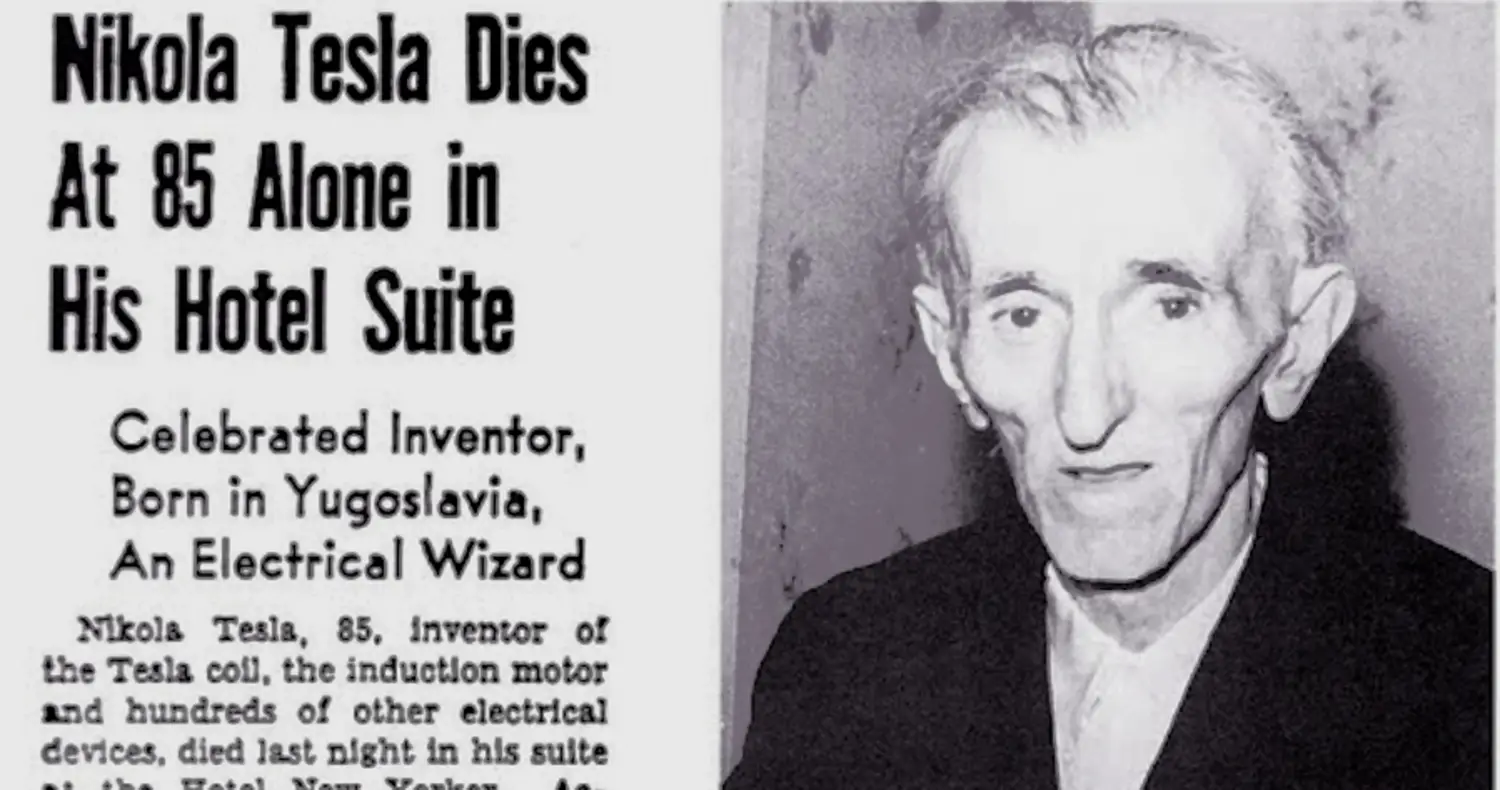
The story of Nikola Tesla’s death is often framed as a tragedy of a forgotten genius, but for the world of technology, it represents one of the most significant pivot points in history. On January 7, 1943, Nikola Tesla passed away in Room 3327 of the New Yorker Hotel. While his physical body succumbed to the natural progression of age and isolation, the technology he left behind—both in physical prototypes and theoretical manuscripts—sparked a decade-long scramble by government agencies and private researchers to secure what many believed were the blueprints for the future.

To understand how Nikola Tesla died is to understand the conclusion of the Gilded Age of invention and the birth of the modern industrial-military tech complex. His passing was not just the end of a life; it was the beginning of a massive technological post-mortem that continues to influence our world today.
The Solitary End of a Visionary Architect
In the final years of his life, Nikola Tesla had retreated from the public eye, becoming a figure of mystery in the heart of Manhattan. Despite his monumental contributions to the development of the alternating current (AC) motor and the fundamental principles of radio, Tesla’s final days were characterized by a stark contrast to the high-voltage energy of his laboratories.
Room 3327: The Context of Tesla’s Final Days
Tesla spent the last decade of his life living in the New Yorker Hotel. By 1943, he was eighty-six years old and increasingly reclusive. His daily routines were rigid, involving feeding pigeons in the local park and maintaining a strict, almost obsessive-compulsive focus on cleanliness and mathematical patterns. From a technological standpoint, this period was frustrating for Tesla. He possessed the theoretical frameworks for technologies that the world would not see for another fifty years—including radar, wireless power transmission, and even precursors to the internet—but he lacked the capital to bring them to fruition.
The Biological Reality: A Heart Failure in Isolation
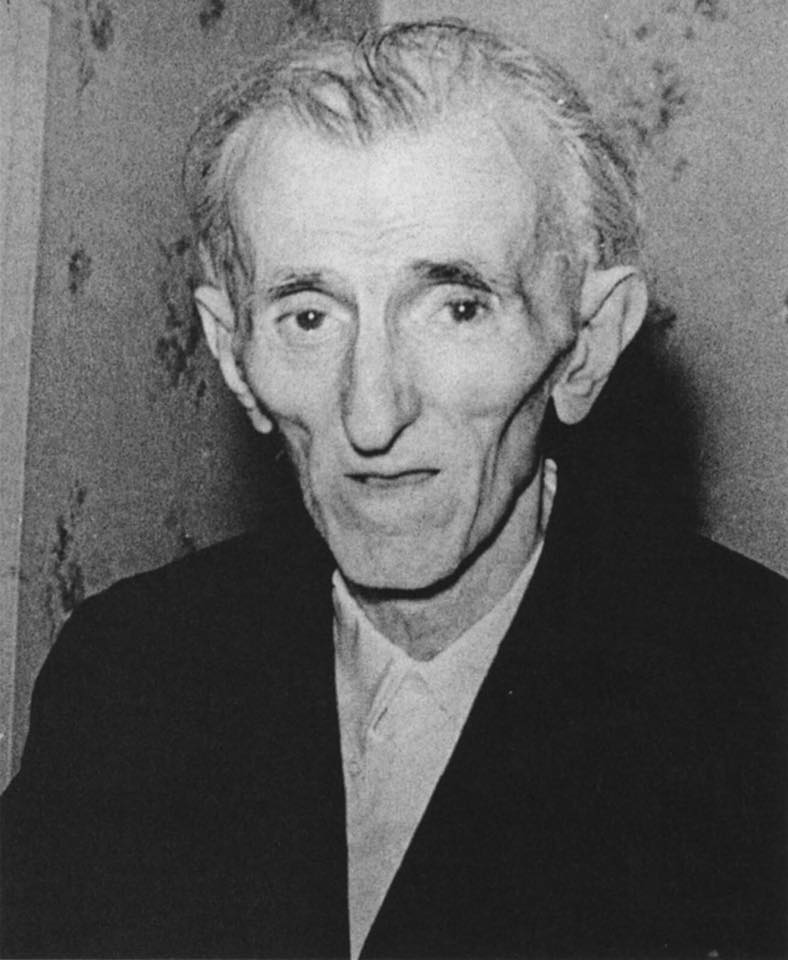
Nikola Tesla died of coronary thrombosis. He was found by a hotel maid, Alice Monaghan, who entered his room two days after he had placed a “Do Not Disturb” sign on his door. Because Tesla lived alone and had no immediate family in the United States, his death initially went unnoticed. When the news finally broke, it triggered a wave of mourning across the scientific community, but it also triggered something far more secretive: a race to secure his intellectual property. His death marked the moment when his theoretical “super-weapons” and energy distribution models transitioned from the mind of an inventor to the classified files of the state.
The Tech Post-Mortem: What Happened to the “Death Ray” and Classified Patents?
The moment Tesla’s death was confirmed, the United States government took an immediate interest in his belongings. We were in the height of World War II, and Tesla had spent his later years claiming he had perfected a “Death Ray” or “Teleforce” weapon that could melt airplane engines from miles away. For the Department of Defense, the tech left behind in Room 3327 was a matter of national security.
The Office of Alien Property and the Seizure of Files
Despite Tesla being a naturalized U.S. citizen, the Office of Alien Property (OAP) seized his trunks and papers. This move was technically illegal given his citizenship status, but the government’s fear was that his advanced technological theories might fall into the hands of the Axis powers. Tesla’s room contained dozens of trunks filled with notebooks, blueprints, and small-scale prototypes. These documents represented a lifetime of non-linear thinking, ranging from advanced mechanical oscillators to concepts for “directed-energy weapons.”
John G. Trump and the Evaluation of Tesla’s “Secret” Weapons
To make sense of the mountains of technical data, the government enlisted the help of an MIT professor and well-known electrical engineer: John G. Trump (the uncle of the 45th U.S. President). Trump was tasked with analyzing Tesla’s papers to see if any of the “secret” tech was viable for the war effort. After a three-day investigation, Trump’s official report stated that Tesla’s thoughts were “primarily of a speculative, philosophical, and somewhat promotional character.”
However, tech historians and enthusiasts have long questioned the completeness of this evaluation. While Trump found no “workable” death ray, the papers contained foundations for technologies that are now commonplace, such as beam-steering for defense systems and advanced wireless communications. The “death” of Tesla’s physical body allowed for his more radical ideas to be absorbed into the classified research programs that would eventually lead to the Cold War’s technological arms race.
From Alternating Current to Wireless Power: The Tech Interrupted
Tesla’s death left several major technological arcs unfinished. If we look at the trajectory of his career, his passing occurred at a time when his ideas were just beginning to be proven correct by others, often without his credit. The transition from his life to his legacy highlights the gap between visionary invention and commercial implementation.
The Wardenclyffe Dream and the Failure of Early Scalability
At the time of his death, Tesla was still haunted by the failure of the Wardenclyffe Tower project. His goal had been to create a global wireless communication and power system. While the tech world eventually adopted his ideas for wireless data (radio and Wi-Fi), the dream of wireless power transmission died with him in that hotel room. Tesla’s death marked the end of an era where a single inventor could hope to revolutionize the entire global energy infrastructure. The tech industry shifted from the “lone genius” model to the corporate R&D model we see today at companies like Google or IBM.
The Modern Resonance of Tesla’s Unfinished Wireless Protocols
Modern tech is currently circling back to the problems Tesla was trying to solve in 1943. We are seeing a resurgence in resonant inductive coupling and long-range wireless charging—technologies that Tesla was experimenting with in the 1890s. His death essentially paused these developments for nearly 80 years. Scientists today are re-examining his patents on “The Art of Individualization,” which served as an early conceptual framework for secure, frequency-hopping communication—the very tech that allows our modern smartphones to operate without interference.
The Technological Legacy: How Tesla’s Departure Influenced 21st-Century Engineering
While Nikola Tesla died in poverty, the “tech equity” he left behind is worth trillions in the modern economy. His death didn’t stop his influence; it merely decentralized it. Today, his name is synonymous with the cutting edge of sustainable energy and automation.
The Rise of Sustainable Energy and the AC Power Grid
The most immediate tech legacy of Tesla is the global power grid. Every time we plug in a device, we are using the polyphase alternating current system that Tesla perfected. His death solidified his status as the architect of the modern world, even if he didn’t live to see the full electrification of the planet. His work paved the way for the renewable energy revolution, as his turbines and motors are the fundamental components of wind and hydroelectric power generation.
AI, Robotics, and the Automation Predicted by Tesla
In one of his last major interviews before his health declined, Tesla spoke of “telautomatons”—remote-controlled machines that could perform tasks without human intervention. He viewed these as the future of labor. Tesla’s death occurred just as the first vacuum-tube computers were being built, yet he had already conceptualized the logic gates that would define them. Today’s advancements in robotics and Artificial Intelligence are the realization of Tesla’s vision of a mechanized world. He saw the “end of human drudgery” through technology, a theme that remains the primary driver of the Silicon Valley ethos.
Conclusion: The Immortal Engine of Innovation
Nikola Tesla died alone, but his intellectual fingerprints are on every piece of technology we touch today. His death was the catalyst for a massive redistribution of scientific knowledge. By the time his belongings were eventually returned to his family (and later to the Tesla Museum in Belgrade), much of the “tech” had already been integrated into the global scientific zeitgeist.
His passing reminds us that technology is rarely a linear path. It is a series of leaps, some of which are so far ahead of their time that they require the death of the inventor for the world to finally catch up. Tesla’s life ended in Room 3327, but the technological revolution he ignited is far from over. As we move into an era of autonomous vehicles, global satellite internet, and wireless energy, we are finally living in the world Nikola Tesla envisioned in his final, silent hours. He died a man of the 19th century, but his mind had already built the 21st.
aViewFromTheCave is a participant in the Amazon Services LLC Associates Program, an affiliate advertising program designed to provide a means for sites to earn advertising fees by advertising and linking to Amazon.com. Amazon, the Amazon logo, AmazonSupply, and the AmazonSupply logo are trademarks of Amazon.com, Inc. or its affiliates. As an Amazon Associate we earn affiliate commissions from qualifying purchases.