
In the intricate world of personal finance, investing, and business, numbers tell a story. Among these numbers, percentages stand out as a universal language, quantifying everything from interest rates on savings accounts to the growth of your investment portfolio, and the elusive profit margins of a thriving business. Understanding how to accurately calculate and interpret percentages isn’t merely a mathematical exercise; it’s a fundamental skill that empowers individuals and entrepreneurs alike to make informed decisions, optimize their financial strategies, and ultimately, build wealth. This article will demystify percentage calculations, illustrating their critical role in various financial scenarios and equipping you with the knowledge to wield them confidently for your financial success.

Understanding the Fundamentals: What is a Percentage?
Before diving into complex financial models, it’s essential to grasp the core concept of a percentage. At its heart, a percentage is simply a way to express a number as a fraction of 100. The word “percentage” itself derives from “per cent,” meaning “per hundred” or “out of one hundred.” This common denominator makes percentages incredibly useful for comparing different quantities or measuring changes relative to a whole.
The Concept of “Per Hundred”
Imagine you have a pie cut into 100 slices. If you eat 10 slices, you’ve eaten 10 out of 100 slices, or 10%. If a survey finds that 65 out of every 100 people prefer a certain investment strategy, then 65% of people prefer that strategy. This “out of 100” nature provides a standardized way to express proportions, making them easily understandable and comparable, regardless of the original size of the whole. A percentage is typically denoted by the percent sign (%). So, 25 percent is written as 25%.
Mathematically, a percentage is a dimensionless number, meaning it has no unit of measurement. It’s always expressed as a fraction of 1, where 1 represents the whole (or 100%). To convert a fraction or a decimal into a percentage, you simply multiply by 100. For instance, 0.25 is equivalent to 0.25 * 100 = 25%. Similarly, 1/4 is 0.25, which translates to 25%.
Why Percentages Reign Supreme in Finance
In the realm of money, percentages are far more than just mathematical curiosities; they are the bedrock of financial analysis and planning. Their power lies in their ability to contextualize numbers, providing a relative measure that raw figures often cannot.
Consider these scenarios:
- Comparing Investment Returns: Knowing that an investment earned $1000 in profit isn’t as insightful as knowing it earned a 10% return on an initial $10,000 investment. The percentage allows you to compare its performance against other investments, regardless of the initial capital.
- Understanding Interest Rates: Whether it’s the interest on a savings account, a credit card, or a mortgage, interest is almost universally expressed as an annual percentage rate (APR). This standardized percentage allows consumers to compare lending and borrowing costs across different financial products.
- Analyzing Budget Allocation: When you allocate 30% of your income to housing or 15% to savings, you’re using percentages to create a flexible budget that scales with your income, rather than fixed dollar amounts that might become obsolete.
- Tracking Economic Indicators: Inflation, unemployment rates, GDP growth – all critical economic metrics are presented as percentages, providing a snapshot of the economy’s health and trajectory.
Without percentages, navigating the complexities of personal finance, managing investments, or even understanding market trends would be significantly more challenging and less precise. They provide the common ground for financial literacy and effective decision-making.
Core Percentage Calculations Every Money Manager Needs
Mastering a few fundamental percentage calculations will unlock a deeper understanding of your finances. These calculations are applicable across a wide spectrum of financial situations, from everyday transactions to long-term financial planning.
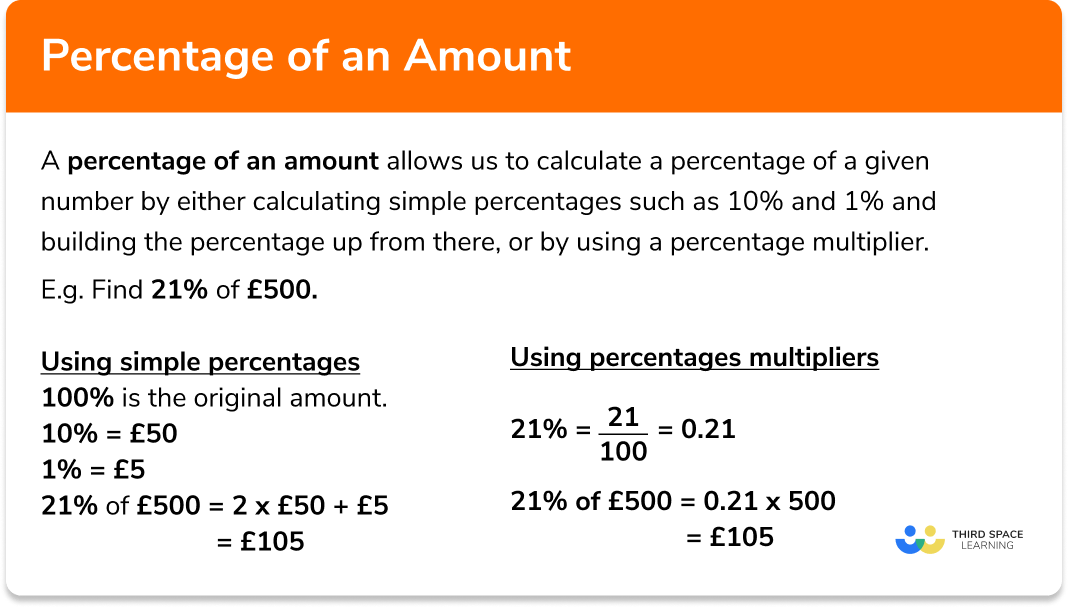
Calculating a Percentage of a Given Number
This is perhaps the most common percentage calculation you’ll encounter. It’s used for figuring out discounts, sales tax, tips, commissions, and a host of other financial deductions or additions.
Formula: Percentage of Number = (Percentage / 100) * Whole Number
Example 1: Sales Tax
You’re buying a new financial planning software for $250, and the sales tax is 8%.
Tax amount = (8 / 100) * $250 = 0.08 * $250 = $20
Total cost = $250 + $20 = $270
Example 2: Investment Commission
Your financial advisor charges a 1.5% commission on a $10,000 investment.
Commission amount = (1.5 / 100) * $10,000 = 0.015 * $10,000 = $150
Determining What Percentage One Number Is of Another
This calculation helps you understand the proportion of a part relative to a whole. It’s invaluable for analyzing budget allocations, calculating profit margins, determining market share, or even understanding how much of your savings goal you’ve achieved.
Formula: Percentage = (Part / Whole) * 100
Example 1: Budget Allocation
You earn $4,000 per month and spend $1,200 on housing. What percentage of your income goes to housing?
Housing percentage = ($1,200 / $4,000) * 100 = 0.30 * 100 = 30%
Example 2: Savings Progress
Your goal is to save $50,000 for a down payment, and you currently have $15,000 saved. What percentage of your goal have you reached?
Progress percentage = ($15,000 / $50,000) * 100 = 0.30 * 100 = 30%
Unraveling Percentage Increase and Decrease
Tracking changes over time is crucial for financial analysis, whether it’s monitoring investment growth, inflation rates, or price fluctuations. Percentage increase/decrease calculations provide a standardized way to measure these changes.
Formula for Percentage Increase: ((New Value - Original Value) / Original Value) * 100
Formula for Percentage Decrease: ((Original Value - New Value) / Original Value) * 100
Example 1: Investment Growth
Your stock portfolio was worth $20,000 at the start of the year and is now worth $24,000. What is the percentage increase?
Percentage Increase = (($24,000 – $20,000) / $20,000) * 100 = ($4,000 / $20,000) * 100 = 0.20 * 100 = 20%
Example 2: Price Drop
A cryptocurrency you invested in dropped from $1,000 per coin to $750 per coin. What is the percentage decrease?
Percentage Decrease = (($1,000 – $750) / $1,000) * 100 = ($250 / $1,000) * 100 = 0.25 * 100 = 25%
Advanced Applications: Percentages in Action for Wealth Building
Beyond the basics, percentages are embedded in nearly every aspect of sophisticated financial planning and wealth accumulation strategies. Understanding these applications can significantly enhance your ability to manage and grow your money effectively.
Interest Rates and Loan Calculations (Simple vs. Compound Interest)
Interest is the cost of borrowing money or the reward for saving it, and it’s almost always expressed as a percentage.
- Simple Interest: Calculated only on the principal amount. If you borrow $1,000 at 5% simple annual interest for 3 years, you pay $50 interest each year, totaling $150.
- Compound Interest: The “eighth wonder of the world,” as Einstein supposedly called it. Compound interest is calculated on the initial principal and also on the accumulated interest from previous periods. This means your money grows exponentially. A 7% annual return compounded over 30 years can turn a modest sum into a substantial nest egg. Understanding compounding is vital for retirement planning and long-term investing.
Investment Returns and Portfolio Performance (ROI, Capital Gains)
When evaluating investments, percentages are your primary tool.
- Return on Investment (ROI): A fundamental measure of an investment’s profitability.
ROI = ((Current Value - Initial Investment) / Initial Investment) * 100. A positive ROI indicates a profit, while a negative ROI indicates a loss. - Capital Gains/Losses: The percentage increase or decrease in the value of an asset (like stocks or real estate) from its purchase price. This determines your tax liability or deductions.
- Portfolio Allocation: Financial advisors often recommend diversifying your portfolio across different asset classes (e.g., 60% stocks, 30% bonds, 10% cash). These percentages guide your investment strategy, balancing risk and potential reward.
Budgeting, Savings, and Debt Management (The 50/30/20 Rule, Debt-to-Income Ratio)
Percentages are indispensable for personal financial management.
- Budgeting Rules: The popular 50/30/20 rule suggests allocating 50% of your after-tax income to needs, 30% to wants, and 20% to savings and debt repayment. This percentage-based approach makes budgeting flexible and scalable.
- Savings Goals: Setting a goal to save 10% or 15% of every paycheck ensures consistent progress towards financial milestones.
- Debt-to-Income (DTI) Ratio: Lenders use your DTI ratio (monthly debt payments / gross monthly income * 100) to assess your ability to manage monthly payments and repay loans. A lower DTI percentage is generally favorable.
Profit Margins and Business Metrics (Gross Margin, Net Margin)
For entrepreneurs and business owners, percentages are critical for assessing financial health and profitability.
- Gross Profit Margin:
((Revenue - Cost of Goods Sold) / Revenue) * 100. This percentage indicates how much profit a company makes from its sales after accounting for the direct costs of production. - Net Profit Margin:
((Net Income / Revenue) * 100). This is the ultimate measure of a company’s profitability, showing what percentage of revenue is left after all expenses, including taxes and interest, have been deducted. - Operating Margin:
((Operating Income / Revenue) * 100). This percentage indicates the profitability of a company’s core operations.
These metrics allow businesses to compare their performance against industry benchmarks, track efficiency, and make strategic pricing and cost management decisions.
Leveraging Tools for Precision and Efficiency
While understanding the manual calculations is fundamental, modern financial management often benefits from leveraging digital tools that offer speed and accuracy.
The Power of Spreadsheets (Excel, Google Sheets)
Spreadsheets are arguably the most powerful and versatile tools for financial percentage calculations. They allow you to:
- Automate Calculations: Once you set up formulas, percentages update automatically as you change input values.
- Create Dynamic Budgets: Easily adjust income and expenses to see how percentage allocations shift.
- Model Investment Scenarios: Project compound interest growth over decades or analyze various portfolio allocations.
- Track Business Performance: Calculate profit margins, growth rates, and other KPIs with ease.
Excel and Google Sheets offer built-in percentage formatting and functions that simplify complex calculations, making them indispensable for both personal and business finance.
Financial Calculators and Online Tools
For specific financial calculations, specialized tools can be incredibly helpful:
- Mortgage Calculators: Determine monthly payments, total interest paid, and amortization schedules, all based on interest percentages.
- Retirement Calculators: Project how much you need to save and how much your investments will grow by using compound interest percentages.
- Loan Calculators: Evaluate different loan scenarios, comparing APRs and total interest.
Many reputable financial websites and apps offer these calculators, providing instant insights without the need for manual setup.
Everyday Calculators and Mental Math Tips
For quick, on-the-spot percentage calculations, a basic calculator (even on your phone) is sufficient. For instance, to find 20% of $50, you can simply type 50 * 0.20 or 50 * 20%.
Developing some mental math shortcuts can also be beneficial:
- To find 10% of a number, move the decimal one place to the left (e.g., 10% of $350 is $35).
- To find 1% of a number, move the decimal two places to the left (e.g., 1% of $350 is $3.50).
- You can often break down percentages (e.g., 15% is 10% + 5%, or 10% + half of 10%).
While not always suitable for complex financial planning, these quick methods can help you estimate discounts, tips, or simple interest on the fly.
Avoiding Common Percentage Pitfalls
Despite their apparent simplicity, percentages can be misinterpreted or misapplied, leading to flawed financial conclusions. Awareness of these common pitfalls is crucial for accurate analysis.
The Base Problem: Understanding “Of What?”
One of the most frequent errors occurs when the base for the percentage calculation is unclear or changes. A common example is consecutive percentage changes. If an investment drops by 10% and then increases by 10%, it does not return to its original value.
- Start with $100.
- A 10% drop means it becomes $90 ($100 * 0.90).
- A 10% increase on the new base of $90 means it increases by $9 ($90 * 0.10), making it $99.
The “of what?” question is critical. Always identify the base number to which the percentage is being applied.
Compounding Errors: The Illusion of Success
Similar to the base problem, misunderstanding the impact of compounding periods can lead to over or underestimation. An “annual interest rate” is often quoted, but if interest is compounded monthly, daily, or continuously, the effective annual rate (EAR) will be higher. While 12% APR sounds simple, 1% per month compounded will yield slightly more than 12% annually. Always look for the effective annual rate (EAR) or clearly understand the compounding frequency to get a true picture of returns or costs.

Context is King: Numbers Without Narrative
A percentage, by itself, rarely tells the whole story. A 20% return on an investment sounds fantastic, but what was the risk involved? Did it take 10 years to achieve? Was the overall market up by 50% in the same period, making your 20% seem less impressive?
Similarly, a 3% inflation rate might seem low, but if your wages only increased by 1%, you’re effectively losing purchasing power. Always interpret percentages within their broader financial, economic, and personal context. What does the percentage signify relative to your goals, your risk tolerance, or market benchmarks?
In conclusion, percentages are far more than just mathematical notations; they are powerful tools for understanding, managing, and optimizing your financial life. From daily budgeting decisions to complex investment strategies and business profitability analysis, mastering percentage calculations provides a robust foundation for making insightful, data-driven choices. By understanding the fundamentals, applying core calculations, leveraging modern tools, and sidestepping common pitfalls, you can confidently navigate the financial landscape and steer your journey towards lasting wealth and financial independence.
aViewFromTheCave is a participant in the Amazon Services LLC Associates Program, an affiliate advertising program designed to provide a means for sites to earn advertising fees by advertising and linking to Amazon.com. Amazon, the Amazon logo, AmazonSupply, and the AmazonSupply logo are trademarks of Amazon.com, Inc. or its affiliates. As an Amazon Associate we earn affiliate commissions from qualifying purchases.