
For millions of Americans, Social Security represents a cornerstone of their financial security, particularly in retirement. Understanding how these benefits are calculated and, more importantly, how to estimate your potential payout is crucial for effective retirement planning. While often perceived as complex, the process of estimating your Social Security benefits can be demystified with the right knowledge and tools. This article will guide you through the essential factors influencing your benefits, introduce you to practical estimation methods, and offer strategies to potentially optimize your future income from this vital program.
Demystifying Social Security: The Foundation of Your Retirement Safety Net
Before delving into the specifics of estimation, it’s essential to grasp the fundamental nature and purpose of Social Security. This federal program, established in 1935, serves as a social insurance scheme providing benefits to retirees, disabled workers, and survivors of deceased workers.

What is Social Security and Its Purpose?
At its core, Social Security is designed to provide a financial safety net, mitigating the risks of old age, disability, and death. It’s funded primarily through payroll taxes (FICA taxes) paid by workers and employers. Unlike a traditional savings account, the money you pay into Social Security isn’t held specifically for you; rather, it’s used to pay current beneficiaries. Your future benefits are then guaranteed by the ongoing contributions of future workers. This “pay-as-you-go” system, while often debated, has been instrumental in reducing poverty among the elderly and providing a baseline income for countless individuals.
Eligibility Requirements: Who Qualifies for Benefits?
To qualify for Social Security benefits, you must have worked and paid Social Security taxes for a sufficient period. Eligibility is determined by “Social Security credits” (also known as “quarters of coverage”). In 2024, you earn one credit for every $1,730 in earnings, up to a maximum of four credits per year. Most people need 40 credits (10 years of work) to qualify for retirement benefits. These credits do not need to be consecutive, allowing for gaps in employment. Different credit requirements apply for disability or survivor benefits, often fewer than 40 depending on your age at the time of disability or death.
Types of Social Security Benefits (Retirement, Disability, Survivors)
While this discussion primarily focuses on retirement benefits, it’s important to acknowledge the breadth of the Social Security program:
-
Retirement Benefits: The most common type, providing monthly income to eligible workers and their spouses/dependents upon retirement.
-
Disability Benefits: Provides income to workers who are unable to engage in substantial gainful activity due due to a severe physical or mental impairment that is expected to last at least 12 months or result in death.
-
Survivors Benefits: Paid to eligible family members (spouse, children, dependent parents) of a deceased worker who earned enough Social Security credits.
Understanding these foundational elements sets the stage for accurately estimating your future retirement income from Social Security.
Critical Factors Shaping Your Benefit Calculation
Your Social Security benefit amount is not a flat sum; it’s a personalized figure determined by several key variables. The better you understand these factors, the more accurately you can estimate your potential benefits.
Your Earning Record: The Cornerstone of Benefits
The primary determinant of your Social Security benefit is your lifetime earning record. The Social Security Administration (SSA) calculates your benefit based on your highest 35 years of earnings, adjusted for inflation. If you have fewer than 35 years of earnings, the missing years are counted as zeros, which can significantly lower your average. This underscores the importance of consistent employment and robust earnings throughout your career. Every dollar you earn (up to the annual Social Security taxable earnings limit) contributes to this calculation.
The Importance of “Credits” or “Quarters of Coverage”
As mentioned, earning credits is essential for eligibility. While 40 credits generally qualify you for retirement benefits, it’s your average indexed monthly earnings (AIME) over your highest 35 years that dictates the amount of your benefit. Each credit represents a step toward eligibility, but the dollar value of your earnings associated with those credits is what ultimately drives the benefit calculation.
Full Retirement Age (FRA): A Pivotal Decision Point
Your Full Retirement Age (FRA) is a crucial concept. It’s the age at which you are entitled to receive 100% of your primary insurance amount (PIA), which is your basic benefit amount calculated from your earnings record. FRA is not a universal age; it depends on your birth year:
-
Born 1943-1954: FRA is 66
-
Born 1955: FRA is 66 and 2 months
-
Born 1956: FRA is 66 and 4 months
-
Born 1957: FRA is 66 and 6 months
-
Born 1958: FRA is 66 and 8 months
-
Born 1959: FRA is 66 and 10 months
-
Born 1960 or later: FRA is 67
Knowing your FRA is critical because your claiming age relative to your FRA directly impacts your monthly benefit amount.
Impact of Starting Benefits Early vs. Delaying
This is perhaps the most significant decision point for most retirees.
-
Claiming Early: You can begin receiving retirement benefits as early as age 62. However, claiming before your FRA results in a permanent reduction in your monthly benefit. This reduction can be substantial, as much as 25% to 30% depending on your FRA.
-
Claiming at FRA: You receive 100% of your PIA.
-
Delaying Benefits: For each year you delay claiming past your FRA, up to age 70, you earn delayed retirement credits. These credits increase your monthly benefit by approximately 8% per year. Delaying until age 70 can result in a monthly benefit that is 24% to 32% higher than your FRA benefit.
This trade-off between earlier access to funds and a higher monthly payout for life is a central consideration in Social Security planning.
Practical Tools and Strategies for Estimating Your Future Benefits
While understanding the underlying factors is vital, practical tools are available to help you translate this knowledge into concrete estimates. The Social Security Administration (SSA) provides excellent resources that every American worker should utilize.
The My Social Security Account: Your Personalized Portal
The “my Social Security” online account is arguably the single most important tool for estimating your benefits. Creating an account (if you haven’t already) allows you to:
-
View your full earnings record: Check for accuracy and ensure all your past earnings are properly credited.
-
Access your Social Security Statement: This statement provides personalized estimates of your future benefits at different claiming ages (early, FRA, and age 70), based on your actual earnings history.
-
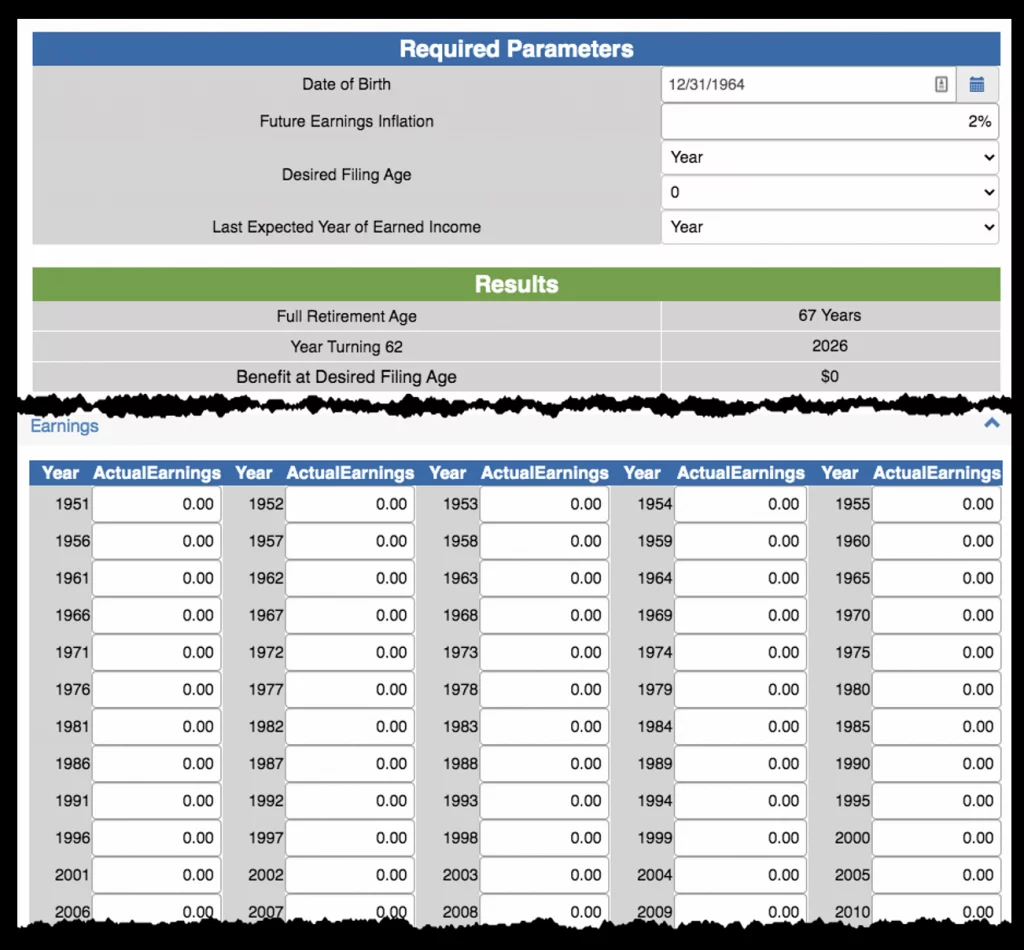
Estimate future benefits with various scenarios: Use the online calculators (described below) pre-populated with your earnings data.
-
Manage your benefits: Once you’re receiving benefits, you can manage them directly through this portal.
Setting up a “my Social Security” account is free, secure, and provides the most accurate estimates available.

Using the Social Security Administration’s Online Calculators
The SSA website offers several user-friendly calculators designed for different planning stages:
-
Retirement Estimator: The most popular tool, available within your “my Social Security” account. It uses your actual earnings record to provide personalized estimates of your future retirement benefits under various scenarios, including different retirement ages and future earning assumptions.
-
Quick Calculator: A simpler tool for a rough estimate, useful if you don’t have a “my Social Security” account or want to do a quick ‘what-if’ scenario without logging in.
-
Benefit Calculators for other scenarios: The SSA also provides calculators for disability and survivor benefits, which can be useful for comprehensive financial planning.
These calculators are designed to be intuitive and provide immediate feedback, allowing you to explore different retirement ages and see the direct impact on your estimated monthly benefit.
Consulting with a Financial Advisor
While the SSA tools are powerful, a qualified financial advisor can offer invaluable insights. They can:
-
Integrate Social Security into your broader retirement plan: Help you see how your Social Security income fits with your pensions, 401(k)s, IRAs, and other investments.
-
Help with complex claiming strategies: Advisors can model various claiming strategies for married couples, considering spousal and survivor benefits, to maximize joint lifetime benefits.
-
Provide tax planning advice: Understand how Social Security benefits are taxed and how they might affect your overall tax picture in retirement.
-
Address unique situations: If you’re self-employed, have worked internationally, or have other complex scenarios, an advisor can help navigate the rules.
Understanding Your Annual Social Security Statement
The SSA used to mail paper statements annually to most workers. While this practice has largely shifted online, you can still access your personalized statement through your “my Social Security” account. This statement is a critical document, summarizing your earnings record and providing estimated benefits for retirement, disability, and survivor benefits. Reviewing it regularly ensures your earnings record is accurate and helps you track your progress toward your retirement goals.
Strategies to Potentially Boost Your Social Security Payout
While your past earnings history is fixed, there are proactive steps you can take to potentially increase your future Social Security benefits. These strategies primarily revolve around your earning years and your claiming decision.
Working Longer and Earning More
Since your benefit is based on your highest 35 years of inflation-adjusted earnings, working longer can often replace lower-earning years (or zero-earning years if you have fewer than 35 years of work history) with higher-earning ones. This directly increases your average indexed monthly earnings (AIME), which in turn boosts your primary insurance amount (PIA). Similarly, maximizing your earnings during your working career, especially in your prime earning years, will result in a higher overall benefit calculation.
Strategizing Your Claiming Age
As discussed, your claiming age relative to your Full Retirement Age (FRA) has a profound and permanent impact on your monthly benefit.
-
Delaying until age 70: This is often the most significant way to increase your monthly benefit. For every year you delay past your FRA, up to age 70, you earn delayed retirement credits, resulting in an 8% annual increase. This creates a powerful incentive for those who can afford to delay.
-
Calculating your break-even point: While delaying increases monthly payouts, you forgo payments in the interim. A financial advisor can help calculate your “break-even point” – the age at which the cumulative value of higher delayed payments surpasses the cumulative value of earlier, smaller payments. This analysis is crucial for making an informed decision based on your health, financial needs, and life expectancy.
Spousal and Survivor Benefits Considerations
Married couples have additional strategies to consider:
-
Spousal Benefits: If your spouse’s benefit at their FRA is less than 50% of your own FRA benefit, they may be able to claim a “spousal benefit” based on your earnings record. This is especially beneficial if one spouse has a significantly higher earnings history.
-
Survivor Benefits: When one spouse dies, the surviving spouse can often claim the higher of their own benefit or the deceased spouse’s benefit. Strategic claiming decisions by the higher earner can significantly impact the survivor’s long-term financial security. Coordinated claiming strategies between spouses are essential for maximizing total lifetime benefits for the couple and the survivor.
Impact of Working While Receiving Benefits
If you claim Social Security benefits before your Full Retirement Age and continue to work, your benefits may be reduced if your earnings exceed certain annual limits.
-
Before FRA: For 2024, if you are under FRA, the SSA deducts $1 from your benefits for every $2 you earn above $22,320.
-
In the year you reach FRA: A different, higher limit applies, and the SSA deducts $1 for every $3 you earn above $59,520 (for 2024) until the month you reach FRA.
-
At or after FRA: Once you reach your FRA, there are no limits on how much you can earn, and your benefits will not be reduced due to work.
It’s important to note that any benefits withheld due to the earnings test are not lost forever; they typically lead to a recalculation of your benefit at your FRA, increasing your future monthly payments.
Incorporating Social Security into Your Holistic Retirement Plan
Estimating and strategizing your Social Security benefits is not an isolated task; it’s an integral component of a comprehensive retirement plan. Social Security is a foundational element, but rarely the sole source of retirement income.
Social Security as One Pillar of Retirement Income
Think of your retirement income as a multi-legged stool. Social Security is a vital leg, providing a guaranteed, inflation-adjusted income stream. However, it’s generally intended to replace only about 40% of the average worker’s pre-retirement earnings. This means it’s crucial to have other legs supporting your retirement income, such as personal savings, investments, and potentially pensions. Relying solely on Social Security can lead to a significant drop in your standard of living in retirement.
Bridging the Gap: Complementary Savings and Investments
Given that Social Security will likely cover only a portion of your retirement expenses, actively saving and investing throughout your working life is paramount. This includes contributing to:
-
Employer-sponsored plans: 401(k)s, 403(b)s, and other workplace retirement accounts.
-
Individual Retirement Accounts (IRAs): Traditional or Roth IRAs.
-
Taxable brokerage accounts: For additional long-term growth.
-
Health Savings Accounts (HSAs): A triple-tax-advantaged account that can also be used for healthcare expenses in retirement.
The earlier you start saving and the more consistently you contribute, the more time your investments have to grow, helping you bridge the gap between your Social Security income and your desired retirement lifestyle.
Regular Review and Adjustment of Your Plan
Your life circumstances, financial goals, and even Social Security rules can change over time. Therefore, it’s essential to regularly review and adjust your retirement plan, including your Social Security strategy.
-
Annual “my Social Security” account check: Verify your earnings record and review updated benefit estimates.
-
Periodic financial planning sessions: Meet with your financial advisor every few years (or more frequently if significant life events occur) to assess your progress, make adjustments to your savings rates, investment allocations, and Social Security claiming strategy.
-
Factor in inflation and healthcare costs: These are significant unknowns in retirement and should be continuously evaluated in your planning.
By actively engaging with the estimation process, understanding the factors at play, and integrating Social Security into a broader financial strategy, you can confidently plan for a secure and fulfilling retirement.
aViewFromTheCave is a participant in the Amazon Services LLC Associates Program, an affiliate advertising program designed to provide a means for sites to earn advertising fees by advertising and linking to Amazon.com. Amazon, the Amazon logo, AmazonSupply, and the AmazonSupply logo are trademarks of Amazon.com, Inc. or its affiliates. As an Amazon Associate we earn affiliate commissions from qualifying purchases.