
Securing a mortgage is a significant step towards homeownership, representing one of the largest financial commitments many individuals will make. The application process, while comprehensive, is designed to assess your financial capacity to repay the loan. Navigating it effectively requires preparation, understanding of financial principles, and careful consideration of available options. This guide breaks down the essential steps to applying for a mortgage, focusing squarely on the financial aspects and tools crucial for success.
Preparing for Your Mortgage Application
Before you even begin engaging with lenders, a thorough financial self-assessment is paramount. This initial groundwork not only streamlines the application process but can also position you for more favorable loan terms.
Assess Your Financial Health
Your financial profile is the cornerstone of any mortgage application. Lenders scrutinize several key metrics to gauge your creditworthiness and repayment capability.
- Credit Score: Your credit score is a numerical representation of your credit risk. Lenders use it to predict how likely you are to repay your debts. A higher score typically translates to lower interest rates. Before applying, obtain copies of your credit reports from the three major bureaus (Experian, Equifax, TransUnion) and review them for inaccuracies. Dispute any errors promptly. Aim for a score of 740 or higher for the most competitive rates, though mortgages are available for lower scores depending on the loan type. Regularly paying bills on time, reducing outstanding debt, and avoiding new credit applications in the months leading up to your mortgage application can help improve your score.
- Debt-to-Income (DTI) Ratio: This ratio compares your total monthly debt payments to your gross monthly income. Lenders typically look for a DTI ratio of 36% or less, though some programs allow for higher ratios (up to 43-50%). Your DTI ratio is calculated by dividing your total monthly debt payments (including the estimated new mortgage payment, credit cards, car loans, student loans, etc.) by your gross monthly income. A lower DTI indicates that you have more disposable income to manage your mortgage payments, reducing risk for the lender. Reducing existing debts or increasing your income can improve this ratio.
- Savings and Down Payment: The down payment is the portion of the home’s purchase price you pay upfront. While a 20% down payment is ideal for avoiding Private Mortgage Insurance (PMI) on conventional loans, many loan types (FHA, VA, USDA, some conventional options) allow for much lower down payments, some even zero. Lenders will verify the source of your down payment funds to ensure they are not borrowed money that could increase your debt burden. Ample savings beyond the down payment are also crucial for covering closing costs, moving expenses, and establishing an emergency fund.
- Income Stability: Lenders prefer borrowers with a stable employment history, typically requiring at least two years in the same job or field. They will verify your income through pay stubs, W-2 forms, and tax returns. Self-employed individuals will need to provide more extensive documentation, often including two years of personal and business tax returns, profit and loss statements, and bank statements. Consistent income demonstrates your ability to meet ongoing mortgage obligations.
Gather Essential Documentation
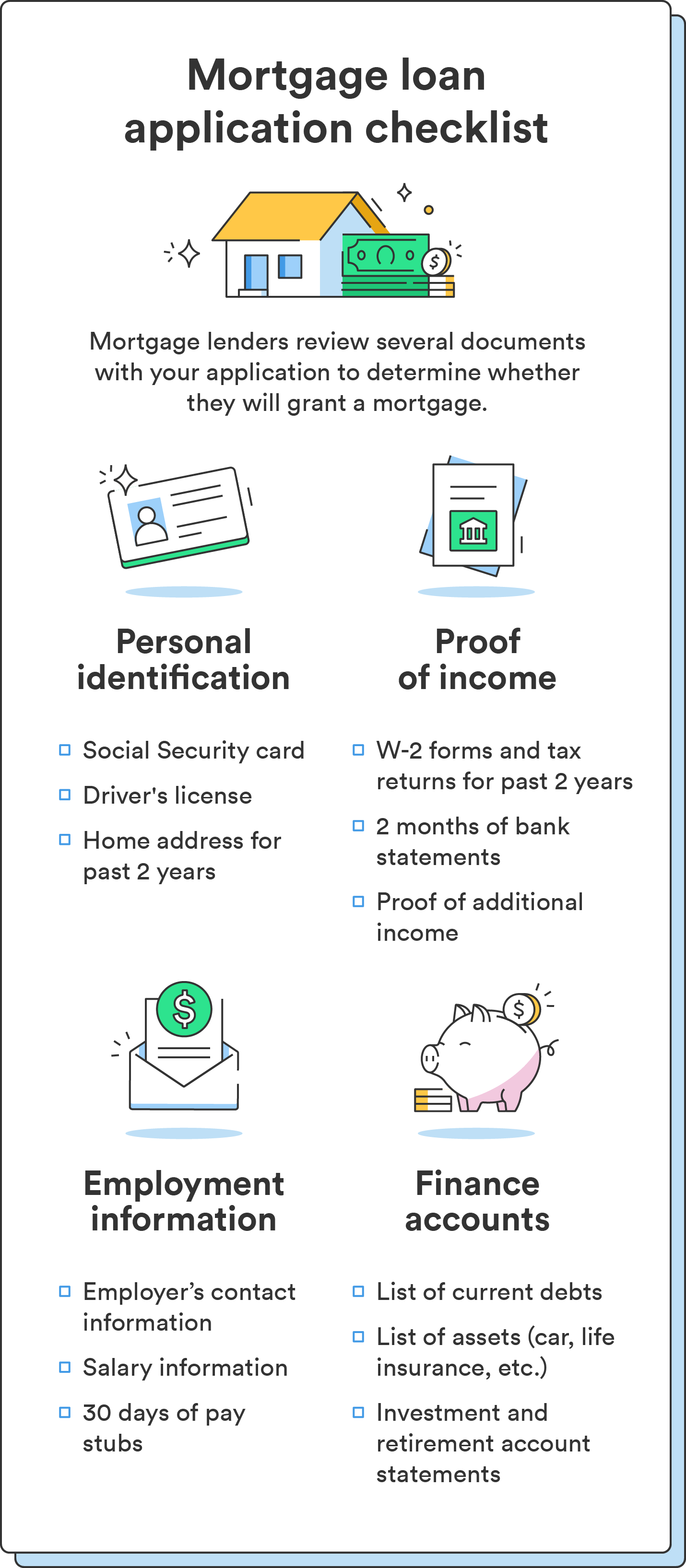
The mortgage application process is document-intensive. Having all necessary paperwork organized and ready will significantly expedite the process.
- Personal Identification: Government-issued photo identification (driver’s license, passport) and your Social Security card.
- Income Verification:
- Last two years of W-2 forms.
- Last two years of federal tax returns (all schedules).
- Most recent 30 days of pay stubs.
- If self-employed: Business tax returns, profit and loss statements, and 1099s.
- Proof of other income: Alimony, child support, pension, Social Security, disability income.
- Asset Verification:
- Bank statements for the most recent two to three months for all checking and savings accounts.
- Statements for investment accounts (stocks, bonds, mutual funds, 401k, IRA).
- Gift letter (if receiving down payment funds from a family member), outlining that the funds are a gift and not a loan.
- Debt Information:
- Statements for all outstanding loans (auto loans, student loans, personal loans).
- Statements for all credit cards.
- Landlord contact information or 12 months of cancelled rent checks if you are currently renting.
- Employment History: Names and addresses of employers for the past two years, along with dates of employment.
Understanding Mortgage Types and Lenders
Not all mortgages are created equal, and choosing the right loan product and lender for your specific financial situation is critical.
Explore Different Mortgage Options
The type of mortgage you select impacts your interest rate, monthly payment, and long-term costs.
- Fixed-Rate Mortgages: The interest rate remains the same for the entire life of the loan, offering predictable monthly payments. This stability makes budgeting easier and protects against rising interest rates. Common terms are 15-year and 30-year.
- Adjustable-Rate Mortgages (ARMs): These loans feature an initial fixed interest rate for a period (e.g., 3, 5, 7, or 10 years), after which the rate adjusts periodically based on market indexes. ARMs typically start with lower interest rates than fixed-rate mortgages, making them attractive for borrowers who plan to sell or refinance before the fixed period ends, or those comfortable with potential payment fluctuations.
- Government-Backed Loans:
- FHA Loans: Insured by the Federal Housing Administration, these loans are popular for first-time homebuyers and those with lower credit scores or smaller down payments (as low as 3.5%). They require mortgage insurance premiums (MIP).
- VA Loans: Guaranteed by the Department of Veterans Affairs, these loans offer eligible veterans, service members, and surviving spouses the ability to purchase a home with no down payment and no mortgage insurance.
- USDA Loans: Backed by the U.S. Department of Agriculture, these loans are designed for low-to-moderate income borrowers in eligible rural areas, offering no down payment options.
- Conventional Loans: These are not insured or guaranteed by the government. They typically require good to excellent credit scores and may require Private Mortgage Insurance (PMI) if your down payment is less than 20%. PMI can often be canceled once you reach 20% equity.
Choose the Right Lender
Your choice of lender can significantly affect your experience and the terms of your loan. It’s wise to shop around and compare offers.
- Banks (Traditional and Online): Large banks often offer a wide range of loan products and may have competitive rates, especially if you have an existing banking relationship. Online banks can sometimes offer lower overhead and more streamlined digital processes.
- Credit Unions: Member-owned financial institutions, credit unions often provide competitive rates and fees, along with personalized service. Membership is typically required.
- Mortgage Brokers: These professionals act as intermediaries, working with multiple lenders to find you the best loan product and rates based on your financial profile. They can be particularly useful for borrowers with complex financial situations.
- Online Lenders: Digital-first lenders offer convenience and often technology-driven application processes, sometimes with competitive rates.
- Factors to Consider: When comparing lenders, look beyond just the advertised interest rate. Evaluate closing costs, origination fees, discount points, customer service reputation, and the variety of loan products they offer. Obtain Loan Estimates from multiple lenders to compare apples-to-apples costs.
The Application Process: Step-by-Step
With your finances in order and your lender chosen, you’re ready to dive into the formal application.
Get Pre-Approved or Pre-Qualified
While often used interchangeably, there’s a key difference.
- Pre-qualification is an informal estimate of how much you might be able to borrow, based on a brief review of your finances. It doesn’t involve a hard credit pull and provides a ballpark figure.
- Pre-approval is a more rigorous process where the lender verifies your income, assets, and credit. It involves a hard credit inquiry and results in a conditional commitment for a specific loan amount, often with an interest rate lock. A pre-approval letter makes you a more attractive buyer to sellers, demonstrating your seriousness and financial readiness.
Complete the Full Application
Once you have a home under contract, you’ll complete the official mortgage application (Form 1003). This is where you provide all the detailed financial documentation you’ve gathered. Be prepared for your lender to ask for additional information or clarification throughout this stage. You will also receive various disclosure forms detailing the loan terms, fees, and your rights as a borrower.
Loan Underwriting
This is the most critical phase where the lender thoroughly vets your financial information and the property. Underwriters review all submitted documents to ensure they meet the lender’s and loan program’s guidelines. They assess your credit history, income stability, asset liquidity, and DTI ratio.
- Requests for Additional Documentation: It’s common for underwriters to request further clarification or additional documents. Respond promptly to keep the process moving.
- Appraisal and Inspection: As part of underwriting, the lender will order an appraisal to determine the home’s market value. This ensures the loan amount does not exceed the property’s worth. While separate from the lender’s process, it’s highly recommended to also get a home inspection to identify any structural issues or necessary repairs, protecting your investment.
What Happens After You Apply?
The period between application submission and closing involves several critical stages and a final review.
The Underwriting Decision
The underwriter will ultimately issue one of three decisions:
- Approval: Your loan is approved, and you’re cleared to close.
- Conditional Approval: Your loan is approved, but with specific conditions that must be met before final approval (e.g., providing an additional bank statement, explaining a credit inquiry).
- Denial: Your application is denied. Lenders are required to provide a reason for denial. If denied, review the reasons and work to improve your financial profile before reapplying.
Final Loan Approval and Closing Disclosure
Once all conditions are met and the underwriter issues final approval, you will receive a Closing Disclosure (CD). This document is crucial. By law, you must receive it at least three business days before your closing date. Carefully review every detail of the CD, comparing it against your last Loan Estimate to ensure there are no unexpected fees or changes to the loan terms, interest rate, or monthly payment. This is your last chance to question any discrepancies before signing.
Closing Day
This is the culmination of the entire process. At closing, you will sign numerous legal documents, including:
- The Promissory Note: Your promise to repay the loan.
- The Mortgage or Deed of Trust: The document that gives the lender a lien on the property until the loan is paid off.
- Other disclosures and agreements.
You will also pay your closing costs and the remaining portion of your down payment (if applicable). Once all documents are signed and funds are disbursed, you’ll officially receive the keys to your new home.

Tips for a Successful Mortgage Application
To maximize your chances of approval and secure the best possible terms, keep these financial strategies in mind throughout the entire process:
- Maintain Financial Stability: Once you start the application process, avoid making any significant financial changes. Do not apply for new credit (credit cards, car loans), make large purchases on credit, or change jobs. Any of these actions can trigger a re-evaluation of your credit and DTI, potentially jeopardizing your approval.
- Be Transparent and Honest: Provide accurate and complete information on your application. Attempting to conceal debts or misrepresent income can lead to denial and potential legal issues.
- Communicate Proactively: Respond promptly to all requests from your lender and processor. Delays in providing documents or information can prolong the underwriting process.
- Shop Around and Compare Offers: Don’t settle for the first lender you speak with. Obtain Loan Estimates from at least three different lenders to compare interest rates, fees, and overall costs. This due diligence can save you thousands of dollars over the life of the loan.
- Read Everything Carefully: Mortgage documents are complex, but it’s essential to understand what you’re signing. Review the Loan Estimate and Closing Disclosure meticulously, and don’t hesitate to ask your lender or real estate agent to explain anything you don’t understand.
- Budget for Closing Costs: Beyond the down payment, closing costs typically range from 2% to 5% of the loan amount. These include appraisal fees, origination fees, title insurance, attorney fees, and prepaid expenses (like property taxes and homeowners insurance). Ensure you have sufficient liquid funds to cover these additional expenses.
Applying for a mortgage is a marathon, not a sprint. By understanding the financial requirements, preparing thoroughly, and engaging diligently with your chosen lender, you can navigate the process successfully and achieve your goal of homeownership.
aViewFromTheCave is a participant in the Amazon Services LLC Associates Program, an affiliate advertising program designed to provide a means for sites to earn advertising fees by advertising and linking to Amazon.com. Amazon, the Amazon logo, AmazonSupply, and the AmazonSupply logo are trademarks of Amazon.com, Inc. or its affiliates. As an Amazon Associate we earn affiliate commissions from qualifying purchases.