
In the intricate dance of modern commerce, “percent off” is a universal language, a beacon for bargain hunters, and a fundamental tool for businesses. From a consumer perspective, understanding how to calculate a percentage off is not merely a mathematical exercise; it’s a critical financial skill that empowers better budgeting, smarter spending, and significant savings. For businesses, mastering these calculations is key to effective pricing strategies, profitable promotions, and clear communication with customers. This article delves into the core mechanics of calculating percent off, exploring its financial implications for both individuals and enterprises, and equipping you with the knowledge to navigate the world of discounts with confidence.

Understanding the Essence of “Percent Off” in Personal Finance
At its heart, “percent off” represents a reduction from an original price, expressed as a fraction of 100. It’s a cornerstone of sales, promotions, and special offers across virtually every sector, from retail and services to subscriptions and investments. For anyone managing personal finances, grasping this concept is non-negotiable.
Deciphering Discount Terminology
While “percent off” is straightforward, the broader landscape of discounts often features terms that can be confusing. We encounter “up to X% off,” “save $Y,” “buy one get one free,” or “tiered discounts” (e.g., 10% off $50, 20% off $100). Each variation requires a slightly different approach to ascertain the true financial benefit. “Percent off” is perhaps the most common and the foundational skill upon which understanding other discounts often builds. It signifies a direct, proportionate reduction, making it a powerful metric for comparing deals across different products or services, regardless of their original price point.
The Ubiquity of Percent-Off Deals in Everyday Spending
Think about your daily life: a grocery store flyer advertises 25% off cereals, an online retailer offers 15% off your first purchase, a software subscription promises 30% off for annual prepayment, or an investment platform waives a percentage of fees for new clients. These aren’t isolated incidents; they are constant opportunities to optimize your spending. Without the ability to quickly and accurately calculate these savings, you risk missing out on significant financial advantages or, worse, falling prey to misleading promotions that appear more attractive than they truly are.
Why Every Savvy Spender Needs This Skill
For the financially astute individual, calculating percent off transcends mere curiosity; it’s an indispensable tool for budgeting, maximizing discretionary spending, and achieving long-term financial goals. Knowing how much you genuinely save allows you to:
- Accurately track expenses: Your budget needs to reflect the actual amount spent, not the original price.
- Compare deals effectively: Is 20% off a $100 item better than $15 off the same item?
- Avoid overspending: Understanding true savings prevents the psychological trick of feeling like you’re saving money while still spending more than intended.
- Make informed purchase decisions: Evaluate if a “deal” genuinely aligns with your financial priorities and value proposition.
- Plan for larger purchases: Strategic saving on smaller items can accumulate funds for more substantial investments or expenses.
The Fundamental Methods of Calculating Discounts
There are two primary, equally valid methods for calculating percent off. Both lead to the same correct answer, but one might feel more intuitive or efficient depending on the context or personal preference.
Method 1: Calculating the Discount Amount First
This approach breaks the calculation into two distinct steps: first finding the dollar amount of the discount, then subtracting it from the original price.
Step-by-Step Breakdown with Example
- Convert the percentage to a decimal: Divide the “percent off” by 100.
- Example: If an item is 20% off, convert 20% to 0.20 (20 / 100).
- Calculate the discount amount: Multiply the original price by the decimal equivalent of the percentage.
- Example: An item originally costs $50. With 20% off, the discount amount is $50 * 0.20 = $10.
- Subtract the discount amount from the original price: This gives you the final sale price.
- Example: $50 (original price) – $10 (discount amount) = $40 (sale price).
This method is often preferred when you want to know the exact monetary saving from the deal, which can be useful for budgeting or comparing the absolute value of different discounts.
Method 2: Directly Finding the Sale Price
This method streamlines the process by directly calculating the remaining percentage of the original price you will pay.
Streamlined Approach for Quick Calculations
- Determine the percentage you will pay: Subtract the “percent off” from 100%.
- Example: If an item is 20% off, you will pay 100% – 20% = 80% of the original price.
- Convert this remaining percentage to a decimal: Divide it by 100.
- Example: 80% becomes 0.80 (80 / 100).
- Multiply the original price by this decimal: This directly yields the final sale price.
- Example: An item originally costs $50. The sale price is $50 * 0.80 = $40.
This method is particularly efficient for mental math or when you primarily care about the final price you’ll hand over, rather than the explicit discount amount. It’s often quicker as it involves only one multiplication step after determining the payable percentage.
When to Use Each Method: Practical Applications
Both methods are robust, and the choice often comes down to personal preference or the specific financial insight you’re seeking.
- Method 1 (Discount Amount First): Ideal when tracking savings against a budget, making a case for a purchase based on the dollar amount saved, or when comparing how much you save on different items. For instance, knowing you saved $20 on groceries versus $5 on apparel can help prioritize future spending habits.
- Method 2 (Direct Sale Price): Perfect for quick estimations in-store, rapid comparison of final prices across competing products, or when you simply need to know the ‘bottom line’ cost for immediate purchase decisions. It’s excellent for “on the fly” budgeting.
Real-World Scenarios and Advanced Discount Applications

Understanding basic percent-off calculations is a crucial first step. However, real-world financial scenarios often present more complex discount structures that require a deeper application of these principles.
Navigating Multi-Tiered and Stackable Discounts
Many retailers offer promotions like “take an additional 10% off sale prices” or “save 15% when you spend $50, 25% when you spend $100.” These require careful, sequential calculation.
- Multi-tiered: Calculate the first discount, then apply the second discount to the already discounted price, not the original. For example, if an item is $100, 20% off, and then an additional 10% off, it’s not 30% off. It’s $100 – (20% of $100) = $80. Then, $80 – (10% of $80) = $80 – $8 = $72.
- Stackable: Some promotions allow multiple discounts to be applied simultaneously. Always clarify the order of application, as it can significantly impact the final price. Typically, a percentage discount is applied after a fixed dollar amount discount, or vice-versa, depending on the retailer’s policy.
Calculating Sales Tax on Discounted Items
A common financial oversight is forgetting that sales tax is typically applied to the discounted price, not the original price.
- First, calculate the final price after all discounts.
- Then, multiply that final price by the applicable sales tax rate (converted to a decimal).
- Add the sales tax amount to the final discounted price to get the total cost.
For example, if an item is $40 after discounts and the sales tax is 7%, the tax is $40 * 0.07 = $2.80. The total cost is $40 + $2.80 = $42.80. This is crucial for accurate budgeting and avoiding unexpected charges at checkout.
Applying Percent Off to Services, Bills, and Investments
The concept of “percent off” isn’t limited to physical products.
- Services: Many service providers (e.g., internet, gym memberships, consultants) offer introductory discounts or loyalty percentages off their standard rates. Applying the calculation helps you compare true costs over time.
- Bills: Utility companies or credit card providers might offer a percentage off your bill for specific actions, like paperless billing or auto-pay.
- Investments: Understanding percentage-based fee reductions (e.g., a lower expense ratio on an ETF or a percentage off advisory fees) can significantly impact your long-term investment returns. Even a seemingly small percentage reduction in fees can translate to thousands over decades due to compounding.
Identifying True Value Beyond the Percentage
A large percentage off doesn’t always equate to the best financial decision. A 70% discount on an item you don’t need or won’t use is still 30% of your money wasted. Savvy financial decision-making involves:
- Need vs. Want: Is this purchase genuinely necessary or merely appealing due to the discount?
- Quality and Durability: Does the discounted item offer good value in terms of longevity and performance? A cheap item at a huge discount might still be a poor investment if it breaks quickly.
- Total Cost of Ownership: Factor in accessories, maintenance, or associated costs that might negate the initial saving.
- Opportunity Cost: What else could that money be doing for you? Is the saving worth foregoing another financial priority?
The Strategic Importance of Percent Off for Consumers and Businesses
The ability to calculate and understand percent off has profound strategic implications, shaping both individual financial health and corporate profitability.
Empowering Personal Budgeting and Saving
For consumers, robust percent-off calculation skills directly translate into a more empowered financial life. It’s about more than just saving a few dollars; it’s about strategic allocation of resources.
- Budget Adherence: When you know the true cost after discounts, you can maintain a more accurate budget, preventing overspending in categories like “shopping” or “discretionary.”
- Emergency Fund Growth: Every dollar saved through smart discount utilization can be redirected towards an emergency fund, debt reduction, or investment goals, accelerating financial independence.
- Financial Literacy: Mastering this skill builds confidence in managing money, fosters an analytical approach to spending, and lays a foundation for more complex financial calculations and decisions. It transforms passive consumption into active financial management.
Informing Business Pricing and Promotional Strategies
For businesses, calculating percent off is integral to competitive pricing, stimulating sales, managing inventory, and ultimately, ensuring profitability.
- Sales Maximization: Properly structured percentage discounts can drive volume, clear old stock, and attract new customers. Businesses must calculate the break-even point and potential profit margins even with discounts.
- Perceived Value: Discounts can enhance the perceived value of an offer, making products more attractive. However, businesses must be careful not to devalue their brand by constant, deep discounting.
- Profitability Analysis: Understanding the impact of a percent off on the bottom line is critical. A 20% discount on a product with a 25% profit margin leaves very little room for error and requires higher sales volume to compensate. Businesses use these calculations to model scenarios and forecast revenue.
- Competitive Positioning: Observing competitors’ percentage-off strategies informs a business’s own pricing tactics, ensuring they remain competitive without engaging in a destructive race to the bottom.
Avoiding Common Pitfalls and Misleading Discounts
Both consumers and businesses must be wary of pitfalls. For consumers, this includes:
- “Phantom” Sales: Discounts off inflated “original” prices that were never truly charged.
- “Buy More, Save More” Traps: Encouraging spending beyond necessity to qualify for a higher discount tier.
- Exclusions and Fine Print: Overlooking items or conditions that invalidate the perceived discount.
For businesses, common pitfalls involve: - Eroding Profit Margins: Over-discounting can lead to unsustainable profit levels.
- Brand Devaluation: Constant or deep discounts can signal low quality to consumers.
- Customer Expectations: Training customers to only purchase during sales can reduce full-price purchases.
Tools and Tips for Effortless Percent Off Calculations
While the mathematical principles are simple, practical execution often benefits from readily available tools and smart habits.
Leveraging Everyday Calculators and Spreadsheets
- Handheld Calculators: For quick, on-the-spot calculations, a basic calculator is your best friend. Many smartphone calculators have a percentage function (%) that can simplify these steps.
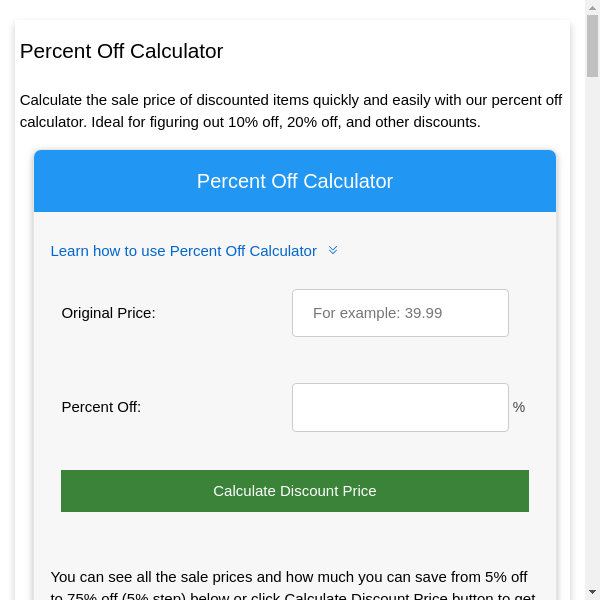
- Online Calculators/Apps: Numerous free online “percentage off” calculators or dedicated budgeting apps can automate these calculations, especially for complex, multi-tiered discounts.
- Spreadsheets (Excel/Google Sheets): For budgeting, inventory management, or detailed financial planning, spreadsheets are invaluable. You can set up formulas (e.g.,
=OriginalPrice * (1 - PercentOff_as_decimal)) to automatically calculate discounted prices, total savings, and even project costs with sales tax. This is particularly useful for tracking recurring expenses or planning large purchases.
Mental Math Shortcuts for Quick Estimates
You don’t always need a calculator. For rough estimates:
- 10% Rule: To find 10% of a number, just move the decimal one place to the left (e.g., 10% of $75 is $7.50).
- Build Up/Break Down: For 20% off, calculate 10% and double it. For 25% off, divide by 4. For 30% off, calculate 10% and multiply by 3.
- Rounding: Round prices to the nearest convenient number for a quick estimate. If an item is $48 and 20% off, think $50 * 0.20 = $10 off, so about $40.
Best Practices for Discount Shopping
- Always Verify: Don’t just trust the advertised “new price.” Do a quick calculation to ensure the discount has been applied correctly.
- Compare Unit Prices: For groceries and household items, compare the “price per unit” (e.g., per ounce, per sheet) after discounts, not just the overall percentage off, to find the true best deal.
- Patience is a Virtue: Unless an item is urgently needed, waiting for a sale or specific promotional period can yield significant savings over time.
- Track Your Savings: Incorporate discounted prices into your budget and note the savings. Seeing the cumulative impact of smart discount utilization can be a powerful motivator for sound financial habits.
In conclusion, the ability to calculate percent off is far more than a simple math trick; it’s a foundational financial skill. It empowers individuals to be more conscientious consumers, safeguarding their budgets and accelerating their financial goals. For businesses, it’s a strategic lever for growth, customer engagement, and sustainable profitability. By mastering these calculations, both parties can navigate the dynamic landscape of commerce with clarity, confidence, and a keen eye for genuine value.
aViewFromTheCave is a participant in the Amazon Services LLC Associates Program, an affiliate advertising program designed to provide a means for sites to earn advertising fees by advertising and linking to Amazon.com. Amazon, the Amazon logo, AmazonSupply, and the AmazonSupply logo are trademarks of Amazon.com, Inc. or its affiliates. As an Amazon Associate we earn affiliate commissions from qualifying purchases.