
The advent of Bitcoin in 2009 heralded a new era in finance, introducing a decentralized digital currency free from the control of any government or financial institution. Unlike traditional fiat currencies, which are printed or minted by central banks, Bitcoins are not physically produced. Instead, they are generated through a complex, computationally intensive process known as “mining.” Understanding how Bitcoins are produced is crucial to grasping their fundamental value, their scarcity, and their role in the evolving global economy. This process isn’t merely a technical endeavor; it’s a meticulously designed economic system that underpins the entire Bitcoin network.
The Genesis of Digital Gold: Unpacking Bitcoin’s Creation
At its core, Bitcoin’s production is an ingenious fusion of cryptography, economics, and distributed network theory. It addresses the age-old problem of trust in financial transactions by replacing intermediaries with a verifiable, immutable public ledger.
Satoshi Nakamoto’s Vision
The anonymous creator, or group of creators, known as Satoshi Nakamoto, outlined the Bitcoin system in a white paper titled “Bitcoin: A Peer-to-Peer Electronic Cash System.” Nakamoto’s vision was to create a currency that could be sent directly from one party to another without going through a financial institution. To achieve this, a mechanism was needed to:
- Prevent double-spending: Ensuring that a single Bitcoin unit cannot be spent more than once.
- Establish trust: Verifying transactions in a decentralized manner without a central authority.
- Control supply: Introducing new units of currency into the system in a predictable and finite way.
The solution to these challenges was the blockchain and a process called “Proof-of-Work,” which forms the basis of Bitcoin’s production.
The Blockchain Ledger
Imagine a global, continuously updated ledger that records every Bitcoin transaction ever made. This is essentially what the blockchain is. It’s a chain of “blocks,” where each block contains a list of verified transactions. Once a block is added to the chain, it is extremely difficult to alter, making the transaction history immutable and transparent.
New Bitcoins are introduced into the economy as a reward to participants who perform the vital function of securing this ledger: the miners. Without miners, new transactions wouldn’t be verified, and the blockchain wouldn’t grow. The production of Bitcoin is inextricably linked to the maintenance and security of its underlying blockchain technology.
The Role of Cryptography
Cryptography is the backbone of Bitcoin’s security and production. It ensures that transactions are secure, identities are pseudonymized, and the integrity of the blockchain is maintained. Public-key cryptography allows users to send and receive Bitcoins securely, while cryptographic hash functions are central to the Proof-of-Work mechanism. Miners compete to solve complex cryptographic puzzles to add new blocks to the blockchain, and their reward for this effort includes newly minted Bitcoins. This elegant system ensures that every Bitcoin in circulation has a verifiable origin and a secure path through the network.
Mining for Value: The Economic Incentive Behind Bitcoin Production
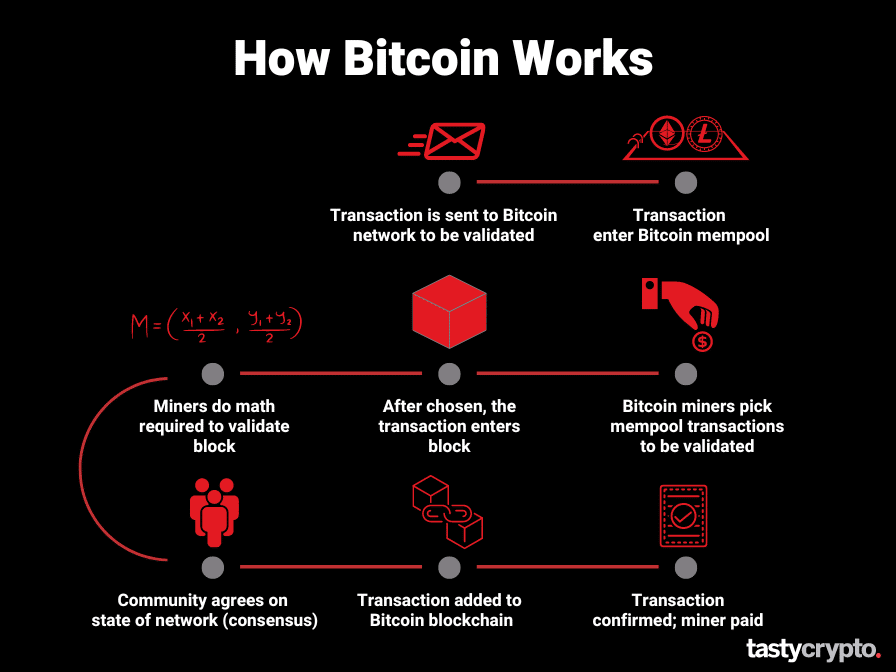
Bitcoin mining is not about digging for gold; it’s about solving intricate mathematical puzzles using powerful computers. This process serves a dual purpose: it verifies and adds new transactions to the blockchain, and it creates new Bitcoins as a reward for the miners’ computational effort.
Proof-of-Work Explained
The “Proof-of-Work” (PoW) algorithm is the consensus mechanism that underpins Bitcoin’s security and production. In simple terms, miners compete to be the first to find a specific numerical solution (a “nonce”) that, when combined with the data in a new block of transactions, produces a cryptographic hash (a fixed-size string of characters) that meets certain criteria (e.g., starting with a certain number of zeros).
This process is computationally intensive and requires significant energy. It’s difficult to find the solution but easy for anyone to verify it. The first miner to find the correct nonce broadcasts their solution to the network. If other nodes verify the solution’s correctness and the validity of the transactions in the block, the block is added to the blockchain, and the successful miner receives the block reward. This “work” proves that significant computational resources were expended, making it economically unfeasible to rewrite the blockchain and prevent double-spending.
Hardware and Energy Costs
Early Bitcoin mining could be done with standard computer CPUs, then GPUs, but as the network grew and the difficulty of finding new blocks increased, specialized hardware became necessary. Today, miners use Application-Specific Integrated Circuits (ASICs), which are designed specifically for Bitcoin mining and are far more efficient than general-purpose processors.
The enormous computational power required translates into significant energy consumption. Mining operations, particularly large-scale ones, consume vast amounts of electricity, leading to discussions about Bitcoin’s environmental impact. However, a significant portion of this energy comes from renewable sources, and miners often seek out cheap, abundant energy, sometimes utilizing otherwise wasted or stranded energy. The economic incentive for mining is directly tied to the cost of electricity and the efficiency of mining hardware.
Block Rewards and Transaction Fees
Miners are compensated in two ways for their services:
- Block Reward: This is the primary incentive for mining new blocks. When a miner successfully adds a new block to the blockchain, they receive a fixed amount of newly minted Bitcoins. This is how new Bitcoins are introduced into circulation. The block reward halves approximately every four years, a mechanism known as the “halving.”
- Transaction Fees: Each transaction on the Bitcoin network typically includes a small fee paid by the sender to the miner. These fees incentivize miners to include transactions in their blocks, especially as block rewards decrease over time.
As the block reward diminishes, transaction fees are expected to become an increasingly important part of miners’ income, ensuring the network remains secure even after all Bitcoins have been mined. This carefully designed economic model ensures that there is always an incentive for miners to contribute their computational power, thus securing the network.
Scarcity and Supply: Bitcoin’s Finite Production Model
Perhaps the most compelling financial characteristic of Bitcoin, and a key driver of its value, is its absolute scarcity. Unlike fiat currencies, which can be printed indefinitely, Bitcoin has a hard cap on its total supply.
The Halving Mechanism

The “halving” is a pre-programmed event within the Bitcoin protocol that cuts the block reward for miners by half, approximately every four years (or every 210,000 blocks).
- Initially, the block reward was 50 Bitcoins.
- The first halving in 2012 reduced it to 25 Bitcoins.
- The second halving in 2016 reduced it to 12.5 Bitcoins.
- The third halving in 2020 reduced it to 6.25 Bitcoins.
- The most recent halving in April 2024 reduced it to 3.125 Bitcoins.
This mechanism ensures a predictable, diminishing rate of new Bitcoin production, mimicking the increasing difficulty and cost of extracting finite resources like gold. It introduces scarcity directly into the monetary policy, differentiating Bitcoin from inflationary fiat currencies.
The 21 Million Cap
A fundamental aspect of Bitcoin’s design is its fixed total supply of 21 million Bitcoins. Once this limit is reached, no new Bitcoins will ever be produced. This hard cap is encoded in the protocol and cannot be changed without a universal consensus of network participants, which is highly improbable. The slow, predictable release schedule through halving events means that it will take until approximately the year 2140 for the last Bitcoin to be mined.
This absolute scarcity is a powerful economic feature. In traditional economics, scarcity often drives value, and Bitcoin’s finite supply makes it a potentially deflationary asset, especially when compared to traditional currencies subject to inflation.
Impact on Valuation
The combination of the halving mechanism and the 21 million cap has a profound impact on Bitcoin’s valuation. Each halving event historically reduces the supply of new Bitcoins entering the market, often leading to increased demand relative to supply and subsequent price appreciation. This predictable scarcity is a significant factor in Bitcoin being often referred to as “digital gold” – an asset whose value is preserved and potentially grows due to its limited supply and resistance to debasement. Investors and financial institutions increasingly view Bitcoin through this lens, allocating a portion of their portfolios to it as a hedge against inflation and economic uncertainty.
The Financial Implications of Decentralized Production
The decentralized nature of Bitcoin’s production has far-reaching financial implications, challenging established norms and offering new paradigms for monetary systems.
Global Accessibility
Anyone with the necessary hardware and internet access can participate in Bitcoin mining, regardless of their geographical location or economic status. This global, permissionless nature contrasts sharply with traditional financial systems, which are often exclusive and subject to national borders and regulations. The ability for individuals and organizations worldwide to contribute to securing the network and earning new Bitcoins fosters a truly global monetary system, transcending geopolitical boundaries.
Reduced Intermediaries
Bitcoin’s production and transaction verification process bypasses traditional financial intermediaries such as banks, payment processors, and central clearing houses. Miners directly confirm transactions and add them to the public ledger. This reduction in intermediaries not only lowers transaction costs (though network congestion can sometimes increase fees) but also enhances financial autonomy. Users maintain direct control over their funds, and transactions are processed without the need for a trusted third party, aligning with the original vision of a peer-to-peer electronic cash system.
Sovereignty for Individuals
The decentralized production and verification process grant a degree of financial sovereignty to individuals. Users can hold and manage their Bitcoins without relying on banks or other institutions, which can freeze accounts or restrict access to funds. This provides an alternative for individuals in regions with unstable economies, hyperinflation, or restrictive financial controls, offering a means to store wealth outside the traditional system. The inherent censorship resistance of Bitcoin transactions, facilitated by decentralized mining, further empowers individuals to transact freely.
Regulatory Challenges
The decentralized and global nature of Bitcoin production also presents unique challenges for regulators and governments. Without a central authority to control its issuance or flow, regulating Bitcoin activity, taxation, and preventing illicit use becomes complex. Governments grapple with how to integrate this new asset class into existing financial frameworks without stifling innovation or compromising national financial security. The ongoing dialogue between regulators and the crypto industry is shaping the future landscape of digital assets, recognizing both the potential benefits and risks associated with a decentralized monetary system.
Beyond Production: Bitcoin’s Role in the Global Economy
Understanding how Bitcoins are produced is the first step in appreciating its broader economic significance. Its unique production model has propelled it from an obscure internet experiment to a recognized asset class influencing global financial markets.
Store of Value vs. Medium of Exchange
While initially conceived as “peer-to-peer electronic cash,” Bitcoin’s characteristics—particularly its scarcity and decentralization—have led many to view it primarily as a “store of value,” akin to digital gold. Its volatility has made it less suitable for everyday transactions as a stable medium of exchange, but its ability to potentially preserve wealth over time, independent of traditional financial systems, has garnered significant attention from investors. The production mechanism underpins this store-of-value narrative, as the predictable, diminishing supply creates a strong case for long-term appreciation.
Institutional Adoption
In recent years, institutional investors, corporations, and even some sovereign nations have begun to acknowledge and adopt Bitcoin. Exchange-Traded Funds (ETFs) for Bitcoin have emerged, allowing traditional investors to gain exposure to the asset without directly holding it. Companies are adding Bitcoin to their balance sheets, and some countries are exploring its potential as legal tender or reserve asset. This institutional embrace is a testament to the growing recognition of Bitcoin’s unique financial properties, directly stemming from its revolutionary production and supply model.

The Future of Money
Bitcoin’s production mechanism fundamentally reshapes our understanding of money. It demonstrates that a reliable, secure, and scarce currency can exist and thrive without central authority. As the world becomes increasingly digital, the principles underlying Bitcoin’s creation – decentralization, transparency, and provable scarcity – are influencing the development of other digital assets and even central bank digital currencies (CBDCs). The conversation about the future of money is now permanently intertwined with the lessons learned from how Bitcoins are produced and the economic ecosystem it has fostered.
In conclusion, the production of Bitcoins is far more than a mere technical process; it’s an economic masterpiece. Through the ingenious application of cryptography and game theory, Satoshi Nakamoto created a system that incentivizes participants to secure a global ledger, simultaneously generating a new form of money with unparalleled properties of scarcity and decentralization. This foundational mechanism is what gives Bitcoin its unique place in the financial world, driving its value, influencing its adoption, and shaping the ongoing evolution of the global monetary system.
aViewFromTheCave is a participant in the Amazon Services LLC Associates Program, an affiliate advertising program designed to provide a means for sites to earn advertising fees by advertising and linking to Amazon.com. Amazon, the Amazon logo, AmazonSupply, and the AmazonSupply logo are trademarks of Amazon.com, Inc. or its affiliates. As an Amazon Associate we earn affiliate commissions from qualifying purchases.