
Bitcoin, often hailed as digital gold, has revolutionized our understanding of currency and value. Unlike traditional fiat money printed by central banks or precious metals extracted from the earth, Bitcoin is brought into existence through a purely digital and intricate process known as “mining.” This process is not a magical manufacturing operation but a sophisticated dance of cryptography, computer science, and economic incentives, all orchestrated by its foundational technology: the blockchain. Understanding how bitcoins are made is to grasp the very essence of its innovation, security, and decentralized power. This article delves into the technological marvel that underpins Bitcoin’s creation, exploring the mechanisms that transform raw computational power into a globally recognized digital asset.
The Foundational Pillar: Blockchain Technology
At the heart of Bitcoin’s creation and existence lies the blockchain, a revolutionary distributed ledger technology. It’s not merely a database; it’s a paradigm shift in how information can be recorded, shared, and secured across a decentralized network.
What is a Blockchain?
A blockchain is fundamentally a continuously growing list of records, called blocks, which are linked and secured using cryptography. Each block contains a cryptographic hash of the previous block, a timestamp, and transaction data. This structure creates an immutable and transparent chain of information. In the context of Bitcoin, this chain records every single transaction ever made, from the first bitcoin ever mined to the latest transfer between two users.
The “distributed” aspect is crucial. Instead of a single central server holding all the data, copies of the entire blockchain are maintained and updated by thousands of independent computers (nodes) across the globe. This decentralized nature ensures that no single entity has control over the network, making it resistant to censorship, single points of failure, and manipulation. The immutability stems from the cryptographic links; once a block is added to the chain, it is practically impossible to alter its contents without also changing all subsequent blocks, which would require an economically unfeasible amount of computational power to convince the entire network.
Blocks, Chains, and Cryptographic Links
Each block in the Bitcoin blockchain is a bundle of validated transactions. When a new block is “mined” (created), it’s essentially a new page added to the digital ledger. This new block references the previous block through a unique digital fingerprint called a cryptographic hash. A hash function takes an input (the data in the previous block) and produces a fixed-size string of characters. Even a tiny change in the input will result in a completely different hash, making it incredibly sensitive to tampering.
This chaining mechanism is what gives the blockchain its integrity. To reverse or modify a transaction from the past, an attacker would need to recalculate not just that single block’s hash, but also the hash of every subsequent block up to the current one, and then convince the majority of the network to accept their altered chain. This becomes exponentially harder with each new block added, practically guaranteeing the finality and security of transactions.
Decentralization as a Core Tenet
The very architecture of the blockchain reinforces Bitcoin’s core principle of decentralization. There is no central bank, no government, and no single corporation dictating the rules or controlling the supply of Bitcoin. The network is peer-to-peer, meaning every participant interacts directly with others without intermediaries.
This decentralized governance is maintained through a consensus mechanism. All nodes on the network must agree on the validity of new blocks and the overall state of the ledger. This agreement is achieved through rules embedded in the Bitcoin protocol itself. This lack of a central authority protects Bitcoin from political interference, hyperinflation through arbitrary money printing, and censorship, offering a truly sovereign form of digital value transfer.
The Art of Bitcoin Mining: A Race for Computation
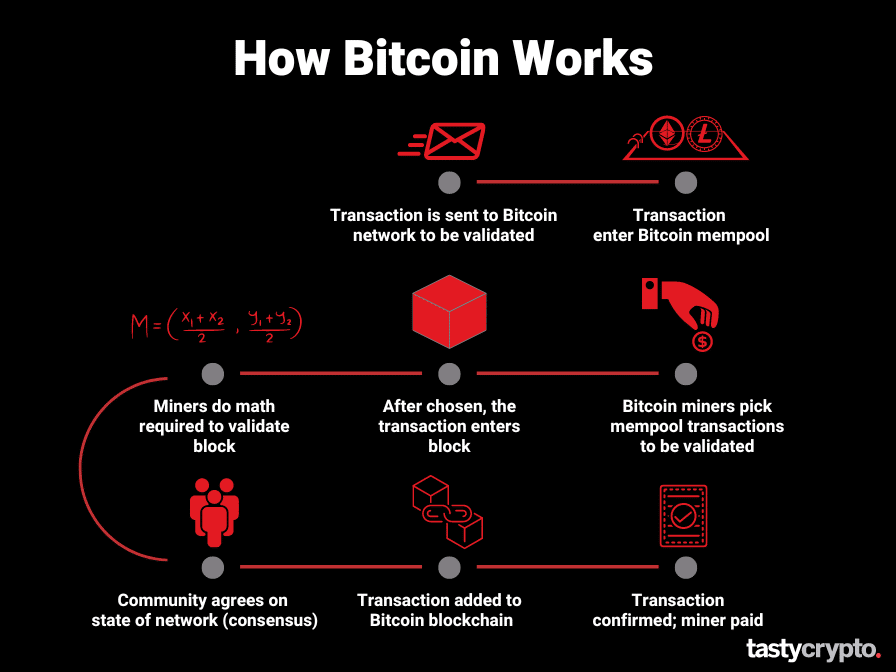
Bitcoin “mining” is the process by which new bitcoins are introduced into circulation and new transactions are added to the blockchain ledger. It’s a highly competitive computational task that serves a dual purpose: securing the network and creating new units of the cryptocurrency.
The Role of Miners and Proof-of-Work
Miners are the backbone of the Bitcoin network. They are individuals or organizations who dedicate powerful computers to solve complex mathematical puzzles. When they successfully solve a puzzle, they get the right to add the next block of verified transactions to the blockchain and are rewarded with newly minted bitcoins and transaction fees. This entire process is called “Proof-of-Work” (PoW).
PoW is the ingenious solution devised by Satoshi Nakamoto to prevent spamming the network and ensure its security. It requires miners to expend significant computational effort to find a solution to a cryptographic puzzle. This effort is verifiable by the rest of the network but incredibly difficult to produce, making it expensive to attack the network. The miner who finds the solution first broadcasts their newly created block to the network, and if validated by other nodes, it becomes the latest addition to the official blockchain.
The Cryptographic Puzzle: Finding the Golden Nonce
The “puzzle” that miners solve isn’t a complex mathematical equation in the traditional sense, but rather a search for a specific number called a “nonce” (number used once). Miners combine a block of transaction data, the hash of the previous block, and a random nonce. They then run this combined data through a cryptographic hash function (specifically SHA-256 for Bitcoin). The goal is to find a nonce such that the resulting hash begins with a certain number of zeros. This “target hash” or “difficulty target” is adjusted roughly every two weeks to ensure that, on average, a new block is found every 10 minutes, regardless of how much mining power is connected to the network.
Miners essentially guess trillions of nonces per second, rapidly trying different combinations until one produces a hash that meets the network’s current difficulty target. It’s a trial-and-error process, akin to a lottery, where the more computing power you have, the higher your chances of winning. The computational effort proves that the miner “worked” to find the block, hence “Proof-of-Work.”
Mining Hardware Evolution: From CPUs to ASICs
The technological arms race in Bitcoin mining has been a defining characteristic of its history. In Bitcoin’s early days, anyone with a standard computer CPU could mine bitcoins. As the network grew and the difficulty increased, miners quickly realized that GPUs (Graphics Processing Units), designed for parallel processing, were much more efficient.
However, the relentless pursuit of efficiency led to the development of Application-Specific Integrated Circuits (ASICs). These are specialized hardware devices designed only for Bitcoin mining, optimized to perform SHA-256 hash calculations at incredibly high speeds while consuming less power than general-purpose hardware. Today, professional Bitcoin mining is dominated by massive farms of ASICs, consuming vast amounts of electricity, underscoring the industrial scale of the computational effort required to create new bitcoins and secure the network.
The Reward System: Incentivizing Security and Creation
The Bitcoin mining process isn’t just a technical marvel; it’s an economic one too. The system is designed with a brilliant incentive structure that encourages miners to dedicate their resources to secure the network and, in doing so, create new bitcoins.
Block Rewards and Transaction Fees

When a miner successfully finds a valid nonce and adds a new block to the blockchain, they receive two forms of reward:
- Block Reward: This is a fixed amount of newly minted bitcoins. This is how new bitcoins are introduced into the circulating supply.
- Transaction Fees: Miners include a bundle of pending transactions in their block. Users typically attach a small fee to their transactions to incentivize miners to include them. The miner who successfully adds the block collects all the fees from the transactions included in that block.
These rewards are the primary motivation for miners to expend significant capital on hardware and electricity. Without these incentives, there would be no reason for anyone to perform the intense computational work required to maintain and secure the network, and thus, no new bitcoins would be created.
The Halving Mechanism: Scarcity by Design
One of Bitcoin’s most unique and well-known features is its “halving” (or “halvening”) mechanism. Approximately every four years (or precisely, every 210,000 blocks), the block reward for miners is automatically cut in half.
- When Bitcoin launched in 2009, the block reward was 50 BTC.
- In 2012, it halved to 25 BTC.
- In 2016, it halved to 12.5 BTC.
- In 2020, it halved to 6.25 BTC.
- The next halving is anticipated in 2024, reducing the reward to 3.125 BTC.
This programmed scarcity is crucial to Bitcoin’s economic model. It ensures a predictable, diminishing supply of new bitcoins, counteracting inflation and mimicking the scarcity of precious metals like gold. As the block reward decreases, transaction fees are expected to become an increasingly larger portion of miners’ revenue, ensuring their continued incentive to secure the network even as the issuance of new bitcoins approaches its limit.
The Fixed Supply: 21 Million Bitcoins
Another defining characteristic of Bitcoin, directly influenced by the halving mechanism, is its absolutely fixed maximum supply: there will only ever be 21 million bitcoins in existence. This hard cap is enshrined in Bitcoin’s protocol and cannot be changed by any single entity.
This contrasts sharply with fiat currencies, which can be printed indefinitely by central banks, often leading to inflation. Bitcoin’s fixed supply makes it a deflationary asset by design. As the demand for Bitcoin potentially increases while its supply remains capped (and new supply diminishes), its value proposition as a store of value strengthens. The final bitcoin is expected to be mined around the year 2140, at which point miners will rely solely on transaction fees for their revenue.
Securing the Network: Consensus and Immutability
The technology of Bitcoin isn’t just about making new currency; it’s fundamentally about creating a secure, trustless system. The network’s resilience and integrity are paramount, and this is achieved through sophisticated consensus mechanisms and cryptographic guarantees.
Network Consensus: The Majority Rule
For the Bitcoin network to function, all participating nodes must agree on the true state of the blockchain. This agreement is achieved through network consensus. When a miner finds a new block, they broadcast it to the rest of the network. Other nodes then verify the block’s validity (e.g., Are the transactions legitimate? Is the PoW correct? Is the timestamp valid?). If the block is valid, they accept it and add it to their copy of the blockchain.
The “longest chain rule” is key here. If, by some rare chance, two miners find a valid block at roughly the same time, the network temporarily has two competing chains. The chain that is subsequently extended with more blocks by other miners becomes the “main” or “canonical” chain, and the other chain is abandoned. This ensures that the network eventually converges on a single, universally agreed-upon history of transactions, effectively achieving “majority rule” based on accumulated computational work.
Double-Spending Prevention
One of the most significant challenges for any digital currency is preventing “double-spending” – the act of spending the same unit of currency more than once. Bitcoin’s blockchain and PoW consensus elegantly solve this problem.
Because every transaction is recorded on an immutable, globally distributed ledger, once a transaction is included in a block and that block is sufficiently “confirmed” by subsequent blocks, it becomes extremely difficult, if not impossible, to reverse. The computational power required to create an alternative chain of blocks that would effectively undo a confirmed transaction (often referred to as a “51% attack”) is astronomically high and economically unfeasible for most attackers. This robust prevention of double-spending is a cornerstone of Bitcoin’s trustworthiness and value.
The Economic Security Model
Bitcoin’s security isn’t just cryptographic; it’s also deeply economic. The incentive structure ensures that it’s always more profitable for miners to act honestly than maliciously. If a miner or a group of miners were to attempt to manipulate the blockchain (e.g., to double-spend), they would need to expend an enormous amount of capital on mining hardware and electricity, effectively outcompeting the rest of the honest network.
Even if successful, such an attack would likely severely damage trust in Bitcoin, tanking its value and rendering the attacker’s investment worthless. Therefore, the economic incentives are aligned with maintaining the integrity of the network, creating a self-reinforcing security model where participation equals protection.
Beyond Creation: The Lifecycle of a Bitcoin
While the focus of “how bitcoins are made” centers on mining, it’s also insightful to briefly understand what happens to these newly minted coins within the technical framework of the network.
Transaction Verification and Propagation
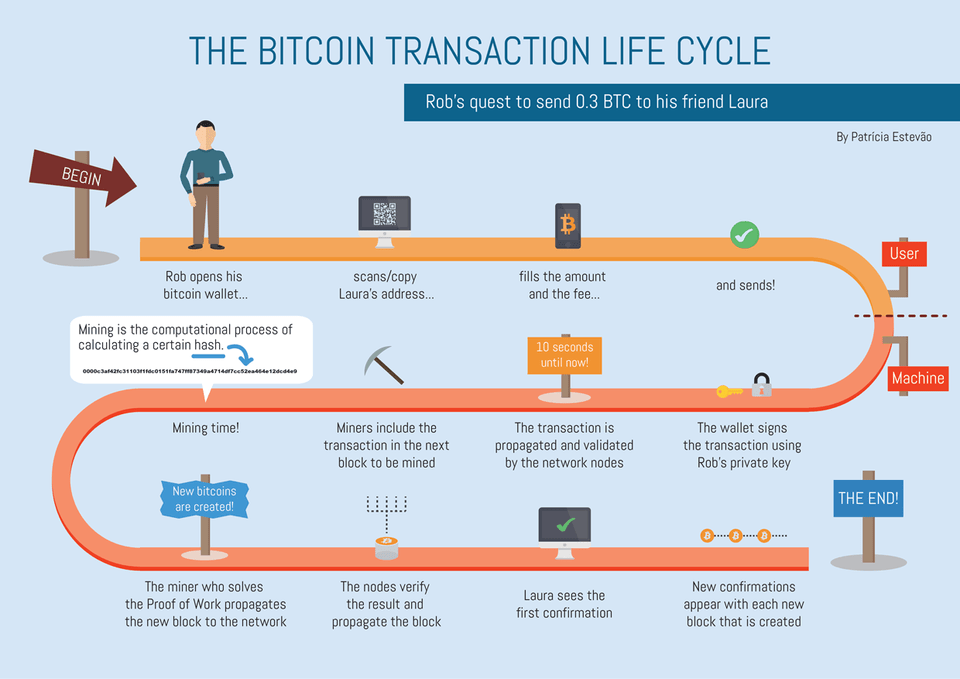
Once bitcoins are created, they become part of the circulating supply and can be transferred between users. When a user initiates a transaction, it is first broadcast to the network as an unconfirmed transaction. Nodes on the network then verify its legitimacy (e.g., does the sender have sufficient funds? Is the digital signature valid?). Verified transactions are then collected into a “mempool” (memory pool) where they await inclusion in the next block by a miner. The entire process, from creation to transaction, is meticulously handled by the decentralized network and its protocols.
Digital Wallets and Private Keys
Accessing and managing bitcoins, whether newly mined or acquired through exchange, relies on digital wallets and cryptographic keys. A Bitcoin wallet is not a physical place where bitcoins are stored; rather, it’s a software application that manages a user’s private and public keys. The private key is a secret number that allows bitcoins to be spent from a specific address. The public key, derived from the private key, generates the user’s Bitcoin address. The security of a user’s bitcoins is entirely dependent on the security of their private key, highlighting the crucial role of personal digital security in the Bitcoin ecosystem.
Conclusion
The creation of Bitcoin is a testament to ingenious technological design, blending cryptography, distributed computing, and economic theory into a cohesive, self-sustaining system. From the intricate linking of blocks in the blockchain to the competitive quest for the “golden nonce” by powerful ASIC miners, every aspect of Bitcoin’s making reinforces its core values of decentralization, security, and scarcity. It is not manufactured in a factory but computationally mined into existence, a process that simultaneously introduces new currency and hardens the integrity of the entire network. Understanding “how bitcoins are made” provides a profound appreciation for its innovative architecture and its enduring potential as a foundational technology for the digital age, a true digital gold forged in the fires of computational proof-of-work.
aViewFromTheCave is a participant in the Amazon Services LLC Associates Program, an affiliate advertising program designed to provide a means for sites to earn advertising fees by advertising and linking to Amazon.com. Amazon, the Amazon logo, AmazonSupply, and the AmazonSupply logo are trademarks of Amazon.com, Inc. or its affiliates. As an Amazon Associate we earn affiliate commissions from qualifying purchases.