
The presidency of the United States comes with immense responsibilities, unparalleled scrutiny, and a substantial salary. However, a select few individuals who have held the nation’s highest office chose to forgo or donate their presidential salary, making a unique statement about their personal finances, public service, and the role of wealth in leadership. This decision, rooted in a mix of personal conviction, financial independence, and symbolic gestures, offers compelling insights into the intersection of money, power, and philanthropy in American history.
The Financial Framework of Presidential Compensation
Understanding the decision to refuse a presidential salary requires a look at the historical and current financial structure of the office. The U.S. Constitution, in Article II, Section 1, Clause 7, stipulates that the President “shall, at stated Times, receive for his Services, a Compensation, which shall neither be encreased nor diminished during the Period for which he shall have been elected, and he shall not receive within that Period any other Emolument from the United States, or any of them.” This clause ensures financial independence and prevents undue influence from Congress regarding presidential pay.

Evolution of the Presidential Salary
The first presidential salary was set at $25,000 annually for George Washington. Over centuries, this figure has been adjusted to reflect inflation, economic growth, and the escalating demands of the office. The current annual salary for the President of the United States is $400,000, accompanied by a $50,000 expense allowance, a $100,000 non-taxable travel account, and $19,000 for entertainment. This robust compensation package is designed to attract capable leaders regardless of their personal financial standing and to cover the extensive personal and official costs associated with the presidency. For most, this salary represents a significant income, providing financial security and the ability to maintain a certain standard of living. However, for those with pre-existing substantial wealth, the salary’s immediate personal financial impact might be less critical than its symbolic value.
The Symbolic Value of Public Service
Beyond the raw numbers, the presidential salary also carries significant symbolic weight. It represents the nation’s commitment to compensating its highest public servant fairly and acknowledges the extraordinary sacrifices made by individuals and their families during their tenure. When a president chooses to decline this compensation, it becomes a powerful statement, often interpreted as an act of patriotism, a demonstration of personal financial independence, or a commitment to serving without monetary gain. Such a gesture can resonate deeply with the public, particularly during times of economic hardship or political polarization, highlighting a leader’s perceived selflessness.
Presidents Who Forwent Their Salary
While the vast majority of U.S. presidents have accepted their constitutionally mandated salary, a distinguished few have notably chosen to either refuse or donate it. Their motivations and methods varied, but each made a distinct financial and public statement.
George Washington: The Founding Philanthropist
The nation’s first president, George Washington, initially sought to serve without compensation. In his address to the Continental Congress in 1775, when he was appointed commander-in-chief of the Continental Army, he stated, “I will enter upon the arduous duty with an entire confidence of a just support of the cause, and with a full persuasion, that I shall sink or swim with it… I do not wish to make any profit from it. I will keep an exact account of my expenses… and that is all I desire.”
While president, he accepted the $25,000 salary as mandated by law, primarily due to concerns that refusing it might set an undesirable precedent or suggest he viewed the office as beneath him financially. However, it is widely documented that Washington was a man of considerable personal wealth from his Mount Vernon estate, derived from landholdings, agriculture, and other investments. His initial inclination and his general approach to public service underscored a deep-seated belief in civic duty over personal financial gain, a sentiment that continued throughout his presidency. He often bore many personal expenses associated with the office, effectively reducing the net financial benefit to himself.
Herbert Hoover: A Legacy of Self-Funding
Herbert Hoover, the 31st President (1929-1933), was a remarkably successful mining engineer and businessman before entering politics. By the time he became president, he had amassed a significant personal fortune, estimated to be in the millions, making him one of the wealthiest individuals to hold the office. During his entire four-year term, Hoover chose to donate his entire $75,000 annual presidential salary. His motivation stemmed from a deeply ingrained sense of public service and the fact that he was already financially independent.
Hoover directed his salary to various charities and public causes. A significant portion went to supplementing salaries of his staff members who he felt were underpaid. This decision reflected his personal financial philosophy and his belief that those fortunate enough to be wealthy should contribute back to society. During the Great Depression, when millions faced severe economic hardship, Hoover’s decision, while not directly alleviating the broader economic crisis, served as a symbolic gesture of solidarity and personal sacrifice. It underscored his position as someone not driven by financial gain from public office.
John F. Kennedy: Wealth and Public Duty
John F. Kennedy, the 35th President (1961-1963), came from one of America’s wealthiest and most politically influential families. With an inherited fortune that placed him among the richest individuals to ever seek the presidency, Kennedy, like Hoover, found himself in a financial position where the presidential salary was not a personal necessity. He consistently donated his $100,000 annual salary to various charities.
Kennedy’s decision was a continuation of a practice he adopted during his time in Congress, where he also donated his legislative salary. His actions were largely motivated by a sense of civic duty and a desire to demonstrate that his service was not for personal financial benefit. It projected an image of a leader committed to public service above all else, an image that resonated powerfully with a public captivated by the youthful charisma and idealism of his administration. His immense personal wealth allowed him the financial freedom to make this philanthropic choice, setting a powerful example of wealth being leveraged for public good rather than personal accumulation.
Donald J. Trump: A Modern Refusal
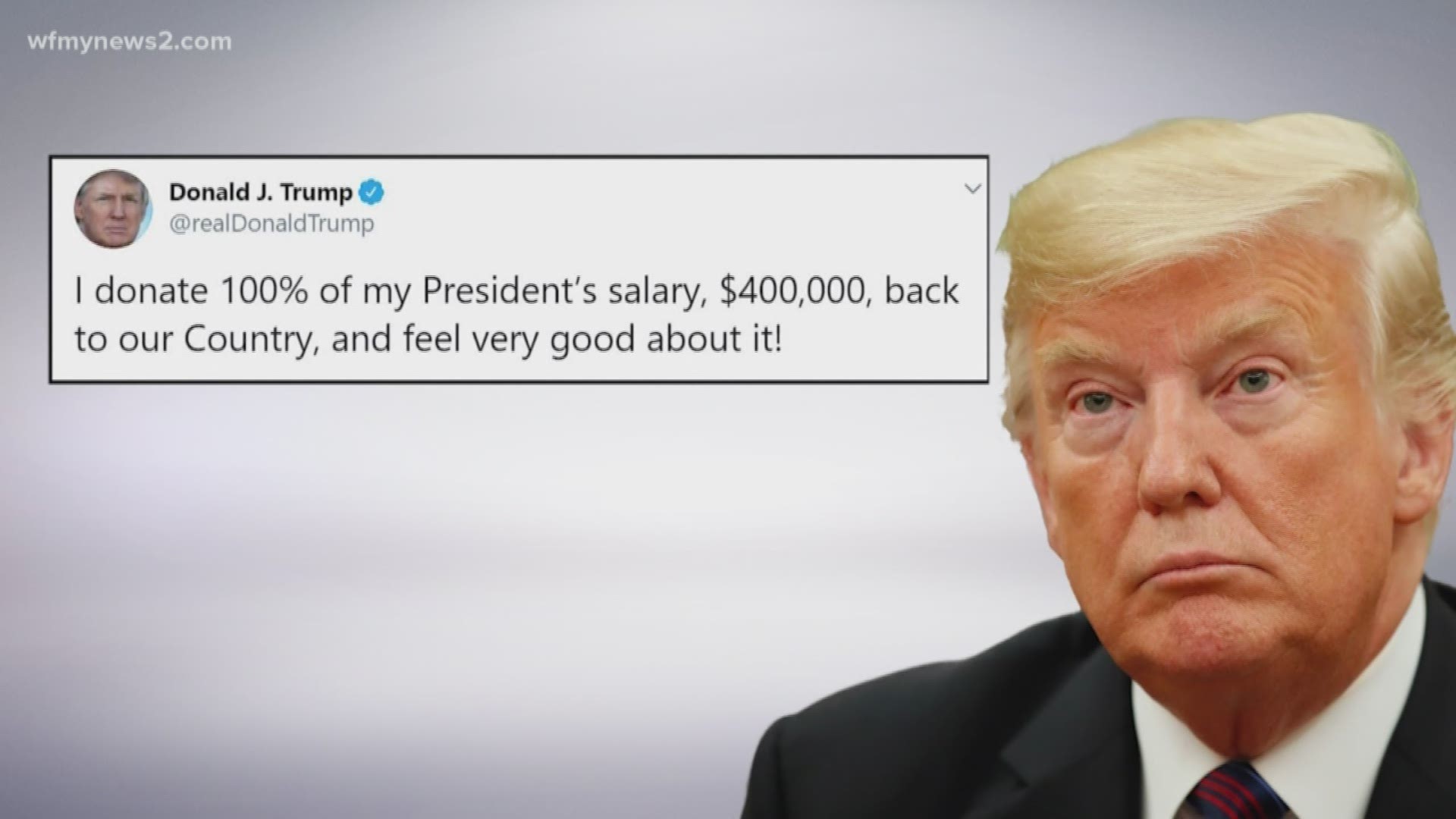
More recently, Donald J. Trump, the 45th President (2017-2021), also opted to forgo his presidential salary. Before assuming office, Trump, a real estate mogul and television personality, often boasted about his substantial personal wealth. Upon his election, he announced his intention to take only $1 of his annual $400,000 salary, legally mandated to accept at least a token amount. He pledged to donate the remainder of his salary to various federal departments and initiatives throughout his presidency.
Trump’s salary donations were made quarterly, with each installment going to a different agency. Recipients included the Department of Veterans Affairs, the Department of Transportation, the National Park Service, the Department of Education, and the Department of Health and Human Services, among others. His stated motivation was to fulfill a campaign promise and to demonstrate his commitment to public service without personal financial gain. This decision aligned with his image as a successful businessman who could self-fund and was not beholden to traditional political financial incentives. From a personal finance perspective, this choice highlighted his considerable net worth, making the presidential salary a negligible contribution to his overall financial portfolio, and allowing him to make a public statement about his priorities.
The Financial and Ethical Considerations of Forgoing Salary
The decision by these presidents to refuse their salary is more than just a grand gesture; it delves into complex financial, ethical, and political considerations that offer broader lessons for personal finance and public service.
Personal Wealth and Financial Independence
A common thread among these presidents — Washington, Hoover, Kennedy, and Trump — is their significant personal wealth before entering office. This financial independence is a critical enabler of their decision. For most individuals, a presidential salary represents a crucial source of income to cover living expenses, save for retirement, and manage family finances. For these wealthy presidents, the salary was not essential for their personal financial well-being, allowing them the luxury of choice. This highlights how pre-existing wealth can alter an individual’s financial calculus regarding employment and public service, freeing them from the direct financial necessity of their official compensation.
The Ethics of Public Service and Financial Gain
The act of refusing a salary also sparks discussions about the ethics of public service and financial gain. Does accepting a salary diminish one’s commitment to public service? Is it more noble to serve without direct compensation? While there’s no universal answer, the gesture implies a detachment from the financial benefits of the office, suggesting a purer form of dedication. For the public, it can be a powerful symbol of a leader prioritizing the nation’s welfare over personal enrichment. However, some critics might argue that such a gesture can inadvertently imply that only the wealthy can truly serve “selflessly,” potentially discouraging individuals of more modest means from aspiring to high office.

Philanthropy and Strategic Giving
From a financial planning perspective, donating a presidential salary can also be viewed as a form of strategic philanthropy. While the personal tax implications of donating a salary (which is generally considered taxable income before donation) can be complex, the act itself allows the president to direct funds to causes they personally believe in, often bypassing typical budgetary allocations for specific, impactful contributions. This aligns with broader personal finance discussions around charitable giving and how individuals with significant resources can use their wealth to support causes important to them, making a tangible difference.
The legacy of presidents who didn’t take a salary is a testament to the diverse motivations that drive leaders. Whether driven by personal conviction, a desire to set an example, or simply the ability to do so due to pre-existing wealth, their choices offer enduring lessons on the interplay between personal finance, public service, and the symbolic power of money in the highest office. It reminds us that while compensation is a fundamental aspect of any role, for some, the greatest reward lies beyond the paycheck itself.
aViewFromTheCave is a participant in the Amazon Services LLC Associates Program, an affiliate advertising program designed to provide a means for sites to earn advertising fees by advertising and linking to Amazon.com. Amazon, the Amazon logo, AmazonSupply, and the AmazonSupply logo are trademarks of Amazon.com, Inc. or its affiliates. As an Amazon Associate we earn affiliate commissions from qualifying purchases.