
In the vast landscape of technology, where algorithms power everything from artificial intelligence to sophisticated software simulations, understanding foundational mathematical concepts is paramount. One such concept, often overlooked by those not deep in the annals of theoretical computer science, is the “implicit derivative.” Far from being a mere academic exercise, implicit differentiation serves as a powerful tool for developers, data scientists, and engineers, enabling them to navigate and optimize complex systems where relationships between variables are not always straightforward.
The Core Concept: Unpacking Implicit Differentiation in a Digital World
At its heart, differentiation is about understanding rates of change. In a tech context, this translates to how small adjustments in one variable affect another – crucial for everything from refining machine learning models to optimizing resource allocation. Implicit differentiation provides a method for calculating these rates of change in scenarios where variables are not explicitly defined as functions of one another.
Explicit vs. Implicit Functions: A Software Analogy
To grasp implicit differentiation, it’s essential to distinguish between explicit and implicit functions.
An explicit function is like a well-defined subroutine in code. You provide an input, and the function directly computes and returns a single, unambiguous output. For instance, if you have y = x^2 + 3x - 5, y is explicitly defined as a function of x. In software, this might be a method calculateY(x) that directly computes y based on x. Taking the derivative dy/dx is straightforward: 2x + 3.
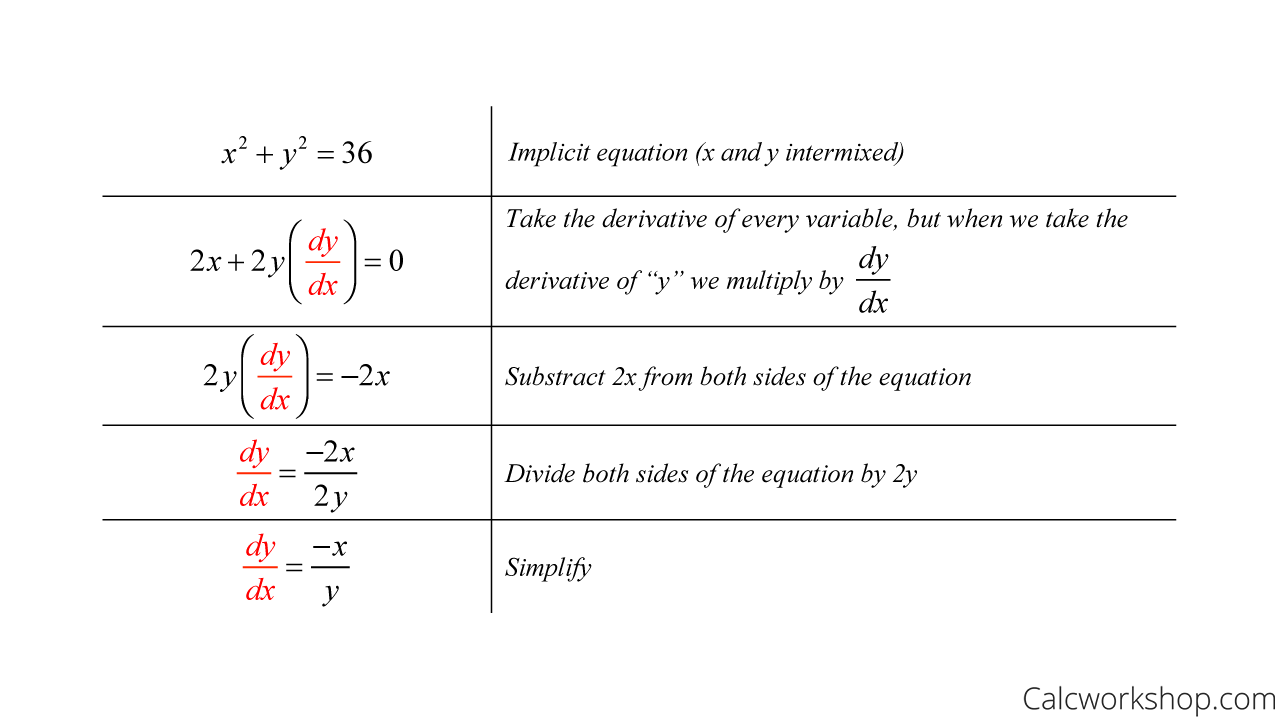
An implicit function, on the other hand, describes a relationship between variables without isolating one as a direct output of the others. Consider the equation x^2 + y^2 = 25, which defines a circle. Here, y is not explicitly written as f(x). For a given x, there might be two possible y values (e.g., for x=3, y could be 4 or -4). In programming terms, this is less like a direct computation function and more like a constraint or a data structure where variables are intrinsically linked. You can’t just call getY(x); you have to solve the relationship. When we need to find the rate of change dy/dx in such a relationship, where y isn’t neatly isolated, explicit differentiation becomes cumbersome or impossible. This is where implicit differentiation steps in.
When Standard Differentiation Fails: The Need for a Smarter Approach
Imagine you are developing a physics engine for a game or a simulation tool. Many physical laws are expressed as implicit relationships. For example, the equation of an ellipse or a complex mechanical system might describe x and y (and other variables) in an entangled form. If you need to calculate the tangent to a curve at a specific point (which is derived from the rate of change dy/dx), and y isn’t explicitly given as a function of x, traditional methods hit a wall.
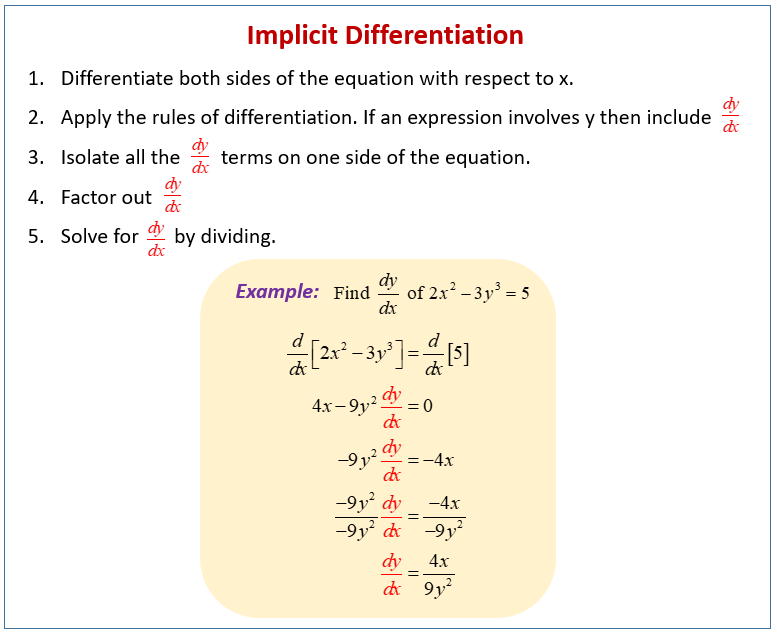
Trying to isolate y in an equation like x^3 + y^3 = 6xy (which describes a Folium of Descartes) would be extremely difficult or lead to multiple functions, complicating the differentiation process significantly. Implicit differentiation provides a systematic way to find dy/dx by treating y as an unknown function of x and applying the chain rule whenever y (or a function of y) is differentiated with respect to x. This involves differentiating both sides of the equation with respect to x, remembering that y is a function of x, and then solving algebraically for dy/dx. This method allows us to analyze the instantaneous rate of change in these intertwined systems, which is invaluable for dynamic digital environments.
Implicit Differentiation as an Algorithmic Backbone
The utility of implicit differentiation extends far beyond theoretical calculus; it underpins critical algorithms and methodologies across various technology domains. Understanding how these derivatives are calculated implicitly helps in designing more robust and efficient software systems.
Powering AI and Machine Learning Models
In the realm of artificial intelligence and machine learning, particularly with deep neural networks, implicit differentiation principles are fundamental, even if not explicitly named as such in every library. The core process of training a neural network involves minimizing a “loss function” through an algorithm called backpropagation. Backpropagation essentially calculates the gradient (a vector of partial derivatives) of the loss function with respect to each weight in the network.
A neural network is a highly complex, nested function where the output and the error (loss) are implicitly related to the vast number of weights and biases. Each layer’s output is an implicit function of the previous layers’ outputs and its own weights. To adjust these weights efficiently to reduce error, the gradient descent optimization algorithm requires these derivatives. The chain rule, which is the mathematical engine behind implicit differentiation, is extensively used to propagate the error backward through the network, allowing the system to determine how each weight implicitly contributes to the overall loss and how it should be adjusted. Automatic differentiation frameworks (like TensorFlow or PyTorch) handle this complex chain rule application behind the scenes, effectively performing implicit differentiation on an massive scale.

Optimization in Software Engineering
Beyond AI, optimization is a constant pursuit in software engineering. Whether it’s optimizing resource allocation in cloud computing, finding the most efficient path in routing algorithms, or minimizing computational overhead in complex simulations, engineers often deal with objective functions that implicitly depend on multiple interlinked parameters.
For instance, consider a system where the performance metric P depends on server load L and database query complexity Q, and L itself depends on Q in a non-explicit way due to caching mechanisms or user interaction patterns. If P needs to be maximized or minimized, understanding dP/dL or dP/dQ implicitly becomes vital. Implicit differentiation provides a formal way to derive these relationships, guiding the development of adaptive algorithms that can dynamically adjust parameters for optimal performance. This is particularly relevant in dynamic systems where parameters interact in non-linear and non-explicit manners.
Graphics and Simulation Development
In computer graphics, creating realistic visuals and interactive environments often relies on defining complex surfaces and volumes. Implicit surfaces, for example, are defined by equations of the form F(x, y, z) = 0, where F is a function that isn’t explicitly solved for x, y, or z. Examples include spheres (x^2 + y^2 + z^2 - r^2 = 0) or more intricate shapes used in medical imaging, CAD/CAM, or special effects.
When rendering these surfaces, calculating surface normals (vectors perpendicular to the surface at a given point, essential for lighting and shading), tangents, or points of intersection with other objects requires differentiation. Since z (or y or x) is not explicitly defined, implicit differentiation is the technique used to find dz/dx, dz/dy, and thus the gradient vector ∇F = (∂F/∂x, ∂F/∂y, ∂F/∂z), which gives the normal vector to the surface at any point. This capability is fundamental for accurate rendering, collision detection, and user interaction within virtual environments. Similarly, in physics simulations, many conservation laws and system constraints are inherently implicit, and their derivatives are necessary for accurately modeling system behavior over time.
Implementing Implicit Derivative Concepts in Code
While the underlying math can appear abstract, its practical application in code leverages established libraries and computational techniques.
Symbolic Computation Libraries
For tasks requiring exact analytical derivatives of implicitly defined functions, symbolic computation libraries are indispensable. Tools like SymPy in Python, MATLAB’s Symbolic Math Toolbox, or Wolfram Mathematica allow developers to define mathematical expressions and perform symbolic differentiation, including implicit differentiation. You provide the implicit equation, specify the variables and the derivative you want (e.g., dy/dx), and the library computes the exact algebraic expression for the derivative. This is useful for developing core mathematical functions for specialized scientific software, creating compilers for domain-specific languages, or generating optimized code for mathematical operations.
Numerical Approximations and Gradient Descent
In scenarios where symbolic differentiation is too complex or computationally expensive (especially with very high-dimensional functions, as in deep learning), numerical methods are employed. Finite difference methods can approximate derivatives by evaluating the function at infinitesimally small steps. While less precise than symbolic methods, they are highly versatile.
More importantly, as mentioned in the AI context, automatic differentiation (autodiff) frameworks have revolutionized how implicit derivatives are handled. These frameworks, found in libraries like TensorFlow, PyTorch, and JAX, automatically compute gradients of complex computational graphs. They don’t explicitly perform the algebraic steps of implicit differentiation like SymPy, but rather apply the chain rule efficiently through the sequence of operations (computational graph) that implicitly defines the output. This capability is the cornerstone of modern machine learning, allowing models with billions of parameters to be trained effectively by iteratively adjusting parameters based on implicitly derived gradients.
The Future Landscape: Enhanced Precision and Automation
As technology continues to advance, the methods for handling implicit derivatives will only become more sophisticated. We can expect further advancements in automatic differentiation, making it even more efficient, memory-optimized, and accessible for a wider range of implicit problems beyond traditional neural networks. New scientific computing paradigms and hardware accelerators (like GPUs and TPUs) are constantly pushing the boundaries of what’s possible, allowing for the real-time processing of implicitly defined relationships in highly complex simulations, real-time AI agents, and interactive scientific visualizations.
The understanding of implicit derivatives, therefore, remains a vital asset for anyone looking to innovate in tech, enabling deeper insights into how complex systems behave and providing the mathematical bedrock for developing more intelligent, efficient, and realistic digital solutions.
aViewFromTheCave is a participant in the Amazon Services LLC Associates Program, an affiliate advertising program designed to provide a means for sites to earn advertising fees by advertising and linking to Amazon.com. Amazon, the Amazon logo, AmazonSupply, and the AmazonSupply logo are trademarks of Amazon.com, Inc. or its affiliates. As an Amazon Associate we earn affiliate commissions from qualifying purchases.