
Enhanced Oil Recovery (EOR) represents a suite of advanced technological processes designed to extract crude oil from reservoirs after primary and secondary recovery methods have ceased to be economically viable. As conventional oil fields mature and become depleted, a significant amount of oil—often 50% or more—remains trapped within the porous rock formations. EOR technologies are the industry’s answer to unlocking this challenging resource, pushing the boundaries of engineering and material science to maximize global energy supply through sophisticated means. These techniques go far beyond simply drilling and pumping, employing complex physical, chemical, and thermal interventions to alter the reservoir’s properties and improve oil mobility.
Beyond Conventional Extraction: The Imperative for EOR
The journey of oil extraction typically unfolds in stages, each progressively more technologically intensive. Understanding the limitations of earlier stages illuminates the critical role EOR plays in modern energy production.
Primary and Secondary Recovery Limitations
Primary recovery relies on the natural pressure within a reservoir, such as dissolved gas expansion, water drive, or gravity, to push oil to the surface. This phase is relatively simple and inexpensive but typically recovers only 5-20% of the original oil in place (OOIP). Once natural pressure diminishes, secondary recovery methods are employed. The most common secondary method is waterflooding, where water is injected into the reservoir to sweep oil towards production wells, or gas injection. While more effective than primary recovery, secondary methods generally boost total recovery to around 30-45% of OOIP.
The remaining oil is often trapped by high capillary forces, high viscosity, or poor sweep efficiency, making it inaccessible to conventional techniques. This is where EOR steps in, utilizing specialized technologies to overcome these geological and physical challenges. The decision to implement EOR is a complex engineering challenge, requiring extensive reservoir characterization, modeling, and pilot testing to determine the most effective and economically viable technological approach for a specific field.
The Role of Technology in Resource Maximization
EOR is fundamentally a technological endeavor. It involves an intricate understanding of reservoir geology, fluid dynamics, chemistry, and thermodynamics. The technologies developed for EOR are often at the cutting edge of materials science and chemical engineering, continually evolving to address increasingly complex reservoir conditions. From advanced injection systems and specialized chemicals to sophisticated monitoring equipment and predictive analytics, technology is the backbone of EOR, enabling the transformation of previously unrecoverable resources into productive assets. The drive to maximize resource recovery is not merely economic; it’s a strategic imperative to meet global energy demands while leveraging existing infrastructure.
The Core Technologies of Enhanced Oil Recovery
EOR methods are broadly categorized into three main types: thermal, gas injection, and chemical, each tailored to specific reservoir characteristics and crude oil properties. The selection of an EOR technology is a sophisticated engineering decision, dependent on factors like oil viscosity, reservoir depth, porosity, permeability, temperature, and pressure.
Thermal EOR Methods
Thermal methods are primarily used for heavy oil and bitumen reservoirs, where the crude oil is too viscous to flow efficiently at reservoir temperatures. Heating the oil reduces its viscosity, making it more mobile and easier to produce.
Steam Injection (SAGD, CSS)
Steam injection is the most widely adopted thermal EOR technique. High-pressure, high-temperature steam is injected into the reservoir, transferring heat to the crude oil and reducing its viscosity.
- Steam-Assisted Gravity Drainage (SAGD): This advanced technique employs two horizontal wells drilled parallel to each other, one above the other. Steam is injected into the upper well, creating a steam chamber that heats the heavy oil. The heated, lower-viscosity oil then drains by gravity into the lower production well. SAGD is highly effective for thick, continuous heavy oil reservoirs and requires precise drilling and steam management technology.
- Cyclic Steam Stimulation (CSS): Also known as “huff and puff,” CSS involves injecting steam into a single well for a period, allowing it to soak into the reservoir to heat the oil, and then producing the heated oil from the same well. This cycle is repeated multiple times. CSS is particularly suited for heterogeneous reservoirs where continuous steam front advancement is challenging.
In-situ Combustion
In-situ combustion involves igniting a portion of the oil in the reservoir itself and injecting air or an oxygen-enriched gas to sustain the combustion front. The heat generated by this controlled fire reduces oil viscosity, cracks heavier components into lighter ones, and creates steam and combustion gases that help mobilize the remaining oil. This method is highly complex to control and requires specialized air compressors and monitoring equipment, but it can be very effective for certain heavy oil reservoirs.
Gas Injection EOR
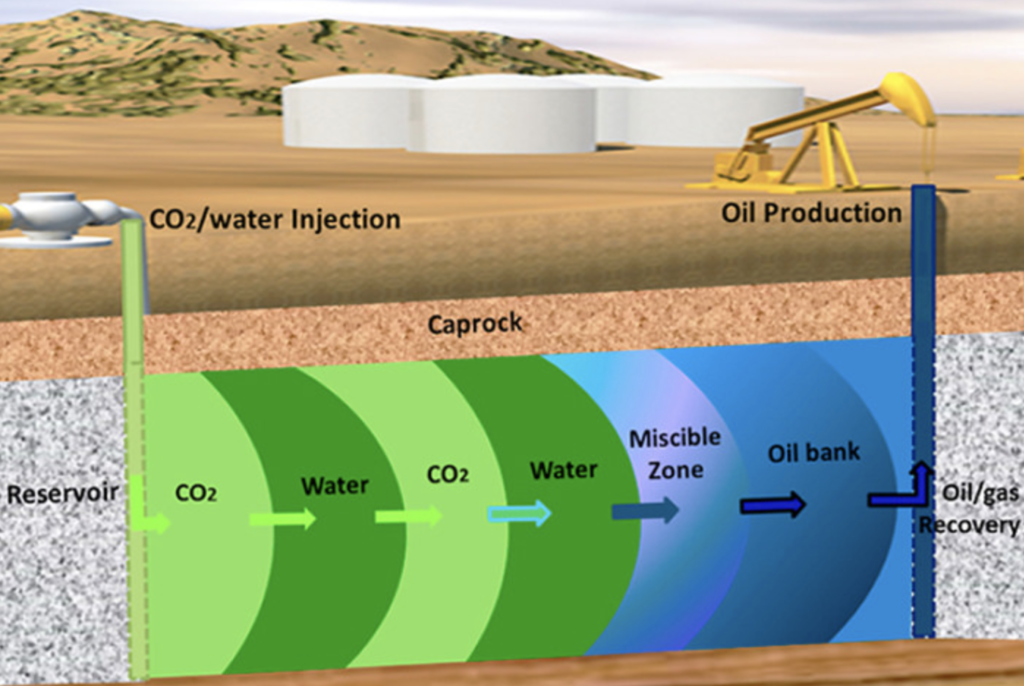
Gas injection methods introduce gases, typically CO2, nitrogen, or hydrocarbon gases, into the reservoir to mix with or displace the oil. The primary goal is to reduce oil viscosity, swell the oil, or create a miscible front that efficiently sweeps the oil towards production wells.
CO2 Flooding
Carbon dioxide (CO2) flooding is a prominent EOR technique, especially effective in light to medium oil reservoirs. When injected, CO2 can dissolve into the crude oil, causing it to swell and become less viscous. At sufficiently high pressures and temperatures, CO2 can become miscible with the oil, meaning they mix like water and alcohol, creating a highly efficient displacement front. The technology involves specialized CO2 compression and injection facilities, along with sophisticated separation and recycling systems to manage the injected gas. The potential for CO2 sequestration alongside oil recovery also makes this an environmentally appealing option.
Hydrocarbon Gas Injection (Methane, Nitrogen)
Hydrocarbon gases (like methane or natural gas liquids) or inert gases (like nitrogen) can also be injected. Similar to CO2, these gases can achieve miscibility with the reservoir oil under specific pressure conditions, reducing interfacial tension and enhancing oil displacement efficiency. The choice of gas often depends on availability and reservoir characteristics, with nitrogen being a cost-effective option where hydrocarbon gas is scarce.
Chemical EOR Techniques

Chemical EOR methods involve injecting chemical solutions into the reservoir to alter the properties of the crude oil, the reservoir rock, or the injected water, thereby improving oil mobility and sweep efficiency.
Polymer Flooding
Polymer flooding involves adding water-soluble polymers to the injected water. The polymers increase the viscosity of the water, making it a more efficient sweeping agent. This reduces the mobility ratio between water and oil, preventing “fingering” (where water bypasses large sections of oil) and improving the overall sweep efficiency of the reservoir. The technology requires specialized polymer mixing and injection systems, along with careful monitoring to prevent polymer degradation.
Surfactant Flooding
Surfactant flooding uses chemicals (surfactants) that reduce the interfacial tension between oil and water to ultra-low levels. This allows the water to more effectively displace oil that is trapped by capillary forces in the pore spaces of the rock. Surfactants act much like detergents, making it easier for oil droplets to detach from rock surfaces and be carried along by the injected fluid. This is a powerful but often complex and expensive method, requiring careful selection of surfactants tailored to reservoir conditions.
Alkaline-Surfactant-Polymer (ASP) Flooding
ASP flooding combines the benefits of alkaline, surfactant, and polymer injection. Alkaline chemicals react with acidic components in the crude oil to generate natural surfactants in situ, reducing interfacial tension. The added surfactants further enhance this effect, while polymers provide mobility control. This synergistic approach can achieve very high recovery factors, particularly in reservoirs with high oil acidity, but demands precise chemical formulation and injection strategies.
Advanced Techniques and Digital Integration in EOR
Modern EOR is increasingly driven by digital transformation, leveraging cutting-edge technologies to enhance efficiency, reduce costs, and optimize recovery rates. The integration of data science, artificial intelligence, and advanced materials is revolutionizing how EOR projects are planned, executed, and managed.
Data Analytics and Machine Learning for Optimization
Large volumes of data are generated throughout the EOR process, from geological surveys and well logs to production histories and real-time sensor readings. Data analytics and machine learning algorithms are employed to process this information, identify patterns, and build predictive models. These tools can optimize injection rates, fine-tune chemical concentrations, predict equipment failures, and forecast production, leading to more efficient resource utilization and higher recovery factors. Machine learning models can also assist in selecting the most appropriate EOR method for a specific reservoir by analyzing vast datasets of past projects and geological parameters.
Nanotechnology and Smart Fluids
Nanotechnology is emerging as a game-changer in EOR. Nanoparticles can be engineered with specific properties to interact with reservoir fluids and rocks at a molecular level. Nano-emulsions can reduce interfacial tension and improve sweep efficiency, while smart fluids containing nanoparticles can respond to changes in temperature or pressure, allowing for targeted fluid placement and controlled release of active agents. These advanced materials offer the potential for more effective and environmentally benign EOR solutions.
Artificial Intelligence in Reservoir Modeling and Management
AI is transforming reservoir modeling, providing more accurate and dynamic simulations of subsurface conditions. AI-powered algorithms can rapidly process complex geological data, generate multiple reservoir scenarios, and predict the long-term impact of various EOR strategies. This allows engineers to make more informed decisions, optimize well placement, and adapt to changing reservoir conditions in real-time. From virtual reality interfaces for reservoir visualization to AI-driven autonomous drilling, the integration of AI is making EOR operations smarter and more adaptive.
Robotics and Automation in Field Operations
Robotics and automation are being deployed to enhance safety, improve efficiency, and reduce operational costs in EOR fields. Automated systems can monitor injection and production wells, adjust flow rates, and conduct routine maintenance tasks with minimal human intervention. Drones equipped with sensors can inspect infrastructure and detect leaks, while robotic systems can perform hazardous tasks in remote or challenging environments. This technological shift is leading to more streamlined operations and greater overall reliability of EOR projects.
The Future of EOR: Sustainability and Innovation
The trajectory of Enhanced Oil Recovery is increasingly intertwined with sustainability goals and continuous innovation. As the energy landscape evolves, EOR technologies are adapting to meet environmental challenges while simultaneously striving for greater efficiency.
Reducing Environmental Footprint through Technology
A significant focus for future EOR development is on minimizing environmental impact. This includes advancing CO2 EOR with dedicated storage components (CCUS – Carbon Capture, Utilization, and Storage) to achieve net-negative or low-carbon oil production. Technologies are also being developed to improve the water efficiency of EOR processes, such as advanced wastewater treatment and recycling techniques for produced water, reducing reliance on freshwater sources. Furthermore, the development of biodegradable chemicals and less energy-intensive thermal methods is a key area of research, aiming to ensure EOR operations are as ecologically responsible as possible.
Geothermal Applications and Renewable Energy Integration
Future EOR operations may increasingly integrate with renewable energy sources. For instance, geothermal energy could potentially be harnessed to generate steam for thermal EOR processes, reducing the carbon footprint associated with heating operations. Similarly, solar or wind power could be used to power pumps and compressors required for gas or chemical injection. This hybridization of energy sources would not only lower operational emissions but also enhance the long-term viability and sustainability of EOR projects.

Continuous R&D for Breakthrough Solutions
The drive for innovation in EOR is relentless. Research and development efforts are concentrated on discovering novel chemicals, developing more resilient materials for extreme reservoir conditions, and exploring entirely new physical phenomena that could aid oil recovery. This includes ongoing work in microbial EOR (MEOR), where specially selected microorganisms are injected into the reservoir to enhance oil mobility through biological processes. The industry is constantly pushing the boundaries of science and engineering to unlock more oil, more efficiently, and with a smaller environmental footprint, solidifying EOR’s role as a critical technological frontier in energy production.
aViewFromTheCave is a participant in the Amazon Services LLC Associates Program, an affiliate advertising program designed to provide a means for sites to earn advertising fees by advertising and linking to Amazon.com. Amazon, the Amazon logo, AmazonSupply, and the AmazonSupply logo are trademarks of Amazon.com, Inc. or its affiliates. As an Amazon Associate we earn affiliate commissions from qualifying purchases.