
Churn rate, often referred to as attrition rate or customer defection rate, is a critical metric in the landscape of business finance, particularly for models reliant on recurring revenue. At its core, churn rate measures the percentage of customers or subscribers who stop doing business with a company over a given period. This seemingly simple metric holds profound financial implications, directly impacting a business’s revenue stability, profitability, and overall valuation. Understanding and actively managing churn is not merely an operational task; it is a fundamental pillar of sound financial health and sustainable growth for any enterprise.

Understanding the Core Concept of Churn Rate
In financial terms, churn represents a leakage in a business’s revenue pipeline. It quantifies the loss of customer relationships, which, for subscription-based services, membership organizations, or any business with an ongoing customer relationship, translates directly into lost future income. This metric is most acutely relevant for industries like SaaS (Software as a Service), telecommunications, streaming services, and fitness clubs, where a consistent customer base is the bedrock of their financial model.
A high churn rate signals that customers are not finding sufficient value in the product or service to justify their continued expenditure. Conversely, a low churn rate suggests strong customer satisfaction, loyalty, and a robust value proposition that encourages sustained engagement and financial commitment. From a business finance perspective, minimizing churn is often far more cost-effective than acquiring new customers, a concept that underpins many strategic financial decisions.
Calculating Churn Rate: Formulas and Financial Application
Accurately calculating churn rate is essential for meaningful financial analysis. There are several ways to compute churn, each offering a slightly different financial insight.
The most common formula for customer churn rate is:
$$ text{Customer Churn Rate} = left( frac{text{Number of Customers Lost During Period}}{text{Number of Customers at the Beginning of Period}} right) times 100% $$
For example, if a business started the month with 1,000 customers and lost 50 customers by the end of the month, its customer churn rate would be $(50 / 1,000) times 100% = 5%$.
While customer churn provides a baseline understanding, a more financially impactful metric is revenue churn rate. This calculates the percentage of recurring revenue lost from existing customers over a period, accounting for downgrades and cancellations. It’s especially vital for businesses with tiered pricing or add-on services, as losing a high-value customer has a greater financial impact than losing a low-value one.
The formula for Gross Revenue Churn Rate is:
$$ text{Gross Revenue Churn Rate} = left( frac{text{Monthly Recurring Revenue (MRR) Lost from Churn}}{text{MRR at the Beginning of Period}} right) times 100% $$
For instance, if a business began with $100,000 MRR and lost $5,000 from churned customers, its gross revenue churn rate would be $( $5,000 / $100,000 ) times 100% = 5%$.
It’s also possible to calculate Net Revenue Churn Rate, which considers upgrades and expansions from existing customers, netting them against lost revenue from churn and downgrades. A negative net revenue churn rate (often called “negative churn”) is a powerful financial indicator, meaning the revenue gained from existing customers (expansions) is greater than the revenue lost from churn and downgrades. This signifies significant financial strength and growth potential.
The period over which churn is calculated (monthly, quarterly, annually) should align with the business’s revenue cycles and financial reporting. Consistency in calculation methodology is paramount for accurate historical analysis and forecasting.
Why Churn Rate Matters: Financial Implications for Your Business
The financial significance of churn rate cannot be overstated. It directly influences several key aspects of a business’s financial health and strategic planning.
Impact on Revenue and Growth Trajectory

High churn creates a persistent drain on potential revenue. Even if a business is successfully acquiring new customers, high churn means a significant portion of that new revenue is simply replacing lost revenue, rather than contributing to net growth. This makes it challenging to scale operations, hit revenue targets, and achieve profitability. For a business aiming for exponential growth, a low churn rate is indispensable as it allows new customer acquisition to compound on a stable base.
The Cost of Acquisition vs. Retention
A widely accepted principle in business finance is that it costs significantly more to acquire a new customer than to retain an existing one. Customer Acquisition Cost (CAC) includes marketing spend, sales efforts, and onboarding costs. When churn is high, businesses are forced into a costly cycle of constantly acquiring new customers just to stay afloat. This inflates operating expenses and can severely erode profit margins. Conversely, reducing churn improves the efficiency of sales and marketing investments, as each acquired customer generates revenue for a longer period, improving the return on investment (ROI) of CAC.
Erosion of Profitability
Churn directly impacts a business’s bottom line. Each churned customer represents not only a loss of future revenue but also a lost opportunity to generate profit. Furthermore, the operational costs associated with serving a customer often have a diminishing marginal cost over time. Longer customer relationships, driven by low churn, allow the business to fully amortize its initial acquisition and onboarding costs, leading to higher profit margins per customer over their lifetime. A business with high churn, even with healthy gross revenue, can struggle with profitability due to the continuous overhead of replacing lost customers.
Investor Perception and Business Valuation
For businesses seeking investment, undergoing mergers and acquisitions, or simply aiming for a strong public valuation, churn rate is a paramount metric. Investors view low churn as a strong indicator of product-market fit, customer satisfaction, and the long-term viability and predictability of recurring revenue streams. A business with a demonstrably low churn rate commands a higher valuation because it signifies a stable, defensible customer base and predictable future cash flows. Conversely, high churn raises red flags about sustainability, competitive vulnerability, and the overall health of the business model.
Factors Influencing Churn and Financial Mitigation Strategies
Numerous factors can contribute to customer churn, many of which have direct financial repercussions or require financial solutions.
Common Causes of Churn
- Perceived Lack of Value: Customers feel the product or service no longer justifies its cost, leading to a poor return on their investment.
- Customer Service Deficiencies: Poor support experiences can frustrate customers, leading them to seek alternatives, thereby impacting their willingness to continue paying.
- Pricing Issues: Customers may find more competitive pricing elsewhere or feel the price-to-value ratio is unfavorable.
- Product/Service Performance: Technical issues, lack of desired features, or a product failing to meet expectations can lead to cancellations.
- Competitor Offers: Attractive deals or superior features from competitors can lure customers away.
- Customer Life Cycle Changes: A customer’s needs may evolve, making the current solution less relevant to their new financial or operational requirements.
Financial Mitigation Strategies
Addressing churn requires a multi-faceted approach, often involving strategic financial decisions:
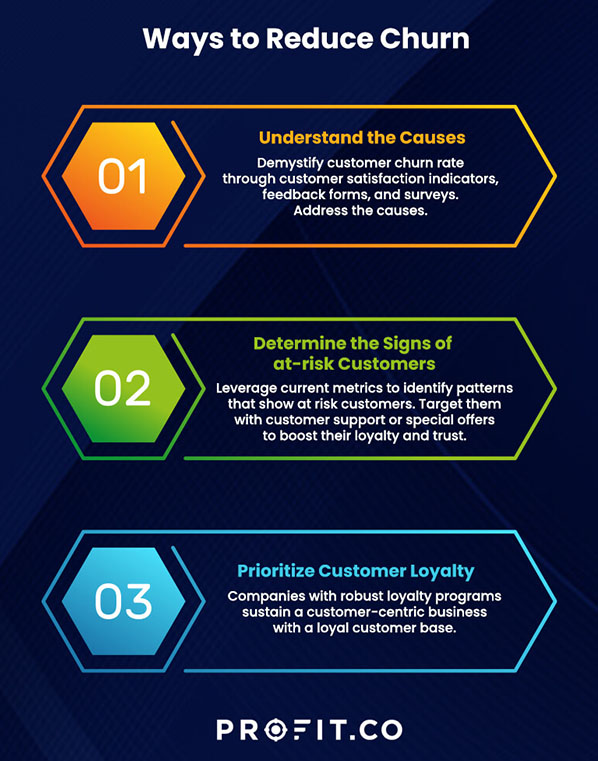
- Investing in Customer Success: Allocating resources to proactive customer success teams can help customers maximize the value they derive from the product, ensuring a strong financial return for their spend and increasing retention.
- Pricing Strategy Optimization: Regularly reviewing and optimizing pricing models to ensure they remain competitive and reflect the perceived value. This might involve tiered pricing, loyalty discounts, or incentives for longer commitments that lock in revenue.
- Product Development Investment: Continuously investing in product improvements and new features to enhance value and stay ahead of competitors. This R&D spend is a direct investment in future retention.
- Personalized Retention Offers: For customers exhibiting churn risk, targeted financial incentives (e.g., discounted annual plans, additional features at no extra cost for a limited period) can be effective.
- Robust Feedback Mechanisms: Implementing systems to gather and analyze customer feedback to identify financial pain points or value gaps allows for proactive adjustments to product, service, or pricing strategies.
The Relationship Between Churn, Customer Lifetime Value (CLV), and Business Valuation
The relationship between churn rate and Customer Lifetime Value (CLV) is intrinsically linked and paramount for financial strategy. CLV is the total revenue a business can reasonably expect to earn from a single customer account over the entire period of their relationship.
A high churn rate directly and dramatically reduces CLV. If customers leave quickly, the “lifetime” part of CLV is short, meaning less revenue generated per customer. Conversely, a low churn rate extends the customer lifecycle, allowing each customer to generate significantly more revenue over time, thus boosting CLV.
From a business finance perspective, maximizing CLV through low churn is a core objective. A high CLV-to-CAC ratio (Customer Lifetime Value to Customer Acquisition Cost) is a key indicator of a healthy, sustainable business model. It means that for every dollar spent acquiring a customer, the business expects to earn many more dollars over that customer’s lifetime. Businesses with a strong CLV and a favorable CLV-to-CAC ratio are inherently more profitable and resilient.
Ultimately, businesses with low churn rates and high CLV are viewed as more financially stable, predictable, and attractive for investment. They demonstrate a capacity for sustainable, organic growth built on a solid foundation of satisfied, long-term customers. This significantly contributes to a higher overall business valuation, whether for internal financial reporting, attracting capital, or preparing for an exit. Controlling churn isn’t just about keeping customers; it’s about safeguarding and maximizing the financial future of the entire enterprise.
aViewFromTheCave is a participant in the Amazon Services LLC Associates Program, an affiliate advertising program designed to provide a means for sites to earn advertising fees by advertising and linking to Amazon.com. Amazon, the Amazon logo, AmazonSupply, and the AmazonSupply logo are trademarks of Amazon.com, Inc. or its affiliates. As an Amazon Associate we earn affiliate commissions from qualifying purchases.