
All-Wheel Drive (AWD) is a sophisticated automotive technology designed to enhance a vehicle’s traction and stability by delivering power to all four wheels, either continuously or when specific driving conditions demand it. Far beyond a simple mechanical configuration, modern AWD systems integrate complex electronic controls, advanced sensors, and intelligent algorithms to dynamically manage power distribution, adapting in real-time to terrain, weather, and driver input. Understanding AWD requires delving into its mechanical underpinnings, electronic brain, and the diverse applications that make it a cornerstone of contemporary vehicle performance and safety.
The Core Concept of All-Wheel Drive
At its heart, an AWD system’s primary function is to optimize grip by ensuring that engine power reaches the wheels with the most traction. Unlike two-wheel drive (2WD) vehicles, which send power exclusively to either the front or rear axle, AWD systems aim to maximize the contact patch utilization of all four tires. This fundamental difference is crucial for handling adverse conditions like wet roads, snow, ice, or loose gravel, but also significantly contributes to dynamic handling on dry pavement.

Differentiating AWD from 4WD
While often used interchangeably by the general public, All-Wheel Drive (AWD) and Four-Wheel Drive (4WD) represent distinct technological approaches with different operational philosophies and intended uses. Historically, 4WD systems were robust, mechanically-locked setups designed for serious off-road driving, often requiring the driver to manually engage the 4WD mode. They typically feature a low-range gearing option for crawling over obstacles and lack a center differential, meaning all four wheels are forced to rotate at the same speed, which can cause driveline binding on high-traction surfaces.
AWD systems, by contrast, are generally designed for on-road stability and mild off-road conditions. They almost always incorporate a center differential or a sophisticated clutch pack that allows for speed differences between the front and rear axles, preventing driveline bind and making them suitable for continuous use on all road surfaces, including dry pavement. Many AWD systems operate automatically, detecting slip and adjusting power distribution without driver intervention. While some advanced AWD systems offer limited off-road capabilities, their primary focus remains on enhancing everyday driving safety and performance. The distinction lies in their engineering emphasis: 4WD for rugged utility, AWD for versatile performance and safety.
The Fundamental Advantage
The inherent advantage of an AWD system stems from its ability to distribute torque across a greater number of wheels. When one or more wheels begin to slip due to insufficient traction, an AWD system can quickly redirect power to the wheels that still have grip. This not only prevents the vehicle from getting stuck but also significantly improves acceleration, cornering stability, and braking performance. By constantly monitoring wheel speed, steering angle, throttle input, and other parameters, modern AWD systems create a more predictable and secure driving experience, empowering the vehicle to maintain optimal contact with the road regardless of surface irregularities or weather challenges.
How AWD Systems Work: Mechanics and Electronics
The complexity of an AWD system lies in its intricate blend of mechanical components and sophisticated electronic control. These two domains work in concert to achieve seamless and dynamic power distribution.
Torque Distribution Mechanisms
At the core of an AWD system’s mechanical operation are components responsible for splitting and transmitting torque. The most common mechanisms include:
- Center Differentials: These mechanical devices allow the front and rear axles to rotate at different speeds, which is essential for smooth cornering on paved roads. Without a center differential (or equivalent system), the driveline would bind and stress components. Center differentials can be open, limited-slip, or locking.
- Viscous Couplings: A simpler, passive form of power transfer, viscous couplings use a series of interleaved plates within a fluid-filled housing. When a speed difference occurs between the input and output shafts, the fluid heats up and thickens, transferring torque to the slower-turning shaft. They are relatively slow to react and offer limited control.
- Electronically Controlled Clutch Packs: These are the most prevalent and advanced mechanisms in modern AWD systems. Often multi-plate wet clutches, they are typically located within the transfer case or rear differential. An Electronic Control Unit (ECU) precisely modulates the pressure applied to these clutches, allowing for variable and rapid torque transfer between axles or even individual wheels (in the case of torque vectoring systems). This allows for proactive torque distribution before slip even occurs.
- Power Take-Off Units (PTU) / Rear Drive Modules (RDM): These gearboxes connect the primary drive axle (often the front) to the secondary drive axle (the rear) via a driveshaft. They house the necessary gearing and, in many cases, the clutch packs for engaging or disengaging the secondary axle.
Sensors and Electronic Control Units (ECUs)
The “brains” of an AWD system reside in its array of sensors and the central Electronic Control Unit (ECU). These components continuously gather and process vast amounts of data:
- Wheel Speed Sensors: Measure the rotational speed of each wheel, crucial for detecting slip.
- Steering Angle Sensors: Inform the ECU about the driver’s intended direction.
- Throttle Position Sensors: Indicate the driver’s acceleration demand.
- Yaw Rate Sensors and G-force Accelerometers: Measure the vehicle’s rotational movement and lateral forces, key for understanding cornering dynamics and potential loss of control.
- Brake Pressure Sensors: Provide data on braking events.
- Transmission Output Speed Sensors: Monitor engine power output.
The AWD ECU, often integrated with the vehicle’s main powertrain and stability control ECUs, takes all this sensor data and, using complex algorithms, determines the optimal torque distribution. This processing happens hundreds, if not thousands, of times per second, allowing for near-instantaneous adjustments.
Real-Time Adaptation and Predictive Capabilities
Modern AWD systems don’t just react to slip; many possess predictive capabilities. By analyzing steering input, throttle position, and current vehicle dynamics, the ECU can anticipate potential traction loss and pre-emptively send power to specific wheels even before slippage occurs. For example, if the system detects the driver turning sharply and accelerating, it might proactively send more power to the outside wheels to enhance stability and reduce understeer. This real-time, adaptive, and often predictive nature is what distinguishes advanced AWD systems from simpler 4WD setups, providing a seamless and highly controlled driving experience.
Types of AWD Systems
The automotive industry has developed several classifications for AWD systems, primarily based on their operational mode and complexity. These categories define how and when power is delivered to all four wheels.
Full-Time AWD
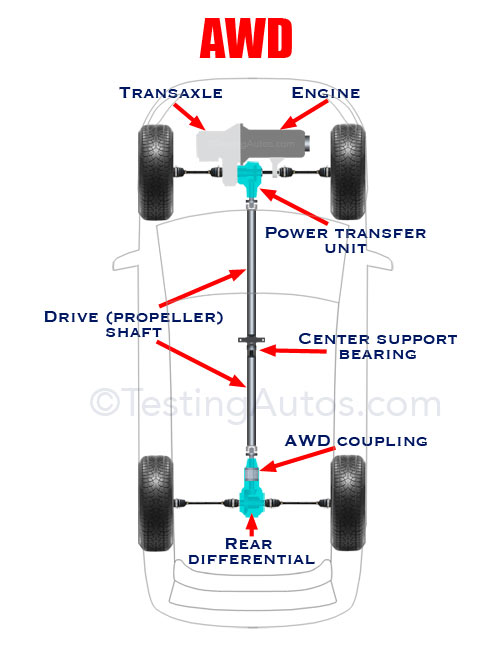
Full-time AWD systems continuously send power to all four wheels, though the distribution ratio (e.g., 50/50 front/rear or a biased split) can vary. These systems inherently use a center differential (or an equivalent clutch-based system that acts like one) to allow for differences in rotational speed between the front and rear axles, making them suitable for all road conditions, including dry pavement. The torque split can be fixed or variable, with more advanced systems dynamically adjusting power based on driving conditions. The primary advantage of full-time AWD is its constant readiness, offering consistent traction and handling benefits without any driver input required.
Part-Time/On-Demand AWD
Often referred to as “on-demand” or “part-time” AWD, these systems primarily operate in two-wheel drive (typically front-wheel drive) mode to maximize fuel efficiency. When the system detects wheel slip, or sometimes when the driver selects a specific mode, it automatically engages the secondary axle, sending power to all four wheels. Engagement usually occurs via an electronically controlled clutch pack that locks or partially locks to transfer torque. While generally more fuel-efficient than full-time systems, they can have a slight delay in engagement as slip needs to be detected first, although modern systems have significantly reduced this delay through predictive algorithms. They are a popular choice for SUVs and crossovers where occasional enhanced traction is desired without the continuous fuel economy penalty of a full-time system.
Performance-Oriented AWD
Beyond basic traction and stability, some highly sophisticated AWD systems are engineered to significantly enhance vehicle performance and handling dynamics. These often incorporate advanced features like torque vectoring.
- Torque Vectoring: This advanced technology takes AWD a step further by not just distributing torque between the front and rear axles, but also between the individual left and right wheels on an axle. Using multiple clutch packs or geared differentials controlled by the ECU, torque vectoring systems can actively send more power to the outside wheel during a turn, effectively “pushing” the vehicle through the corner. This reduces understeer (where the vehicle wants to go straight) and oversteer (where the rear slides out), significantly improving handling precision, agility, and stability at higher speeds or during aggressive driving. Some systems can even apply braking to an inside wheel to achieve a similar effect, working in conjunction with the power transfer. These systems are typically found in high-performance sports cars, luxury vehicles, and premium SUVs.
Benefits and Limitations of AWD Technology
While AWD systems offer compelling advantages, they also come with certain trade-offs that consumers and manufacturers must consider.
Enhanced Traction and Stability
The most direct benefit of AWD is its ability to provide superior traction across a broad spectrum of challenging conditions. On slippery surfaces like snow, ice, or wet roads, the system’s capacity to distribute power to the wheels with grip prevents slippage, significantly reducing the likelihood of skidding or getting stuck. This translates to more confident acceleration from a standstill, more stable cornering, and reduced stopping distances when integrated with advanced braking systems. The overall result is a substantial improvement in driver confidence and vehicle safety, particularly in regions with inclement weather.
Improved Driving Dynamics
Beyond mere traction, advanced AWD systems, especially those with torque vectoring, fundamentally enhance a vehicle’s driving dynamics. By actively managing power distribution during cornering, these systems can improve steering response, reduce body roll, and make the vehicle feel more planted and agile. Performance-oriented AWD can transform a car’s handling, allowing it to navigate curves with greater speed and precision, offering a more engaging and controlled driving experience on both public roads and track conditions. The electronic control over torque allows for a level of dynamic tuning that traditional mechanical systems cannot match.
Considerations: Fuel Economy, Weight, Cost
Despite their numerous benefits, AWD systems introduce certain practical considerations. The additional mechanical components (transfer case, extra differentials, driveshafts, clutch packs) and electronic sensors/ECUs inevitably add weight to the vehicle. This increased mass can negatively impact fuel efficiency, as more energy is required to move the heavier vehicle. Furthermore, the parasitic losses within the driveline components themselves, even when not actively transferring power, can slightly reduce fuel economy compared to a 2WD equivalent.
The complexity of an AWD system also contributes to a higher manufacturing cost, which is then passed on to the consumer. Maintenance can also be more involved and potentially more expensive due to the additional fluids, filters, and moving parts that require periodic servicing. While modern engineering strives to mitigate these factors, they remain important trade-offs when evaluating the total cost of ownership and environmental impact.
The Future of AWD in Automotive Technology
The evolution of AWD systems is far from complete, with ongoing advancements driven by new vehicle architectures and the overarching trends in automotive technology.
Integration with Electric Vehicles
Electric Vehicles (EVs) are poised to revolutionize AWD technology. With individual electric motors often positioned at each axle, or even within each wheel, EVs can achieve true “electronic AWD” without complex mechanical linkages. This allows for instantaneous, highly precise, and infinitely variable torque distribution to each wheel, far surpassing the capabilities of traditional mechanical systems. Software can control each motor independently, enabling highly sophisticated torque vectoring, stability control, and regenerative braking. This distributed power architecture promises unprecedented levels of traction, handling, and efficiency, making AWD a natural and even superior fit for the electric era.
Advanced Software and AI Enhancements
The role of software and artificial intelligence (AI) in AWD systems will continue to expand. Future systems will likely leverage more predictive analytics, drawing data from a wider array of vehicle sensors and even external sources (e.g., GPS, weather data) to anticipate road conditions and driver needs with even greater accuracy. Machine learning algorithms could continuously refine the torque distribution strategies, adapting to individual driving styles and evolving environmental factors. This will lead to even more seamless, proactive, and personalized AWD performance.

Autonomous Driving Implications
As autonomous driving technology matures, AWD systems will play a critical role in ensuring the safety and reliability of self-driving cars. Precise control over each wheel’s torque output is essential for maintaining stability and trajectory in complex driving scenarios, especially when human intervention is minimal or absent. AWD can provide the robust platform needed for autonomous vehicles to navigate diverse conditions confidently and safely, serving as a fundamental layer of control for maintaining optimal grip and maneuverability, thereby enhancing the overall safety and trustworthiness of autonomous systems.
aViewFromTheCave is a participant in the Amazon Services LLC Associates Program, an affiliate advertising program designed to provide a means for sites to earn advertising fees by advertising and linking to Amazon.com. Amazon, the Amazon logo, AmazonSupply, and the AmazonSupply logo are trademarks of Amazon.com, Inc. or its affiliates. As an Amazon Associate we earn affiliate commissions from qualifying purchases.