
An airsoft hop-up is a critical component within an airsoft gun designed to impart backspin on the BB as it exits the barrel. This seemingly simple mechanism is a fundamental piece of airsoft technology that dramatically enhances the projectile’s flight characteristics, extending effective range and improving accuracy. Without a hop-up, airsoft BBs would exhibit a much shorter range and a highly parabolic trajectory, significantly limiting the sport’s engagement distances and tactical realism. Understanding its function, design, and proper adjustment is paramount for any airsoft enthusiast looking to optimize their equipment’s performance.
The Aerodynamic Principle: Magnus Effect
At the core of the hop-up system’s efficacy lies a scientific phenomenon known as the Magnus effect. This principle describes the force exerted on a spinning object moving through a fluid (in this case, air).

How Backspin Works
When a projectile, such as an airsoft BB, spins on its horizontal axis while moving forward, it creates differences in air pressure around its surface. As the hop-up applies backspin, the top surface of the BB moves in the same direction as the airflow over it, while the bottom surface moves against the airflow. This results in the air pressure on the top of the BB being reduced and the air pressure on the bottom being increased. This pressure differential generates an upward lifting force, counteracting gravity and prolonging the BB’s flight path.
Extending Range and Improving Accuracy
The upward lift provided by the Magnus effect allows the BB to stay airborne for a longer period than it would purely under the influence of its initial velocity and gravity. This translates directly into a greater effective range for the airsoft gun. Furthermore, by stabilizing the BB’s flight and keeping it on a flatter trajectory for longer, the hop-up system significantly improves shot accuracy. A properly tuned hop-up will cause the BB to travel in a relatively straight line before gently arcing downwards at the very end of its flight, allowing for more consistent and predictable shot placement. Without it, the BB would drop rapidly, making long-range engagements nearly impossible to predict or execute.
Anatomy of a Hop-Up System
The hop-up system is typically located at the breech end of the inner barrel, where the BB is fed from the magazine. While designs vary between manufacturers and gun types, the core components and their functions remain consistent.
Hop-Up Unit
This is the housing that contains the other hop-up components and provides the mechanism for adjustment. Often made from plastic, metal alloys (like zinc or aluminum), or even CNC machined aluminum, the unit holds the bucking and nub in place and interfaces with the gun’s gearbox or firing mechanism. Rotary-style units are common for their fine adjustment capabilities, while lever-style units offer quick, coarser changes. The unit also serves to centralize the BB before it enters the inner barrel, ensuring consistent alignment.
Hop-Up Bucking
The bucking is a small, rubber sleeve that fits over the breech end of the inner barrel. Its primary function is twofold: to create an airtight seal between the nozzle of the gearbox and the inner barrel, preventing air loss and maximizing muzzle velocity, and more importantly, to impart the backspin on the BB. The bucking features an internal contact patch or mound that protrudes slightly into the barrel’s path. As the BB is pushed forward by the air pressure from the nozzle, it rubs against this contact patch, initiating the crucial backspin. The material and design of the bucking (e.g., hardness, shape of the contact patch) can significantly influence hop-up effectiveness and consistency.
Hop-Up Nub/Arm
The nub, sometimes called a tensioner or spacer, is a small cylindrical or flat piece that sits between the hop-up arm (part of the hop-up unit’s adjustment mechanism) and the bucking’s contact patch. When the hop-up adjustment dial or lever is manipulated, it moves the hop-up arm, which in turn pushes the nub downwards onto the bucking. This action causes the bucking’s internal mound to protrude further into the barrel, increasing the pressure applied to the BB and thus intensifying the backspin. The shape and material of the nub can also affect the consistency and distribution of pressure on the BB, leading to different hop characteristics.
Barrel Relationship
The inner barrel, while not strictly part of the hop-up unit itself, works in direct conjunction with it. The hop-up bucking sleeves onto the end of the inner barrel, and the BB travels through this combined system. The quality, material, and cleanliness of the inner barrel all play a role in how effectively the hop-up can impart spin and guide the BB downrange. A smooth, clean barrel with a consistent bore diameter ensures that the hop-up’s work is not undermined by friction or inconsistent BB-to-barrel contact.
Types of Hop-Up Systems
While the fundamental principle remains constant, various hop-up system designs exist, each offering different characteristics in terms of adjustability, consistency, and performance potential.
Standard/Rotary Hop-Up
This is the most common type found in modern airsoft AEGs (Automatic Electric Guns). A rotary dial allows for very fine and precise adjustments to the hop-up pressure. The mechanism typically involves a worm gear or a finely toothed wheel that moves the hop-up arm up or down. These systems are generally reliable, easy to adjust, and offer good consistency out of the box.
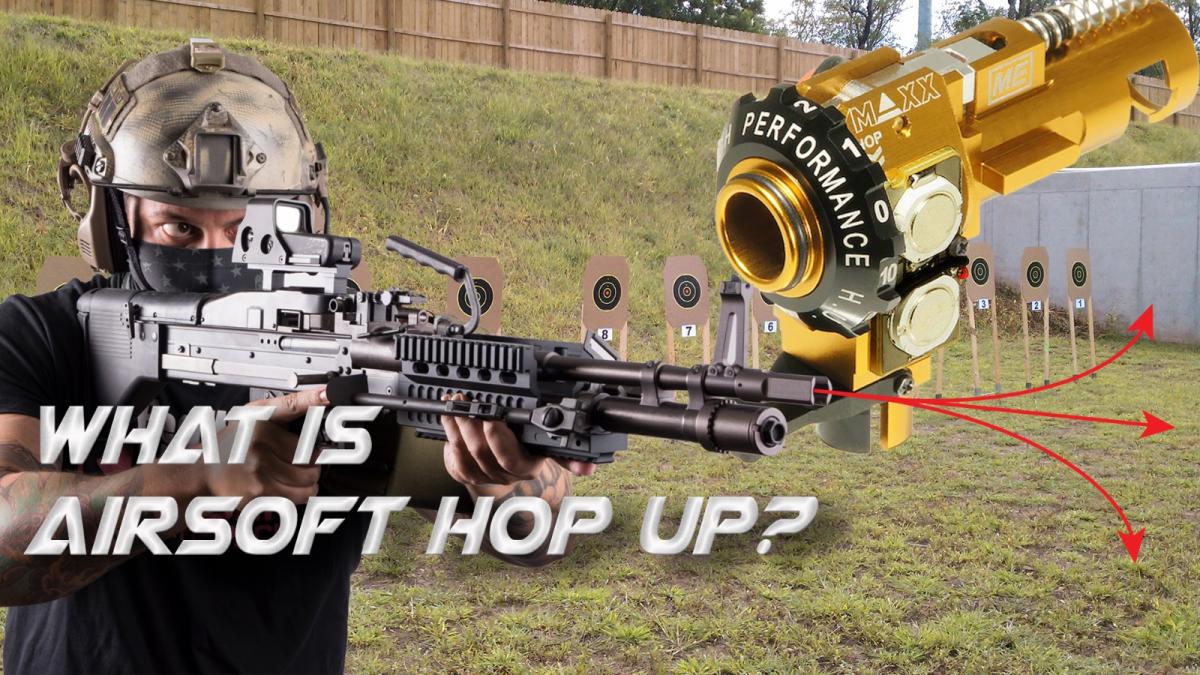
Flat Hop and R-Hop Systems
These are advanced hop-up modifications designed to maximize consistency and performance, especially with heavier BBs.
- Flat Hop: This modification involves replacing the standard bucking’s internal mound with a flat patch (often a custom cut piece of silicone or rubber) and using a flat nub. The goal is to provide a larger, more even contact area with the BB, which can lead to a more consistent spin and reduced side-to-side deviation, often resulting in increased range and accuracy.
- R-Hop: Considered by many to be the pinnacle of hop-up performance, the R-hop involves installing a precisely cut, curved patch (typically made of silicone or rubber, like an IR-hop) directly into a window milled into the inner barrel. This patch provides an extremely large and consistent contact surface with the BB, offering unparalleled spin consistency, especially with heavy BBs (0.30g and above). It requires significant technical skill and precision to install correctly but can yield dramatic performance improvements.
TDC (Top Dead Center) Hop-Up
TDC hop-up systems aim to apply pressure to the BB directly from the top, ensuring perfectly even downward force without any lateral bias. This contrasts with some traditional systems where the hop arm might push the nub at a slight angle. TDC mods often involve replacing the original hop-up unit with one that has a vertically aligned screw pushing directly down on the hop-up nub or a custom-made flat patch, offering highly consistent and repeatable hop application. These are particularly popular in high-precision sniper rifles.
Electronic/Tracer Hop-Up
While not a different type of hop-up in terms of how it applies spin, some hop-up units integrate electronic components. Tracer hop-up units, for example, incorporate UV LEDs that charge special glow-in-the-dark BBs as they pass through, making them visible in low-light conditions. These are an enhancement to the existing hop-up unit, adding a functional accessory rather than changing the fundamental spin mechanism.
Adjusting and Maintaining Your Hop-Up
Proper adjustment and regular maintenance are crucial for maximizing the performance and longevity of your hop-up system.
Calibration for BB Weight
The amount of hop-up applied needs to be carefully calibrated to the weight of the BB being used. Heavier BBs (e.g., 0.28g, 0.30g, 0.32g) require more hop-up pressure to achieve the same flat trajectory as lighter BBs (e.g., 0.20g, 0.25g). When adjusting, the goal is to achieve a trajectory where the BB travels flat for as long as possible before making a gentle, consistent drop. This “sweet spot” ensures maximum effective range and accuracy. Testing different settings and observing the BB’s flight path is essential. Too little hop and the BB will drop prematurely; too much hop and it will “sky” upwards.
Common Issues and Troubleshooting
Several issues can arise with hop-up systems:
- Inconsistent shots: This can be due to a worn bucking, a dirty barrel, an improperly seated bucking, or inconsistent pressure from the nub.
- BBs curving left or right: Often indicative of uneven pressure from the hop-up nub or a damaged/misaligned bucking. Custom nubs (like flat nubs) and R-hops aim to mitigate this by providing a broader, more uniform contact surface.
- Reduced range/velocity: Can be a symptom of a torn bucking causing an air seal leak, or simply the hop-up being set too low for the BB weight.
- BB feeding issues: A bucking that protrudes too far into the barrel can sometimes impede BB feeding, causing jams or misfeeds.
Troubleshooting involves systematic inspection of each component, ensuring cleanliness, proper seating, and integrity.
Cleaning and Longevity
Regular cleaning of the inner barrel and hop-up bucking is vital. Silicone oil or residues from low-quality BBs can accumulate on the bucking’s contact patch and inside the barrel, reducing friction and negatively affecting the spin. Using a cleaning rod with a small patch of cloth moistened with rubbing alcohol (isopropyl alcohol) is effective. Avoid harsh solvents that could degrade rubber components. Inspect the bucking for tears, hardening, or deformation, as these are common wear items that require periodic replacement to maintain optimal performance. Storing your airsoft gun with the hop-up set to minimum tension can also help prolong the life of the bucking by reducing constant compression.
The Impact on Airsoft Performance
The hop-up system’s role in airsoft performance cannot be overstated. It transforms a short-range toy into a reasonably effective projectile device, critical for the sport’s competitive and recreational aspects.
Range vs. Accuracy Trade-offs
While hop-up generally improves both range and accuracy, there can be subtle trade-offs. Extreme hop settings, while potentially increasing the “lift” and thus the initial range, might introduce instability or inconsistencies that reduce pinpoint accuracy. The goal is to find the optimal balance where the BB travels as far as possible while maintaining a tight grouping. This balance is often achieved through experimentation with different BB weights and hop-up settings.
BB Weight and Hop-Up Synergy
The choice of BB weight is intrinsically linked to hop-up performance. Heavier BBs, while requiring more energy to accelerate, retain their velocity better over distance and are less susceptible to wind drift due to their increased momentum. To achieve a flat trajectory with heavier BBs, a stronger hop-up effect is needed. High-performance hop-up systems (like R-hops) are particularly effective with heavier BBs, allowing players to leverage the inherent stability of denser projectiles for superior long-range engagement. Conversely, very light BBs can be easily over-hopped, leading to unstable flight.

Enhancing the Player Experience
Ultimately, a well-understood and properly adjusted hop-up system significantly enhances the airsoft player’s experience. It allows for more engaging gameplay over varied distances, enabling tactical maneuvers and precision shots that would otherwise be impossible. Understanding this core technology empowers players to diagnose issues, make informed upgrade choices, and get the most out of their airsoft equipment, elevating their participation in the sport.
aViewFromTheCave is a participant in the Amazon Services LLC Associates Program, an affiliate advertising program designed to provide a means for sites to earn advertising fees by advertising and linking to Amazon.com. Amazon, the Amazon logo, AmazonSupply, and the AmazonSupply logo are trademarks of Amazon.com, Inc. or its affiliates. As an Amazon Associate we earn affiliate commissions from qualifying purchases.