
The ball screen, a fundamental offensive action in basketball, has evolved from a simple tactic into a sophisticated strategic cornerstone. While its core principle—a player setting a stationary pick to free up a ball-handler—remains constant, the modern understanding, execution, and optimization of the ball screen are increasingly intertwined with advanced technology. Far beyond chalkboards and verbal instructions, digital tools, AI, and sophisticated analytics now illuminate every nuance of this crucial play, offering unparalleled insights into its effectiveness, timing, and strategic variations. This article delves into how technology defines, refines, and revolutionizes our comprehension and application of the ball screen in contemporary basketball.

Unpacking the Ball Screen Through Data Analytics
Data analytics has transformed basketball coaching and player development, providing a granular view of every on-court action, including the ball screen. By leveraging advanced tracking systems and statistical models, teams can dissect the efficacy of a ball screen in ways previously unimaginable, moving beyond qualitative assessment to empirical validation.
Real-time Tracking and Performance Metrics
High-resolution cameras and sophisticated sensor technology, often embedded in arenas or worn by players, capture vast amounts of data during games and practices. These systems track player movement, ball trajectory, and spatial relationships, allowing for precise quantification of ball screen parameters. Coaches can analyze:
- Screen Angle and Contact Quality: Software can identify the exact angle at which a screen is set, the solidity of the contact, and whether the screener maintained a legal stationary position. This helps players understand optimal body positioning for maximizing screen effectiveness while avoiding offensive fouls.
- Screen-Roll/Pop Timing: The synchronization between the ball-handler’s move off the screen and the screener’s subsequent roll to the basket or pop to the perimeter is critical. Analytics platforms can measure this timing down to milliseconds, identifying delays or premature movements that compromise the play. This data helps identify perfect execution windows, enabling players to fine-tune their chemistry and reactivity.
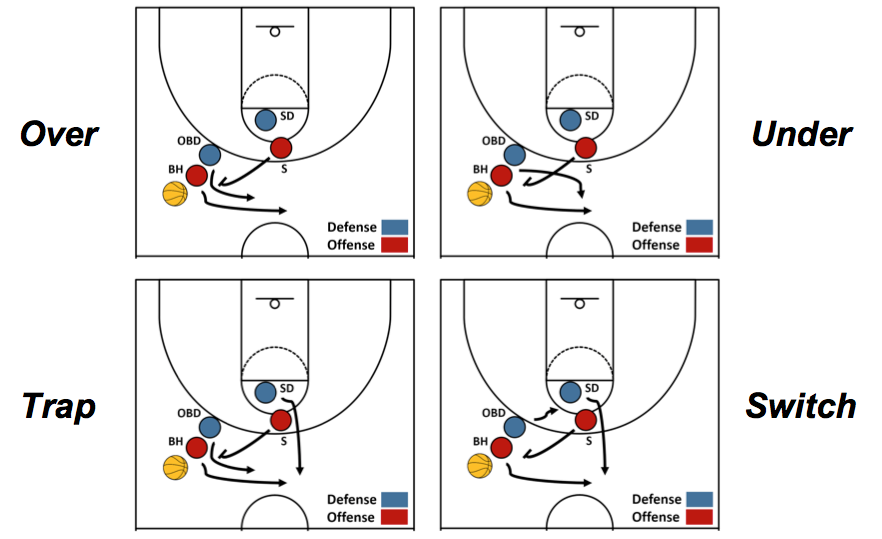
- Defender Reaction Time and Pathways: Tracking defensive players’ movements provides critical insights into how opponents react to different ball screen coverages. Coaches can identify if a defender is “going over,” “going under,” “switching,” or “dropping back,” and how quickly they adjust. This information is invaluable for designing specific reads and counters for the ball-handler and screener.
- Shot Quality and Offensive Efficiency: Post-screen outcomes are meticulously recorded. Analytics can link a specific ball screen action (e.g., high screen, side screen, short roll) to the resulting shot location, assist, turnover, or offensive rebound. This allows teams to statistically evaluate which ball screen variations lead to the highest expected point value against various defensive schemes. For instance, a “pick-and-pop” might generate more open three-point attempts, while a “pick-and-roll” might lead to high-percentage shots at the rim, depending on personnel and opponent.
Predictive Analytics and Strategic Implementation
Beyond descriptive analysis, predictive analytics leverages historical data to forecast outcomes and inform strategic decisions regarding ball screen usage. Machine learning algorithms can process millions of data points to identify patterns and predict the most effective ball screen scenarios.
- Opponent Scouting Automation: AI-powered scouting tools can automatically analyze an opponent’s defensive tendencies against ball screens. They can predict how a specific team or player will defend a screen, allowing coaches to prepare tailored offensive sets and player-specific reads. For example, if an algorithm predicts a defender frequently goes “under” the screen against a poor shooter, the offense can be designed to exploit that space for a mid-range jumper or an immediate drive.
- Personnel Optimization: Analytics can guide coaches on which player combinations are most effective in ball screen situations. By analyzing player strengths (e.g., a strong roller, a good pick-and-pop shooter, an elite ball-handler) against specific defensive profiles, teams can optimize their lineups to maximize ball screen efficiency. This might involve pairing a powerful screener with a shifty guard, or a stretch-big with a drive-first point guard.
- Game State Adaptability: Predictive models can suggest optimal ball screen strategies based on game state (e.g., time remaining, score differential, foul trouble). In a close game needing a quick score, a particular ball screen variation might have a higher probability of success based on historical data under similar pressure situations.
Simulation and Virtual Training Environments
The complexity of the ball screen—requiring split-second decisions and seamless coordination—makes it an ideal candidate for technology-enhanced training. Simulation and virtual reality (VR) tools offer immersive, repeatable, and scalable platforms for players to practice and master ball screen concepts without the physical toll of live practice.
Software for Playbook Design and Visualization
Modern coaching software goes beyond simple diagramming. These tools allow coaches to create dynamic 3D representations of plays, including intricate ball screen actions, and simulate them from various camera angles.
- Interactive Playbooks: Players can access digital playbooks that animate ball screen concepts, showing player movement, passing lanes, and potential reads in real-time. This visual learning approach is far more effective than static diagrams for understanding the flow and timing of a complex play.
- Customizable Scenarios: Coaches can input specific defensive coverages and player tendencies into the software to create custom ball screen scenarios. Players can then visualize how to react, for instance, if the defense switches, traps, or shows and recovers. This helps develop cognitive processing and decision-making skills.
- Instant Feedback and Iteration: These platforms often include tools for drawing over plays, highlighting successful options, or pointing out errors. Coaches can record voice-overs explaining specific nuances, allowing players to review and internalize strategies at their own pace.
VR/AR for Immersive Skill Development
Virtual Reality (VR) and Augmented Reality (AR) represent the cutting edge of basketball training, particularly for decision-making in ball screen situations.
- Immersive Decision-Making Training: VR headsets can place a ball-handler or screener directly into a simulated game environment. The player faces virtual defenders reacting dynamically to their movements, forcing them to make reads (e.g., drive, pass to the roller, pass to the popper, shoot) in real-time. This trains the brain to process complex visual information and react appropriately under simulated game pressure.
- Repetitive Scenario Practice: Unlike live practice, VR allows for infinite repetitions of specific ball screen scenarios without physical exertion. A player can practice responding to a “hedge and recover” defense hundreds of times, building muscle memory and mental quickness.
- Spatial Awareness and Positioning: AR overlays in a real-world gym can project virtual defenders or play diagrams onto the court, guiding players on optimal positioning for setting screens, anticipating rolls, or exploiting openings. This merges virtual instruction with physical movement, enhancing spatial awareness.
- Reduced Injury Risk: Practicing high-intensity, high-contact plays like ball screens in a virtual environment reduces the risk of injury associated with physical contact, allowing players to refine their technique in a safe setting.
AI and Machine Learning for Tactical Mastery
Artificial Intelligence (AI) and Machine Learning (ML) are not just processing data; they are interpreting it, learning from it, and even generating tactical insights that human analysts might miss. For the ball screen, AI offers a new dimension in strategic advantage.
Identifying Optimal Screen Angles and Timing
AI algorithms, trained on vast datasets of successful and unsuccessful ball screens, can identify the subtle factors that contribute to optimal execution.
- Predicting Defensive Breakdown Points: ML models can analyze historical defensive behaviors to predict specific moments or angles where a ball screen is most likely to create an advantage against a particular opponent. This could include identifying a defender’s tendency to hesitate, to overcommit, or to be slow in recovery, and then recommending a screen angle or timing that exploits that weakness.
- Personalized Screening Recommendations: For individual players, AI can suggest ideal screening angles, contact points, and roll/pop timing based on their physical attributes, offensive skill set, and the defensive opponent. For example, a larger, stronger player might be advised to set a deeper, more physical screen, while a quicker, more agile player might be coached on “ghost screens” or slips.
- Adaptive Play Calling: During a game, AI systems could potentially analyze live data and recommend adjustments to ball screen strategy in real-time, based on changes in opponent defense, player fatigue, or game flow. While not yet fully implemented in live game situations for automated play-calling, the analytical potential is significant.
Automating Opponent Scouting and Counter-Strategies
The laborious task of scouting opponents for ball screen tendencies is significantly streamlined and enhanced by AI.
- Pattern Recognition in Defensive Schemes: AI can swiftly analyze hours of game footage to identify recurring defensive patterns against ball screens, far more efficiently than human scouts. It can pinpoint common rotations, individual defensive habits, and areas of vulnerability.
- Developing Counter-Strategies: Based on identified defensive patterns, AI can suggest and even design counter-strategies. If an opponent consistently “hedges” hard, the AI might recommend an immediate pass to the short roller or a quick “re-screen.” If they frequently “switch,” it might suggest exploiting mismatches or quickly “slip-screening.”
- Predicting Mismatches: AI can identify potential offensive mismatches created by ball screens, such as a smaller defender guarding a larger player post-switch, or a slower defender trying to guard a quick guard. This allows teams to target specific defensive weaknesses strategically.
Wearable Technology and Biometric Feedback
Beyond just tactical understanding, wearable technology provides critical insights into the physical aspects of executing a ball screen, ensuring players are performing optimally and safely.
Enhancing Player Execution and Injury Prevention
Wearable sensors provide biometric data that directly relates to a player’s physical performance in ball screen actions.
- Force and Impact Analysis: Sensors embedded in jerseys or worn as bands can measure the force and impact generated during screen setting. This helps coaches understand if players are setting screens effectively and safely, avoiding illegal moving screens while maximizing contact. It can also monitor the cumulative impact to assess injury risk.
- Fatigue Monitoring: Biometric data like heart rate variability, movement efficiency, and power output can indicate player fatigue. Coaches can use this information to manage workload in practice and games, ensuring players are fresh enough to execute complex ball screen actions effectively, especially in late-game situations where precision is paramount.
- Technique Refinement: Real-time feedback from wearables can help players refine their physical technique for setting and using screens. For instance, if a player is consistently losing balance during a screen, or if their burst after the screen is subpar, the data can highlight these issues for targeted coaching intervention.

The Future of Integrated Tech in Ball Screen Development
The trajectory of technology in basketball points towards increasingly integrated systems where data from tracking, simulation, AI, and wearables coalesce into a unified platform. Imagine a scenario where:
- A player completes a VR session practicing ball screens, and the data immediately feeds into an AI algorithm that suggests personalized adjustments to their footwork based on their unique biomechanics captured by wearables.
- During a live game, coaches receive real-time alerts from an AI system highlighting optimal ball screen variations against the opponent’s current defensive setup, considering the fatigue levels of their players derived from biometric data.
- Post-game, advanced analytics automatically generate video clips tailored to each player, demonstrating their successful and unsuccessful ball screen actions, complete with overlaid data points and suggested improvements.
The ball screen, while an age-old basketball maneuver, is constantly being redefined and perfected through the lens of cutting-edge technology. From data-driven insights and immersive simulations to AI-powered strategies and biometric feedback, technology is not just explaining “what is a ball screen”; it’s revealing its full potential, transforming it into a dynamic, data-optimized weapon in the modern game.
aViewFromTheCave is a participant in the Amazon Services LLC Associates Program, an affiliate advertising program designed to provide a means for sites to earn advertising fees by advertising and linking to Amazon.com. Amazon, the Amazon logo, AmazonSupply, and the AmazonSupply logo are trademarks of Amazon.com, Inc. or its affiliates. As an Amazon Associate we earn affiliate commissions from qualifying purchases.