
Wrist wraps, often perceived as simple gym accessories, are in fact sophisticated tools engineered to enhance human performance and mitigate the risk of injury during strenuous physical activities. Far from being merely strips of cloth, their design, material composition, and application contribute to a precise biomechanical advantage, making them a critical component in the tech stack of a serious athlete or fitness enthusiast. Understanding their functionality involves delving into the principles of support, leverage, and force transmission, positioning them as an essential piece of personal performance technology.
Engineering Stability and Performance Augmentation
At their core, wrist wraps function by providing external support to the wrist joint. This support is not just about comfort; it’s a calculated intervention in the biomechanics of the human body under load. When lifting heavy weights, performing complex gymnastic movements, or engaging in repetitive, high-impact activities, the wrist joint is subjected to significant stresses. These stresses can lead to instability, pain, and, in severe cases, acute or chronic injury. Wrist wraps are designed to counteract these forces, creating a more stable and efficient kinetic chain.

The Biomechanics of Support
The wrist is a complex joint, comprising eight carpal bones arranged in two rows, articulating with the radius and ulna of the forearm and the metacarpals of the hand. This intricate structure allows for a wide range of motion, which is advantageous for dexterity but can be a liability under axial or compressive loads. When a heavy barbell is pressed overhead or a kettlebell is swung, the forces exerted on the hand travel through the wrist. Without adequate support, the wrist can extend excessively, collapse laterally, or experience unwanted flexion.
Wrist wraps act as an external ligament system. By encircling the wrist firmly, they compress the carpal bones together and restrict excessive movement, particularly hyperextension and lateral deviation. This restriction aligns the bones in a more mechanically advantageous position, allowing for more efficient force transmission from the forearm through the hand to the implement being manipulated. Essentially, they create a rigid column where flexibility might otherwise compromise stability, thereby improving the structural integrity of the joint under stress. The degree of stiffness and inelasticity in the wrap’s material directly influences the amount of support provided, allowing users to select a wrap tailored to their specific needs and the demands of their activity.
Material Science and Design Innovation
The efficacy of wrist wraps is deeply rooted in the material science and design principles applied during their manufacturing. Modern wrist wraps are typically constructed from a blend of cotton, polyester, and elastic fibers. This composition is not arbitrary; each component plays a crucial role in the wrap’s performance.
- Cotton provides breathability and comfort, preventing excessive sweat build-up and skin irritation during long training sessions.
- Polyester adds durability and strength, ensuring the wrap can withstand repeated stretching, compression, and washing without significant degradation.
- Elastic fibers are perhaps the most critical component, providing the necessary compressive force and allowing the wrap to conform snugly to the unique contours of the wrist. The percentage and type of elastic determine the wrap’s flexibility and the level of support it offers. Stiffer, less elastic wraps offer maximum support, ideal for powerlifting or heavy pressing movements, while more flexible wraps provide a balance of support and mobility suitable for Olympic weightlifting or gymnastics.
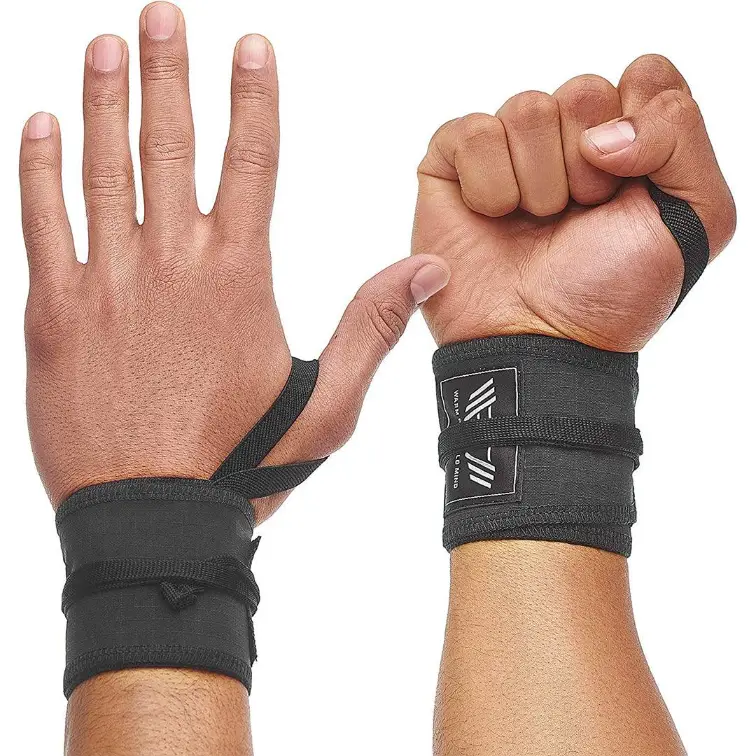
Beyond material composition, design elements like thumb loops and robust Velcro closures are integral to their functionality. The thumb loop ensures the wrap stays in place during the initial application, facilitating a tight, secure fit. The Velcro closure, often wide and strong, is designed to withstand significant tensile forces, preventing the wrap from unraveling mid-lift. These seemingly small design considerations are vital for the wrap to maintain its engineered support throughout the entire duration of a demanding set or exercise.
Optimizing Human-Machine Interaction in Training
In the context of physical training, the human body acts as a complex machine interacting with external loads and implements. Wrist wraps serve as an interface technology, optimizing this interaction by enhancing the body’s natural capabilities and protecting vulnerable points. They are not a substitute for proper technique or joint strength, but rather a performance enhancer that allows individuals to push boundaries safely and effectively.
Enhancing Grip and Lifting Capacity
One of the less obvious, but significant, benefits of wrist wraps is their indirect impact on grip strength and lifting capacity. When the wrist is unstable or hyperextended, the muscles of the forearm and hand must work harder to maintain a secure grip on the weight. This increased demand can lead to premature grip fatigue, limiting the number of repetitions or the total weight lifted, even if the primary target muscles (e.g., chest, shoulders, back) are not yet fully exhausted.
By stabilizing the wrist, wraps reduce the compensatory effort required by the forearm extensors and flexors. This allows the lifter to focus more energy on the primary muscles involved in the lift, leading to better muscle activation and greater overall output. For instance, in a heavy bench press, a stable wrist allows the force from the chest and triceps to be transferred directly to the barbell without energy being lost to wrist instability. Similarly, in overhead presses, a firm wrist prevents the bar from tipping backward, ensuring a more direct and powerful push. This optimization of force transfer directly translates to the ability to handle heavier loads or perform more repetitions, thereby accelerating strength and hypertrophy gains.
Injury Prevention and Joint Health
The most direct and critical function of wrist wraps is injury prevention. Repetitive strain, sudden impact, or excessive loading without adequate support can lead to a range of wrist injuries, from minor sprains and strains to more severe conditions like carpal tunnel syndrome, tendonitis, or ligament tears. Wrist wraps act as a prophylactic measure, safeguarding the joint against these risks.
By limiting the wrist’s range of motion and providing external compression, they prevent the joint from moving into positions of vulnerability. This is particularly important during movements that inherently place the wrist in extreme extension, such as heavy cleans and jerks, overhead squats, or even push-ups and handstands. For individuals with pre-existing wrist discomfort or those recovering from minor injuries, wraps can provide the necessary support to continue training without exacerbating the condition, facilitating a safer return to full capacity. They contribute to long-term joint health by minimizing micro-trauma and cumulative stress, allowing athletes to sustain their training regimens over extended periods.
Integrating Wrist Wraps into a Smart Training Regimen
Integrating wrist wraps effectively into a training regimen requires a nuanced understanding of their purpose and proper application. They are a specialized tool, not a universal solution, and their strategic use is key to maximizing benefits while avoiding potential pitfalls.
Selecting the Right “Tool” for Your “System”
Just as one selects specific software for a given task, choosing the right wrist wrap involves considering the activity and desired outcome. Different types of wrist wraps are optimized for different modalities:
- Flexible/Elastic Wraps: These offer moderate support and allow for greater wrist mobility. They are often favored by Olympic weightlifters who need to transition quickly from rack position to overhead, or by gymnasts who require a balance of support and flexibility for handstands and other bodyweight movements.
- Stiff/Inelastic Wraps: These provide maximum support and severely limit wrist mobility. They are the preferred choice for powerlifters, strongmen, or anyone performing maximal efforts in pressing movements (bench press, overhead press) where wrist stability is paramount and range of motion is less critical.
The length of the wrap also plays a role, with longer wraps (e.g., 24 inches or more) offering more turns around the wrist for increased support, while shorter wraps (e.g., 12-18 inches) offer quicker application and less bulk. Matching the wrap’s characteristics to the specific demands of the exercise and individual preference is crucial for optimal performance.
Proper Application: A User Manual for Optimal Functionality
The effectiveness of a wrist wrap is heavily dependent on its proper application. Incorrect wrapping can negate its benefits or even cause discomfort. The general technique involves:
- Thumb Loop Placement: Threading the thumb through the loop ensures the wrap is anchored securely on the hand’s dorsum.
- Starting Point: Begin wrapping just below the base of the hand, covering the lower part of the palm and the beginning of the wrist joint.
- Direction and Tension: Wrap tightly around the wrist, working downwards towards the forearm, overlapping each layer. The tension should be firm but not restrictive to circulation. The goal is to create a supportive “cast” around the wrist. For pressing movements, focus on keeping the wrist in a neutral or slightly extended position.
- Securing: Once sufficient layers are applied, secure the end of the wrap with the Velcro closure. The thumb loop can be removed once the wrap is secured, or left in place if preferred for additional stability.
It’s important to use wrist wraps primarily for heavy sets or specific movements where maximal support is required, rather than for every exercise. Over-reliance can potentially lead to a decrease in the natural stabilizing strength of the wrist over time. They are a tool for augmentation, not replacement.
The Future of Performance Accessories: Beyond Basic Tech
As fitness technology continues to evolve, the humble wrist wrap also stands on the cusp of innovation. While current designs excel in passive mechanical support, future iterations could integrate active technologies, transforming them from static supports into dynamic, intelligent performance enhancers.

Potential for Smart Integration
Imagine wrist wraps embedded with micro-sensors that provide real-time feedback on wrist angle, load distribution, and joint stability. Such “smart wraps” could connect to fitness apps, offering immediate data to athletes and coaches. This data could inform technique adjustments, warn of potential injury risks before they manifest, and track joint health metrics over time. Materials science could advance to include smart textiles that dynamically adjust stiffness based on detected stress levels, offering variable support precisely when and where it’s needed. While this vision is still emerging, it highlights how even seemingly simple physical aids like wrist wraps are part of a broader technological ecosystem aimed at optimizing human potential and safeguarding health in the pursuit of peak physical performance.
aViewFromTheCave is a participant in the Amazon Services LLC Associates Program, an affiliate advertising program designed to provide a means for sites to earn advertising fees by advertising and linking to Amazon.com. Amazon, the Amazon logo, AmazonSupply, and the AmazonSupply logo are trademarks of Amazon.com, Inc. or its affiliates. As an Amazon Associate we earn affiliate commissions from qualifying purchases.