
The mood ring, an iconic accessory born from the 1970s counterculture, captured the imagination with its promise of revealing inner emotional states through a simple shift in color. While often dismissed as a mere novelty, understanding the “meaning” behind its colors requires a deep dive into the surprisingly clever, albeit rudimentary, thermochromic technology at its core. Far from a mystical device, the mood ring stands as an early example of personal wearable tech, a gadget designed to provide biofeedback, however indirect, to its user.
The Thermochromic Tech Behind the Trend
At its essence, a mood ring is a miniature thermometer disguised as jewelry. Its ability to seemingly “read” emotions isn’t magic, but rather the precise engineering of specific chemical compounds. The core technology relies on thermochromic liquid crystals, a class of materials that exhibit changes in color when exposed to different temperatures.

The Science of Liquid Crystals
Thermochromic liquid crystals (TLCs) are organic compounds that respond to temperature fluctuations by rearranging their molecular structure. This rearrangement alters the way they reflect and absorb light, leading to a visible change in color. Unlike solid crystals, liquid crystals possess properties of both liquids (flowability) and solids (ordered molecular structure). In a mood ring, these TLCs are usually encapsulated within a quartz or glass dome, often mixed with a black backing to enhance visibility and contrast.
The specific type of TLCs used in mood rings is known as chiral nematic or cholesteric liquid crystals. These materials are engineered to have a specific “transition temperature range” where they display a full spectrum of colors. As the temperature rises, the liquid crystal molecules twist more tightly, causing them to reflect shorter wavelengths of light (blues, purples). As the temperature falls, the molecules relax, reflecting longer wavelengths (reds, yellows, greens).
How Mood Rings “Sense” Temperature
A mood ring doesn’t directly detect emotions; it detects changes in the wearer’s skin temperature. The human body is a complex thermoregulatory system, and skin temperature, particularly in the extremities like fingers, is a remarkably sensitive indicator of physiological responses to various stimuli, including emotional states.
When a person experiences stress, anxiety, or excitement, the autonomic nervous system often triggers vasoconstriction (narrowing of blood vessels) in the extremities, leading to a slight drop in skin temperature. Conversely, feelings of relaxation, warmth, or arousal can lead to vasodilation (widening of blood vessels) and a rise in skin temperature. The mood ring capitalizes on these subtle shifts. The encapsulated TLCs are calibrated to respond to the typical range of human skin temperatures, usually between 82°F (28°C) and 92°F (33°C). Within this narrow window, even a degree or two change can cause a dramatic color transformation.
From Lab to Lifestyle Gadget
The concept of thermochromism existed before the mood ring, but its application in a personal wearable gadget was a stroke of marketing genius. Invented in 1975 by New York inventors Josh Reynolds and Maris Ambats, the mood ring tapped into the era’s fascination with self-discovery and the mystical. Its rapid rise to popularity demonstrated the public’s appetite for gadgets that offered a personalized, if pseudo-scientific, insight into one’s own body and mind. It was an accessible, affordable piece of technology that promised more than just aesthetic appeal; it offered an interactive experience, a daily mini-diagnostic of one’s emotional climate.
Decoding the Chromatic Spectrum of Emotion (and Temperature)
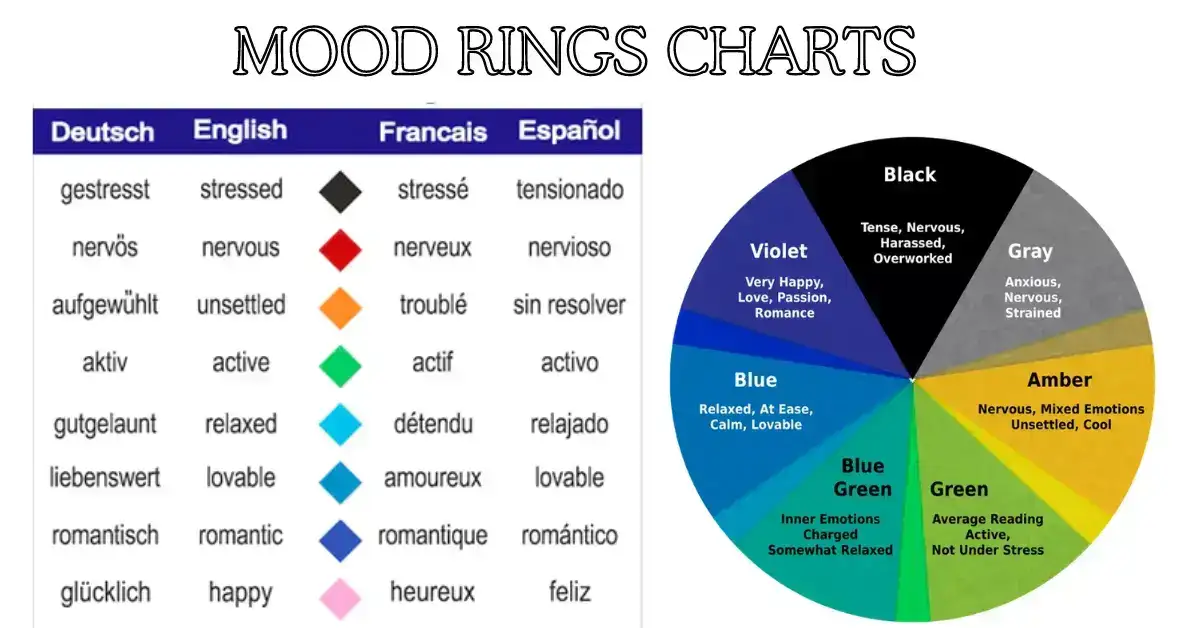
The color chart accompanying mood rings is less a scientific mapping of emotions and more an interpretive guide designed to enhance the user experience. Each color represents a specific temperature range, which is then assigned an emotional correlation based on common physiological responses. It’s crucial to remember that these are interpretations, not direct measurements of mood.
Blue: Calm to Intense
- Temperature Range: Cooler (e.g., 86-90°F / 30-32°C)
- Interpretation: Often associated with feelings of relaxation, peace, tranquility, or a generally positive emotional state. Deeper blues might suggest calm concentration. This corresponds to a relatively stable, slightly elevated finger temperature, indicating good circulation and a relaxed physiological state. Sometimes, vibrant blue can also signify passion or heightened emotion if the temperature is on the higher end of “calm.”
Green: The Baseline of Balance
- Temperature Range: Neutral/Average (e.g., 84-86°F / 29-30°C)
- Interpretation: The most common “default” color, signifying an average, balanced, or “normal” mood. It suggests neither heightened stress nor profound relaxation, just a steady state. Physiologically, this indicates a stable resting skin temperature, neither particularly vasoconstricted nor vasodilated.
Amber/Yellow: Nervous Energy
- Temperature Range: Slightly cooler (e.g., 80-84°F / 27-29°C)
- Interpretation: Often linked to feelings of nervousness, uncertainty, anxiety, or being unsettled. This corresponds to a slight drop in skin temperature, consistent with the body’s ‘fight or flight’ response initiating subtle vasoconstriction in the extremities.
Gray/Black: Stress or Malfunction?

- Temperature Range: Coldest (e.g., below 80°F / 27°C)
- Interpretation: Indicates significant stress, tension, anxiety, or even illness. Physiologically, a very low finger temperature points to strong vasoconstriction, a common response to stress or cold. If the ring consistently stays black, it could also indicate the ring itself is faulty or simply too cold to register within its active thermochromic range.
Purple/Pink: Passion and Love
- Temperature Range: Warmest (e.g., 90-92°F / 32-33°C)
- Interpretation: Associated with heightened emotions like love, romance, passion, excitement, or being very happy. A warmer skin temperature suggests increased blood flow, a physiological response often linked to arousal, excitement, or warmth in a relaxed state.
Other Hues and Variations
Many mood rings display a continuous spectrum. Colors like teal (between blue and green) might suggest calmness with a hint of energy, while darker greens bordering on amber could imply mild apprehension. The specific shade and intensity are all functions of the precise temperature influencing the liquid crystals. The variations between manufacturers and the quality of the TLCs can also lead to slightly different color interpretations and sensitivity ranges.
The Interface Between Gadget and Human Perception
The mood ring’s enduring appeal lies not just in its chemical mechanism but in its unique interaction with human perception and psychology. It represents an early form of biofeedback that, despite its simplicity, offered a tangible, real-time “reading” of an internal state.
User Experience and Interpretation
The user experience of a mood ring is highly personal. Wearers learn to correlate the ring’s colors with their own subjective feelings, often reinforcing a perceived connection. If someone feels anxious and their ring turns amber, that correlation is strengthened in their mind. This self-referential feedback loop is a powerful aspect of its appeal. The ring becomes a conversational piece, a mini-oracle, or even a self-monitoring tool, however inaccurate. It facilitates introspection, prompting users to consider their own emotional state in relation to the gadget’s output.
The Placebo Effect in Personal Tech
The psychological impact of the mood ring cannot be underestimated. The very act of wearing a device believed to indicate one’s mood can, through the placebo effect, influence one’s perception of their mood. If the ring turns “calm blue,” a wearer might consciously or subconsciously try to embody that calm, or simply interpret their existing feelings through that lens. This highlights how user belief and expectation play a significant role in the perceived efficacy and value of personal gadgets, even those based on simple physical principles.
Mood Rings as Wearable Tech Precursors
Before smartwatches tracked heart rates and fitness bands monitored sleep cycles, mood rings provided a primitive form of wearable biofeedback. They were an early foray into integrating technology directly onto the body for personal insight. While their “mood-reading” capability was based on inference rather than direct measurement, they foreshadowed the public’s acceptance and desire for devices that could provide real-time data about their physiological and psychological states. They laid groundwork for the human-computer interaction models that permeate modern wearable tech, demonstrating that users are willing to engage with devices that offer self-monitoring and personalized data, even if the data’s interpretation requires a leap of faith.
Modern Iterations and the Future of Biofeedback Gadgets
While the classic mood ring remains a nostalgic curiosity, the principles it embodies continue to evolve within contemporary wearable technology. The desire for personalized insight into our internal states is stronger than ever.
Beyond Simple Temperature Sensing
Today’s biofeedback gadgets go far beyond skin temperature. Smartwatches, fitness trackers, and specialized rings (like the Oura Ring) utilize a range of sensors to collect vast amounts of physiological data: heart rate variability (HRV), skin conductance (EDA for stress), blood oxygen levels, sleep patterns, and even EEG for brain activity. These advanced devices offer a much more nuanced and scientifically validated picture of one’s physiological state, which can then be correlated with mood, stress levels, and overall well-being.
Integrating with Smart Wearables
Modern smart wearables effectively integrate the “mood ring” concept into a holistic health and wellness ecosystem. Instead of a single color, users receive detailed metrics and actionable insights via companion apps. An elevated heart rate combined with low HRV might indicate stress, prompting the app to suggest breathing exercises. Poor sleep quality might lead to recommendations for better sleep hygiene. The “meaning” of these indicators is derived from complex algorithms and data analysis, moving far beyond simple thermochromic shifts.
The Ethical Considerations of Emotional Data
The evolution from a simple mood ring to advanced biofeedback gadgets also introduces significant ethical considerations. While a mood ring merely suggested a feeling, modern wearables collect intimate personal data. The “meaning” of that data, and how it is stored, analyzed, and potentially shared, raises questions about privacy, data security, and the potential for manipulation or misinterpretation. As technology continues to offer deeper insights into our internal worlds, understanding the mechanisms, interpreting the outputs, and safeguarding the data become paramount. The mood ring, in its innocent simplicity, provided an early, charming glimpse into this complex future.
aViewFromTheCave is a participant in the Amazon Services LLC Associates Program, an affiliate advertising program designed to provide a means for sites to earn advertising fees by advertising and linking to Amazon.com. Amazon, the Amazon logo, AmazonSupply, and the AmazonSupply logo are trademarks of Amazon.com, Inc. or its affiliates. As an Amazon Associate we earn affiliate commissions from qualifying purchases.