
The concept of “man-made vegetables” might conjure images of futuristic laboratories and genetically engineered crops, but the reality is far more pervasive and has roots stretching back thousands of years. From the vibrant produce aisles of today to the foundational crops that fed early civilizations, humanity’s technological ingenuity, in its myriad forms, has sculpted the plant kingdom to meet our nutritional needs and culinary preferences. This transformation, an ongoing testament to agricultural innovation, relies on a spectrum of technologies, from ancient selective breeding to cutting-edge biotechnology and advanced cultivation systems.
The Dawn of Agricultural Technology: Selective Breeding and Domestication
Humanity’s first foray into “making” vegetables was not through complex machinery but through observant selection and patient cultivation. The domestication of plants, beginning roughly 10,000 to 12,000 years ago, marked a pivotal shift from hunter-gatherer societies to settled agricultural communities. Early farmers identified wild plants with desirable traits—larger fruits, fewer seeds, better taste, or easier harvesting—and intentionally propagated them. This process, known as selective breeding, is arguably the original biotechnology, leveraging natural genetic variation to steer plant evolution in a human-directed path.

From Wild Mustard to Diverse Crops: A Case Study in Brassica Oleracea
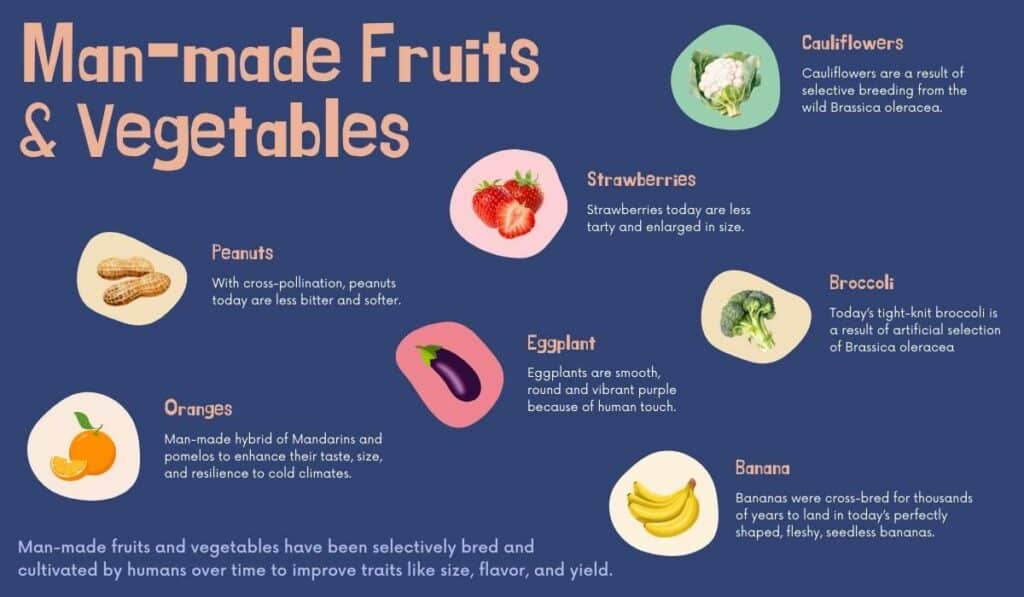
One of the most remarkable examples of ancient bioengineering through selective breeding is Brassica oleracea, the wild mustard plant. This unassuming plant, native to coastal Europe, is the genetic ancestor of an astonishing array of common vegetables, each “man-made” by humans selecting for different genetic mutations over millennia.
- Cabbage: Developed by selecting for plants with large, dense terminal leaf buds.
- Kale/Collard Greens: Resulted from selecting for large, edible leaves.
- Broccoli: Cultivated by selecting for undeveloped flower heads and stems.
- Cauliflower: A variation of broccoli, where selection focused on flower head proliferation.
- Kohlrabi: Bred for its swollen, turnip-like stem.
- Brussels Sprouts: Developed by selecting for enlarged lateral buds along the stem.
Each of these distinct vegetables exists not as a naturally occurring species, but as a human-engineered variant of a single wild plant, created through centuries of technological application in the form of careful observation, selection, and propagation. This highlights that “man-made” doesn’t necessarily mean “unnatural” in a pejorative sense, but rather “human-influenced” or “human-directed.”
Early Innovations in Plant Cultivation
Beyond selective breeding, early agricultural technologies also encompassed innovations in cultivation. The development of irrigation systems, crop rotation, and tools for tilling and harvesting all represent technological advancements that allowed for more controlled and productive plant growth. These methods not only increased yields but also facilitated the continued development of desirable traits in crops, effectively creating environments where “man-made” vegetables could thrive and become staples of human diets.
Modern Biotechnology: Engineering the Future of Food
While selective breeding remains a foundational technology, the 20th and 21st centuries have ushered in an era of unprecedented precision in modifying plant genetics. Modern biotechnology provides tools that allow scientists to directly manipulate the genetic code of plants, moving specific genes across species boundaries or precisely editing existing genes.
Genetic Modification (GM) and CRISPR Technology
Genetic modification (GM) involves introducing foreign DNA into a plant to confer new traits. This technology has given rise to numerous “man-made” vegetable varieties designed for specific benefits, such as resistance to pests (e.g., Bt corn), tolerance to herbicides, or enhanced nutritional profiles. While often met with public debate, GM technology represents a significant leap in our ability to engineer crops with targeted improvements.
More recently, CRISPR-Cas9 (Clustered Regularly Interspaced Short Palindromic Repeats) technology has revolutionized genetic engineering. CRISPR acts like molecular scissors, allowing scientists to make incredibly precise edits to a plant’s existing DNA. Unlike traditional GM, which often involves introducing genes from other organisms, CRISPR can be used to tweak a plant’s own genes, for example, to turn off a gene responsible for browning in potatoes or to enhance disease resistance. This precision editing capability blurs the lines between what is considered “natural” evolution and “man-made” alteration, as the resulting plants often contain no foreign DNA, only modified versions of their own. Examples of CRISPR-edited vegetables include non-browning mushrooms and potatoes, and tomatoes with enhanced nutritional value.
Enhancing Nutrition and Resilience through Bioengineering
Modern bioengineering extends beyond pest resistance to directly improve the nutritional content and resilience of vegetables. “Golden Rice,” for instance, is a genetically modified rice variety engineered to produce beta-carotene, a precursor to Vitamin A, addressing a critical nutritional deficiency in many parts of the world. While not a vegetable, it exemplifies the potential for engineering food for enhanced health benefits. Similarly, efforts are underway to engineer vegetables with increased resistance to drought, salinity, and extreme temperatures, crucial adaptations in the face of climate change. These are vegetables not just “made” by humans, but meticulously designed to thrive in challenging conditions and deliver superior nutritional value.
Advanced Cultivation Techniques: Hydroponics, Aeroponics, and Vertical Farming
Beyond genetic manipulation, another set of technologies allows for the creation and cultivation of vegetables in highly controlled, often artificial, environments. These advanced cultivation techniques represent a sophisticated form of “making” vegetables by optimizing every aspect of their growth cycle, sometimes even enabling year-round production in unlikely locations.
Controlled Environments for Enhanced Crop Development
Hydroponics is a method of growing plants without soil, using mineral nutrient solutions dissolved in water. This technology allows for precise control over nutrient delivery, oxygenation, and pH levels, leading to faster growth rates, higher yields, and sometimes, novel plant characteristics. Vegetables grown hydroponically, such as various lettuces, herbs, and tomatoes, are “man-made” in the sense that their growth is entirely dependent on a meticulously engineered system rather than natural soil ecosystems.
Aeroponics takes this a step further, growing plants in an air or mist environment without any solid medium. Roots are suspended in the air and misted with nutrient-rich water. This technique is incredibly efficient in water and nutrient use and can accelerate plant growth even further than hydroponics, yielding highly optimized produce.
The Role of AI and Automation in Precision Agriculture
The latest iteration of controlled environment agriculture involves vertical farming, where crops are grown indoors in vertically stacked layers, often utilizing hydroponic or aeroponic systems under artificial LED lighting. This technology allows for significant land-use efficiency and localized food production, reducing transportation costs and environmental impact. Within these vertical farms, AI and automation play a critical role. Sensors monitor everything from light intensity and humidity to nutrient levels and plant health. AI algorithms analyze this data to optimize growing conditions in real-time, fine-tuning environmental parameters to maximize yield, flavor, and nutritional content. Robotic systems can automate planting, harvesting, and even pest detection. These AI-driven systems are “making” vegetables in an entirely new way, not just through genetic selection but through highly intelligent environmental design and management, creating produce that is perfectly tailored to human demand.
The Ethical and Economic Landscape of Engineered Produce
The proliferation of “man-made” vegetables, through both traditional and cutting-edge technologies, presents complex ethical and economic considerations. The debate around genetically engineered crops, for instance, touches upon issues of food safety, environmental impact, corporate control over seed supplies, and the right of consumers to know how their food is produced.
Navigating Public Perception and Regulatory Frameworks
Public perception remains a significant hurdle for many biotechnologically engineered vegetables. Terms like “GMO” often carry negative connotations, regardless of scientific consensus on safety. Communicating the benefits and dispelling misinformation about these “man-made” foods is crucial. Regulatory frameworks vary widely across different countries, impacting market access and consumer choice. As technologies like CRISPR become more widespread, governments are grappling with how to regulate these “gene-edited” products, which often don’t contain foreign DNA and may be harder to distinguish from traditionally bred varieties. Balancing innovation with safety and transparency is a constant challenge in the realm of food technology.

Economic Implications for Global Food Systems
Economically, “man-made” vegetables have profound implications. Enhanced yields, pest resistance, and extended shelf life can lead to increased food security and reduced waste. The ability to grow crops in controlled environments, irrespective of climate or soil quality, offers new economic opportunities for urban farming and regional food independence. However, the development and patenting of advanced seeds and technologies can also consolidate power in the hands of a few large corporations, potentially affecting small farmers and developing economies. Understanding these dynamics is essential as we continue to leverage technology to shape the future of our food supply.
In essence, “man-made vegetables” are not a recent anomaly but the culmination of millennia of human ingenuity applied to agriculture. From the ancient practice of selective breeding that gave us broccoli and kale to the precision genetic editing of CRISPR and the hyper-efficient cultivation in AI-managed vertical farms, technology has consistently been the driving force behind the evolution of our food landscape, continuously redefining what is possible in feeding a growing global population.
aViewFromTheCave is a participant in the Amazon Services LLC Associates Program, an affiliate advertising program designed to provide a means for sites to earn advertising fees by advertising and linking to Amazon.com. Amazon, the Amazon logo, AmazonSupply, and the AmazonSupply logo are trademarks of Amazon.com, Inc. or its affiliates. As an Amazon Associate we earn affiliate commissions from qualifying purchases.