
In the decade following the release of Satoshi Nakamoto’s whitepaper, the concept of Bitcoin mining has evolved from a niche hobby for cryptography enthusiasts into a global industrial powerhouse. At its core, Bitcoin mining is the process of updating the ledger of all transactions and ensuring that the network remains synchronized without a central authority. While the term “mining” evokes images of physical extraction, in the digital realm, it refers to a sophisticated technological competition involving cryptographic puzzles, high-performance hardware, and decentralized consensus protocols.
To understand how Bitcoins are mined, one must look past the financial speculation and examine the underlying software architecture and hardware engineering that sustain the world’s most secure blockchain.

The Core Mechanism: Proof of Work and the SHA-256 Algorithm
The foundation of Bitcoin mining is a consensus mechanism known as Proof of Work (PoW). This protocol ensures that for a participant to add a new block of transactions to the blockchain, they must prove they have expended a significant amount of computational effort. This effort is not arbitrary; it is directed toward solving a complex mathematical puzzle.
The Cryptographic Hash Function
At the heart of this process is the SHA-256 (Secure Hash Algorithm 256-bit) cryptographic hash function. Developed by the NSA, SHA-256 is a one-way function that takes an input of any size and produces a fixed-size 256-bit string of characters. In the context of Bitcoin, the “input” includes the data of the current transactions, the hash of the previous block, and a random number called a “nonce.”
The beauty of SHA-256 lies in its “avalanche effect.” If even a single character in the input is changed, the resulting output (the hash) becomes entirely unrecognizable from the original. This ensures that transaction data cannot be tampered with once it is recorded in a block.
Solving the “Puzzle”
Mining is essentially a brute-force search for a specific hash. The Bitcoin network sets a “target” value for the hash of a new block. To successfully mine a block, a miner must find a hash that is numerically less than or equal to this target. Because the output of SHA-256 is entirely unpredictable, the only way to find a valid hash is to repeatedly change the “nonce” and re-hash the data millions of trillions of times per second.
This technological race continues until a miner finds a valid hash, broadcasts it to the network, and earns the right to update the ledger.
The Hardware Evolution: From CPUs to ASICs
When Bitcoin first launched in 2009, the computational difficulty was low enough that a standard home computer’s Central Processing Unit (CPU) could successfully mine blocks. However, as the network grew, the technological requirements escalated in an unprecedented hardware arms race.
Why CPUs and GPUs Became Obsolete
A CPU is a general-purpose processor designed to handle a wide variety of tasks, from word processing to complex system logic. While versatile, it is inefficient at performing the repetitive, simple mathematical calculations required for SHA-256 hashing.
By 2010, miners migrated to Graphics Processing Units (GPUs). Unlike CPUs, GPUs are designed for parallel processing, allowing them to perform hundreds of hashing operations simultaneously. However, even GPUs eventually hit a ceiling in terms of power efficiency and hash rate.
The Rise of the ASIC
The current standard in Bitcoin mining technology is the Application-Specific Integrated Circuit (ASIC). Unlike a computer or a gaming console, an ASIC miner is a piece of hardware designed for one purpose and one purpose only: mining Bitcoin.
Modern ASICs, such as those produced by Bitmain or MicroBT, contain hundreds of specialized chips optimized for the SHA-256 algorithm. These machines can perform trillions of hashes per second (terahashes) while consuming significantly less power per hash than any general-purpose hardware. This specialization has turned mining into a high-tech industrial operation, requiring climate-controlled data centers and advanced power management systems.
The Mining Lifecycle: Transactions, Blocks, and Consensus
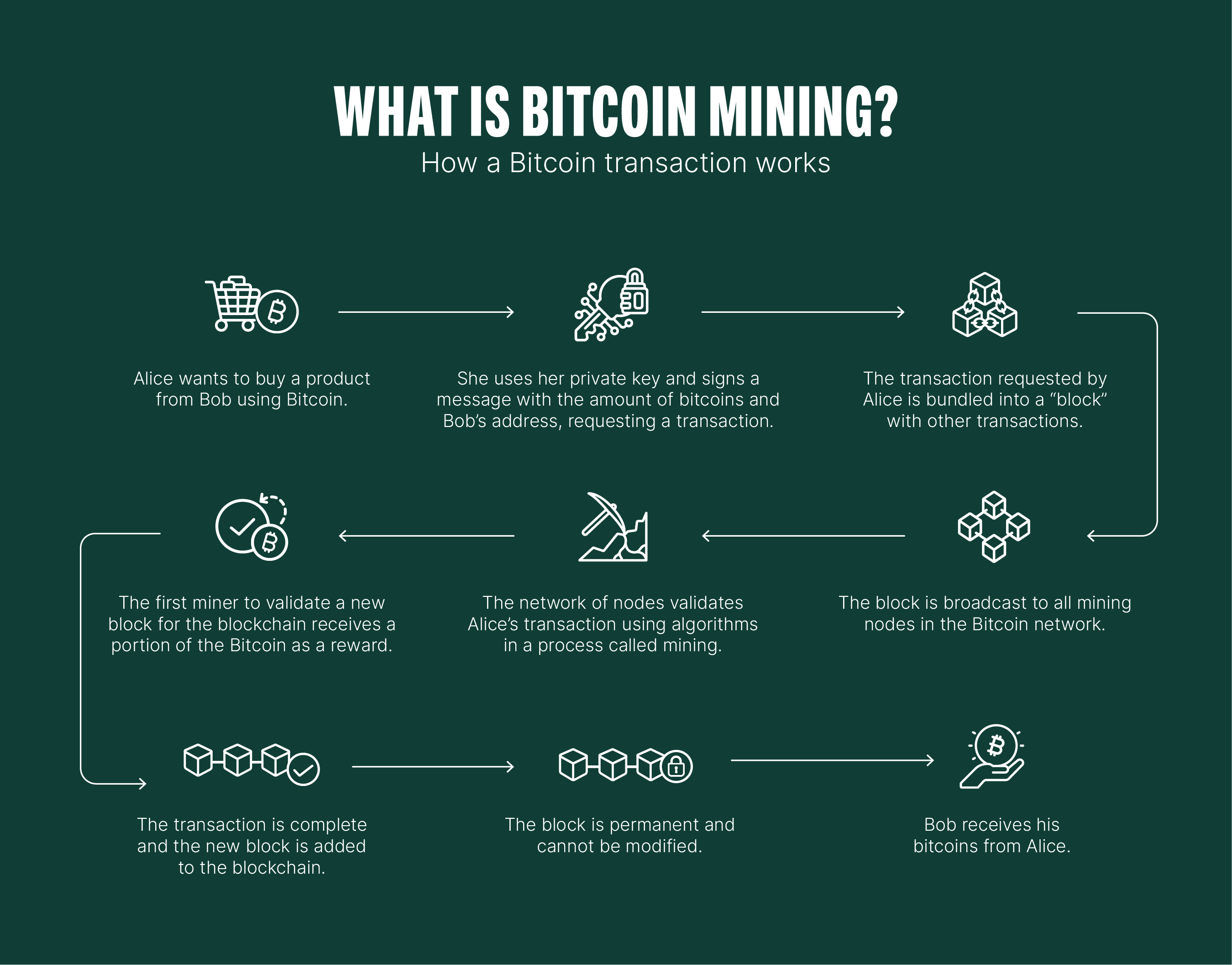
The actual process of mining follows a strict logical sequence defined by the Bitcoin Core software. It is a cycle that repeats approximately every ten minutes, ensuring the continuous flow of data across the decentralized network.
Memory Pools and Transaction Validation
Before a transaction is mined, it sits in a “mempool” (memory pool). Thousands of nodes across the globe receive these transaction broadcasts and verify their digital signatures to ensure the sender has the necessary funds. Miners select transactions from this pool—usually prioritizing those with higher attached fees—and aggregate them into a “candidate block.”
The Race for the Nonce
Once a candidate block is formed, the miner’s hardware begins the hashing process. As discussed, the miner changes the “nonce” (a 32-bit field) and calculates the hash of the block header. If the hash does not meet the network’s difficulty target, the miner increments the nonce and tries again.
This process happens at a staggering scale. The current global “hash rate”—the total computational power of the Bitcoin network—is measured in exahashes per second (EH/s), meaning quintillions of hashes are performed every second across the globe.
Propagation and Confirmation
When a miner finally discovers a valid hash, they immediately propagate the completed block to the rest of the network. Other nodes quickly verify that the hash is indeed valid and that all transactions within the block follow the network’s rules (e.g., no double-spending). Once verified, the block is added to the blockchain, and miners begin working on the next block, using the hash of the newly accepted block as part of the input for the next one. This creates the “chain” in “blockchain.”
Network Security and the Difficulty Adjustment
One of the most ingenious technological features of Bitcoin is its ability to self-regulate. Unlike traditional computer networks that might crash under heavy load or become too fast as hardware improves, Bitcoin maintains a steady heartbeat through the “Difficulty Adjustment.”
Ensuring 10-Minute Intervals
The Bitcoin protocol is hard-coded to produce one block every ten minutes on average. If more miners join the network and the total hash rate increases, blocks would naturally be found faster. To prevent this, the software automatically adjusts the “difficulty” of the cryptographic puzzle every 2,016 blocks (approximately every two weeks).
If the previous 2,016 blocks were found in less than two weeks, the target hash value decreases, making the puzzle harder to solve. If they were found too slowly, the target increases, making it easier. This feedback loop ensures that the issuance of new Bitcoin remains predictable regardless of how powerful mining technology becomes.
Defense Against 51% Attacks
This massive expenditure of computational power serves a vital security function. To “fake” a transaction or reverse a block, an attacker would need to control more than 50% of the network’s total hash rate. Given the specialized nature of ASIC hardware and the sheer volume of electricity required to power them, a “51% attack” is computationally and logistically nearly impossible. The tech stack effectively uses physics (energy) to protect digital data.
The Future of Mining: Energy Efficiency and Infrastructure
As we look toward the future, the technology of Bitcoin mining is shifting its focus from pure power to efficiency and sustainability. The integration of mining into the global energy and tech infrastructure is creating new opportunities for innovation.
Sustainable Mining Solutions and Heat Recycling
Modern mining data centers are increasingly experimenting with immersion cooling, where ASIC miners are submerged in a specialized dielectric fluid. This technology allows for better heat dissipation, higher overclocking potential, and a longer lifespan for the hardware.
Furthermore, the tech industry is seeing a rise in “heat recycling” projects. Because ASIC miners generate a significant amount of heat as a byproduct of computation, some facilities are now redirecting this thermal energy to heat greenhouses, residential buildings, or industrial processes. This turns a traditional waste product into a valuable resource.

Layer 2 Innovations and the Global Tech Stack
While mining handles the “base layer” of the Bitcoin network, new technologies like the Lightning Network are being built on top of it. These “Layer 2” solutions rely on the security provided by miners but allow for near-instant, low-cost transactions.
The relationship between the robust, energy-intensive mining layer and the fast, lightweight application layers represents the future of decentralized technology. As ASICs continue to shrink in transistor size (moving toward 3nm and 2nm processes), the efficiency of the network will only continue to improve, further solidifying Bitcoin’s role as the most secure computational network in human history.
In conclusion, Bitcoin mining is far more than a financial activity; it is a pinnacle of modern computer science. By combining cryptographic theory, specialized hardware engineering, and a self-adjusting software protocol, mining provides the secure, decentralized foundation upon which the future of digital value is built.
aViewFromTheCave is a participant in the Amazon Services LLC Associates Program, an affiliate advertising program designed to provide a means for sites to earn advertising fees by advertising and linking to Amazon.com. Amazon, the Amazon logo, AmazonSupply, and the AmazonSupply logo are trademarks of Amazon.com, Inc. or its affiliates. As an Amazon Associate we earn affiliate commissions from qualifying purchases.