
Honda Sensing represents a comprehensive suite of advanced safety and driver-assist technologies designed to enhance driver awareness, mitigate collisions, and provide a more confident and comfortable driving experience. Far more than just a collection of individual features, it’s an integrated system that leverages sophisticated sensors, cameras, and software algorithms to proactively monitor the road, identify potential hazards, and intervene when necessary. This technology package has become a hallmark of modern Honda vehicles, embodying the brand’s commitment to safety innovation and bringing semi-autonomous driving capabilities to the mainstream.
The Core Concept of Honda Sensing
At its heart, Honda Sensing is built on the principle of preventive safety. Instead of merely reacting to an accident, the system aims to help drivers avoid them altogether by providing timely warnings and, in some cases, automatically assisting with braking and steering. It moves beyond traditional passive safety features like airbags and seatbelts to actively engage with the driving environment, creating an extra layer of protection for occupants and pedestrians alike.

A Proactive Approach to Safety
The suite operates continuously, using a combination of radar and camera technologies to scan the road ahead and around the vehicle. This constant vigilance allows the system to detect other vehicles, pedestrians, lane markings, and even road signs. When the system identifies a potential risk, it first alerts the driver with visual and audible warnings. If the driver does not respond adequately, certain features can then initiate corrective actions, such as applying brakes or adjusting steering, to help prevent or mitigate a collision. This tiered approach ensures that the driver remains ultimately in control while benefiting from intelligent assistance.
Evolution and Integration
First introduced in 2014, Honda Sensing has undergone continuous refinement and expansion. Early iterations focused on core safety functions, while newer versions incorporate more sophisticated features that enhance driver convenience, particularly in highway driving and stop-and-go traffic. The system’s integration has also become more seamless, with driver-assist features working in concert rather than as isolated functions. This holistic design ensures that the various technologies complement each other, providing a cohesive and intuitive safety net for the driver. It’s not just about adding more features, but about making them work together intelligently to create a superior driving assistance experience.
Key Technologies Within Honda Sensing
Honda Sensing is not a single technology but a compilation of several distinct yet interconnected systems. Each component addresses a specific aspect of driving safety and convenience, working together to provide comprehensive coverage.
Collision Mitigation Braking System (CMBS)
CMBS is designed to help bring the vehicle to a stop when it detects a high likelihood of a frontal collision with another vehicle or a pedestrian. Using radar and a monocular camera, the system first provides visual and audible alerts to the driver. If the driver fails to react, CMBS can then automatically apply moderate braking, and if the system determines that a collision is unavoidable, it will apply strong braking to reduce the severity of the impact. This proactive braking can significantly reduce injury risk.
Road Departure Mitigation System (RDM)
The RDM system helps drivers stay on the road. It uses a monocular camera to detect lane markers and the edge of the road. If the vehicle begins to stray from its detected lane without an activated turn signal, RDM provides audible and visual warnings. If the driver does not respond, the system can apply steering torque to help return the vehicle to its lane and can also apply braking to help prevent the vehicle from leaving the road entirely.
Adaptive Cruise Control (ACC) with Low-Speed Follow
ACC is a convenience feature that also contributes to safety, particularly during highway driving. It allows the driver to set a desired speed and a following distance from the vehicle ahead. The system uses radar to maintain this preset distance, automatically adjusting the vehicle’s speed, even slowing it down to a complete stop and resuming acceleration in stop-and-go traffic (thanks to the Low-Speed Follow function). This reduces driver fatigue on long journeys and in congested conditions.
Lane Keeping Assist System (LKAS)
LKAS is designed to help keep the vehicle centered in its detected lane. Using the monocular camera, it recognizes lane markings. If the vehicle begins to drift out of its lane without an intentional signal, LKAS provides subtle steering inputs to help guide the vehicle back towards the center of the lane. This system is not autonomous steering but rather a helpful assistant to maintain lane discipline, especially on highways.
Traffic Jam Assist (on newer models)
Building upon ACC and LKAS, Traffic Jam Assist further enhances low-speed driving convenience. This feature works in conjunction with ACC with Low-Speed Follow and LKAS to provide steering assistance at speeds typically below 45 mph (or around 72 km/h). In congested traffic, it helps keep the vehicle centered in its lane and maintains a set following distance, significantly reducing the driver’s workload during monotonous stop-and-go conditions.
Traffic Sign Recognition (TSR)
TSR uses the front-facing camera to detect and display speed limit signs and other select traffic signs on the instrument panel or head-up display. This feature helps keep the driver informed of current road rules, reducing the chance of inadvertently exceeding speed limits or missing important directional information.
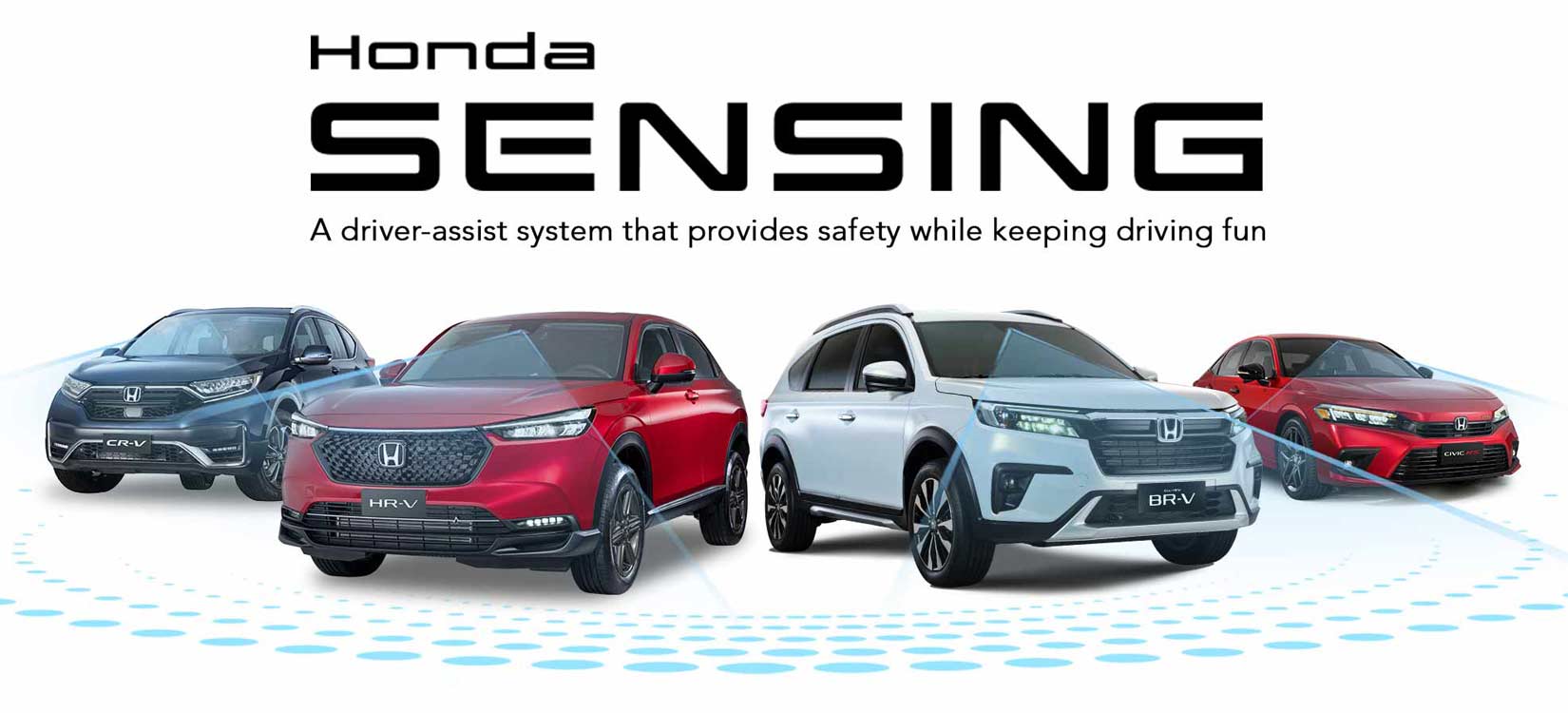
How Honda Sensing Works: Sensors and Processing
The efficacy of Honda Sensing lies in its sophisticated combination of hardware and software. It’s a complex interplay of various sensors gathering data, which is then processed by advanced algorithms to interpret the driving environment in real-time.
Radar and Camera Integration
The primary data inputs for Honda Sensing come from a multi-purpose camera mounted near the rearview mirror, typically on the windshield, and a radar unit usually located behind the Honda emblem in the front grille.
- Millimeter-Wave Radar: This sensor is crucial for detecting the distance and speed of objects ahead, such as other vehicles and pedestrians. Its ability to penetrate fog and rain makes it reliable in various weather conditions. It’s particularly effective for long-range detection and the functioning of features like ACC and CMBS.
- Monocular Camera: The high-resolution camera identifies objects by their shape, size, and color. It excels at recognizing lane markings, road signs, and the detailed contours of vehicles and pedestrians. This visual data is vital for LKAS, RDM, and TSR, providing a more granular understanding of the immediate environment.
The real strength of Honda Sensing comes from the fusion of data from these two distinct sensor types. The radar provides precise distance and velocity measurements, while the camera offers rich visual context. By combining these inputs, the system can build a more robust and accurate perception of the driving scene than either sensor could achieve alone, minimizing false positives and enhancing reliability.
The Role of Software and AI
Raw sensor data is meaningless without intelligent processing. This is where sophisticated software algorithms and elements of artificial intelligence (AI) come into play. The system continuously analyzes the incoming data streams from the radar and camera, comparing them against vast databases of driving scenarios.
- Pattern Recognition: AI algorithms are trained to recognize patterns indicative of potential hazards—for instance, a vehicle suddenly decelerating or the car drifting towards a lane boundary.
- Predictive Analysis: The software doesn’t just react; it predicts. By analyzing the speed and trajectory of other vehicles and pedestrians, it can anticipate potential collisions moments before they become critical, allowing for earlier warnings and interventions.
- Real-time Decision Making: Within milliseconds, the system evaluates the situation, determines the appropriate response (e.g., a visual warning, an audible alert, subtle steering input, or brake application), and executes it. This real-time processing capability is what makes Honda Sensing so effective as a driver-assist system. Continuous software updates further refine these algorithms, improving performance and adding new capabilities over time.
Benefits and Impact on Driving Experience
The integration of Honda Sensing into modern vehicles brings a multitude of benefits, transforming not only the safety profile of a car but also the overall driving experience.
Enhanced Safety and Accident Prevention
The most obvious and significant benefit is the considerable enhancement in safety. By acting as an extra set of eyes and an intelligent co-pilot, Honda Sensing demonstrably reduces the risk of collisions. Features like CMBS can mitigate the severity of or even prevent frontal impacts, while RDM helps keep vehicles from inadvertently leaving the road. These preventative measures contribute directly to fewer accidents, fewer injuries, and potentially fewer fatalities, making roads safer for everyone. The data collected by various safety organizations often highlights the positive impact of such ADAS (Advanced Driver-Assistance Systems) suites on accident statistics.
Reduced Driver Fatigue
Driving, especially on long commutes or in heavy traffic, can be mentally and physically taxing. Features like Adaptive Cruise Control with Low-Speed Follow and Lane Keeping Assist System significantly alleviate this burden. By managing speed, maintaining following distances, and providing steering assistance, these technologies reduce the constant need for micro-adjustments and vigilance. This reduction in cognitive load means drivers arrive at their destinations feeling more refreshed and less stressed, which in turn can lead to better overall driving performance.
Confidence on the Road
Knowing that a sophisticated safety net is actively monitoring the surroundings instills a greater sense of confidence in drivers. Whether navigating busy highways, enduring rush hour traffic, or simply driving on unfamiliar roads, the awareness that the vehicle is assisting in preventing potential hazards can be incredibly reassuring. This psychological benefit allows drivers to focus more on the road and less on anxiety, leading to a more pleasant and confident driving experience. It empowers drivers with tools that extend their natural capabilities, making them feel more secure behind the wheel.
Limitations and Future Outlook
While Honda Sensing offers remarkable advancements in automotive safety and convenience, it’s essential to understand its current limitations and the ongoing trajectory of ADAS development.
Environmental Factors and Sensor Performance
The performance of Honda Sensing, like all camera and radar-based systems, can be affected by certain environmental conditions. Heavy rain, snow, dense fog, or bright glare can obscure the camera’s view or interfere with radar signals, potentially reducing the system’s effectiveness. Similarly, dirty sensors (e.g., mud on the radar unit or a smeared windshield over the camera) can impair functionality. While engineers continuously work to improve robustness in adverse conditions, drivers must remain aware that these systems are not infallible and might not operate optimally in all circumstances. Lane markings faded by age or covered by snow can also challenge the camera-based systems like LKAS and RDM.
Driver Responsibility Remains Paramount
It is crucial to remember that Honda Sensing is an assist system, not an autonomous driving system. The driver remains solely responsible for the safe operation of the vehicle at all times. The system is designed to provide warnings and interventions, but it expects the driver to maintain situational awareness, keep hands on the wheel, and be prepared to take full control. Over-reliance on these technologies can lead to complacency, which is a significant safety risk. Drivers should view Honda Sensing as a helpful co-pilot, not a replacement for their own attentiveness and driving skill.

The Road Ahead for Advanced Driver-Assistance Systems (ADAS)
The evolution of Honda Sensing, and ADAS in general, is continuous. Future iterations will undoubtedly feature enhanced sensor fusion, leveraging LiDAR alongside radar and cameras for even more accurate and robust environmental perception. Improvements in AI and machine learning will lead to more sophisticated decision-making, enabling systems to handle complex scenarios with greater nuance. We can expect to see advancements towards higher levels of driving automation, where vehicles can operate more independently under specific conditions, eventually progressing towards fully autonomous capabilities. These advancements will likely include more proactive steering and braking in a wider range of situations, enhanced pedestrian and cyclist detection, and seamless vehicle-to-infrastructure (V2I) communication, further integrating vehicles into intelligent transportation systems. Honda Sensing, therefore, is not just a current safety feature but a foundational step towards the future of mobility.
aViewFromTheCave is a participant in the Amazon Services LLC Associates Program, an affiliate advertising program designed to provide a means for sites to earn advertising fees by advertising and linking to Amazon.com. Amazon, the Amazon logo, AmazonSupply, and the AmazonSupply logo are trademarks of Amazon.com, Inc. or its affiliates. As an Amazon Associate we earn affiliate commissions from qualifying purchases.